Showing posts with label Indonesia. Show all posts

Tuesday, September 9, 2014

(More than!) Five Cool Things We Could See if the Okeanos Went Back to Indonesia


So, over the weekend, the livestream of Okeanos Explorer briefly mentioned and entertained the idea that they might head back to Indonesia for a revisitation of their inaugural expedition from 2010! (The INDEX-SATAL Mission). (I think someone mentioned the ambassador was on ship?)

That expedition was, of course, 4 years ago and the program had just begun. Updates were not as forthcoming. But an opportunity to RETURN to Indonesia? With the benefit of hindsight, experience and further preparation?? That would be awesome!

That area is known as home to probably one of the MOST diverse marine faunas of anywhere in the world.  And although there's a lot known from shallow and deep habitats, the deep sea areas (below 200 m) in the Indonesian area will likely make all the stuff R/V Okeanos Explorer and E/V Nautilus have been observing in the Atlantic look like a goldfish bowl by comparison! 

A LOT of the species in this area are likely undescribed. A veritable gold mine of biodiversity to be studied! Some of these taxa have no Atlantic members. (It would be even better if these were enhanced by collections of course!)

Here's some highlights that I would love to see again!  

1. The Sea Cucumbers
I don't think I've seen ALL the pics but the ones I have were brilliant. This red elasiopod would be something I think everyone should see again... 
Okeanos from expl2168

The oddball swimming sea cucumber with the big lobe: the appropriately named Psychropotes! 
From Okeanos expl5494
and this gorgeous swimming Enypniastes? Or something similar to it.. But wow! Transparent body! You can literally SEE the sediment filled intestine THROUGH the body wall!
from Okeanos expl5475
2. The Hydrothermal Vents
When people talk about hydrothermal vents, there's 2 or 3 places that register as the most iconic spots.. the Mid-Atlantic and the East Pacific Rise.  There's others but one vent site that no one really talks about much?  The ones surveyed by Okeanos in Indonesia! 

These are the hydrothermal vents found on the undersea volcano Kawio Barat (West Kawio) 
from Okeanos expl2184
Amazingly gorgeous spires created by hydrothermal activity. 0.5 to 1 meter tall active and inactive spires on the summit of the Kawio Barat submarine volcano. Spires observed at 1849 meters depth. 
From Okeanos expl2188
Further venting through some of these chimneys gives us these amazing structures covered by barnacles! 
from Okeanos expl 2195
What's that? you want to see those barnacles more close up? here ya' go...
fr. Okeanos expl 2196

3. The Insane Stalked Crinoid Diversity
One of the very interesting animals noted in the expedition pictures notes was the incredible diversity of stalked crinoids which were observed.. I've only shown two of them below..but the gallery shows many different types of stalked crinoids.. to say nothing of the feather stars (aka unstalked crinoids)

This red one, as identified by Dr. Marc Eleaume in Paris is likely Proisocrinus ruberrimus 
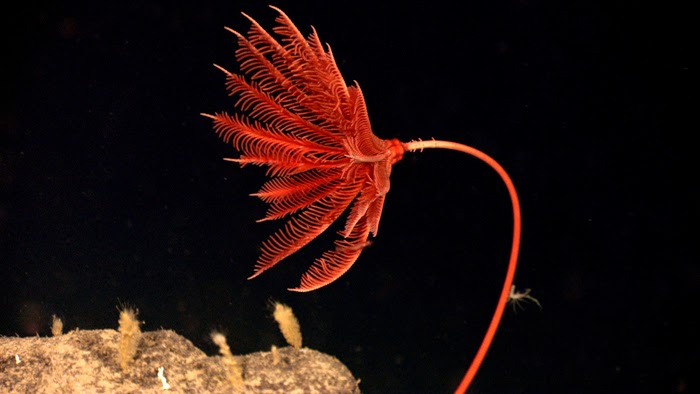
From Okeanos expl5403
 And an likely unidentified member of the Hyocrinidae...                                     
                            

4. Bizarre and wonderous Deep Sea Sponges (Hexactinellid or Glass Sponges? I think)
A wonderous cladorhizid carnivorous sponge from about 1000 m! 
from Okeanos expl5560
A bizarre sponge with unusual body morphology
from Okeanos expl 5599
5. And the underappreciated Slit Shell Snails (Pleurotamariidae)! 
I'm honestly not sure how many people recognized a majority of the animals observed on the 2010 dive but some of the shots from the NOAA Photo Library showed some awesome images of that most treasured of marine snails: The Slit Shelled Snail (family Pleurotamariidae).       

These snails have always held a certain appeal to shell collectors. The shells are known from the fossil record and have a distinct slotted opening near the shell's opening. They are one of the largest marine snails observed in deep-sea settings..
from Okeanos expl5650
 The images place the slit-shell moving into this gorgeous field of corals..                                  
From Okeanos expl 5648
Some of these snails are predators on echinoderms, such as sea stars and possibly serpent stars (ophiuroids). So, conceivably this one is about to feed...
From Okeanos expl5646
PLUS! those Hermit Crabs with shells replaced by sea 
anemones! 
fr. Okeanos 5671
fr. Okeanos 5672
ONE More GREAT thing?? In situ observations of WOOD FALL COMMUNITIES!  These are some of the weirdest, rarest of deep-sea habitats as written by Craig McClain at Deep-sea news as he's documented here and here.  What are they? Deep-sea communities based entirely on wood from the surface that have fallen to the deeps!!

Some of these species are known ONLY from wood substrates!

But how often do you get to see an established wood fall community??  Here's what looks like those wood-eating urchins I wrote about a few years ago...
Okeanos expl 5968
and here's a close up of some more urchins and polychaetes
from Okeanos expl 5972

and yeah, there was a LOT more...

So, Okeanos Decision Committee?? LET'S GO BACK TO INDONESIA!!! 

Tuesday, July 22, 2014

Deep-Sea Poop, Amoebas, Basket Stars, Pinwheel Crinoids and MORE! Pics from the NOAA Deep-sea Photo Archive!

Gulf of Alaska 2004 Expedition. NOAA Office of Ocean Exploration 
This week I have been researching images from deep-sea video on the home page for the NOAA Photo Library, which has housed ALL of the deep-sea and other imagery from NOAA's deep-sea expeditions since 2003, including those of the Okeanos Explorer!

Many of you know that I have participated in the last two R/V Okeanos ROV dives as an onshore advisor. I often identify asteroids (i.e. starfish) and provide other information as I am able. I've only helped them out since 2013 but found lots of their images useful for my research.

You can find NOAA-Okeanos dive screengrab recaps on my blog here for 2013 and here for the recent 2014 dive. 

Those of you on my Twitter account (@echinoblog) have been watching me post links to various pictures as I have been reviewing these pics.. There are literally THOUSANDS of pictures of deep-sea biology, geology and history !!!  Who would be crazy enough to go through all of it one by one???  Yes. Me!

So, for your education and infotainment I have cherry picked many noteworthy images and have showcased them below. (note that ALL images have original links below them)! Enjoy!

Giant Amoeba Houses??
Here's a cool structure made by a giant amoeba called a xenophyophorean! (deep-sea Galapagos) Take a moment to consider that a UNICELLULAR organism could have made this! (and yes, they will eat proper animals!)
From the 2011 NOAA Okeanos Explorer Program, Galapagos Rift Expedition 2011 
But in contrast, what about this from Indonesia??? A Mystery?? Another xenophyophorean?? 
From July 2010 NOAA Okeanos Explorer Program, INDEX-SATAL 2010


Basket Stars Behaving uh... badly? 
What is going on here? I've honestly never seen TWO basket stars so close to one another. What are they doing? Fighting? Doin teh sex? The gorgonocephalid equivalent of a backrub?   Only they know for sure.  (North Atlantic)
From Lophelia II 2008: Deepwater Coral Expedition: Reefs, Rigs, and Wrecks 
Brittle Stars Doing Crazy Things! 
From the Atlantic... Probably just filter feeding, but I don't know that I've ever seen so many of them with their arms all curled up like that just FLAT on the sediment. Weird.
From the Lophelia II 2008: Deepwater Coral Expedition: Reefs, Rigs, and Wrecks 
and more of the same...
from Lophelia II 2008: Deepwater Coral Expedition: Reefs, Rigs, and Wrecks 

Here is what we call in science "a fancy pants brittle star" (note the gorgeous red and white pattern though) on a really extended whip coral (aka antipatharian). Video from the Bahamas in 2009. 
From Bioluminescence 2009 Expedition, NOAA/OER 
And still MORE!
From 2009 Bioluminescence 2009 Expedition, NOAA/OER 
PIN WHEEL CRINOID?? 
A cool looking "pin wheel" stalked crinoid (Hyocrinidae) from Indonesia, a new species currently being worked on by colleagues in Paris. This is what it looks like "open"
From NOAA Okeanos Explorer Program, INDEX-SATAL 2010 
and curiously, this species retracts its arm in repose like this! As the kids say these days "That is pretty whack! "
From NOAA Okeanos Explorer Program, INDEX-SATAL 2010
BIG PACKS OF FILTER FEEDING ECHINODERMS! 
Stalked isocrinid crinoids! From the Marianas Arc, Pacific Ocean! All turned into the current!! 
 Image courtesy of Submarine Ring of Fire 2006 Exploration, NOAA Vents Program 
Also from the Marianas Arc, Pacific Ocean: A crazy huge field of basket stars (Gorgonocephalidae)..
Image from the Submarine Ring of Fire 2006 Exploration, NOAA Vents Program 
Some translucent Swimming Sea Cucumber intestine showing POOP?? 
 from NOAA Okeanos Explorer Program, Mid-Cayman Rise Expedition 2011 
Is this Sea Cucumber Poop??
Exotic Indonesian Sea cucumber poop?  Or possibly from an Acorn Worm? (below)
 From NOAA Okeanos Explorer Program, INDEX-SATAL 2010 
From NOAA Okeanos Explorer Program, INDEX-SATAL 2010
Deep-Sea Urchin POOP! 
Here is a great shot of an Echinothuriid urchin (aka the pancake or tam o shanter urchin) taking a poop!! A Gulf of Mexico species. Contrary to what the labels on the website say, this is defecation and NOT gametes being released.
NOAA Okeanos Explorer Program, Gulf of Mexico 2012 Expedition 
 Deep-sea Urchin Poop! 
NOAA Okeanos Explorer Program, Gulf of Mexico 2012 Expedition 
and a special non-echinoderm poop bonus! Acorn Worm POOP! 
Images from Indonesia.. Worms leaving unique castings in the sediment...
From NOAA Okeanos Explorer Program, INDEX-SATAL 2010 
What I hope is that this will provide a spotlight on NOAA's very EXTENSIVE library of images!

MANY valuable and interesting things in there! Enough for many more posts. But what's most amazing? A lot of it is UNPUBLISHED stuff!!

But its hard to make a guess as to what kinds of things you will find (sometimes because you don't know what you are looking for)  This provides a taste of the diversity and abundance of tantalizing images. Sponges! Corals! Worms! Even protists!
                              

Tuesday, August 28, 2012

Crinoid Close ups!

                White crinoid - Pulau Weh

Crinoids, aka Feather stars are probably the least familiar of echinoderms to many people. They've been around for awhile and you can often see their older Paleozoic ancestors with stalks in fossil beds throughout the world.

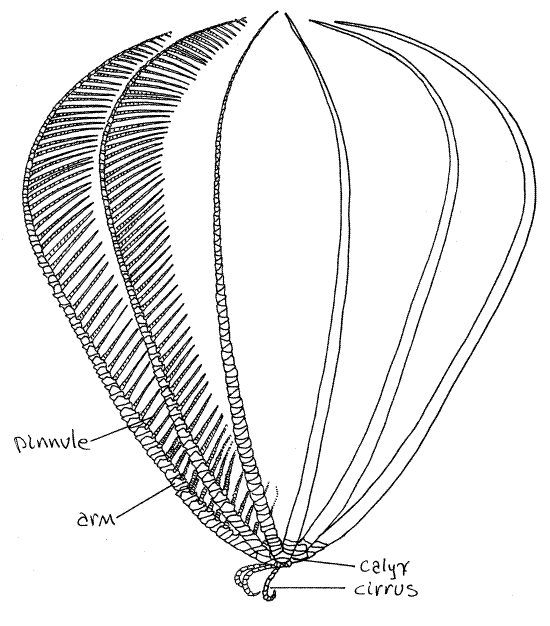
But most modern crinoids almost resemble plants (albeit stunning ones). The picture above shows a typical "feather star" or comatulid crinoid. The arms have feathery appendages called pinnules which are used for capturing food. 

To give you some reference.. here's a generalized diagram. Food goes into the mouth located on the "inside" of the cup where the arms meet.  
Image from lander.edu
I've often tried to make several echinoderms more "visible" to people by sharing some incredible imagery of them-from perspectives that might be unfamiliar. Some of my posts on ophiuroids here and here for example...

Here is a very busy picture of the many structures surrounding the MOUTH (at center covered by more tentacles) (critter from Fiji) (image by Jaw'sDad-Jeff Williams):
Crinoid Patterns

Here's a great picture of the UNDERSIDE of a feather star. See those tentacle-like things wrapped around the whip coral?  Those are called "cirri". Those are the "feet" that adhere the remainder of the animal to its perch.   This image by "sabahsharky"
P1010024

Blue Crinoid Close up.. from Sulawesi, Indonesia.  These are the feeding arms with yellow tipped extensions called pinnules. Image by Richard Merritt, FRPS.
Blue & yellow crinoid (feather star)

A stunning image of Oxycomanthus bennetti from Indonesia by il Cosaro.
Crinoide (Oxycomanthus bennetti)


More close ups!  Neat crinoid close up of the arm. Yellow tips on purple pinnules and arms.

A nice close up of the feeding arms. Three Photos below by Geoff Spiby.
crinoid abstract
crinoid detail copy
crinoid detail 2

Yellow arms by Friscodive
Crinoid abstract 02

A stunning shot of a red-white crinoid by Russel Taylor
Crinoid (featherstar)
Another amazing close up by Russel Taylor
Crinoid (featherstar)
Gorgeous in Green!
Crinoid (Feather Star)

Two photos of crinoids from the Philippines by Courtney Platt
Kirbys Crinoid 7361
Kirbys Crinoid Detail 7363

A neat red/yellow crinoid from the Philippines Image by Jex207
Crinoid

There's a shrimp in this..but mostly I just think the arms are amazing. Photo by MerMate
Bottoms up

One showing nice detail of the segmentation present on each individual arm
Philippines 10_09 Cabilao 1 (19)

And a fossil for comparison. Note that the cup is upside down. Photo by zxgirl
Crinoid Crown

And one of these days I will follow up with the commensals that live on crinoids! The mimicry is stunning...