Showing posts with label Okeanos. Show all posts

Thursday, August 10, 2017

Okeanos Explorer Communities & Deep-Sea Discoveries!


I'm BACK! After a month at sea with 2.5 weeks worth of dives I've safely returned to "home base" in Washington DC! I was out in the central Pacific with NOAA's R/V Okeanos Explorer on their Laulima O Ka Moana expedition, exploring the deep-sea of the Marine National Monument in the Central Pacific! 


1. Forest of the Weird: Land of the Glass Sponges!
This was probably the most amazing thing I have seen in awhile! (at least since that Basket Star community in the Marianas a few years ago!)

So, the key thing about nearly ALL Of these sponges? Many of them are what's called GLASS SPONGES aka members of the Hexactinellida. That means they have bodies which are made out of silicon oxide!

These often have bizarre and weird shapes. I have done a post about these before here in 2015.

Here's a highlight video of the discovery-basically water currents ran at an ideal rate at the top of this geologic feature making it IDEAL for what seems to be a huge abundance, if moderate diversity of glass sponge species!

Note also how all of them are turned into the current!! We were in this "forest of the weird" for the remainder of the dive (over an hour) so there was quite a lot of it..
Here's few more that show off the crazy architecture.. These varied in height from one to four feet in height..

2. The Carnivorous Sponge Field
This area was kind of the opposite to the one above. Rather than big and obvious, it was quite dense and discontinuous, being present on one big boulder to another...

But what was amazing was that this was composed of a different type of sponge in the family Cladorhizidiae. (possibly in the genus Asbestopluma..) Cladorhizids are not glass sponges and have physical properties more like what's seen in many other sponges. EXCEPT...

...that they are CARNIVOROUS!!!

Wait.. WHAT? Yup. MOST sponges are filter feeders. But in this group, they use glue or spines to capture prey, which are then digested by the animal in question. We've seen different types of these carnivorous sponges before, including some possible new species..  These sponges kind of look like a feather.. a central stalk with fine hairs or spines coming off the sides

Similar to this species in the NOAA benthic inverts guide...

Here..they were present in HUGE densities.. alongside some frond-like bryozoans! and some stoloniferous zoanthids (a sea anemone like cnidarian)  These actually seemed to be pretty thin at first but got bigger, longer and thicker as we encountered them!

Yes.. I suppose I'm overhyping them..but that's basically a "killing field" of carnivorous sponges!  with these projecting into the
Interestingly, this shot above looks like there might be a snail on one of those sponges..so even more going on!

3. This Amazing Farreid Sponge/Acanthogorgia Wall! 
Shallow-water dives can be VERY productive but because of the nature of Okeanos Explorer we tend not to do many of them relative to the really deep dives (>1000 m).

The one we did at Johnston Atoll did NOT disappoint!

This large block and several like it had this AMAZING side flanked on one side by sponges in the Farreidae, but then on another side covered by octocorals in the genus Acanthogorgia!

The coral side (Acanthogorgia) was relatively high current...
versus the "sponge side" which was relatively low current...

and many critters were to be found amongst the corals (such as this... sea slug)

3. Astrophiura! the "sea star ophiuroid" Probably one of the MOST memorable observations for me OUTSIDE of the starfishes was this weird little brittle star!

One of the videographers, Bob, saw it adjacent to the base of one of the sponges. And there it was plain as day!

These animals are TINY. Maybe dime sized. So, the D2 camera's caught a really RARELY ENCOUNTERED and SMALL species.. (about 2000 m depth)
This genus of brittle star was described in the 19th Century by Walter Percy Sladen, the author of the HMS Challenger sea star monograph. He hypothesized that it was some kind of "missing link" between brittle stars and sea stars... (since been disproven)

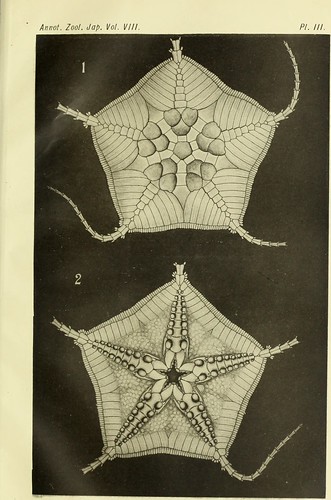
Here is some imagery of as illustrated by H. Matsumoto.. It has rather famously been shown in echinoderm books as an example of a bizarre form.  Its shape is very similar to those caymanostellids and is thought to be an adaptation to lying flush on the substrate..

Astrophiura kawamnrai n. sp.
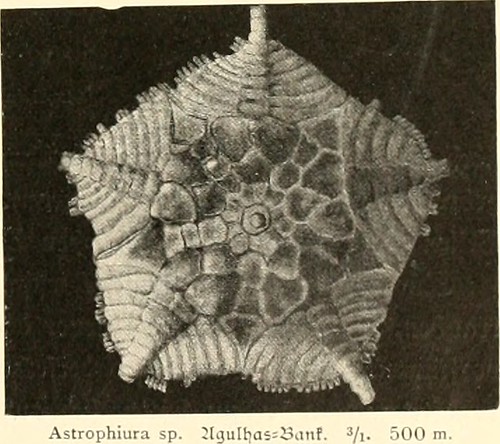
Image from page 210 of "Aus den tiefen des weltmeeres" (1903)
Image from page 662 of "Annotationes zoologicae japonenses / Nihon dōbutsugaku ihō" (1897)


4. Pumpkin Sized Echinothuriids Sea urchins! 
This dive started out pretty uneventfully up slope along a cone, resulting in the discovery of a pretty amazing colony of plexaurid corals

As I've mentioned with some of the OTHER high density communities- not only were there corals present but LOTS of other animals living among them.. 

One of the most remarkable? These HUGE echinothuriid urchins!!  For those who might not be familiar.. these are aka "pancake" or "tam o shanter" urchins. You can see more about them here (with links therein). 

Basically, these are soft-bodied sea urchins which often have poisonous spines and little walking legs.

But the ones we saw on this peak? just ENORMOUS.

The lasers are 10cm across,(about 4 inches)..so, okay this one is only about 8 inches across
but we panned across to another ledge and found a few more...
This darker brown one ended up being about 2 laser lengths..so about 8 inches across! that's basically the size of a small pumpkin! do they get bigger?

Wikipedia lists the "largest" species at 14 inches (36 cm) but did not elaborate on species..(will need to check). But if that's the upper limit, then 8 inches is definitely monstrous!


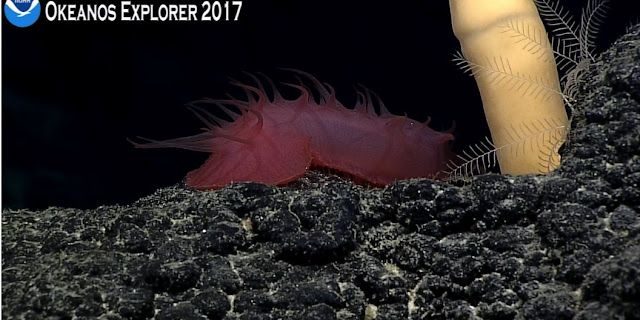
5. A deep-sea... NUDIBRANCH??
This one was quite a surprise, because I had largely thought that sea slugs were limited to relatively shallow depths, much less PROPER nudibranchs which are overwhelmingly found in nearshore settings.

This looked pretty bigh on camera and was about 5 inches long? when we collected it..

Amazingly, there is one genus of proper nudibranch in not only the Antarctic but in the deep-sea: Bathydoris!  I'm not sure quite yet what they eat but will find out!


How will the species we collected compare??? Stay tuned! (and thanks to Vanessa Knutson for her help with the ID!)

That's a quick recap of some of the non-sea star events..but I'll post more as opportunity permits!  THANK YOU to the crew of the Okeanos Explorer, NOAA and my science team colleagues for inviting my participation!


Tuesday, April 25, 2017

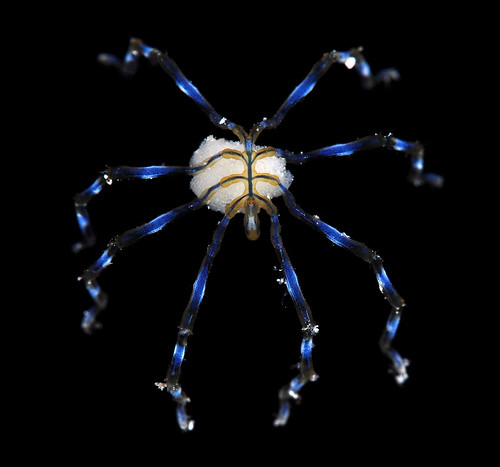
Okeanos Follow-up: Giant Sea-Spiders EAT! Cnidarians, Anemones, Hydroids & Corals! oh my!

Many of you know that I occasionally "call in" when the NOAA deep-sea research platform Okeanos Explorer goes out to see on its missions. (remember the next leg BEGINS APRIL 27  http://oceanexplorer.noaa.gov/okeanos/media/exstream/exstream.html)

Mostly I call in on starfishes or echinoderm biology..but I do have a broad interest in deep-sea biology. And I just LOVE seeing observations like the one above: a weird animal doing something no one is familiar with!

And the BEST thing about Okeanos Explorer? EVERYONE can enjoy it along with you!! Here's a BUNCH of Sea spider observations from the Atlantic Okeanos Explorer in 2014! 

...BUT of course, our ship and shore-side scientists can't know EVERYTHING. We'll often observe an event, many of us make note of it in case we see it again and often times we'll move on.... forgetting about it until such a time when the observation comes up again.

ONE such observation was one from 2014 on the Atlantic Physalia Seamount wherein we observed a sea spider in the genus Colossendeis sp. with its proboscis (that's the long cigar shaped feeding tube) stuckINTO into this hydroid (an animal similar to a Hydra from freshwater)! Was this feeding? Was it NEW?
Physalia Seamount in the North Atlantic
A brief into: Sea spiders are not spiders. They belong to a group known as the Pycnogonids (also called the pantopods) which are mysterious arthropods. Some folks consider them distantly related to the greater group of arachnids whereas others think they are even more unusual...

Most sea spiders are pretty tiny and are less than about an inch (2 cm) across and its not unusual for them to be quite cryptic. So even though they can be present, you really DO have to look for them...
Here a photoessay of tropical, shallow water species by scientist/photographer Arthur Anker displaying some spectactular colors!   Here's a spectacular male carrying eggs..
Male ovigerous sea spider (Pycnogonida)

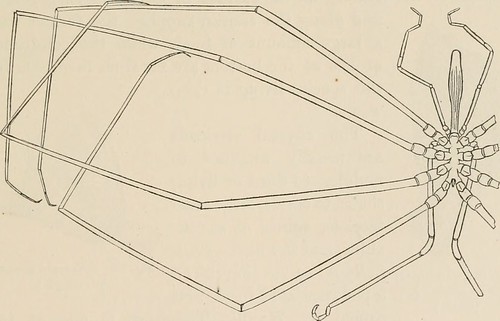
Many live in shallow water but are never seen (hidden and small)... but that's NOT a problem with the deep-sea and Antarctic species!  There's one frequently encountered genus: Colossendeis which is one of the largest known sea spiders reaching a leg-to-leg diameter of over 50 cm! that's almost a FOOT and a HALF!

Most members of Colossendeis live in the proper deep ocean abyss: roughly 1000 to 5000 m and also in Antarctica where the cold-waters allow them to occur in relatively shallow water settings.

Note also the sizeable cigar shaped projection at the top end! That's called the PROBOSCIS! That will be important later! That is presumably what they use to feed.
Image from page 96 of "A contribution to American thalassography; three cruises of the United States Coast and geodetic survey steamer "Blake," in the Gulf of Mexico, in the Caribbean Sea, and along the Atlantic coast of the United States, from 1877 to 18
Unfortunately, there is relatively little information known about sea spiders..... And the deep-sea species? Even less!

So, were the observations something unusual? Has science encountered something like that before??

But much to my delight: YES! There WAS a previous account of sea spiders feeding! and WOO HOO!  It turns out my friends at the Monterey Bay Aquarium Research Institute in Moss Landing, California actually observed something JUST LIKE THIS in 2010!!! Here was their blog post about it! 


The paper, by Caren Braby, Vicky Pearse, Bonnie Bain and Bob Vrijenhoek was published in Invertebrate Biology in 2009, 128(4): 359-363. and it documented "Pycnogonid-cnidarian trophic interaction in the deep Monterey Submarine Canyon"

They observed the same genus, Colossendeis, but at least two species, C. gigas and C. japonica feeding on commonly encountered sea anemones in the deeps of Monterey Canyon.
Braby's paper reveals that only Colossendeis in Antarctica had been observed feeding. These animals fed on limpets and bristle worms and in 1999 sea spiders were observed feeding on sea anemones

Braby et al.'s observations were the first for deep-sea Colossendeis (as opposed to Antarctic) species. Her team's work focused on their feeding on the deep-sea "pom pom anemone" Liponema brevicornis, an unusual sea anemone which literally "rolls" along the bottom of the deep-sea in a manner similar to a tumbleweed!

After the last 2017 Okeanos leg in the Phoenix Islands, I rounded up a BUNCH of the sea spider-feeding observations and decided to share them here as a comparison! Who knows? perhaps it will inspire a further paper!

Remember that NOAA's Okeanos Explorer program has captured these images and made them available for EVERYONE's enjoyment! Please remember that the next time someone talks about government funded science!

Pacific Observations! Over the last few weeks of the Phoenix Island expedition, we saw a BOUNTY of sea spider feeding observations!  

Winslow Reef: This one had its proboscis firmly ensconced into this flytrap anemone and was apparently sucking something out of it! The rather lethargic looking appearance is likely the result of being on the receiving end of whatever is going on here...

And ANOTHER on Winslow Reef! that was QUITE a dive! Here's another flytrap anemone with a sea spider attacking it!   As we saw earlier from Monterey Canyon, sea anemones and other cnidarians seem to be one kind of preferred food!

Baker Island we saw one attacking what was identified as a cup coral...The proboscis seemed to be "drinking" pretty heavily on this one...


Howland Island.....and just for good measure they saw this one crawling over a glass sponge

More Atlantic Feeding? Here we had a sea spider in the Atlantic Nygren Canyon which has been identified as Pallenopsis (thanks to Bonnie Bain), climbing and possibly feeding on this sea pen.

So, unfortunately I'm not really a sea spider taxonomist, so beyond the genus Colossendeis, I'm not sure how many species we are looking at here..but images such as this inspire many questions: Is predation specific to species? Or generalized?  How significant are these events to the ecosystem?
Do sea spiders attack the big colonial corals as well?

Stay tuned for the next exciting episode!

Friday, March 17, 2017

Okeanos Tropical Pacific Highlights: RARE and BRILLIANT Echinoderms!!

Over the last 10 days or so since Okeanos Explorer has resumed its ROV-telepresence based exploration of the Phoenix Islands and adjacent areas in the tropical Pacific they've seen some REMARKABLE animals of all kinds, from corals to siphonophores, crabs to ribbon worms, etc... but particularly ECHINODERMS!

Before I get into the cool pix.. remember NOAA OPERATES Okeanos Explorer!! NOAA has been threatened with severe budget cuts. CONTACT YOUR CONGRESSIONAL REP AND TELL THEM THAT NOAA IS AN ESSENTIAL Agency!

1. PELAGOTHURIA!  The "TRUE" swimming Echinoderm!!
I have written about this amazing animal before when I found an image of it misidentified as a jellyfish in the Galapagos Rift 2011 Okeanos photo gallery and have written at some length about swimming sea cucumbers here.

Basically, almost all sea cucumbers and indeed most echinoderms are benthic..that is they live entirely on the sea floor and never get into the water column the way fish or jellyfish do.. Yes. Some sea cucumbers can swim but ultimately they return to the bottom.

Pelagothuria is unique because it LIVES SWIMMING in the water column! Similar to the way a jellyfish does. As a result of its strange lifestyle, it has MANY bizarre adaptations and looks unlike most other sea cucumbers much less other echinoderms!

Its not a commonly encountered animal..and we live in a wonderous time that we can see several minutes of HD video of this seldom seen animal swimming by...

The video for this can be found HERE:  http://oceanexplorer.noaa.gov/okeanos/explorations/ex1703/dailyupdates/media/video/dive08_seacuke/seacuke.html
Here are the feeding arms extended into the water...


Pelagothuria is contrasted with this other swimming sea cucumber which, after landing on the bottom, poops and then takes off! (from that unnamed seamount off Winslow Reef)


2. The strange irregular urchin Phrissocystis! From Polo Seamount, about 2100 m we saw one of the most seldom seen spatangoid urchins known! These are highly evolutionarily derived sea urchins which live by digging through and swallowing sediment looking for food.

Although they are bristling with spines, they are actually quite delicate. One collected many years ago apparently collapsed as soon as it was brought out of the water in the submersible collection box!

3. A stunning new phyrocrinid stalked crinoid! From an unamed seamount in the Phoenix Island chain, this bold and striking stalked crinoid was observed..and ultimately collected after it was identified as a new species by crinoid scientist Chuck Messing (based on a paper by Tunniclife et al.)

It was quite large with an unusual texture to the stalk and the cup...

4. The "jumping" brittle star Ophioplinthaca
Brittle stars, distant cousins of sea stars, are EVERYWHERE in the ocean. And especially in the deep-sea you can see them inhabiting numerous cracks, crevices and living on corals!

Some are VERY spiny.. such as this species, what I think is called Ophioplinthaca. We've been seeing these ever since the first leg of the Samoa Expedition.  They seem to occur on corals with the tissue removed.. possibly by the ophiuroid itself..

Another curiosity is that these seem to "jump" off their perches as soon as the ROV approaches. Whether this is due to light, vibration, the bow wave of the D2 or disturbance in the "ophiuroid force" (NOTE: Ophiuroid force does not exist) is unclear...


5. The enigmatic sea star Tremaster mirabilis Here's another strange one! A sea star that basically looks like a bowl on the top of a table!

We've seen these before on Atlantic Okeanos dives (see that here) and I wrote about this animal many years ago before people started seeing them alive..

There is nominally ONE species present in almost every ocean in the world.. they've been found in the Atlantic, around New Caledonia, near Hawaii and in the Antarctic. Not sure if they've been found in the Indian Ocean.

Interestingly, these were found in astonishing abundance on one of the seamount dives


5a. The Deep-Sea Slime Star HYMENASTER 
From Titov Seamount was this glorious, glorious deep-sea SLIME STAR, in the genus Hymenaster.

I've written about the shallow water representatives of this genus here. and explored the diversity of Hymenaster in the deep-sea here


*EXTRA! and of course a bunch of weird sea cucumbers!!
A deimatid sea cucumber with many tentacular extensions, this one from Swains Atoll
and this one from Titov Seamount  but they look to be similar if not identical


This one has been seen repeatedly rearing back and presenting what I think is its mouth into the water. so maybe feeding?

A red one from Polo Seamount
This interesting purple/translucent one from Polo Seamount

Some kind of translucent "sea pig" (family Elpidiidae?) also from Polo Seamount