Showing posts with label sea pig. Show all posts

Friday, March 17, 2017

Okeanos Tropical Pacific Highlights: RARE and BRILLIANT Echinoderms!!

Over the last 10 days or so since Okeanos Explorer has resumed its ROV-telepresence based exploration of the Phoenix Islands and adjacent areas in the tropical Pacific they've seen some REMARKABLE animals of all kinds, from corals to siphonophores, crabs to ribbon worms, etc... but particularly ECHINODERMS!

Before I get into the cool pix.. remember NOAA OPERATES Okeanos Explorer!! NOAA has been threatened with severe budget cuts. CONTACT YOUR CONGRESSIONAL REP AND TELL THEM THAT NOAA IS AN ESSENTIAL Agency!

1. PELAGOTHURIA!  The "TRUE" swimming Echinoderm!!
I have written about this amazing animal before when I found an image of it misidentified as a jellyfish in the Galapagos Rift 2011 Okeanos photo gallery and have written at some length about swimming sea cucumbers here.

Basically, almost all sea cucumbers and indeed most echinoderms are benthic..that is they live entirely on the sea floor and never get into the water column the way fish or jellyfish do.. Yes. Some sea cucumbers can swim but ultimately they return to the bottom.

Pelagothuria is unique because it LIVES SWIMMING in the water column! Similar to the way a jellyfish does. As a result of its strange lifestyle, it has MANY bizarre adaptations and looks unlike most other sea cucumbers much less other echinoderms!

Its not a commonly encountered animal..and we live in a wonderous time that we can see several minutes of HD video of this seldom seen animal swimming by...

The video for this can be found HERE:  http://oceanexplorer.noaa.gov/okeanos/explorations/ex1703/dailyupdates/media/video/dive08_seacuke/seacuke.html
Here are the feeding arms extended into the water...


Pelagothuria is contrasted with this other swimming sea cucumber which, after landing on the bottom, poops and then takes off! (from that unnamed seamount off Winslow Reef)


2. The strange irregular urchin Phrissocystis! From Polo Seamount, about 2100 m we saw one of the most seldom seen spatangoid urchins known! These are highly evolutionarily derived sea urchins which live by digging through and swallowing sediment looking for food.

Although they are bristling with spines, they are actually quite delicate. One collected many years ago apparently collapsed as soon as it was brought out of the water in the submersible collection box!

3. A stunning new phyrocrinid stalked crinoid! From an unamed seamount in the Phoenix Island chain, this bold and striking stalked crinoid was observed..and ultimately collected after it was identified as a new species by crinoid scientist Chuck Messing (based on a paper by Tunniclife et al.)

It was quite large with an unusual texture to the stalk and the cup...

4. The "jumping" brittle star Ophioplinthaca
Brittle stars, distant cousins of sea stars, are EVERYWHERE in the ocean. And especially in the deep-sea you can see them inhabiting numerous cracks, crevices and living on corals!

Some are VERY spiny.. such as this species, what I think is called Ophioplinthaca. We've been seeing these ever since the first leg of the Samoa Expedition.  They seem to occur on corals with the tissue removed.. possibly by the ophiuroid itself..

Another curiosity is that these seem to "jump" off their perches as soon as the ROV approaches. Whether this is due to light, vibration, the bow wave of the D2 or disturbance in the "ophiuroid force" (NOTE: Ophiuroid force does not exist) is unclear...


5. The enigmatic sea star Tremaster mirabilis Here's another strange one! A sea star that basically looks like a bowl on the top of a table!

We've seen these before on Atlantic Okeanos dives (see that here) and I wrote about this animal many years ago before people started seeing them alive..

There is nominally ONE species present in almost every ocean in the world.. they've been found in the Atlantic, around New Caledonia, near Hawaii and in the Antarctic. Not sure if they've been found in the Indian Ocean.

Interestingly, these were found in astonishing abundance on one of the seamount dives


5a. The Deep-Sea Slime Star HYMENASTER 
From Titov Seamount was this glorious, glorious deep-sea SLIME STAR, in the genus Hymenaster.

I've written about the shallow water representatives of this genus here. and explored the diversity of Hymenaster in the deep-sea here


*EXTRA! and of course a bunch of weird sea cucumbers!!
A deimatid sea cucumber with many tentacular extensions, this one from Swains Atoll
and this one from Titov Seamount  but they look to be similar if not identical


This one has been seen repeatedly rearing back and presenting what I think is its mouth into the water. so maybe feeding?

A red one from Polo Seamount
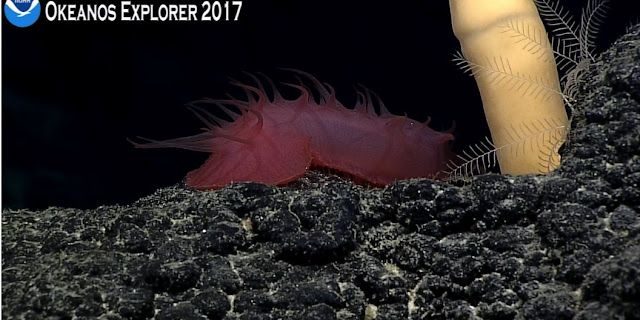
This interesting purple/translucent one from Polo Seamount

Some kind of translucent "sea pig" (family Elpidiidae?) also from Polo Seamount

Wednesday, July 15, 2015

Biology we have learned from James Cameron's DeepSea Challenger Expedition!

Image from the Census of Marine life
This week a new paper that I think everyone will be interested in! Remember back in 2012 when filmmaker James Cameron (famous for Terminator 2, Titanic, and Avatar) personally travelled down to the deepest known place on earth (> 10,000 meters!)?

It was in all the papers! There was certainly some good criticism of what was accomplished but many argued that even though Cameron himself did not bring back very much, he did apparently make some collections which were studied by scientists at Scripps Institute of Oceanography in San Diego, California, and as explained by Deep Sea News' Holly Bik even mud from that depth holds the potential for interesting data (here). 

So, here we are now THREE years later and one of the first papers detailing results from Cameron's Expedition has been published!! !

The OPEN ACCESS paper was published just recently in Deep Sea Research in the May 2015 issue, written by Natalya Gallo at Scripps Institution of Oceanography and a host of coauthors, including yes, director James Cameron. 

Cameron famously descended in the one-man submersible, DeepSea Challenger to 10,000 meters where he took some video and grabbed some mud..
I saw him and his team as they stopped in DC on their way up to deposit the sub at Woods Hole Oceanographic awhile back...


This paper by Gallo et al. details not just his dive but ALL of the dives undertaken by the sub during the expedition to the region, including several of the world's deepest trenches, including the New Britain and the Mariana Trench (Challenger Deep).  This totaled seven dives, five general dives and two into the trenches, overall ranging from 884 to 10,908 meters!
Figure 1 from Gallo et al. 2015
Everything was captured on video and these observations are scrutinzed and analyzed!

 What do they report??

1. Organic input was different in the New Britain Trench
In the paper, there is what they call "allochthonous organic input" which is"science speak" for organic external or foreign materials that fall into the deep-sea which was seen more heavily near the New Britain Trench than the other regions sampled.
Figure 4 from Gallo et al. 
In this case: plants and other related material: palm fronds, leaves, sticks, etc. but also carrion or dead animals..  Many of the animals observed interacted with the plant material.. some living on or hiding under..

In contrast, the carrion in the form of bones, etc. contributed food or nutrients to the ecosystem..

I am always keen to remind folks how important what happens at the surface impacts what happens at the deepest depths. Note here at 1000 meters food still falls FROM THE SURFACE.

2. Deep-sea Starfish?
One of the more interesting finds was the observation of these starfish living on bones and woody debris at 8.2 kilometers down! (8200 meters!!)

These were identified as caymanostellids, a weird group of deep-sea starfish which live on wood. No scale was available but known examples of these sea stars are relatively small.

If these are truly from 8.2 kilometer depths, they might be the deepest individuals known for this group! WOO!
I've mentioned the deepest known records of OTHER starfish species here. Some of the deepest records are recorded from 8400 meters! So 8200 meters isn't much of a reach. 

3. Lower abundance & diversity in nutrient poor canyons
Figure 7 from Gallo et al. 

This is the "on the other hand" of the study areas. The New Britain Trench (NBT) at 1000 m was nutrient rich but the Mariana Trench at the nearby Ulithi Atoll region (1100 m) were relatively poor in nutrients.

Correspondingly, the abundance AND diversity of animals observed was much less in the Mariana Trench and Ulithi Atoll regions.

The New Britain Trench site also seemed to demonstrate MORE diversity than the other two studied regions.


4. There is a large and diverse bottom/scavenging community in the New Britain Trench.
 
Figure 10 from Gallo et al. 2015
The New Britain Trench (NBT) seems to be showing a huge diversity relative to the Mariana Trench and this was further seen int terms of scavenging communities such as the amphipods.

Looking at the number of amphipods in each video (per frame) they observed that there was a HUGE difference in the number observed!

Those in the New Britain Trench were MUCH more abundant!

Multiple species were likely present but this assemblage also apparently included the "supergiant" amphipod Alicella gigantea:
Image from the BBC
Sea cucumbers and various crustaceans were also apparently present...

One interesting thing: Absent from ALL the deep localites on this dive?  NO FISH were observed. Its been argued that fish "bottom out" at about 8000 meters and are unable to occur below that.. The observations here seem to be consistent with this data.

5.  Other animal observations.. Potentially new species?? 
Among the few animals observed at depth (from their Figure 9 below) were an odd ulmariid jellyfish (labelled C) as well many other crustaceans (D) which were either mysids or some kind of shrimp like crustacean..
One of the significant discoveries was this "squid worm", a swimming polychaete, likely in the genus Teuthidodrilus from 1 KM down in the New Britain Trench!!  These were originally described from the Philippines. 

5a. The Deepest Known Deuterosotome Known Probably one of the DEEPEST of the critters noted in Gallo et al's paper were, you guessed it! SEA CUCUMBERS.

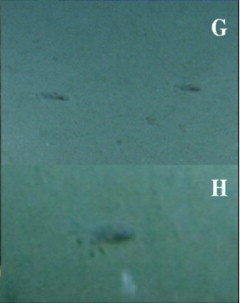
In the Marianas trench at the deepest depth (10,900 meters!) they observed sea cucumbers oriented into the current, which is consistent with behavior seen in deep-sea sea cucumbers like sea pigs  

The animals observed from the deepest point were only tentatively identified as members of the family Elpidiidae (Fig. 10 on the right G & H). They indicate these might possibly have been Peniagone sp.  (Note Peniagone below is only for representative purposes and was NOT from Gallo et al.'s paper!)
Peniagone islandica from EOL

Previously, the deepest known sea cucumber was Myriotrochus brunni which was collected from 10,710 meters in the Mariana Trench.

However, the account by Gallo et al. for the elpidiid sea cucumbers (their Fig. 10, G, H) are from 10,900 meters!! Which yes, makes them the DEEPEST known deuterostome animal!!  (and certainly the deepest known echinoderm!!)
Wednesday, April 15, 2015

Five Cool Things we have already seen on the Okeanos Oceano Profundo Expedition!


This week: Some echinoderm highlights from the 2015 Okeanos Oceano Profundo cruise! 

I've made the point in the past about how AWESOME it is to be able to see so many deep-sea animals alive!

As a scientist who works mostly with preserved specimens, our typical perception of these species from dead material is something like this:
The above specimen is a species of Freyastera, a deep-sea brisingid asteroid. Brisingids have special suspension feeding arms with very delicate arms covered by needle-like spines. I've discussed them at length here.

In stark contrast, here is one alive: 
Dang. THAT's a world of difference!! And the living observation gives us basic info like color and basic posture. Surprisingly important information when you consider how badly deformed and damaged specimens collected by trawl net can be....

But on the other hand, it is FROM these specimens that we are able to have records of these rare species from past expeditions.  

Case in point: 

1. Laetmaster spectabilis 
We saw this Tuesday. At a depth of 3915 meters from the east wall of Mona Canyon. This is a member of the Solasteridae, which are the "sun stars", which I have written up briefly here. 
This is one of the rarest known sea stars, which was known previously from one or two specimens in the late 19th Century on which the descriptions were based. Collected in 1878 by the Blake, a famous oceanographic vessel!

That pretty much means that no one has collected this species for over 130 years! It gave a hard pass to the 20th Century. yow.


2. Plinthaster dentatus feeding!
Another cool thing that we often encounter on these dives is basic aspects of biology which, for deep-sea species, are unknown. 

This "cookie star" is in the family Goniasteridae. These get collected quite a bit but we know very little about them. I wrote about some Hawaiian ones here.

Now, we know this one fees on sponges (or hydroids)!
                            

3. Holopus sp. Bizarre stalked crinoid! 
This was a great pleasure to see... These are unusual types of stalked crinoids which I have written about before.
This sequence nicely shows the arms extended and withdrawn...

4. Oneirophanta mutabilis! A different kind of "sea pig"!! This one is in the family Deimatidae, so it is different from the classic sea pig Scotoplanes globosa.. So what is a "sea pig" anyway? A discussion for a different day...

5. Big Unknown Spiny Cidaroid Urchin!
with ophiuroid (Asteroporpa annulata? I think?) living on the spines!

But who is it? Not sure..
Note that there's some striped ophiuroids living on the spines...
They could be this species? Asteroporpa annulata?

Other noteworthy observations!!
Swimming sea cucumbers (Elasiopoda mostly) were everywhere...

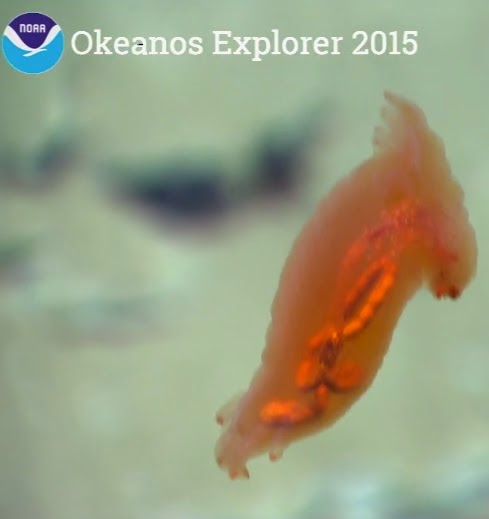
A Enypniastes like species (possibly Amperima or Peniagone?) with transparent body.... That's the gut you are seeing THROUGH the body wall.
And a Benthodytes also with clear body wall showing the gut! 
And a white one.. but again.. transparent body wall...

And finally... one pic full of intrigue! my "phantom" wood starfish?? Did I see it or not? A revisitation to the HD is in the stars....