Showing posts with label tropical Pacific. Show all posts

Friday, March 17, 2017

Okeanos Tropical Pacific Highlights: RARE and BRILLIANT Echinoderms!!

Over the last 10 days or so since Okeanos Explorer has resumed its ROV-telepresence based exploration of the Phoenix Islands and adjacent areas in the tropical Pacific they've seen some REMARKABLE animals of all kinds, from corals to siphonophores, crabs to ribbon worms, etc... but particularly ECHINODERMS!

Before I get into the cool pix.. remember NOAA OPERATES Okeanos Explorer!! NOAA has been threatened with severe budget cuts. CONTACT YOUR CONGRESSIONAL REP AND TELL THEM THAT NOAA IS AN ESSENTIAL Agency!

1. PELAGOTHURIA!  The "TRUE" swimming Echinoderm!!
I have written about this amazing animal before when I found an image of it misidentified as a jellyfish in the Galapagos Rift 2011 Okeanos photo gallery and have written at some length about swimming sea cucumbers here.

Basically, almost all sea cucumbers and indeed most echinoderms are benthic..that is they live entirely on the sea floor and never get into the water column the way fish or jellyfish do.. Yes. Some sea cucumbers can swim but ultimately they return to the bottom.

Pelagothuria is unique because it LIVES SWIMMING in the water column! Similar to the way a jellyfish does. As a result of its strange lifestyle, it has MANY bizarre adaptations and looks unlike most other sea cucumbers much less other echinoderms!

Its not a commonly encountered animal..and we live in a wonderous time that we can see several minutes of HD video of this seldom seen animal swimming by...

The video for this can be found HERE:  http://oceanexplorer.noaa.gov/okeanos/explorations/ex1703/dailyupdates/media/video/dive08_seacuke/seacuke.html
Here are the feeding arms extended into the water...


Pelagothuria is contrasted with this other swimming sea cucumber which, after landing on the bottom, poops and then takes off! (from that unnamed seamount off Winslow Reef)


2. The strange irregular urchin Phrissocystis! From Polo Seamount, about 2100 m we saw one of the most seldom seen spatangoid urchins known! These are highly evolutionarily derived sea urchins which live by digging through and swallowing sediment looking for food.

Although they are bristling with spines, they are actually quite delicate. One collected many years ago apparently collapsed as soon as it was brought out of the water in the submersible collection box!

3. A stunning new phyrocrinid stalked crinoid! From an unamed seamount in the Phoenix Island chain, this bold and striking stalked crinoid was observed..and ultimately collected after it was identified as a new species by crinoid scientist Chuck Messing (based on a paper by Tunniclife et al.)

It was quite large with an unusual texture to the stalk and the cup...

4. The "jumping" brittle star Ophioplinthaca
Brittle stars, distant cousins of sea stars, are EVERYWHERE in the ocean. And especially in the deep-sea you can see them inhabiting numerous cracks, crevices and living on corals!

Some are VERY spiny.. such as this species, what I think is called Ophioplinthaca. We've been seeing these ever since the first leg of the Samoa Expedition.  They seem to occur on corals with the tissue removed.. possibly by the ophiuroid itself..

Another curiosity is that these seem to "jump" off their perches as soon as the ROV approaches. Whether this is due to light, vibration, the bow wave of the D2 or disturbance in the "ophiuroid force" (NOTE: Ophiuroid force does not exist) is unclear...


5. The enigmatic sea star Tremaster mirabilis Here's another strange one! A sea star that basically looks like a bowl on the top of a table!

We've seen these before on Atlantic Okeanos dives (see that here) and I wrote about this animal many years ago before people started seeing them alive..

There is nominally ONE species present in almost every ocean in the world.. they've been found in the Atlantic, around New Caledonia, near Hawaii and in the Antarctic. Not sure if they've been found in the Indian Ocean.

Interestingly, these were found in astonishing abundance on one of the seamount dives


5a. The Deep-Sea Slime Star HYMENASTER 
From Titov Seamount was this glorious, glorious deep-sea SLIME STAR, in the genus Hymenaster.

I've written about the shallow water representatives of this genus here. and explored the diversity of Hymenaster in the deep-sea here


*EXTRA! and of course a bunch of weird sea cucumbers!!
A deimatid sea cucumber with many tentacular extensions, this one from Swains Atoll
and this one from Titov Seamount  but they look to be similar if not identical


This one has been seen repeatedly rearing back and presenting what I think is its mouth into the water. so maybe feeding?

A red one from Polo Seamount
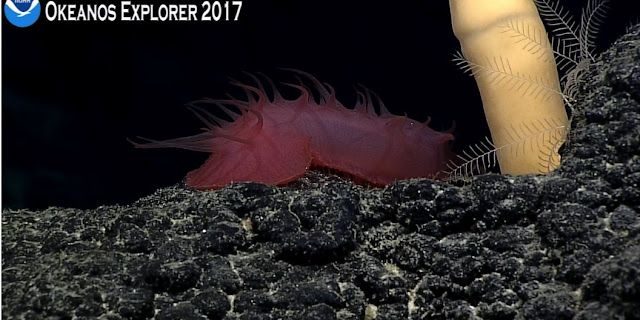
This interesting purple/translucent one from Polo Seamount

Some kind of translucent "sea pig" (family Elpidiidae?) also from Polo Seamount

Monday, October 22, 2012

Benthic Ctenophore Video Watch!

Benthic combjelly on Luzon seastar (Coeloplana astericola) Photo by Arne Kuilman
This is one of those RARELY seen animals that I love sharing with people because they are SO strange.

First lesson: Ctenophores are a group similar in appearance to jellyfish. But in a separate phylum-The Ctenophora. Here's the Wikipedia for handy-dandy quick reference. They are identified by "ctene rows" that are what they use to propel themselves. Underlight these ctene rows shimmer giving them an iridescent appearance which looks like this:

But there's one subgrouping of comb jellies that, for some odd reason, have taken to living on the sea bottom-sometimes on other animals, such as sea stars but also on sea urchins and corals.

Its thought that these are commensal relationships. In other words, the ctenophores live at no apparent "cost" to the host. But relationships are poorly understood-so who knows?  

At the very least having THAT many ctenophores crawling around on your surface might clog up your papulae for respiration and so forth.

A brief explanation was from my blog awhile back here.  I don't know how common it is to see these in the field but these are pretty rarely seen for most people (although here is a small group on Flickr devoted to them) .. so I thought it would be a good idea to put them all in one place for everyone to enjoy (especially since there's a couple of new ones!)

Enjoy! 

The animals are those strange moving white blobs on the surface. The ones living on the sea stars are in the genus Coeloplana. I'm not sure if the ones further down that are not living on sea stars are the same genus.. but I'm guessing probably not.

Those threads? Are the feeding tentacles that you would normally see here in the "sea gooseberry" Pleurobrachia
Untitled

But here is Some neat NEW Benthic Ctenophores on Echinaster callosus! Shot in Lembeh

here is the FIRST video of benthic ctenophores as shot by Blenny Watcher. Host is Echinaster luzonicus

Here are some from Bocas Del Toro, Panama without the sea star host. Shot by Rosana Rocha

Here's are more species from Japan!!

Tuesday, September 11, 2012

Feather Stars (crinoids) and their look-alike camouflaged shrimp!!

So you know how some people look like their pets?   Well one could say that the same goes for crinoids and their shrimp!

Tiny little commensal crustaceans that live camouflaged and hidden among the feathery arms and striking colors of a crinoids' arms! Presumably, the crinoids provide some protection from predators.

This one for example in stunning green from Nudi Falls in Sulawasi... Image by "EcoDivers1"
Crinoid Shrimp,

Another green one (identified as Laomenes cornutus) from the Philippines. Image by "MatYie_00" (Mohd Syukri Mazlan)
Green Crinoid

Here is a nice little video about how crinoid shrimp VANISH along with their host..
crinoid shrimp from Steve Clark on Vimeo.


Blue and orange! Identified as Periclimenes amboinensis by the photographer. Image by "avloetscher"
Crinoid Shrimp (Periclimenes amboinensis)

A blue/yellow one.. by "funseadiving"


Can you find the yellow shrimp?  (Perilimenes commensalis)


Yellow and purplish! from Indonesia. Image by "FrogfishPhotos"
Yellow Crinoid Shrimp

A zebra colored one.. Identified by the photographer as Periclimenes.  Image by "PacificKlaus"
Crinoid Shrimp
Another one with the same color from the Philippines. Image by "scubaschnauzer"
crinoid shrimp.jpg

A video of a similar colored one from Japan


and sometimes clingfish (Fiji) get in on the action! Image by Mark Atwell.
Clingfish on/amongst a Crinoid

AWKWARD!!  (great moment from Sulawesi)  Image by "Christian Loader"
Crinoid Clingfish + Shrimp - Bunaken

Hopefully, next week I will be able to put together a PROPER post for you guys!  Seeya then!

Tuesday, July 31, 2012

Sea Stars/Starfish/Estrella de Mar of the tropical East Pacific- Baja California, Mexico, etc.! Some cool Flickr Pix!

Phataria unifascialis from the Pacific coast of Panama
(this image by Arthur Anker!)
The tropical East Pacific region, including Baja California/Mexico, Panama, to Ecuador and the Galapagos has some of the most unique, diverse and GORGEOUS starfish species anywhere in the world.

This area is also interesting for studies of biogeography and evolution as the "middle ground" between the highly diverse Indo-Pacific region and the tropical Atlantic.

One cool resource for this area is the Gulf of California Invertebrates Database run by the Center for Sonoran Desert Studies at the Arizona-Sonora Desert Museum. Go check it out! 

Here's a bunch of the more prominent shallow water starfish you're inclined to encounter in this region...

Pentaceraster cumingi (aka Oreaster occidentalis). Oreasteridae.  Photo by bswift. From Bahía de los Ángeles, Sea of Cortez. This one is interesting-have not seen the yellow highlights. It almost looks like one of the Indo-Pacific species...
Pentaceraster cumingi
Image by cam17 from the Galapagos.
red star
and this "frosted" variant. Image by cam17 from the Galapagos
dark-tipped arms

This next pic is something special! You can probably not see this anywhere but in the Panama area (where there are both Atlantic and Pacific coasts)!!

The yellowish-orangish individual on the left? is the tropical ATLANTIC Oreaster reticulatus. Vs. the deep red individual on the right which is the tropical PACIFIC Pentaceraster cumingi (also called Oreaster occidentalis in the past). They are closely related.. and possibly sister-species separated by the Panamanian land bridge/isthmus!

There are VERY few places in the world where you would you be able to see them BOTH alive in the same place at the same time. I would be curious to know where this was shot...
Two Starfish

Nidorellia armata aka the "chocolate chip star". Oreasteridae. Photo by cam 17. From the Galapagos
chocolate chip star
Another great image by billamp. Pic from off San Carlos Mexico.
Sea Star 04 off San Carlos Mexico
Close up on Nidorellia. This terrific image by Scott Trageser (NatureStills) shows tiny ophiuroids (possibly Ophiactis?) living on the spines! Not sure, but these might be something new?

Pharia pyramidata. Ophidiasteridae. Image by Hawkfish from Cabo Pulmo, Baja California, Mexico.
Pyramid starfish, Cabo Pulmo, Baja California Mexico

Phataria unifascialis. Ophidiasteridae. Image by Hawkfish from Cabo Pulmo, Baja California, Mexico.
Tan starfish, Cabo Pulmo, Baja California, Mexico
here's a red variant from Panama by colleague Arthur Anker!
Phataria unifascialis from the Pacific coast of Panama
Mithrodia bradleyi. Mithrodiidae. Image by Hawkfish from Cabo Pulmo, Baja California, Mexico.
Starfish, Cabo Pulmo, Baja California, Mexico

Heliaster kubiniji. Heliasteridae. Image by Sou so-Fine from La Paz, Baja California, Mexico.
Sea Star

Acanthaster planci. Acanthasteridae. The Crown of Thorns starfish! Image by Sou So Fine. Image from La Paz, Baja California, Mexico.

At one time, there was one species of crown-of-thorns starfish which occurred from Baja California to Southern Japan/Hawaii all the way to the east coast of Africa! Nowadays, genetics tells us there are likely multiple cryptic species that morphology may or may not be able to distinguish..
Sea Star 3

hmm..an interesting red Astropecten sp. Astropectinidae from Ecuador. Image by altsaint.
starfish
and another non-red Astropecten.. image by Ed Robinson
Bright Star

Here is Amphiaster insignis one of the few members of the family Asterodiscidiae (image from Simon Coppard's "Echinoderms of Panama" Lifedesk.  In life these are a brilliant orange..
and finally-saving the best for last From the Galapagos is the HUGE sand star Luidia superba (very stunningly presented by Dr. Jen H. for scale)