Showing posts with label commensal. Show all posts

Tuesday, May 20, 2014

Brittle Stars are EVERYWHERE: 5 EXTREME Ophiuroid Habitats!

fringehead1Jan19-14
Brittle stars are EVERYWHERE. They are not only the most diverse (over 2000 species), but also the most ABUNDANT of echinoderms (go here for the full thing)

The truth is that they live frakkin' EVERYWHERE. The diversification of brittle stars is thought to have been successful mainly because they've found a niche just about anywhere and everywhere they can! They live in all the nooks and crannies on the marine bottoms: buried in sediment, rocks, sponges, corals so on and so forth..
Tiny in-a-sponge brittle stars (Ophiactis savignyi) in chocolate sponge (Spheciospongia cf. vagabunda)

Some Brittle stars live in some of the deepest places on earth down to >8,000 meter depths! (here)

But brittle stars also manage to find some pretty crazy, unusual and just downright SURPRISING places to live. Are there ANY habitats which which they cannot exploit???

Here's a few of them....

Ophiuroids GO where other Echinoderms fear to tread! 

1.  Floating Plastic Garbage.
garbage-patch-19-hoshaw_lindsey
A recent paper by my colleague Miriam Goldstein et al. (2014) in Marine Biology has documented ophiuroids among the plastic garbage debris "islands" found in the North Pacific.  In this case, I'm told, there were hundreds among some of the ropes on these bundles... (my thanks to Miriam and her co-authors for the paper & sharing their info!)

Although garbage/debris is created by humans, it may functionally serve as just another venue for brittle stars to practice rafting, which is one means for animals that don't swim as adults, to be dispersed widely via ocean currents. 

I've also written about the tiny, 6-rayed brittle star, Ophiactis which has likely been transported all around the world via human activity, probably like this and several other ways.....

2.  Jellyfish.
Speaking of one of those other ways?? I wrote about brittle stars "rafting via jellyfish" in one of my posts from 2009! (here)  But the short version is that some species are regularly found inside jellyfish for uh..... various possible reasons (go see the post to see the discussion why..)

another great pic of this can be found over here! 
via Thomas Peschak Photography
3. Hydrothermal Vents.
Here is ANOTHER place you generally don't expect to find echinoderms. Why? Because most of the environment around hydrothermal vents is not just, very, VERY hot but also filled with toxic chemicals, such as hydrogen sulfide.
East Pacific Vent from this R. Blake's page
Given how sensitive most echinoderms are to having clean, seawater these factors probably exclude most other echinos from being present in these poisonous areas. and YET somehow brittle stars have found a living here.

Observe Ophiolamina eprae from the East Pacific Rise. And there are actually about three others that live in and around vent settings...

This species actually looks like it lives directly in the path of some of the hot water and toxic materials...
From IFREMER
4. Brackish Water (i.e., nearly fresh water)
Image via Florida shellfish ID guide
Echinoderms are exclusively marine and they don't handle shifts in the amount of salinity in the water well. Some echinoderms, such as sea stars will often die from a significant drop in ocean salinity from say, a big rainstorm.

Salinity in ocean water ranges  about 30-50 ‰  (ppt)  and freshwater is generally less than 0.5 ‰ (ppt). A lot of sea stars, for example start to get unhappy when you drop below 30ish ‰ (ppt). 

But some brittle stars? Brittle stars are probably the toughest of the echinoderms with some species, such as the above Ophiophragmus filograneus (Amphiuridae) can withstand up to 7.7 ‰ (or ppt-parts per thousand). 

Another species in the Amphiuridae, Amphipholis squamata has been recorded as withstanding salinity as low as 5 ‰ !!
from Wikipedia! 
In the salinity battle, brittle stars are tough, little bastards.

5. Crinoids! 
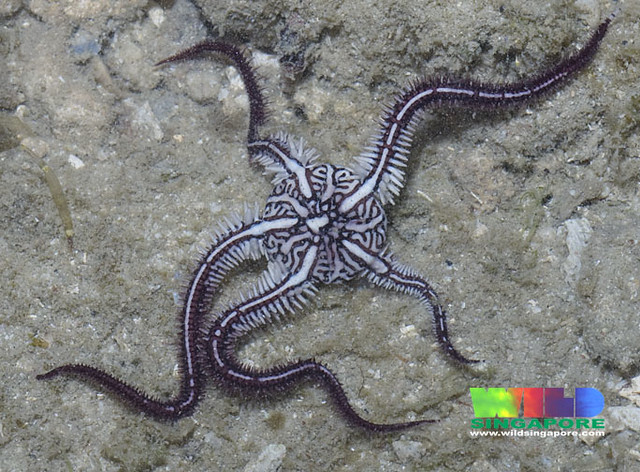
Here's one species, Ophiomaza chaotica a strikingly black and white species which famously lives on feather stars! A short write up on it at Wild Singapore here. 
Pale feather star (Class Crinoidea)  with Feather-hitching brittle star (Ophiomaza cacaotica)
Blue feather star (Class Crinoidea) with Feather-hitching brittle star (Ophiomaza cacaotica)
Feather-hitching brittle star (Ophiomaza cacaotica)

BONUS!
and I found this pic of a tiny striped brittle star living on Ophiomastix annulosa  Another example of commensalism?? Maybe one just incidentally crawling on the other? It wasn't actually clear and unfortunatley I couldn't actually find a record Ophiomastix-on-Ophiomastix action..so for now a mystery...
Ophiomastix varabilis brittle star ind11a 1086

There ARE some accounts of brittle stars living symbiotically on other brittle stars but for various reasons, those are the subject of a future post!

UPDATE:  Should also have mentioned that brittle stars live on that other extreme deep-sea habitat-WOOD. But that's a story for another day...
Borrowed from my friends at Deep-sea News

Tuesday, March 18, 2014

Echinoblog Travelog! Pt. 4 Stories from Tsukuba & Japan!

Travel is about experiences. Here are some of mine.... Starfish and not....

1. Starfish Story! 
Found this cool disk from the starfish Plazaster borealis the other day.  I am somewhat obsessed with this starfish (see this blog). It goes by the common name "tako hitode" aka the "octopus starfish" and we know next to nothing about it.  Sadly, this specimen was found without arms. Probably something that happened when it was collected....

Cool thing about this and the specimen lot it was found in?? Collected in 1932.  This species of starfish was originally described in 1938. That means, this specimen was actually collected SIX years before the species was actually described by Dr. Tohru Uchida.
 Here's what the animal looks like in its natural state. Almost 40 arms! But they disarticulate pretty easily.

2. Starfish-Worm Story!
The other day, I encountered this: polynoid polychaete worms which live commensally on the starfish Solaster borealis! STILL attached and living to their "host".

                                        
To give you some perspective, here is what the animal looks like in situ (from the North American side of the Pacific). 
This image from the Monterey Bay Aquarium Research Institute! 
And here is a close up of the worms living inside the mouth and tube foot grooves of the starfish...
With this Japanese Solaster borealis, we are seeing the relationship among some relatively deep-sea species but this type of relationship is also seen on several North American species of Solaster, such as this one from a shallow-water Washington species.

Where better to live/feed than on the "top dog" starfish predator like Solaster?  (or any starfish for that matter!)

3. Tunicate Food Story!
Travelling to foreign lands and new places means trying new foods and dishes that you don't normally get to try when you are at home. Sometimes, these dishes can be quite exotic.

Case in point: after a presentation at the University of Tokyo, I was treated to some hospitality including the opportunity to try hoya aka raw sea squirt or tunicate! 
I wrote a post about exotic invertebrates eaten around the world here. Here is a picture of what hoya looks like alive.
What does it taste like? Hm. An acquired taste certainly. Kind of sour and medicine-like is probably the most polite way to put it... Not one of my favorites but glad that I tried it!

4. Bathroom Story!
This one is a simple lesson in keeping track of different kinds of plumbing! Behold my bathrooom set up!

The shower is nozzle connected to the sink faucet. Very efficient. There's a shunt switch that routes water either to the faucet OR to the shower head. The shower head is used in the bathtub, where it can drain. But it is stored on the wall up there over the sink.

Sometimes you forget that the shunt switch is turned to "shower" instead of "sink" AND you have replaced the shower head on the wall.

Looking to brush your teeth and BOOM!  That was messy. 

5. EARTH Story! 
So I'm workin' one night, when "I-san" a worker in the lab, who speaks only a little english, gets up and starts saying "oscillate" ????  Odd.  

So, I get up and he's pointing to the mini-fridge shaped air vent sitting above my seat (above). Big, but held up by big metal struts. It is ROCKING back and forth. The rest of the lab, the floor seems perfectly stationary.  "Ground is shaking because of Earth moving" He says. My eyes open wide, as I grasp what he is saying and realize, "Oh crap, we're having an earthquake!"  

It was a 5.1... and I very nearly ignored it. Yow. 
Info for the quake can be found here. 

There's a HUGE Diversity  of starfishes in Japan...
Whew! I'm winding down the trip to Tsukuba/Tokyo and the National Museum of Nature and Science!  I'm finding a HUGE diversity of sea stars in the collections. When I arrived, there was an estimated 200 species in Japan. When I leave, this number will be significantly higher!  Many of them will be from deep-sea habitats.

Hopefully, this trip will only be Part One!

Wednesday, January 22, 2014

Worms & Snails that Live On/In Sea Cucumbers!

There's something about sea cucumbers which seems to make them attractive as hosts for various other animals.
Some sea cucumbers got clams that live in their throat...
The sea cucumber anal region seems to be popular as a place to live as crabs and of course, pearlfish find good homes there..

This week.. More animals that have made sea cucumbers hosts to their lives!!

Worms!
This scale worm above was identified as Gastrolepidia clavigera, living on its host sea cucumber (apparently Bohadschia graeffei). Image by Arne Kuilman.

This one by Theresa Legler, shows another polynoid worm, but it looks like a different genus/species...

Another similar looking polynoid. Image by Kevin Lee.

This one, by Ben Naden,  seems to be taking advantage of the rough skin texture...


Snails! Most of the snails shown here appear to be members of the Eulimidae, which are a diverse group of snails, which has apparently adapted a parasitic lifestyle. Many of them live on echinoderms. I review some of them here.  

Eulimids basically feed on their hosts. They have a proboscis which is inserted into the bodywall and used to suck out precious bodily fluids and other nutrients!

Here's a neat pic by Eunice Khoo showing several embedded in the epidermis.


A different kind of snail, Melanella sp. living on the sea cucumber Thelenota ananais.


Images below by "wj", what looks to be another set of eulimid snails, feeding on the sea cucumber Colochirus.


and let us not forget that eulimid snails (in this case-the genus Stilapex) ALSO inhabit deep-sea sea cucumbers... (from the sea pig post)
(from the New Zealand R/V Tangaroa weekly log, photo cred-Stefano Schiaparelli, NZ IPY-CAML) 
What makes Sea Cucumbers such desirable housing?  While there's no immediately clear data on the topic, it seems to be important that sea cucumbers are all composed of a soft, edible yet durable, tissue. So, maybe a good house that these protects and feeds?

Tuesday, October 1, 2013

Crabs & Shrimps that Live in Sea Cucumber Anuses!

_MG_2243_0713
Image by Yellowbeetlebug
Crab IMG_1357-2
Image by Jasdivr
One of the things I find fascinating about sea cucumbers is that they're basically a section of intestine, including the mouth and the anus which has evolved to live on its own. We sometimes think of animals by their most prominent features.. jaws in sharks, eyes in insects...

But Sea cucumbers are basically a big living gut! and have developed many unusual ways of living with this body plan..
Sea Cucumber
Image by WhiteBeachDivers
It should not be so unusual that the openings to this "living gut" are especially important. The mouth of course, we see used in feeding but in sea cucumbers, of particular significance seems to be the importance of that second, most prominent opening.. the ANUS!
Another Sea Cucumber Anus
Awesome image by PacificKlaus
This is of course, where inorganic sediment is defecated after the animal has eaten and removed the organic material that fuels its diet...

But SO many other biological functions in sea cucumbers are now being observed in sea cucumbers..

This account for example about how sea cucumbers can FEED through their ANUS. and of course, the simple fact is that sea cucumbers use the anal opening in order to process water over their internal "gills"...

OPEN
Open
Image by Pacific Klaus
and shut! 
Closed
Another fantastic image by Pacific Klaus
And by the way.. Pacific Klaus has assembled an AWESOME photo gallery of echinoderm anuses on Flickr here. 

But of course, sea cucumbers can host several commensal animals. That is, animals which live, in or around the animal as a habitat but which bring neither harm nor advantage to the host sea cucumber..

The most striking example is the "fish-in-sea cucumber-anus" Pearl Fish. Go here to see this. 
or there's video of course...


and just because I can, lets not forget: Anal Teeth!
Sea Cucumber Anus
Image by PacificKlaus
Awhile back I wrote about flatworms living in sea cucumbers and sea urchins..
But another evocative animal living in sea cucumber anuses?  These little crabs!
_MG_2243_0713
Image by Yellowbeetlebug
Many of these have been called Lissocarcinus throughout the internet.. but I'm not sure how dependable those names are. They appear to be scavengers taking advantage of any leftover food ..

Is the anal habitation a matter of opportunity? Regular behavior? Species specific?

But clearly, they do seem to make the most out of uh... living in the shadow of greatness...
Sea Cucumber Crab - Where the Sun don't Shine from liquidguru on Vimeo.

Another
DSC_0353
Image by Martin "El Grande" Sequerah
Interestingly, there are also photo accounts of these shrimps living around sea cucumber anuses.. perhaps to take advantage of other organic material?
IMG_2336
Image by Eric Francis
Here are more shrimp+crab anal assemblages...
Lembeh Strait
Image by Swaflyboy
Incidental occurrence? or preference?
shrimp on sea cucumber 2
Image by ScubaSchnauzer
This shrimp seems to have found itself completely embedded in sea cucumber anus!
Imperator Shrimp - Periclimenes Imperator stuck in the anus of a Sea Cucumber
Image by Prillfish
Many questions-what do the crabs and shrimps get out of this? Are they species specific? Is this really a region specific habitat? Or do they just use the whole animal as a house with the anus as a door?

Tuesday, April 30, 2013

Flukes in Cukes! Flatworm Commensals in Sea Cucumbers, Sea Urchins and Starfish!

DSC00523
Fantastic image by Chelsea L. Wood
Today we look at some neat examples of flatworms that live in echinoderms!

And to the flatworm and parasitic worm people reading this? YES, I know flukes aren't free-living flatworms. It rhymed! So go with it for now. thanks for your patience!

Flatworms aka the Platyhelminths (in Greek-literally the "flat worms") look like living carpets. They are mostly predatory, but may also feed on small organic particles and live all over the place. They can be parasites, such as tapeworms or free-living beasts such as the one featured in the collage below.

These include the familiar Dugesia-that you find in high school biology (brown with arrow shaped head and two weird eyes) to these big, colorful species that live throughout the tropical Atlantic and Pacific. There are some 4500 recognized species of free-living flatworms..
Polyclad flatworm collage
An awesome collage by Arthur Anker!
Papers that were used today:  this paper by George Shinn (1981)-Hydrobiologia 84: 155-162
another in Biological Bulletin 169: 182-198 (also by Shinn) and this one, from Canadian J. of Zoology 61(4): 750-760 which describes the species living in the sea cucumber

What's interesting about the ones that I'll be talking about is that none of these is exclusively parasitic (such as a tapeworm or a trematode). These are free-living species..but they live INSIDE the body cavities of echinoderms!  

Think of it as if you ended up living in the intestine or the body cavity of a whale. Lots of space there and potentially...a  lot of food. Plus protection from predators, the elements and a safe place to reproduce!

So, technically they aren't really parasites (where the host 'loses') they are commensals that are considered just kind of benign.
Image from WallaWalla University Inverts site! 
It makes sense. Sometimes, an animal with a huge internal body cavity can be a home. We've seen the classic pearlfish and even when clams that live inside the throats of sea cucumbers.

It turns out that there's something in the neighborhood of SEVENTY species of different free-living flatworms that live in echinoderms as hosts! A nice list of these can be found in this paper here.

Most of these hosts appear to be sea cucumbers with sea urchins and sea stars. Some in cold water but also in the tropics!  Crinoids and brittle stars seem to be among the minority as hosts for flatworms..probably because there's not much "living space" inside their body cavity. Or maybe they're just not as well studied?

Here are two well-documented worms from the North Pacific coast.. one that lives in several Pacific urchins and one in a North Pacific sea cucumber...

The Urchin as a "House" for flatworms! 
Urchins on the west coast of North America (in the Pacific Northwest) include the well-known purple sea urchin (Strongylocentrotus purpuratus)
Purple Sea Urchin - Strongylocentrotus pupuratus
Image by Joe McKenna
And the giant red urchin (Strongylocentrotus franciscanus)
Red Sea Urchin
Image by Dan Hershman
and the deep-sea Allocentrotus fragilis
expl1040
Image by NOAA Photo Library

ALL of these are often inhabited by this beast! Syndisyrinx franciscanus
DSC00519
Image by Chelsea L. Wood
Syndisyrinx franciscanus lives in the digestive tract of its host and apparently, infested urchins have been found with up to 186 worms!!! (an average of about 29/individual)
DSC00521
Image by Chelsea L. Wood
This one is called Syndesmis dendrastrorum 
From the EOL page for S. dendrastrorum
and it lives in the common Pacific Northwest sand dollar Dendraster excentricus!! (seen below alive with spines)
Sand Dollar (Dendraster excentricus)
Image by Patrick Warren
or perhaps more familiar if seen like this? Spines removed...
Eccentric Sand Dollar (Dead) - Dendraster excentricus
Image by Cheryl Moorehead
Even the familiar Pacific Sand Dollars can HAVE WORMS!!!  Ya' learn something new every day!

What do they do in there? Mostly, these live in the intestine feeding on the host's intestinal lining (the tissue) AND apparently also like to eat on the symbiotic protists (the ciliates) that ALSO live in the intestine of the host.  But this apparently doesn't create any detrimental effects on the host. So-commensal rather than parasitic.

Apparently, the worms produce egg capsules are released into the intestine of the host and released outside with the feces.  When the capsules are eaten by a new host, they become active.... probably a reaction to the intestinal fluid and proceed to live out their new life in the new host's intestine.

Flukes in Cukes! 
A free-living worm lives in the Pacific NW sea cucumber Parastichopus californicus.
California Sea Cucumber (Parastichopus californicus)
Image by T. Van Nunnery
This beast is called Anoplodium hymanae, a worm that is named for the famous Invertebrate Zoologist Libbie Hyman
DSC00524
Image by Chelsea L. Wood
These are a little more aggressive than the ones that live in sea urchins.

This species reaches the body cavity by penetrating the wall of the intestine..usually through the respiratory trees (feathery structures colored in blue in the pic).  I've briefly mentioned this area as where some sea cucumbers can feed via their butt!


The eggs are spread out via the anus with the feces until they are devoured by a host.

Similar to the ones in urchins, the larvae hatch in response to digestive fluids in the intestine of the host. Get into the intestine, move to the respiratory trees and then further move out into the body cavity of their new host!
DSC00523
Image by Chelsea L. Wood
Starfish got worms too!
So, there aren't a lot of records of flatworms that live in/among sea stars. Six were recorded in asteroids..and oddly enough, the one below was not included. So maybe its something new?

Description of this pic indicated the cold-temperate North Atlantic asteriid species Leptasterias littoralis. Is this a commensal flatworm moving within the tube foot groove? Moving around on the surface?  Something new? A convergence of two species by chance?
Starfish & Flat Worm
Image by Nick Sleptov
For more worm-starfish relations?

Go to this pic of Echinaster callosus and look closely at the short, striped things crawling on the swellings!    this one has a tighter shot that shows them a little more easily..note the brown squares with the white stripes.. (and includes a shrimp to boot!) WOO!  Acoel flatworms? 

How many remain to be discovered??