Showing posts with label polychaete. Show all posts

Thursday, June 30, 2016

Five GREAT Polychaete Names! for #PolychaeteDay

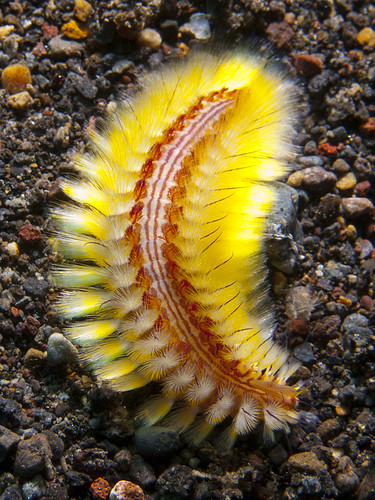
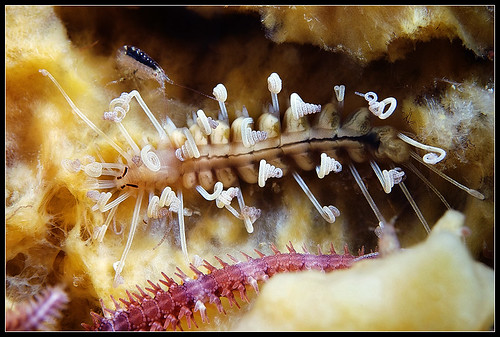
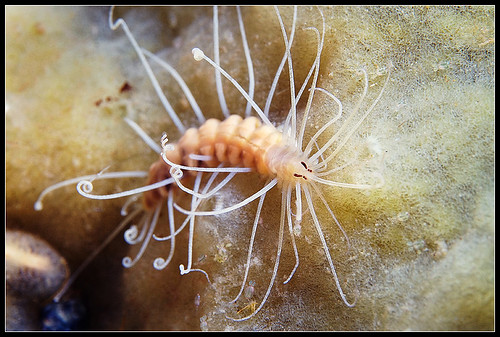
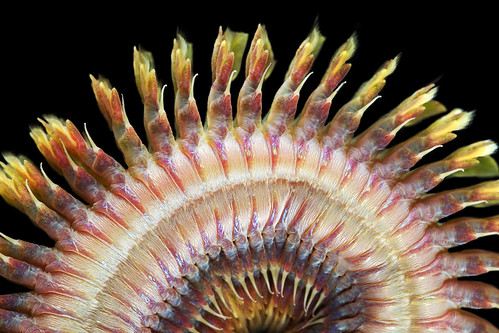
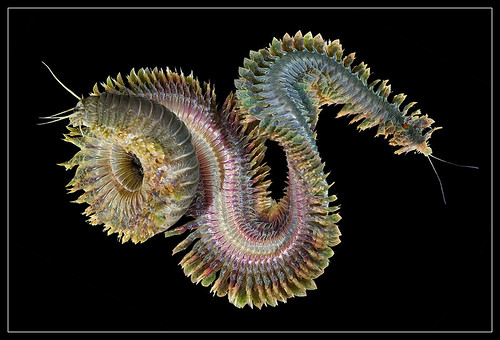
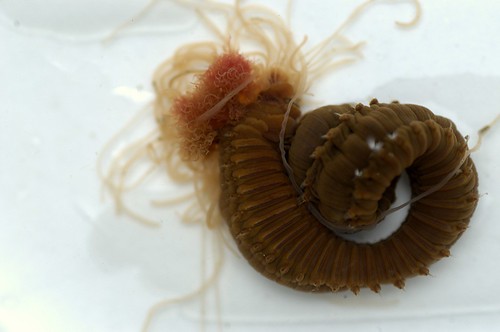
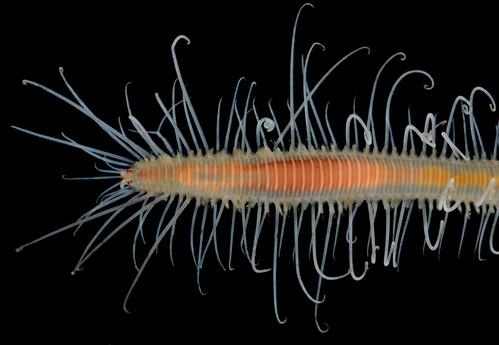
Beautiful polychaete worm (Syllidae)
July 1st, every year is now recognized as INTERNATIONAL POLYCHAETE DAY in honor of long-time and widely loved polychaete worm expert, Dr. Kristian Fauchald's birthday!  Dr. Fauchald passed away in April 2015

Here is a great post on Dr. Fauchald's academic legacy at the museum and beyond...

But the Invertebrate Zoology Department at the National Museum of Natural History honors his life's work with an INTERNATIONAL and MUSEUM wide education celebration of his favorite animals: POLYCHAETES!   If you are in the DC area feel free to visit Ocean Hall or the Q?rius Center to see specimens and displays about polychaete worms!!

Meanwhile, I honor International Polychaete Day with a polychaete worm-themed post!!  Here's the one I wrote up last year that revealed polychaete facts you may not have known!

And don't forget this is a TWITTER thing also!! Hashtag #InternationalPolychaeteDay

Here is the Storify Of International Polychaete Day from Last year!  

Among the points I made? that many polychaetes are actually named for greek nymphs, goddesses and other mythological characters!! Today.. I focus on that topic and share the etymology of some awesome looking polychaete worms!!

5. Aphrodite
Probably one of the first polychaete worms I was able to recognize on sight was this gorgeous animal! Also known as the "sea mouse" the genus Aphrodite described by Linnaeus in 1758 is arguably one of the most distinctive of marine invertebrates.

It is of course named for the famous Greek Goddess of Love, Beauty and Sex. But I suspect what made her name particularly apt, was that she was born from the foam of the sea (aphros).. the complete name Aphrodite means "Risen from the Foam"
Image via Wikipedia: https://en.wikipedia.org/wiki/Aphrodite#/media/File:Sandro_Botticelli_-_La_nascita_di_Venere_-_Google_Art_Project_-_edited.jpg

Its many iridescent bristles and unusual shape have made it one of the more memorable animals to encounter in an Invertebrate Zoology laboratory or field trip. These and the various members of this family (the Aphroditidae) occur primarily in cold-water habitats and can be encountered in a wide range of habitats, from SCUBA diving to bottom trawls in the Antarctic!

And is any animal more deserving of the name? Stunning.
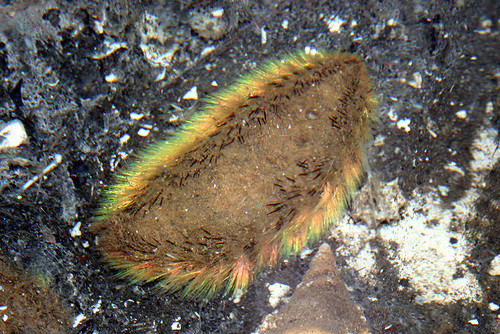
Sea Mouse

4. Chloeia
Perhaps one of the most strikingly beautiful fire worms (a type of polychaete with very inflamatory setae) is named for the female name Chloe. Given that the name was assigned by none other than the famous French naturalist Lamarck in 1818, the name may be in reference to Chloe from the Greek story Daphnis and Chloe

Chloeia is a worm with large, colorful bristles and occurs throughout the tropical Atlantic and Indo-Pacific, certainly the beauty of its namesake!
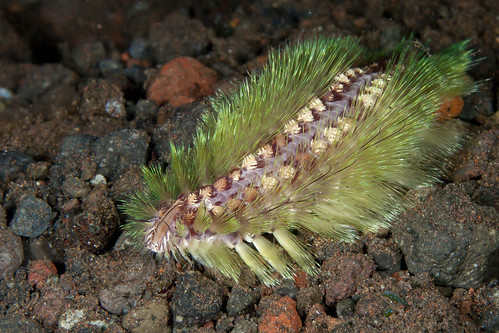
Chloeia sp.
Chloeia flava
Images of  "Chloeia flava" are seen commonly on various image and video websites. Its not clear if these are all correctly identified, but they DO show a wide range of colors and patterns!! 


3. Swima  & Flota
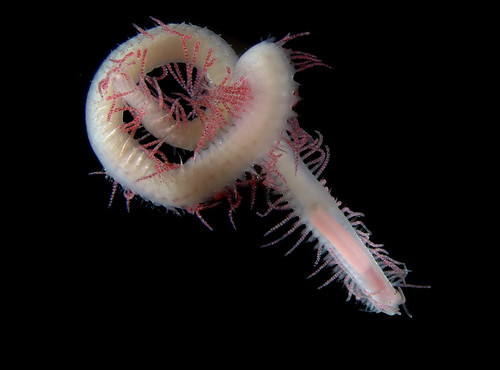
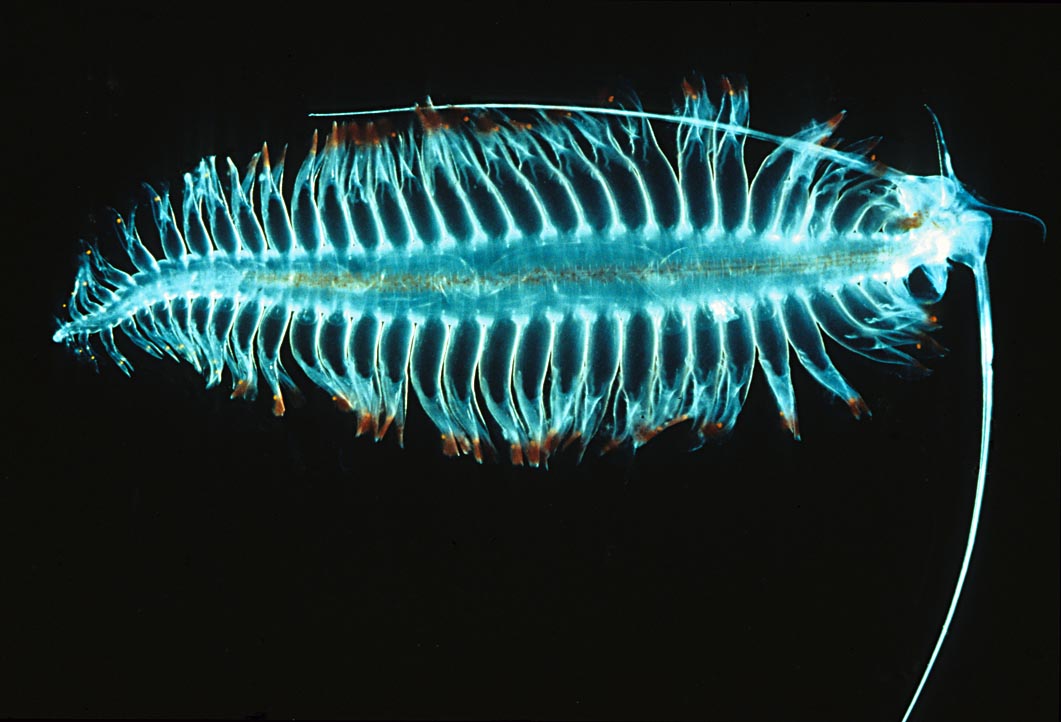
The "truth in advertising" award for polychaetes (in the Accrociridae) goes to these two pelagic worms with names that essentially DESCRIBES their life style! So, for Swima, was named for that species ability to SWIM.

The genus name Flota would seem to similarly suggest "float" in Latin..


There is of course a GREAT story surrounding Swima that you can watch in the MBARI video below but essentially Swima, with one particularly appropriate species, Swima bombaviridis can actually relelase GLOWING BOMB of BIOLUMINESCENCE as a defensive mechanism!(read more here

 You can read MORE about both of them aMBARI's feature story! 
           
We've been seeing SIMILAR types of worms on the Okeanos Explorer dives off Hawaii! I'm honestly not sure which genus we are seeing (or if there's a third? I am simply ignorant of)
Here is one of those swimming Swima worms with some... creative embellishment! THANK YOU Amber Cobley on TWITTER! 
2. Syllis & the Syllidae
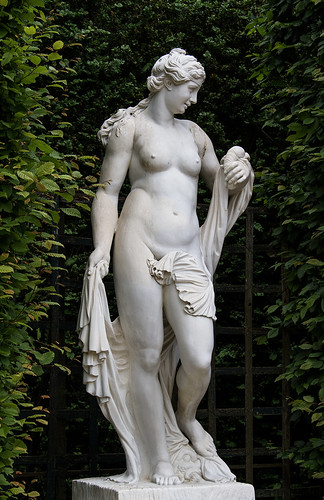
Another bunch of polychaete worms whose name was apparently inspired by a classical mythological nymph is Syllis! Who was a naiad nymph from Greek mythology! (here
Disclaimer: Statue of a generalized classical nymph intended to represent concept and NOT a statue of Syllis! 
Syllis and all of the members of the Syllidae are quite gorgeous polychaete worms and its not hard to see how Marie Savigny and Lamarck saw fit to naming them after a Greek naiad! 
Freek worm
Pterosyllis
Syllis garciae
1. All the Worms named for Kristian Fauchald! 
International Polychaete Day honors Dr. Kristian Fauchald, but EVEN IF the event were to pass, his name has been immortalized into the polychaete literature!! 

Based on a search of the WoRMS database (World Registry of Marine Species), as of this writing, there are approximately FORTY polychaete worms which carry the name "Fauchald"!!

Most are species epithets but there are at least TWO genera, Fauchaldius and Fauchaldonuphis

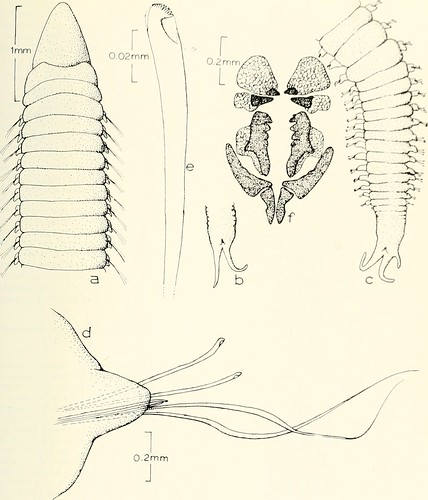
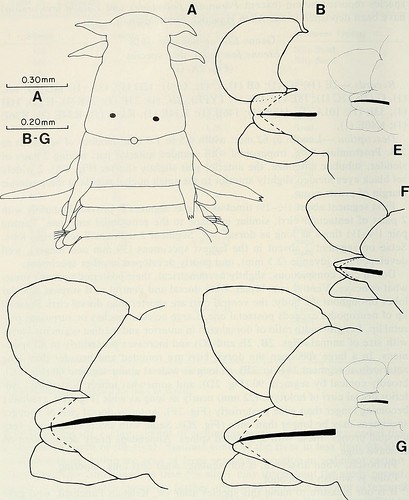
Sadly, I could not locate any living images, but here are diagnostic diagrams of species named for Dr. Fauchald!!

Here for example is Amphisamytha fauchaldi which was a new species of ampharetid (Annelida: Polychaeta) from the hydrothermal vents at Guaymas Basin, Mexico. Over 2000 meter depths! (as one would expect for a hydrothermal vent species). 
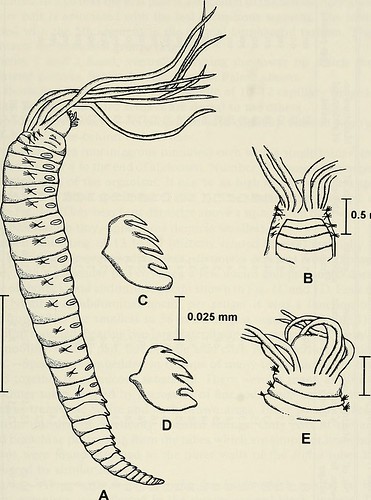
Image from page 42 of "Bulletin" (1971-)
Image from page 294 of "Bulletin" (1971-)
Image from page 15 of "Bulletin" (1971-)

and here's actually ONE of a LIVING specimen!! Sphaerodorium fauchaldi!
Image from the Bergen Museum: From their page on the First International Polychaete Day: http://invertebrate.b.uib.no/2015/06/30/the-1st-international-polychaete-day/

Wednesday, July 15, 2015

Biology we have learned from James Cameron's DeepSea Challenger Expedition!

Image from the Census of Marine life
This week a new paper that I think everyone will be interested in! Remember back in 2012 when filmmaker James Cameron (famous for Terminator 2, Titanic, and Avatar) personally travelled down to the deepest known place on earth (> 10,000 meters!)?

It was in all the papers! There was certainly some good criticism of what was accomplished but many argued that even though Cameron himself did not bring back very much, he did apparently make some collections which were studied by scientists at Scripps Institute of Oceanography in San Diego, California, and as explained by Deep Sea News' Holly Bik even mud from that depth holds the potential for interesting data (here). 

So, here we are now THREE years later and one of the first papers detailing results from Cameron's Expedition has been published!! !

The OPEN ACCESS paper was published just recently in Deep Sea Research in the May 2015 issue, written by Natalya Gallo at Scripps Institution of Oceanography and a host of coauthors, including yes, director James Cameron. 

Cameron famously descended in the one-man submersible, DeepSea Challenger to 10,000 meters where he took some video and grabbed some mud..
I saw him and his team as they stopped in DC on their way up to deposit the sub at Woods Hole Oceanographic awhile back...


This paper by Gallo et al. details not just his dive but ALL of the dives undertaken by the sub during the expedition to the region, including several of the world's deepest trenches, including the New Britain and the Mariana Trench (Challenger Deep).  This totaled seven dives, five general dives and two into the trenches, overall ranging from 884 to 10,908 meters!
Figure 1 from Gallo et al. 2015
Everything was captured on video and these observations are scrutinzed and analyzed!

 What do they report??

1. Organic input was different in the New Britain Trench
In the paper, there is what they call "allochthonous organic input" which is"science speak" for organic external or foreign materials that fall into the deep-sea which was seen more heavily near the New Britain Trench than the other regions sampled.
Figure 4 from Gallo et al. 
In this case: plants and other related material: palm fronds, leaves, sticks, etc. but also carrion or dead animals..  Many of the animals observed interacted with the plant material.. some living on or hiding under..

In contrast, the carrion in the form of bones, etc. contributed food or nutrients to the ecosystem..

I am always keen to remind folks how important what happens at the surface impacts what happens at the deepest depths. Note here at 1000 meters food still falls FROM THE SURFACE.

2. Deep-sea Starfish?
One of the more interesting finds was the observation of these starfish living on bones and woody debris at 8.2 kilometers down! (8200 meters!!)

These were identified as caymanostellids, a weird group of deep-sea starfish which live on wood. No scale was available but known examples of these sea stars are relatively small.

If these are truly from 8.2 kilometer depths, they might be the deepest individuals known for this group! WOO!
I've mentioned the deepest known records of OTHER starfish species here. Some of the deepest records are recorded from 8400 meters! So 8200 meters isn't much of a reach. 

3. Lower abundance & diversity in nutrient poor canyons
Figure 7 from Gallo et al. 

This is the "on the other hand" of the study areas. The New Britain Trench (NBT) at 1000 m was nutrient rich but the Mariana Trench at the nearby Ulithi Atoll region (1100 m) were relatively poor in nutrients.

Correspondingly, the abundance AND diversity of animals observed was much less in the Mariana Trench and Ulithi Atoll regions.

The New Britain Trench site also seemed to demonstrate MORE diversity than the other two studied regions.


4. There is a large and diverse bottom/scavenging community in the New Britain Trench.
 
Figure 10 from Gallo et al. 2015
The New Britain Trench (NBT) seems to be showing a huge diversity relative to the Mariana Trench and this was further seen int terms of scavenging communities such as the amphipods.

Looking at the number of amphipods in each video (per frame) they observed that there was a HUGE difference in the number observed!

Those in the New Britain Trench were MUCH more abundant!

Multiple species were likely present but this assemblage also apparently included the "supergiant" amphipod Alicella gigantea:
Image from the BBC
Sea cucumbers and various crustaceans were also apparently present...

One interesting thing: Absent from ALL the deep localites on this dive?  NO FISH were observed. Its been argued that fish "bottom out" at about 8000 meters and are unable to occur below that.. The observations here seem to be consistent with this data.

5.  Other animal observations.. Potentially new species?? 
Among the few animals observed at depth (from their Figure 9 below) were an odd ulmariid jellyfish (labelled C) as well many other crustaceans (D) which were either mysids or some kind of shrimp like crustacean..
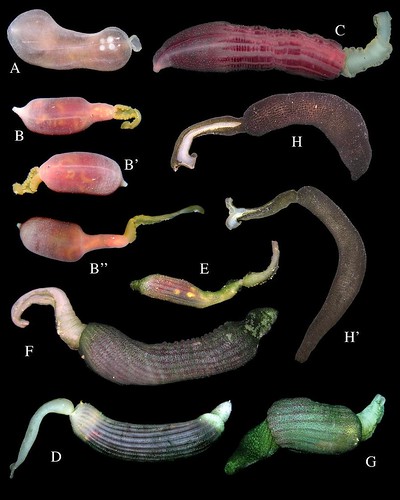
One of the significant discoveries was this "squid worm", a swimming polychaete, likely in the genus Teuthidodrilus from 1 KM down in the New Britain Trench!!  These were originally described from the Philippines. 

5a. The Deepest Known Deuterosotome Known Probably one of the DEEPEST of the critters noted in Gallo et al's paper were, you guessed it! SEA CUCUMBERS.

In the Marianas trench at the deepest depth (10,900 meters!) they observed sea cucumbers oriented into the current, which is consistent with behavior seen in deep-sea sea cucumbers like sea pigs  

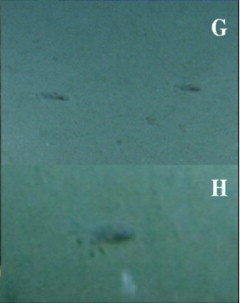
The animals observed from the deepest point were only tentatively identified as members of the family Elpidiidae (Fig. 10 on the right G & H). They indicate these might possibly have been Peniagone sp.  (Note Peniagone below is only for representative purposes and was NOT from Gallo et al.'s paper!)
Peniagone islandica from EOL

Previously, the deepest known sea cucumber was Myriotrochus brunni which was collected from 10,710 meters in the Mariana Trench.

However, the account by Gallo et al. for the elpidiid sea cucumbers (their Fig. 10, G, H) are from 10,900 meters!! Which yes, makes them the DEEPEST known deuterostome animal!!  (and certainly the deepest known echinoderm!!)

Wednesday, July 1, 2015

Five Things you Probably Didn't Know about Polychaetes! #PolychaeteDay

Polychaete worm
This week I celebrate International Polychaete Day which falls on July 1, the birthday of noted polychaete expert Kristian Fauchald, recently of the Smithsonian's NMNH, who passed away in April of this year (2015).


What are polychaete worms? 
Polychaetes are segmented worms, which are distinguished by their leg like structures called parapodia, which each bear distinct bristles (hair-like structures) known as chaetae which are composed of chitin (the material found in arthropod skeletons).
Alitta virens puziko 2
In the traditional sense, polychaetes are usually classified with earthworms and leeches.  But more recent molecular phylogenetic studies have shown that the "Polychaeta" is actually a big messy group that likely includes groups of worms which, at one time might actually have been classified as separate phyla !
This includes spoon worms (echiurans)
Eastern Pacific echiurans or spoon worms
and peanut worms (sipunculans)
Phasocolosoma agassizii, Agassizi's Peanut Worm
How many are there and where do they live? 
Its thought that there are likely over 13,000 species of polychaetes which live in every ocean and at every depth (intertidal to >7000 m abyssal depths) and indeed a small proportion of them (about 168 species) even live in freshwater. The diversity of polychaetes is stunning. Those 13,000 species reside within 80 families!!

As I've shown in photo essays here (by Arthur Anker), they can be STUNNINGLY beautiful!

and some, such as these forms from Antarctica can be quite huge.

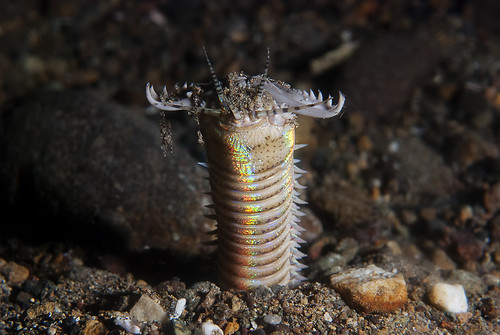
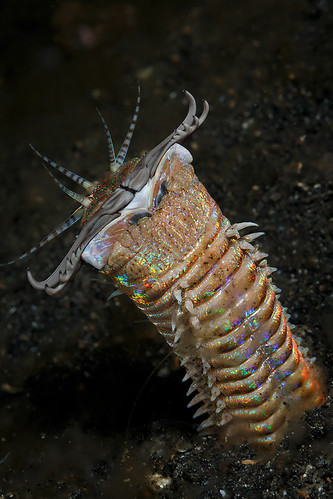
Feeding ranges from deposit feeding on sediment, filter feeding to of course, raptorial predation which has been made famous by the Indo-Pacific Bobbit Worm! (Eunice sp. )
Rise of the bobbitworm! (Eunice aphroditois)
So, here's five subjective things about polychaetes for IPD!!!

1.  Eat the Palolo Worm! Out in Guam and the Solomon Islands, there are several island cultures who are privileged to be around swimming polychaetes during their reproductive periods, where they undergo a stage/morphological transformation known as epitoky.
The worms swim up into the water column en masse as seen here..
                            
These worms are then promptly eaten by the locals. There are many accounts of this, such as here on National Geographic Palolo worm is considered quite the delicacy and is apparently very reminiscent of caviar and is served here on toast. A traditional presentation.
From MrLavalava's blog!
2. Polychaetes that glow in the dark! 
                            
What would any group of invertebrates be without at least a FEW members that glow in the dark??? (i.e., emit bioluminescence?)

I actually found two: this one is the "Bahamas Glow Worm" aka Odontosyllis enopla. This species looks like a more conventional polychaete

And then you also have the pelagic (aka swimming) polychaete, Tomopteris! which is a bit more unusual given its habitat (the water column)
Image from Wikipedia! 
3. They have a fossil record dating back to the Cambrian
All of the major invertebrate groups can usually be traced back to the very earliest moments in Earth's history when the first evidence of life appears. Polychaetes are no exception.

This pic shows what is thought to be a Cambrian polychaete from the famous Burgess Shale in Canada. It is  appropriately enough called Canadia spinosa
From the Smithsonian's Paleobiology-Cambrian Page! 
The Royal Ontario Museum has a fairly detailed page on this animal here including some nifty paleo art showing what the animal might have looked like alive..
There were apparently a few of these Cambrian polychaetes, including Burgessochaeta,  Phragmochaeta and others..  These were thought to have paddles and interpreted as having the ability to swim. Length: 2-4 cm, so some tiny beasts. 


4. Many polychaete species live in close relationships with other animals
The most photogenic polychaetes might be large predatory ones or possibly even the colorful Christmas tree worms..but there are many polychaetes with a cryptic lifestyle which includes living as a "guest" on other, larger animals.

Sometimes with strong relationships than had been surmised. I wrote about the scale worm Arctonoe vittata a few years ago.  These worms live within the tube foot groove and along the underside of the leather star, Dermasterias imbricata on the Pacific North West coast. 

In experiments, not only did the worms move to the sea stars when separated, but the seastars moved toward the worms! 
Photo by Paul Norwood-from iNaturalist
Scale worms are very dedicated commensals to their hosts.. As I reported from my time in Japan, these stayed with their host, a solasterid until death...


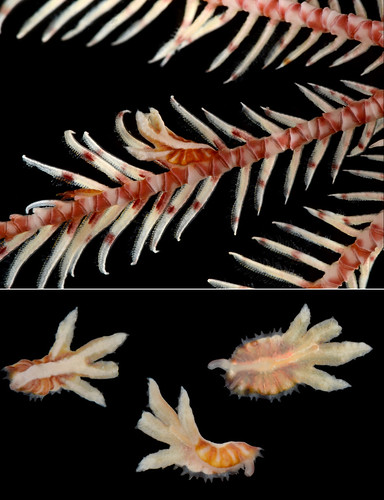
Polychaete worms sometimes have highly specialized relationships. Here are a group of worms known as myzostomes, which are parasites on crinoids. and apparently have been parasitic on crinoids since the Jurassic! (Here
Myzostome 1
5. Many polychaete names are derived from greek mythology: nereids (nymphs) and goddesses!
A comparison of the names of various nereids (sea nymphs or female water spirits) shows that there are in fact a LOT of them shared by a host of polychaete worms..
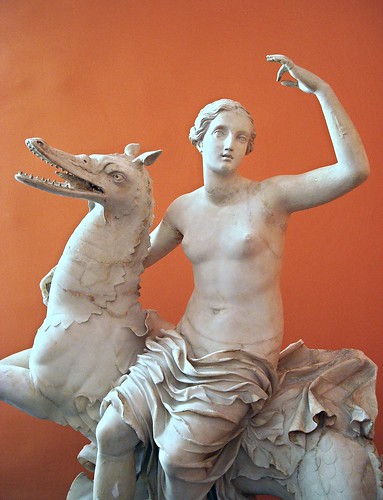
"Nereid on Ketos" from "Pausilypon" in Naples - beginning 1st century AD - Naples Archaeological Museum - "Augustus and Campania" - Exhibition at Archaeological Museum of Naples, until May 4, 2015
Everything from the genus for the "Bobbit Worm" Eunice sp.
Jack in the box Bobbit Worm
to Nereis which is itself, the Greek word for the water god Nereus
The Worm
Amphitrite, Goddess of the Seas...
Amphitrite
and her terebellid namesake..
DSC_8341
While I'm not privy to the original etymology of these names, its not unusual for the original scientists to name organisms which they perceived as beautiful with namesakes which befitted them...

Happy International Polychaete Day!