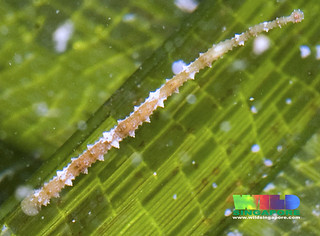
Showing posts with label worms. Show all posts

Wednesday, January 22, 2014

Worms & Snails that Live On/In Sea Cucumbers!

There's something about sea cucumbers which seems to make them attractive as hosts for various other animals.
Some sea cucumbers got clams that live in their throat...
The sea cucumber anal region seems to be popular as a place to live as crabs and of course, pearlfish find good homes there..

This week.. More animals that have made sea cucumbers hosts to their lives!!

Worms!
This scale worm above was identified as Gastrolepidia clavigera, living on its host sea cucumber (apparently Bohadschia graeffei). Image by Arne Kuilman.

This one by Theresa Legler, shows another polynoid worm, but it looks like a different genus/species...

Another similar looking polynoid. Image by Kevin Lee.

This one, by Ben Naden,  seems to be taking advantage of the rough skin texture...


Snails! Most of the snails shown here appear to be members of the Eulimidae, which are a diverse group of snails, which has apparently adapted a parasitic lifestyle. Many of them live on echinoderms. I review some of them here.  

Eulimids basically feed on their hosts. They have a proboscis which is inserted into the bodywall and used to suck out precious bodily fluids and other nutrients!

Here's a neat pic by Eunice Khoo showing several embedded in the epidermis.


A different kind of snail, Melanella sp. living on the sea cucumber Thelenota ananais.


Images below by "wj", what looks to be another set of eulimid snails, feeding on the sea cucumber Colochirus.


and let us not forget that eulimid snails (in this case-the genus StilapexALSO inhabit deep-sea sea cucumbers... (from the sea pig post)
(from the New Zealand R/V Tangaroa weekly log, photo cred-Stefano Schiaparelli, NZ IPY-CAML) 
What makes Sea Cucumbers such desirable housing?  While there's no immediately clear data on the topic, it seems to be important that sea cucumbers are all composed of a soft, edible yet durable, tissue. So, maybe a good house that these protects and feeds?

Tuesday, October 29, 2013

5 Worms that will give you the creeps! Happy Halloween!

WHY DO WORMS GIVE US THE CREEPS??
The "worm" body plan is a successful one. A head. Bilateral symmetry. Long body. That makes a lot of sense. The head takes the lead and you've got a long, slender body which facilitates success for moving through crevices and such. This has been thought by some to be the body plan for the very first metazoan predators (although not all with the body plan are predators).
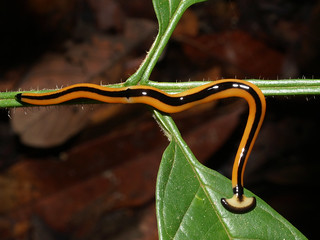
Land Planarian
Image by Divaholic
There's versatility in feeding and life modes... and the body plan is observed in multiple PHYLA (major grouping) of animals (e.g., annelids, flatworms, etc) and even in other groups which don't primarily have a "worm" like body plan (e.g., aplacophorans in molluscs, sea cucumbers in echinoderms, snakes in vertebrates).

Curiously, there's something ABOUT animals with this body shape that seems to freak people out.


Is it the body shape? Something left over from our "metazoan" brain from a LONG time ago?

People hate snakes. They always use 'mealworms" (actually beetle larvae) on monster and horror films and TV (totally harmless btw).   Heck, earthworms are HARMLESS (at least to people) and you can still totally squick most people out by dangling one in front of them!
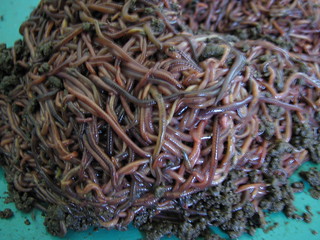
monster worm ball
Image by Mely-o
So what if we looked at worms that are actually PREDATORS? That feed on prey in really graphic ways??

Its Halloween week! Here's FIVE disturbing predatory worms! 

Imagining ANY of these as human sized or above would be cause for alarm!


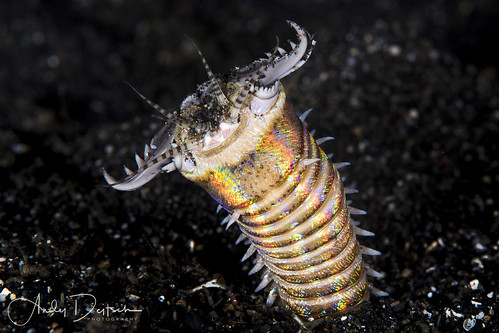
1. Bobbit Worm-Raptorial Predator!

Bobbit Worm
Lets start with an easy one.  By this point, a LOT of people know about Bobbit Worms. I've written about them before.

Short version: Tropical, shallow-water predators.  Up to 6 or more FEET long. They lie in wait and pounce on prey with their spring-loaded jaws. They feed on fish and other vertebrates!
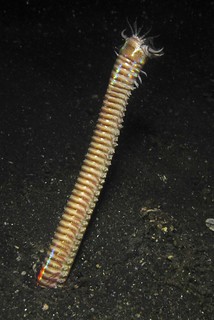
Bobbit worm stretch
Image by MerMate
There's plenty of video... but here's a nice one...


So, I know 46 year old men who STILL get freaked out by Bobbit Worms. Even after all the reassurances and graphic photo evidence PLUS the knowledge that they will never go SCUBA diving in the tropical Pacific!!

Wanna see WORSE than the Bobbit worm?? Let's GO!

2. Ribbon Worms-Long distance Death!
Worms dining on a fish head

Ribbon worms, also known as Nemerteans, are an obscure phylum of worms that are similar in appearance to flatworms (below) BUT one of the big differences is that Ribbon Worms possess a CRAZY long proboscis!

Basically the proboscis is an extended feeding structure used for a FAST grab which in some cases, extends easily 100% of the worms body LENGTH! 

Ribbon worms really need to be seen to be appreciated. So here's some video!

A terrestrial species....


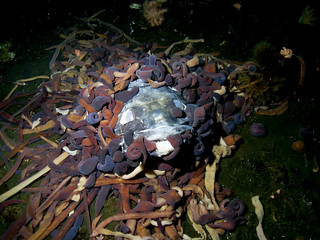
But not all nemerteans are small, cryptic beasts. Some species, such as the Antarctic Parborlasia are HUGE. I wrote about them in this post about Weird Antarctic Invertebrates. They are upwards of THREE FEET LONG. And are about as wide around as a garden hose!
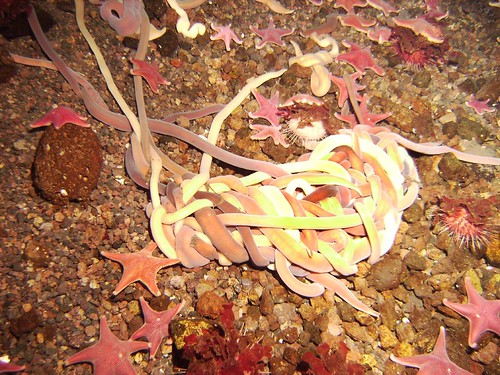
Worm snarl
Image by Icy_Sea_Slugs
and they EAT everything. In both the picture above and the one near the top, there's a dead fish under all those worms!

Ribbon worms are CRAZY abundant and are almost certainly important to the ecosystems they inhabit but they're often difficult to find...

3. Marine Flatworms! Eating from the inside out
Image from this website on introduced Netherlands invertebrates
Feeding in this worm, is to put it mildly, HORRIFIC.  The marine Euplana gracilis is a flatworm that consumes its prey by LITERALLY sucking out its guts, while the prey is still ALIVE! 
I'll let the video's author comment:
In this video, Euplana attacks a shrimp-like amphipod by wrapping around its back and completely immobilizing it. Sticking its tube-like pharynx through a segment of the amphipod, the flatworm then consumes and digests its internals--a process that takes about half an hour. Once finished, it abandons the empty carcass and goes into a resting period until its next meal. On the outside, an amphipod that's been eaten doesn't look that different from a normal amphipod...except for the fact that it's, well, dead.
Videographer: Dean Janiak (Smithsonian Environmental Research Center Benthic Ecologist)

4. LAND Flatworms! Eat em' while they're alive!
Flatworms that live on the land are seen uncommonly but they're there. And they are mean, vicious predators. I wouldn't have known or even thought to think that, but here we go...

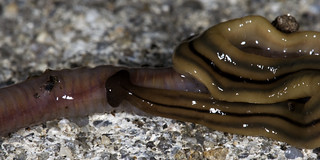
Here is Bipalium, a widely known genus of terrestrial flatworm. Originally from Asia, they've since been introduced all over the world. In their natural habitat, they have these really gorgeous, bright colors....
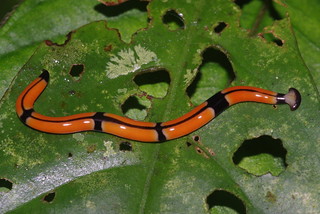
Land planarian (Bipalium sp.)
image by pbertner
Bipalium feeds on earthworms, so much so that they will inspire an immediate escape response whenever they are put in contact with one (see the video below).

Ever see an earthworm literally JUMP in sheer terror? Watch this...


Here's the feeding dance blow by blow...  The worm's head approaches the worm and applies digestive enzymes. It physically begins digesting its prey WHILE THE PREY IS ALIVE...
Planarian Dissolves Its Earthworm Meal
Image by Amuderick
It digests its meal as a dissolved earthworm milkshake...
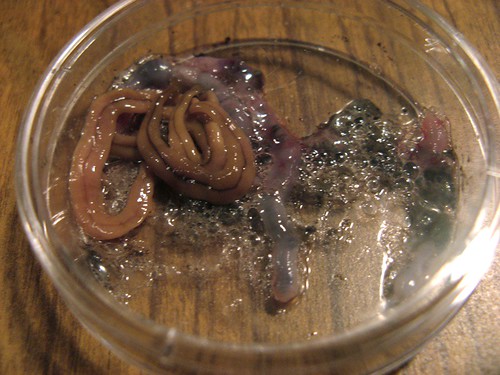
Ewwww!
Image by Cornell Fungi
BUT its not just the one to one predation which is a concern. TOO many of these predatory land flatworms can actually affect the large-scale ECOLOGY of a region if they devour all the earthworms!

As summarized nicely in the video. No earthworms?  No aeration of the soil. No crops.
Flatworms: An Invasive Flatworm Hunts Earthworms from Shape of Life on Vimeo.

5. LEECHES! 
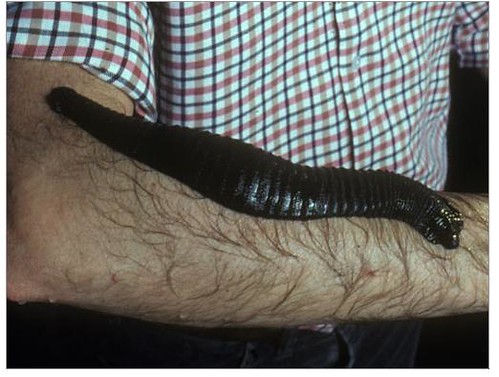
giant amazon leech
Image by uezane
There's marine leeches, terrestrial leeches and of course, freshwater leeches such as the Giant Amazon Leech pictured above! It reaches a length of frakking 18 inches long!!  and feed on mammals that happen to stop by to drink...

While many leeches do the blood sucking thing- others are purely predatory, feeding on earthworms and other comparably sized animals.  Here is a pretty amazing pic of a leech eating a tiny toad! 

Here's some marine leeches!   One from Lembeh, Indonesia.
marine Leech - Lembeh
Image by Christian Loader
and another from Singapore
Unidentified animal: fish leech?
Image by Ria Tan and Wild Singapore! 
Honorable Mention to Whale Worms!
When I say "whale worms" No, I don't mean, yet another post about Osedax, I mean worms that live IN the INTESTINES OF WHALES! (and other cetaceans)
thanks to Miriam for letting me borrow her pic to the Tokyo Tapeworm Museum & fr providing scale
As a tantalizing and horrifying tip, the tapeworm that parasitizes a whale's intestine has SIX sets of reproductive organs and is over 30 METERS (90 FEET) LONG! 

But that's for another day....


Wednesday, December 19, 2012

Biodiversity Spotlight on: The NMNH Invertebrate Zoology Department!

This week a departure from the weekly echinoblogging to spotlight some people behind the biodiversity of marine invertebrates! (although that is a very photogenic Protoreaster lincki on the cover!)

A few weeks ago Ward Appeltans, who was the project manager for the massive World Registry of Marine Species database (here) collected and presented 121 contributors of various marine species, including some plants, protozoans and chromistans, fungi, some chordates and a WHOLE bunch of invertebrates!
The link to the paper is here. I believe it is open access until January 2013.

There are a lot of digests and news articles about this including these:
Natureblog
Discovery News
Phys.org
e!Science News

But of course in a "big picture" treatment, one often lacks some detail so I thought I would spotlight a department with which I was most familiar:  Invertebrate Zoology at the National Museum of Natural History!
Department of Invertebrate Zoology
Eight out of the 121 contributors of the paper (that's about 6%) are residents/associates/employees of  the Invertebrate Zoology Dept. at the National Museum of Natural History!!(part of the Smithsonian Institution)
Top: Jon Norenburg (worms), Dennis Opresko (antipatharians aka black corals), Stephen Cairns (scleractinians and gorgonians)
Middle: Rafael Lemaitre (anomuran crabs), Kristian Fauchald (polychaetes)
Lower: T. Chad Walter (copepods), Marilyn Schotte (isopods)
Bottom: Me (starfish)
6 % may not seem like a lot, but it is the largest contribution of the 95 different organizations which participated.  Only the Dept. of Marine Zoology at the Naturalis Biodiversity Center in the Netherlands had the 2nd highest number of contributors (n=7)

A look at the number of records modified per taxonomic editor below. Several of the largest contributors are persons from the NMNH!
This graph from the WoRMS statistics page
Among the names and numbers!
Chris Mah with 6,060
Marilyn Schotte with 14, 384
Chad Walter with 27, 508
and Kristian Fauchald with a whopping 36, 480 records!!

Here's which Marine Invertebrate Databases and/or taxa they oversee..

Kristian Fauchald (lead editor: Geoff Read): World Polychaeta Database and Twitter: @WPolyDB
Chad Walter (with Geoff Boxshall): World of Copepod Database! 
Dennis Opresko: WoRMS-the Antipatharia (black corals)
Chris Mah:  World Asteroidea Database (starfishes and sea stars)

Some Neat Factoids about the NMNH Invertebrate Zoology Dept.

  • The Collection includes a representative of every recognized animal phylum, including the two most recently recognized-the Loricifera and the Cycliophora! 
  • You can always check the holdings by going to the online catalog here! 
  • The dept. has over ONE MILLION cataloged specimens in its database! 
  • IZ oversees one of, if not the largest collection of Antarctic invertebrates in North America. Here is the USARP page!
  • IZ currently hosts 10 active on-staff research zoologists whose interests range from deep-sea cucumbers, freshwater mollusks, midwater polychaete worms, to barcoding and understanding tropical biodiversity.
  • Go Check out the IZ Twitter page:  @InvertebratesDC

Tuesday, February 21, 2012

What can the Internet do for Biodiversity? Let's study COMMENSALS!! Some biology can't be studied from samples!

Hostess with the Mostest
(photo by MerMate)
The Internet is amazing!

But often one gets the impression that a lot of people haven't quite realized the potential for discovery.
What can something as simple as humble as a photostream or video channel do for science?

Especially for something like exploring biodiversity? For looking at the many different kinds of animals -some that have yet to be discovered?

What makes the Internet so potentially important is YOU. Everyone out there. A nearly infinite amount of eyes, cameras, videos, talent, and interest.

What does that mean? That means that some people have the good (nay excellent!) graces to take pictures (and/or videos) of moments and/or species in places that many scientists just aren't or can't be. I believe the buzzword is "crowd sourcing".

Sources like Flickr and YouTube thus become great treasure troves of potential discoveries.  Moments and relationships caught of the live animals doing their thing!

So, today I thought I would use some videos and images to demonstrate some commensal relationships between sea stars/starfish) that most people don't often see because they are best seen in the wild when the animals are left to their own devices.

........But then, some incredible individual took a picture or video of it!

And in conjunction with a little bit of narrative (on my part) there is another layer of appreciation of these images as more than just aesthetically pleasing-but a representation of something in nature that everyone can enjoy. GO!

1. Fish Living commensally among the oreasterid Protoreaster nodosus


This video was exciting! I'd never heard of fish living in and around asteroids and have yet to discover prior accounts.

Was this unique or does it happen all the time? Are fish juveniles tied to sea stars? Is this important to their life cycle?

Note also the tiny little brittle stars living on the spines! Probably Ophiactis savignyi-a species of ophiuroid that may literally live everywhere!
Cool star 2 (photo by Mermate)

2. The benthic ctenophore Coeloplana living on the surface of Echinaster luzonicus
Benthic ctenophores on Echniaster  luzonicus (Coeloplana astericola)
(photo by Arne Kuilman)

So, what are these?

Ctenophores are usually found swimming in the water column like this (intro to the group in the video)

But some of the really WEIRD ones live on tropical bottoms and look like this.. (note the feeding tentacles emerging out of the two top "lobes")

But some of these benthic ctenophores are these worm-like forms and they actually live ON sea stars, such as this Echinaster luzonicusBenthic combjelly on Luzon seastar  (Coeloplana astericola)
(photo by Arne Kuilman via Flickr)
I don't know if they are necessarily rare..but people don't see them often. They can be difficult to see and who thinks to look for what is basically a bottom-living jellyfish??

On top of all this- the benthic ctenophores themselves almost never preserve well. So scientists have relativelly little data on them. When I learned about these in Invertebrate Zoology way back when, there was only a footnote about these critters.


If we were lucky-we MIGHT see one in our lifetime. Now-everyone can!
Parasitic flatworms Hostess with the Mostest
(photo by "MerMate" on Flickr)
Here's one close up..

Sea Star (Starfish) Rider
(photo by Mark Atwell via Flickr)

3. This looks like a polychaete and/or a flatworm living on another specimen of what looks like Echinaster luzonicus (Taiwan? or the Philippines?)
2010_0703_100935
(photo by Star Tsai via Flickr)

4. And finally,the shrimp Periclimenes that lives in and around various big tropical sea stars.

They're all called P. soror in the pictures but there seem to be so many-I'm not entirely sure its the same species.. But here's a bunch...

This one living on the ophidiasterid Linckia laevigata in Komodo, IndonesiaSoror Shrimp on Blue Starfish (photo by Fiona Ayerst)
this one on the Crown of Thorns-Acanthaster planci..4113 Commensal shrimp on crown-of- thorns

(photo by Diver Ken)
Periclimenes soror on Acanthaster ellisii
(photo by Olin Feuerbacher)
This one looks like a shrimp living in/around the uncommon oreasterid Halityle regularis
Pin Cushion Star and Periclemenes Shrimp
(photo by Shaun-in-Munich)
On/around the mouth of a "cushion star" so..Culcita?Shrimp On Cushion
(photo by pummkin)
In and around Echinaster luzonicus (oreasterids aren't the only ones with shrimp!)Who's the star?

(photo by MerMate)

If you had collected any of these shrimp without the asteroid (or vice versa) it would have been difficult to make the animal-animal association. What function do the shrimp serve? What do they get out of it? Protection?

These images may seem just like holiday snaps-but to some scientist-they may demonstrate some new species/behavior/relationship!

So, if you're in some exotic part of the world and have some weird, neat picture that you've never seen before let a biologist who knows a thing or two-take a look! You never do know...

And uh... for those with more...mercantile motivation, scientists don't do it for the money (and mostly don't have a lot to give away).