Showing posts with label halloween. Show all posts

Wednesday, October 21, 2015

Japanese Invertebrates, Spirits & Monsters! Animals that inspire yokai (妖怪) & more!

Its October! Which means we are around the corner from Halloween! Many of you have seen how I have expressed a strong interest in Japanese science fiction and pop culture.  One of my starfish has even been made into a toy! 

My research over the last few years has taken me not only to Japan but also gotten me interested in the nomenclature of various Japanese starfish species!!

Although many of these are essentially common names, they are surprisingly standardized and are widely recognized in addition to the western Latin names.  While studying these I also encountered a few other cool stories about invertebrates which have been part of Japanese folklore and myth.

So this week: The Invertebrate-Japanese folklore connection! Names & monsters/spirits inspired by invertebrates!!

I thank Matt Alt of AltJapan and Dr. Toshihiko Fujita of the National Museum of Nature & Science for providing me with some of the the information in today's post!

1. The Oni Hitode
  So, the term yokai (妖怪) refers to a spirit or ghost , most of which have a strong root in Japanese folklore and myth. There are a great MANY types, some of which are listed here and Wikipedia of course!  Perhaps one of the types of yokai which I see popularly presented in pop culture and literature and in some Western sources is a demon called an Oni, of which one face is represented below...
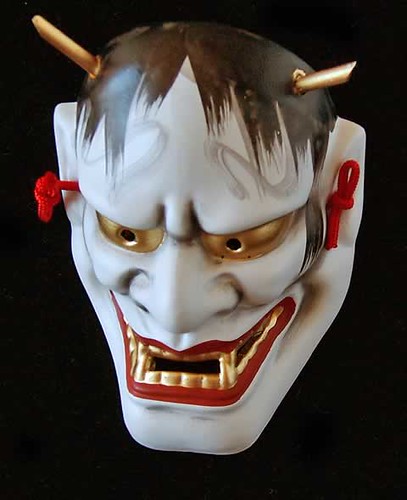
Oni Mask
The spines on the head are a characteristic feature of this yokai. Its this characteristic which has most likely been lent to Acanthaster planci,  the crown of thorns starfish which is known in Japanese as the Oni Hitode or "Demon starfish" 鬼ヒトデ
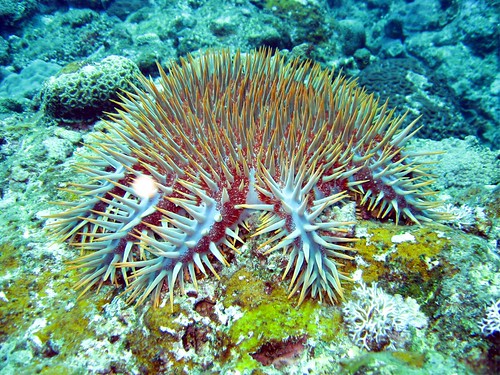
Crown of Thorns
Here's another kawaii I found of the Oni-hitode, which from what I understand was part of a"Kill the crown of thorn starfish" campaign. Acanthaster planci, is a fairly well known predator of coral and has been undergoing massive population booms leading to frequent efforts to remove them.
From this Japanese site 
And of course, the inevitable transformation of the crown of thorns starfish into a kaijin or "human sized" monster to be defeated by a snorkel-adorned Kamen Rider! 

2. Higuruma Hitode (or not?)
Another cool Japanese starfish name is one this deep-sea brisingid starfish, Brisingaster robillardi.

I've described brisingid sea stars at length here. Deep-sea species which feed on prey in water currents using "velcro" (tiny claws) on their spines. More great images of these animals here.

The common name for this species is called the Higuruma Hitode which sounds GREAT! Hitode is Japanese for starfish. But What is a "Higuruma"??

Higuruma is apparently one name for a ghost/yokai called Kasha (whose name apparently translates to "flaming chariot" who carts the corpses of sinners off to the underworld (thanks to Matt Alt for this info). I suppose in this case the "corpses of sinners" are represented by small crustacean prey! Muahaha!

The resemblance between the flames (the arms) emerging from the wheel  (the disk) is how this starfish was likely named! Pretty neat!
Image from Dr. Fujita
To give you a better idea, here is a very similar "fire wheel" type yokai called Wanyudo, which translates to "wheel monk" and who apparently steals the souls of those who gaze upon it. Apparently many yokai can be similar in appearance

It also shows the "flames from wheel" appearance that this starfish takes after...
Image via the Yokai Attack! FB group
Interestingly, Higuruma hitode was actually assigned to a similar species called Novodinia pacifica so perhaps Brisingaster robillardi  should be referred to as a Wanyudo hitode or perhaps a Kasha hitode??


3. The Sazae-oni aka the "Snail Ogre" 栄螺鬼
This yokai is apparently one of the more malevolent ones and according to Yokai.com is a dangerous spirt that pretends to be a beautiful drowning woman in order to lure and feed on sailors.

There's a whole mythology about these yokai which involves pirates and monsters biting off their testicles.  You can read the colorful version here. 
Image by Toriyama Sekien via wikipedia and also this Japanese site
These yokai are actually based on horned turban snails, Turbo cornutus which look like this
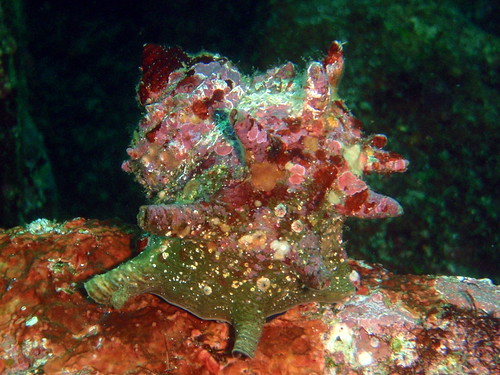
#791 horned turban (サザエ)
These snails in Japan are called sazae (hence the name "snail demon"and are eaten throughout Japan, often grilled in their own shell
Sazae being grilled in IH Cooking Heater

This species of snail is widely familiar to the Japanese and was even made into a kaiju called Gogo in the show Ultra Q, the precursor to Ultraman!

4. Hekigani ヘイケガニ The "samurai crabs"(the crab Heikeopsis japonica)
This "ghost" is actually more of a ghost story. It basically relates the story of this crab, Hekeopsis japonica which often have a very human-like face on their carapace (i.e., the top side of the skeleton).
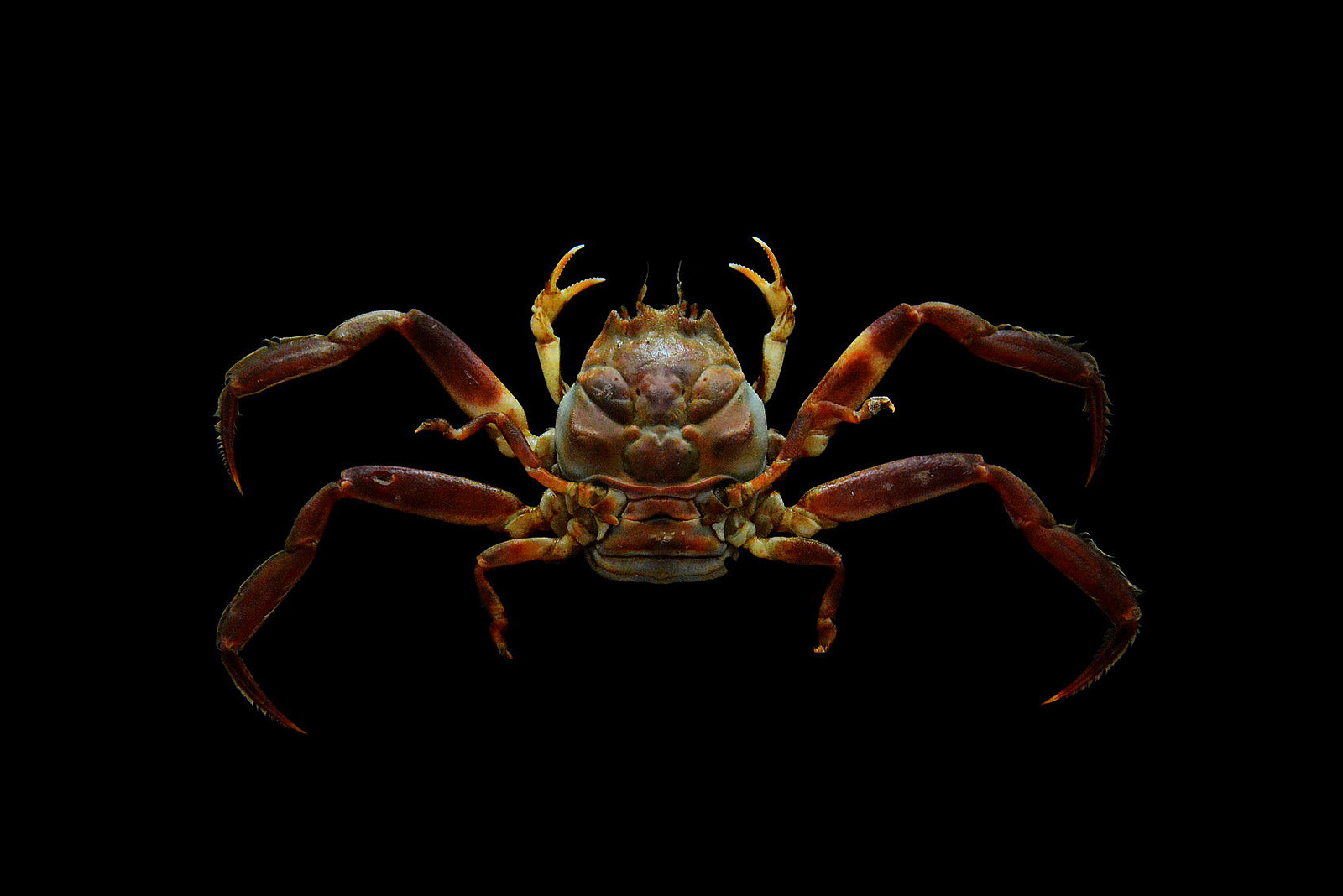
Heikegani 日本平家蟹
This species is referred to as the "samurai crab"?   Why? The "faces" on these crabs (actually the fine morphology of the carapace) have been thought to be the reincarnations of Japanese Heikie warriors defeated at the Battle of Dan-no-ura as told in The Tale of the Heike. Wikipedia has a nice summary of this event.

But here's a gorgeous painting which shows this event in various stages..
Image by Utagawa Kuniyoshi via Wikipedia
This crab species was also made famous by Carl Sagan who discussed them as an example of inadvertent character selection on Cosmos. You can watch this segment here


4a. The Kani-Oni: DEMON CRAB!! 
While doing research for this post I came across this creature, the Kani oni! aka the Crab Demon.   I couldn't find out much about it, but I did realize one thing..
 Thereare only THREE pairs of legs per side.  This is a characteristic feature of lithod crabs, which are actually more closely related to hermit crabs. "Proper crabs" such as the Japanese spider crabs have 4 legs on each side. 

But this species is very similar to this species, Lithodes aequispina (unconfirmed ID). Thus, the ghost crab does seem to be something in the Lithodidae. 
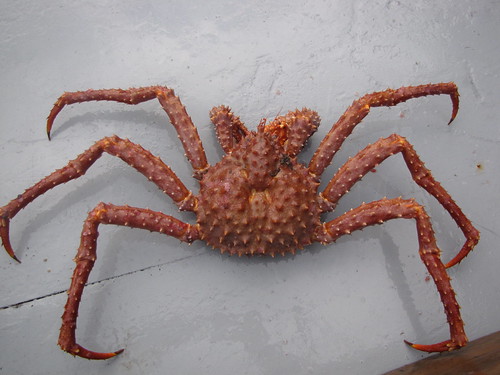
Golden King Crab (Lithodes aequispina)
The spines on the crab might allude to another species of lithode crab which has bigger and more prominent spines on the carapace, such as this one.
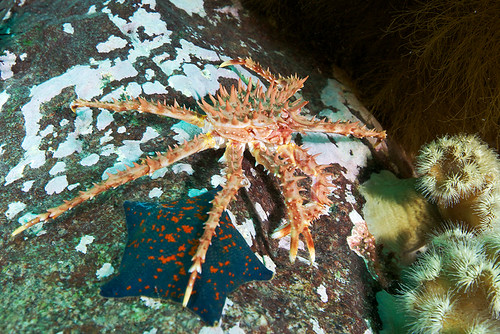
Paralithodes camtschaticus 5

5. The Umibōzu 海坊主
So this particular ghost isn't actually based on an invertebrate..but it gets honorable mention..

The name Umibozu translates to "Ocean or Sea, Buddhist Monk" and have been explained as the ghosts of drowned buddhist monks.  They are apparently haunted spirits of the ocean and mentioning their name invokes bad luck for ships at sea.
From all the accounts that I could find, there are apparently different "morphotypes" of what Umibozu look like with some images looking a bit more of a human shape...

The Umibozu tend to be rarely seen and considered somewhat mysterious..

I happened to notice a curious coincidence between these and Opisthoteuthis, aka one of the "dumbo octopuses"! But nah.. the umibozu are FAR more menacing! 

NEXT WEEK: NUDIBRANCHS!

Tuesday, October 28, 2014

Five Invertebrates that would be Terrifying if they were Bigger!

The secret of the big terrifying jaws is #1 below! 
HALLOWEEN! Every year, I like to use the season's festive theme to try and highlight some cool invertebrate diversity! Last year I did an overview of creepy worms and the year before that, I did an overview of spooky things that echinoderms (my research focus & subject of this blog's love) are known to do. 

So, note that I actually am using REAL aspects of these animal's biology that make them, creepy, terrifying, spooky, whatever. Unlike SOME places.. I won't just find some weird looking, random animal and just SAY its spooky or creepy. It actually HAS to do something worthy of the name!

This year: a theme that often comes up with invertebrates: Predators that would be terrifying if they were larger!! 

So, this is a pretty popular trope and frankly, there are ALREADY a bunch of huge, oversized marine invertebrates that freak people out. You will doubtlessly see some tweets about those beasts this week.

Here are some of my picks for invertebrate PREDATORS that to me, have earned the RIGHT to be optioned for movie rights! or other fantastic treatment!  So, nothing that is weird looking but harmless (I mean, c'mon, BASKING SHARKS? SHREWS?)

There were MANY to choose from of course and so perhaps next year I'll present more of them. But for now, here's some good ones.....

5. Arrow Worms (phylum Chaetognatha)
Imagine the oceans filled with fast-swimming, transparent worms with sharp spines for teeth on their head, and which can effectively "see" in a 360 degree field of view AND attack and devour prey several times their own size.

Bodies are transparent and with unusual "eyes" that are arrayed in 5 directions, essentially giving them a full field view (360 degrees). Fortunately, these "eyes" lack lenses and are thought primarily to be used for orienting to light and dark.
They feed with these big nasty hooks that emerge off the front of the head!!  Some are even known to do so with venoms like tetrodotoxin, the potent toxin from puffer fish.

Arrow worms have been documented as having capture prey several times their size...like fish!
Here's an interesting video that shows the spines extending from the head on a Japanese species... 
Sadly, or perhaps fortunately for us.. these are pretty small. Ranging from less than half an inch with monsters up to 4 inches! 

But what if they were HUGE????  Honestly, I think one movie from 1998Deep Rising had these things, which swam through the water at a good clip. and the spines were KINDA chaetognath like! 

So, yes! We want MORE ARROW WORM MONSTERS PLEASE!!! 
Via Wikipedia
4. Cone Snails.  Does everyone know what cone snails are? Marine snails that use a modified tooth like a harpoon + very potent toxins to capture their highly mobile prey. Often times, vertebrates like fish..

Some of them, however, rather than using the proboscis to directly paralyze prey, will use this  highly modified "net" which is presumably, a modified feeding proboscis.. 
Yikes.. imagine what that would be like if cone snails were bigger..like bear or even elephant sized! 

3. Rhizocephalans! Barnacle Parasites that take command of your Body! 
Imagine  a fleshy parasitic network that works its way into your body, commandeering your all your bodily functions, INCLUDING your gonads, such that all you do is produce eggs to make NEW parasites.

These don't really NEED to be bigger..but merely adjusted to parasitizing MORE than crabs.

These have been written about in some detail by Rebecca Helm over at Deep Sea News. Her account is quite chilling. I recommend reading it in the dark, while you are alone with some seafood....
Or, watch this video from Casey Dunn's "Creature Cast" series which also very ably explains the life of this creepy parasitic barnacle... 


2. LEECHES! This is kind of a cheat, since I put leeches into my "Creepiest Worms" post last year.  I just thought this was kind of awesome... 

1. Labidiaster annulatus, the giant 50 armed star of the Antarctic!
This is one of my FAVORITE beasts.. which I wrote up here, early on in the blog (and on numerous other occasions).
But the short story:  Giant 1.5 foot wide starfish with 50 arms, catches krill and other prey with arms!!                  

The surface of the starfish, especially on the arms is covered by THESE.. 

Jaw like structures called pedicellariae which act as "bear traps" to capture krill and other prey if they get too close to the arms. 
Thanks to Bob Ford & Taylor Steed of Frederick University for the SEM pics
These are ALREADY pretty big. About 1-2 mm. But look at those fangs!!  and the shanks on the teeth!

Can you IMAGINE if this critter was DOG or even BEAR sized on the land????  Catching everything from tiny mammals to birds!!! 


For the Next few weeks: Echinoblog Returns to PARIS!

Tuesday, October 29, 2013

5 Worms that will give you the creeps! Happy Halloween!

WHY DO WORMS GIVE US THE CREEPS??
The "worm" body plan is a successful one. A head. Bilateral symmetry. Long body. That makes a lot of sense. The head takes the lead and you've got a long, slender body which facilitates success for moving through crevices and such. This has been thought by some to be the body plan for the very first metazoan predators (although not all with the body plan are predators).

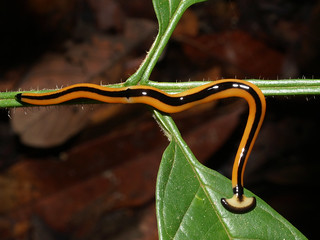
Land Planarian
Image by Divaholic
There's versatility in feeding and life modes... and the body plan is observed in multiple PHYLA (major grouping) of animals (e.g., annelids, flatworms, etc) and even in other groups which don't primarily have a "worm" like body plan (e.g., aplacophorans in molluscs, sea cucumbers in echinoderms, snakes in vertebrates).

Curiously, there's something ABOUT animals with this body shape that seems to freak people out.


Is it the body shape? Something left over from our "metazoan" brain from a LONG time ago?

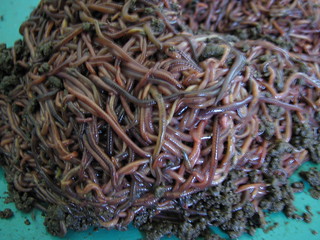
People hate snakes. They always use 'mealworms" (actually beetle larvae) on monster and horror films and TV (totally harmless btw).   Heck, earthworms are HARMLESS (at least to people) and you can still totally squick most people out by dangling one in front of them!
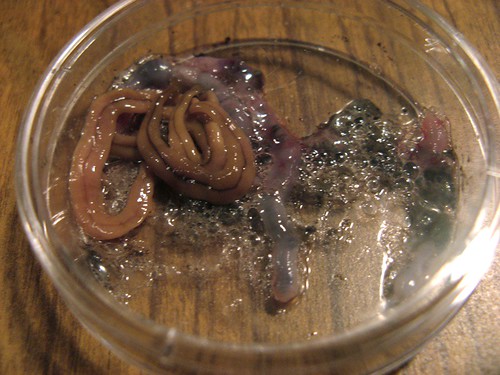
monster worm ball
Image by Mely-o
So what if we looked at worms that are actually PREDATORS? That feed on prey in really graphic ways??

Its Halloween week! Here's FIVE disturbing predatory worms! 

Imagining ANY of these as human sized or above would be cause for alarm!


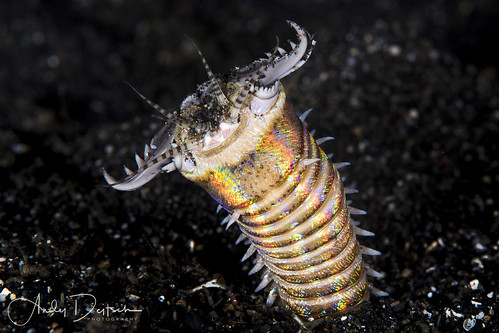
1. Bobbit Worm-Raptorial Predator!

Bobbit Worm
Lets start with an easy one.  By this point, a LOT of people know about Bobbit Worms. I've written about them before.

Short version: Tropical, shallow-water predators.  Up to 6 or more FEET long. They lie in wait and pounce on prey with their spring-loaded jaws. They feed on fish and other vertebrates!
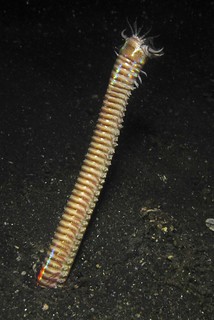
Bobbit worm stretch
Image by MerMate
There's plenty of video... but here's a nice one...


So, I know 46 year old men who STILL get freaked out by Bobbit Worms. Even after all the reassurances and graphic photo evidence PLUS the knowledge that they will never go SCUBA diving in the tropical Pacific!!

Wanna see WORSE than the Bobbit worm?? Let's GO!

2. Ribbon Worms-Long distance Death!
Worms dining on a fish head

Ribbon worms, also known as Nemerteans, are an obscure phylum of worms that are similar in appearance to flatworms (below) BUT one of the big differences is that Ribbon Worms possess a CRAZY long proboscis!

Basically the proboscis is an extended feeding structure used for a FAST grab which in some cases, extends easily 100% of the worms body LENGTH! 

Ribbon worms really need to be seen to be appreciated. So here's some video!

A terrestrial species....


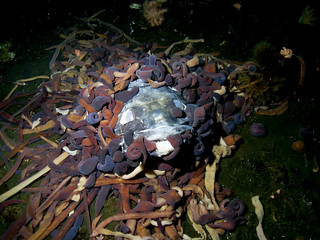
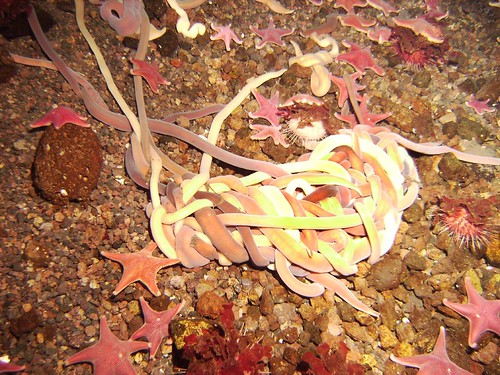
But not all nemerteans are small, cryptic beasts. Some species, such as the Antarctic Parborlasia are HUGE. I wrote about them in this post about Weird Antarctic Invertebrates. They are upwards of THREE FEET LONG. And are about as wide around as a garden hose!
Worm snarl
Image by Icy_Sea_Slugs
and they EAT everything. In both the picture above and the one near the top, there's a dead fish under all those worms!

Ribbon worms are CRAZY abundant and are almost certainly important to the ecosystems they inhabit but they're often difficult to find...

3. Marine Flatworms! Eating from the inside out
Image from this website on introduced Netherlands invertebrates
Feeding in this worm, is to put it mildly, HORRIFIC.  The marine Euplana gracilis is a flatworm that consumes its prey by LITERALLY sucking out its guts, while the prey is still ALIVE! 
I'll let the video's author comment:
In this video, Euplana attacks a shrimp-like amphipod by wrapping around its back and completely immobilizing it. Sticking its tube-like pharynx through a segment of the amphipod, the flatworm then consumes and digests its internals--a process that takes about half an hour. Once finished, it abandons the empty carcass and goes into a resting period until its next meal. On the outside, an amphipod that's been eaten doesn't look that different from a normal amphipod...except for the fact that it's, well, dead.
Videographer: Dean Janiak (Smithsonian Environmental Research Center Benthic Ecologist)

4. LAND Flatworms! Eat em' while they're alive!
Flatworms that live on the land are seen uncommonly but they're there. And they are mean, vicious predators. I wouldn't have known or even thought to think that, but here we go...

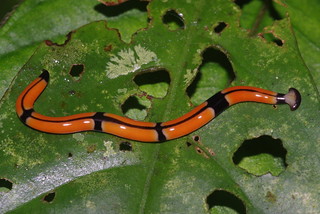
Here is Bipalium, a widely known genus of terrestrial flatworm. Originally from Asia, they've since been introduced all over the world. In their natural habitat, they have these really gorgeous, bright colors....
Land planarian (Bipalium sp.)
image by pbertner
Bipalium feeds on earthworms, so much so that they will inspire an immediate escape response whenever they are put in contact with one (see the video below).

Ever see an earthworm literally JUMP in sheer terror? Watch this...


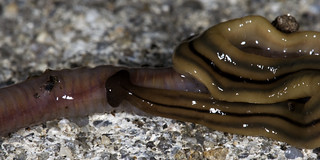
Here's the feeding dance blow by blow...  The worm's head approaches the worm and applies digestive enzymes. It physically begins digesting its prey WHILE THE PREY IS ALIVE...
Planarian Dissolves Its Earthworm Meal
Image by Amuderick
It digests its meal as a dissolved earthworm milkshake...
Ewwww!
Image by Cornell Fungi
BUT its not just the one to one predation which is a concern. TOO many of these predatory land flatworms can actually affect the large-scale ECOLOGY of a region if they devour all the earthworms!

As summarized nicely in the video. No earthworms?  No aeration of the soil. No crops.
Flatworms: An Invasive Flatworm Hunts Earthworms from Shape of Life on Vimeo.

5. LEECHES! 
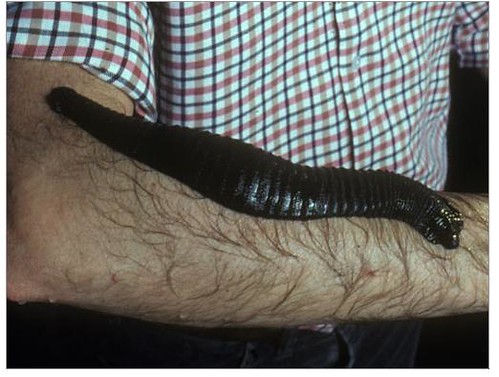
giant amazon leech
Image by uezane
There's marine leeches, terrestrial leeches and of course, freshwater leeches such as the Giant Amazon Leech pictured above! It reaches a length of frakking 18 inches long!!  and feed on mammals that happen to stop by to drink...

While many leeches do the blood sucking thing- others are purely predatory, feeding on earthworms and other comparably sized animals.  Here is a pretty amazing pic of a leech eating a tiny toad! 

Here's some marine leeches!   One from Lembeh, Indonesia.
marine Leech - Lembeh
Image by Christian Loader
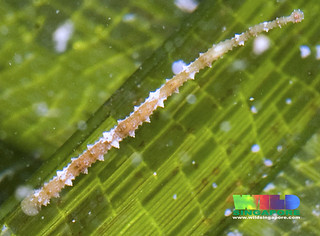
and another from Singapore
Unidentified animal: fish leech?
Image by Ria Tan and Wild Singapore! 
Honorable Mention to Whale Worms!
When I say "whale worms" No, I don't mean, yet another post about Osedax, I mean worms that live IN the INTESTINES OF WHALES! (and other cetaceans)
thanks to Miriam for letting me borrow her pic to the Tokyo Tapeworm Museum & fr providing scale
As a tantalizing and horrifying tip, the tapeworm that parasitizes a whale's intestine has SIX sets of reproductive organs and is over 30 METERS (90 FEET) LONG! 

But that's for another day....


Tuesday, October 30, 2012

Five SPOOKY Things about Echinoderms! Happy Halloween!

From J. Mallefet's Lab Page
Echinoderms are WEIRD animals. That's why I love them.

Their evolution is replete with adaptations to survival that are kind of mind blowing but as with all insanely unusual things, the ideas can be a little unsettling and frankly... a little SPOOOOKKKYY................
jack-o-lantern

1. They don't seem to know when to die...
Most biologists have noticed that echinoderms don't quite die immediately when threatened with the kind of life-threatening injuries that many would consider life-threatening. Or else..its the WRONG part of the animal that seems to go on living... [Yes, some do regenerate (and that will be a subject for a future post!) but not all.]  Some examples:

The Story of Stumpy

Here is a true story (although I don't remember who told me this story originally)

Years ago, following a lab accident or perhaps a crab run amok, the disk and 4 arms from a sand starfish (Luidia clathrata) was separated from the mid to end part of its 5th arm.

Contrary to popular myth, not all starfish can regrow a complete body from just the arm. This one certainly could not.

This separated arm tip (which was named "Stumpy") was kept in the water table and continued to move around for weeks to months...(I honestly don't remember how long but it was  a long time).

Stumpy was even "fed" clams, which it apparently moved via tube feet to where it thought the mouth was. These clams would move up the tube foot groove and then just...fall out when it reached the disk location. No disk! (and thus no mouth)

It was never clear to me if Stumpy just sort of died on its own or if it creeped everyone out so much that they eventually just preserved it in the lab somewhere.

This isn't necessarily unusual "behavior." One can often observe the arm of a brittle star sometimes continue to move long after it is separated....

Presumably a combination of the unusual radial nervous system and the separated body part's ability to sustain itself using sea water (and nutrients) were responsible for this tenacious behavior?

But why believe an echinoderm zombie story when you can simply watch it... 

Here is a "Zombie" Sea Urchin..The animal is broken open with insides removed and yet....IT LIVES

And another...
                              
But on the OTHER hand.....

2. Uh... Do Echinoderms ever die of natural causes??
As a person who has worked in and out of museums and aquariums, one of the things you notice is how some species kept in captivity become bigger and bigger..

Some species such as Pycnopodia helianthoides (from the North Pacific coast)
Photo by Allison Gong
And the enormous Pisaster brevispinus, approach three FEET in diameter (that's about a meter for those outside the US).
Photo by Mr. J. Volz
When kept in captivity sea stars have no predators, are fed every day, and generally don't undergo much, if any, kind of stressors. Its never been clear if any of them perish of "natural causes."

Now, to be clear-they do die. Diseases, aquarium mishaps, introduced predators and so on.

But under optimal conditions?? I have had people watching these cold water species live on for over 10 years (but I'll be honest I would need to verify) and more than once I've been asked "Do they EVER just die of natural causes??"

And honestly, I don't know if they do. Some accounts from the 1960s reported that they became "reproductively senile" but this account was speculative.

The idea of echinoderms as long-lived is not necessarily new. Here is a post I wrote back in 2009 about how ancient sea urchins can get.

So next time you go into say hello to a large sunflower star at your local aquarium-pay it some respect. It might be much older than you are...

3. Some of them GLOW in the Dark!
There is a whole POST worth of stuff on bioluminesence in echinoderms! And at some point in the near future I will write up more about it..but for now accept that a LOT of echinoderms glow!
Image from J. Mallefet's lab page
And here is a neat video that shows the bioluminescent granular covering off a deep-sea swimming sea cucumber..


4. They way some of them go after prey, If they were bigger, WE would be afraid of them!
Most people seem to have a fairly benign impression of echinoderms. Harmless shapes that sit on the bottom of the sea floor that make up part of a dreamy seascape...

Here at the Echinoblog I've done everything I can to change this image!
Many starfish and brittle stars can capture MOVING prey and do so in a variety of surprising ways. Imagine ANY of these things as dog or even COW sized and humans would be more respectful of the humble echinoderm...

                                    
Ophiarachna incrassata 'green serpent star'

And just for good measure?  Here's an earlier post featuring brittle stars that capture squid or fish if they come too close, rending it apart into pieces!! click here.

5. Dried Echinoderms are MUMMIES, NOT shells
This is probably one of the more macabre things that I've made note of before. Undoubtedly we have all seen starfish decorations for the holidays and weddings?? 
A sad Pisaster ochraceus
 sad Linckia laevigata
So, let's remember/invoke some basic biology about ALL echinoderms here.  Remember that ALL echinoderms have skin covering OVER their endoskeleton.
When sea star (or ANY echinoderm) is prepared dried this way?  

This isn't the same as some shell. There is/was skin on them. THESE ARE MUMMIES. 

What you are doing above?  Is like putting funny clothes on a skeleton or a mummy like this... (which I suppose is fine if you realize what you're doing..)

HAPPY HALLOWEEN!!  
pestar