Showing posts with label nemertea. Show all posts

Tuesday, April 12, 2016

Ribbon Worms: The Incredible Predators You've Barely Heard About!

Colourful nemertean worm - Monostilifera gen sp ? (new species)

This week: Some cool examples of predation by a predator, you've probably NEVER heard of! And yet, they are deadly, efficient and can take down prey or food that is MANY times their body size.

I am of course talking about the Nemertea aka the Ribbon worms (or sometimes the proboscis worms)! This is actually a whole PHYLUM of worms, which in spite of their superficial appearance, are actually VERY different from flatworms and have a very significant number of internal features..

There's somewhere in the neighborhood of 1300 species of ribbon worms. Most are flattened and can be VERY elongate with some (e.g., Lineus longissimus) approaching 60 METERS (nearly 200 feet) long! Most occur in the oceans but there are freshwater and terrestrial species as we'll see.

Here's a nice summary of info from the Smithsonian magazine. 

Relevant to today's post is that many nemertean worms are PREDATORY.

They capture food using an eversible proboscis which, thanks to the internet's fascination with weird, gross stuff, you have undoubtedly seen in a variety of formats. Here's two of the popular ones: the red Thailand species expelling its bizarre, almost fractal proboscis:
This proboscis is one of the primary defining characteristics of this group.

and of course this green one from Taiwan!

According to an interview with Dr. Jon Norenburg in the Invertebrate Zoology Department of the NMNH, the proboscis of nemerteans is ejected from a body cavity and used to capture prey. Often times, they can capture prey that is THREE TO FOUR TIMES larger than their body!!

Here's the thing though, the above two video/gifs? Showed these animals in stressed situations outside of their natural environment. And NOT demonstrating their mastery of their predatory proboscis appeasing their ravenous rhyncocoel!

These animals likely represent a HUGE ecological impact which is probably difficult to study owing to their rather cryptic nature.

Here today is a nice little collection of ribbon worms "strutting their stuff" with some GREAT images showing attacking/devouring prey (thanks to YouTube and Flickr!)

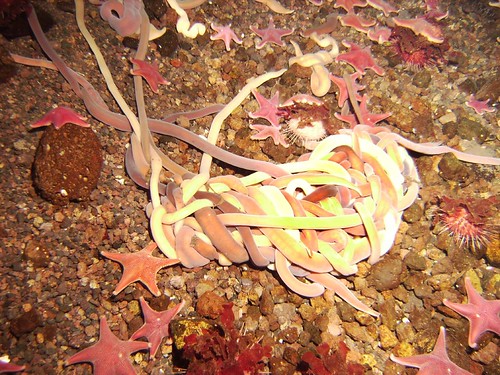
Some ribbon worms such as these huge Antarctic ribbon worms (Parborlasia corrugatus) are both scavengers AND predators and have been reported as feeding on nearly ANYTHING:  fecal pellets, starfish, dead seal meat, fish, sponges, sea anemones, worms amphipods, penguin meat AND sardine meat with tomato sauce! and on and on....
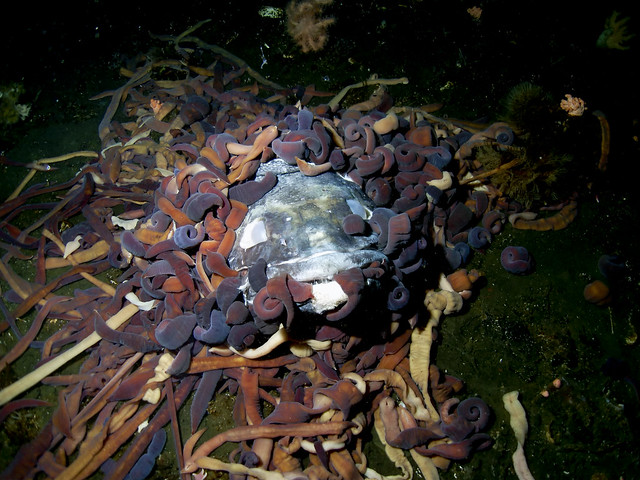
Worms dining on a fish head

5. POLYCHAETE WORMS! Polychaete worms of various types appear to be a popular food among ribbon worms.

Here's one image by James Zhan showing a large ribbon worm consuming a "paddle worm"
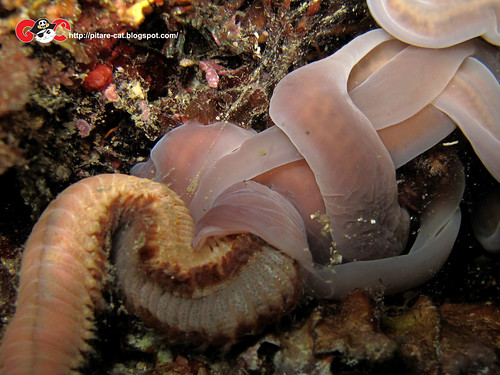
Nemertina- Cerebratulus

This one is impressive. You can actually watch the proboscis IN ACTION as its used to attack its polychaete prey!


Here's another showing feeding on dead but still, LARGER polychaete worm food..

Here are pics AND video from Florida of the ribbon worm Tubulanus feeding on a feather duster worms (a filter feeding polychaete).  Here's a nice shot showing it attacking the "head"
Image from Wetpixel, photo by lindai http://wetpixel.com/forums/index.php?showtopic=51604
And a separate video showing another interaction with the same two players! 

4. CRUSTACEANS!! 
From two different sources. Marvyn Yeo shows us this ribbon worm seemingly coming up behind a tiny crab..
Marine ribbon worm IMG_3544-2
And this video shows us a ribbon worm feeding on this amphipod!

and even mysid "shrimp"!

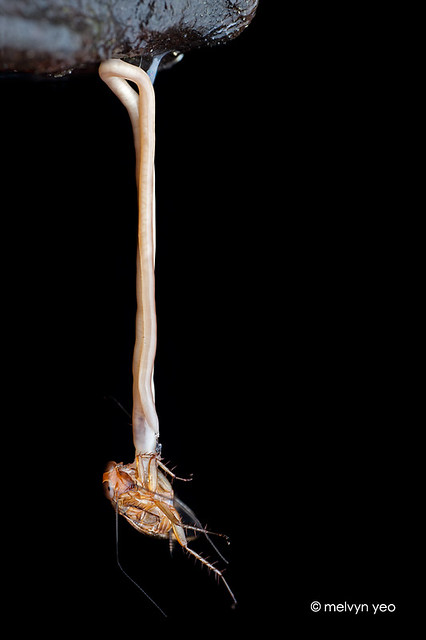
3. INSECTS and land arthropods
Most ribbon worms live in the ocean, but a sparing few have gotten into freshwater and even terrestrial habitats! And yes.. with those same predatory habits!

I'll be honest though, some of these can be pretty difficult to ID even to phylum. these were identified as ribbon worms but I suppose they could easily be flatworms. 
IMG_4107 copy
IMG_4957
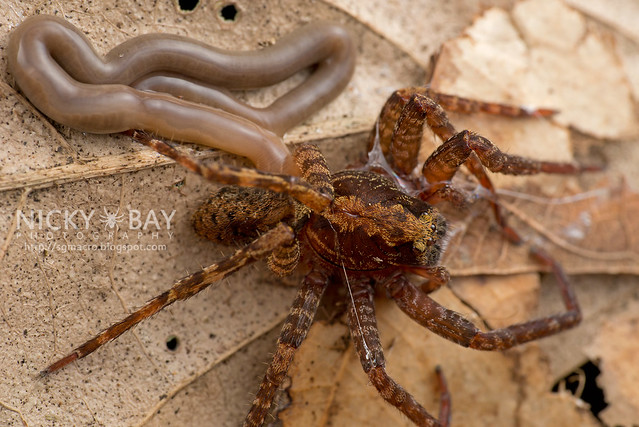
Ribbon Worm (Nemertea) devouring Wandering Spider (Ctenidae) - DSC_2510
IMG_1222
IMG_1200

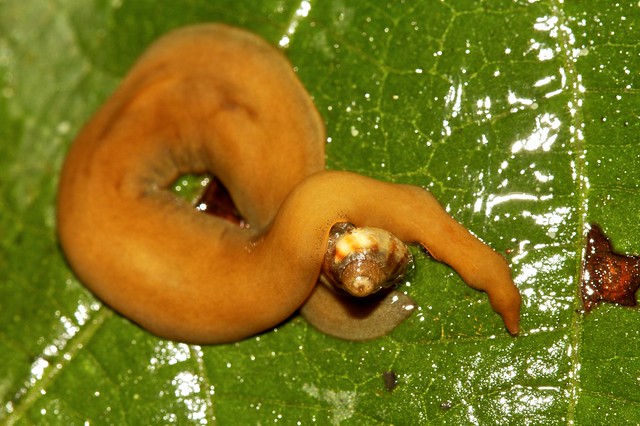
2. Snails! Flickr users Marvyn Yeo and "Paul" brings us stunning pictures from Asia and Ecuador showing this ribbon worm attacking this snail! Apparently by working its way into the shell aperature and attacking the animal in its own shell.
IMG_1902 copy
nemertean worm with prey

1. FISH!! and finally the pièce de ré·sis·tance! To be sure, I'm don't think that these worms actually captured these fish, BUT they are very clearly DEVOURING THEM.

Many ribbon worms have a stylet or thorn which is thought to deliver a toxin against some prey items.. so is it entirely unreasonable to suggest they capture fish, esp. prey much larger than them? Probably not. 

This one is from the Falkland Islands/Malvinas..
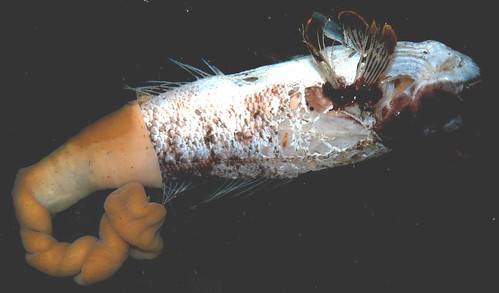
Falkland Islands-18-019-Nemertean eating fish-Credit David Barnes

Here is another GREAT feeding observation in VIDEO with a professional commentary by ribbon worm expert Dr. Jon Norenburg at the No Bones blog! here  This one shows a ribbon worm devouring a HUGE fish from a reef in the Cayman Islands.

But good grief: LOOK AT THAT! Amazing. 


And of course leave it to the folks at Tokyo Sea Life Park to capture this AWESOME video of Parborlasia corrugatus An Antarctic ribbon worm devouring this mackeral in time lapse! (Although Parborlasia is pretty big relative to that fish-its still impressive to watch)

LOVECRAFTIAN FOOTNOTE
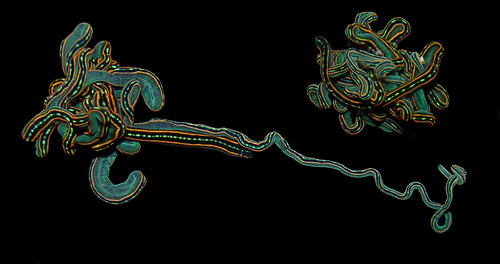
So, I am enough of an old Lovecraft/Cthulu "unnaturalist" to recognize the similarities between aforementioned nemerteans and Lovecraft's famous wormy Dholes! Images shown here from Fig. 8 (Petersen et al. 1988- Petersens' Field Guide to Cthulhu Monsters) on the left and on the right from YogBlogsoth.

The proboscis is close..but I'm thinking.. polychaete instead (dholes do seem to be segmented worms after all)? But that only suggests that if dholes are derived polychaetes than a giant Cthuloid Ribbon Worm may yet be lurking in the darkness....
fr http://yog-blogsoth.blogspot.com/2012/06/dholedoelbhole.html


Tuesday, October 29, 2013

5 Worms that will give you the creeps! Happy Halloween!

WHY DO WORMS GIVE US THE CREEPS??
The "worm" body plan is a successful one. A head. Bilateral symmetry. Long body. That makes a lot of sense. The head takes the lead and you've got a long, slender body which facilitates success for moving through crevices and such. This has been thought by some to be the body plan for the very first metazoan predators (although not all with the body plan are predators).

Land Planarian
Image by Divaholic
There's versatility in feeding and life modes... and the body plan is observed in multiple PHYLA (major grouping) of animals (e.g., annelids, flatworms, etc) and even in other groups which don't primarily have a "worm" like body plan (e.g., aplacophorans in molluscs, sea cucumbers in echinoderms, snakes in vertebrates).

Curiously, there's something ABOUT animals with this body shape that seems to freak people out.


Is it the body shape? Something left over from our "metazoan" brain from a LONG time ago?

People hate snakes. They always use 'mealworms" (actually beetle larvae) on monster and horror films and TV (totally harmless btw).   Heck, earthworms are HARMLESS (at least to people) and you can still totally squick most people out by dangling one in front of them!
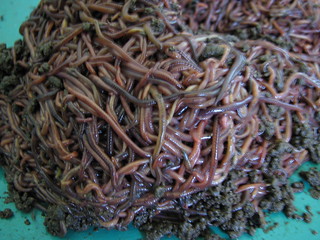
monster worm ball
Image by Mely-o
So what if we looked at worms that are actually PREDATORS? That feed on prey in really graphic ways??

Its Halloween week! Here's FIVE disturbing predatory worms! 

Imagining ANY of these as human sized or above would be cause for alarm!


1. Bobbit Worm-Raptorial Predator!

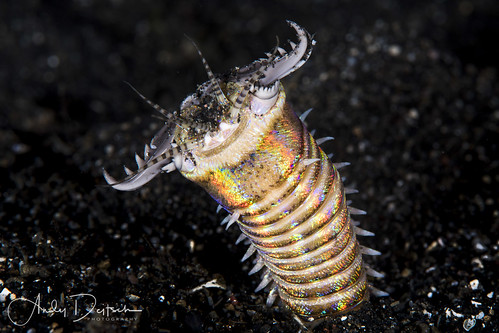
Bobbit Worm
Lets start with an easy one.  By this point, a LOT of people know about Bobbit Worms. I've written about them before.

Short version: Tropical, shallow-water predators.  Up to 6 or more FEET long. They lie in wait and pounce on prey with their spring-loaded jaws. They feed on fish and other vertebrates!
Bobbit worm stretch
Image by MerMate
There's plenty of video... but here's a nice one...


So, I know 46 year old men who STILL get freaked out by Bobbit Worms. Even after all the reassurances and graphic photo evidence PLUS the knowledge that they will never go SCUBA diving in the tropical Pacific!!

Wanna see WORSE than the Bobbit worm?? Let's GO!

2. Ribbon Worms-Long distance Death!
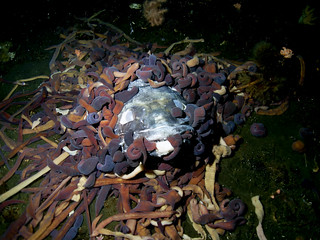
Worms dining on a fish head

Ribbon worms, also known as Nemerteans, are an obscure phylum of worms that are similar in appearance to flatworms (below) BUT one of the big differences is that Ribbon Worms possess a CRAZY long proboscis!

Basically the proboscis is an extended feeding structure used for a FAST grab which in some cases, extends easily 100% of the worms body LENGTH! 

Ribbon worms really need to be seen to be appreciated. So here's some video!

A terrestrial species....


But not all nemerteans are small, cryptic beasts. Some species, such as the Antarctic Parborlasia are HUGE. I wrote about them in this post about Weird Antarctic Invertebrates. They are upwards of THREE FEET LONG. And are about as wide around as a garden hose!
Worm snarl
Image by Icy_Sea_Slugs
and they EAT everything. In both the picture above and the one near the top, there's a dead fish under all those worms!

Ribbon worms are CRAZY abundant and are almost certainly important to the ecosystems they inhabit but they're often difficult to find...

3. Marine Flatworms! Eating from the inside out
Image from this website on introduced Netherlands invertebrates
Feeding in this worm, is to put it mildly, HORRIFIC.  The marine Euplana gracilis is a flatworm that consumes its prey by LITERALLY sucking out its guts, while the prey is still ALIVE! 
I'll let the video's author comment:
In this video, Euplana attacks a shrimp-like amphipod by wrapping around its back and completely immobilizing it. Sticking its tube-like pharynx through a segment of the amphipod, the flatworm then consumes and digests its internals--a process that takes about half an hour. Once finished, it abandons the empty carcass and goes into a resting period until its next meal. On the outside, an amphipod that's been eaten doesn't look that different from a normal amphipod...except for the fact that it's, well, dead.
Videographer: Dean Janiak (Smithsonian Environmental Research Center Benthic Ecologist)

4. LAND Flatworms! Eat em' while they're alive!
Flatworms that live on the land are seen uncommonly but they're there. And they are mean, vicious predators. I wouldn't have known or even thought to think that, but here we go...

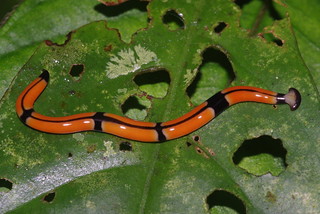
Here is Bipalium, a widely known genus of terrestrial flatworm. Originally from Asia, they've since been introduced all over the world. In their natural habitat, they have these really gorgeous, bright colors....
Land planarian (Bipalium sp.)
image by pbertner
Bipalium feeds on earthworms, so much so that they will inspire an immediate escape response whenever they are put in contact with one (see the video below).

Ever see an earthworm literally JUMP in sheer terror? Watch this...


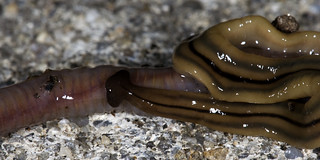
Here's the feeding dance blow by blow...  The worm's head approaches the worm and applies digestive enzymes. It physically begins digesting its prey WHILE THE PREY IS ALIVE...
Planarian Dissolves Its Earthworm Meal
Image by Amuderick
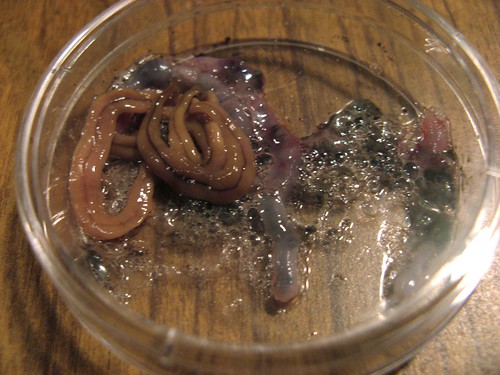
It digests its meal as a dissolved earthworm milkshake...
Ewwww!
Image by Cornell Fungi
BUT its not just the one to one predation which is a concern. TOO many of these predatory land flatworms can actually affect the large-scale ECOLOGY of a region if they devour all the earthworms!

As summarized nicely in the video. No earthworms?  No aeration of the soil. No crops.
Flatworms: An Invasive Flatworm Hunts Earthworms from Shape of Life on Vimeo.

5. LEECHES! 
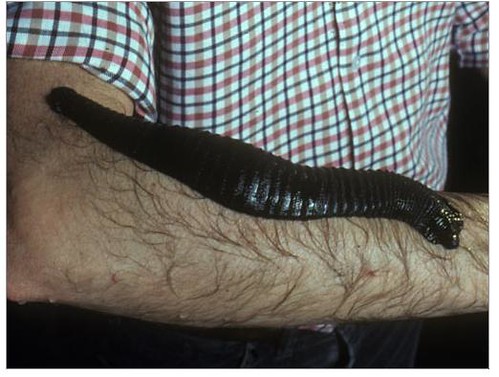
giant amazon leech
Image by uezane
There's marine leeches, terrestrial leeches and of course, freshwater leeches such as the Giant Amazon Leech pictured above! It reaches a length of frakking 18 inches long!!  and feed on mammals that happen to stop by to drink...

While many leeches do the blood sucking thing- others are purely predatory, feeding on earthworms and other comparably sized animals.  Here is a pretty amazing pic of a leech eating a tiny toad! 

Here's some marine leeches!   One from Lembeh, Indonesia.
marine Leech - Lembeh
Image by Christian Loader
and another from Singapore
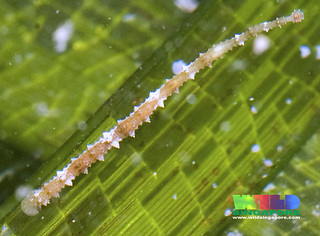
Unidentified animal: fish leech?
Image by Ria Tan and Wild Singapore! 
Honorable Mention to Whale Worms!
When I say "whale worms" No, I don't mean, yet another post about Osedax, I mean worms that live IN the INTESTINES OF WHALES! (and other cetaceans)
thanks to Miriam for letting me borrow her pic to the Tokyo Tapeworm Museum & fr providing scale
As a tantalizing and horrifying tip, the tapeworm that parasitizes a whale's intestine has SIX sets of reproductive organs and is over 30 METERS (90 FEET) LONG! 

But that's for another day....