Showing posts with label off topic. Show all posts

Wednesday, October 8, 2014

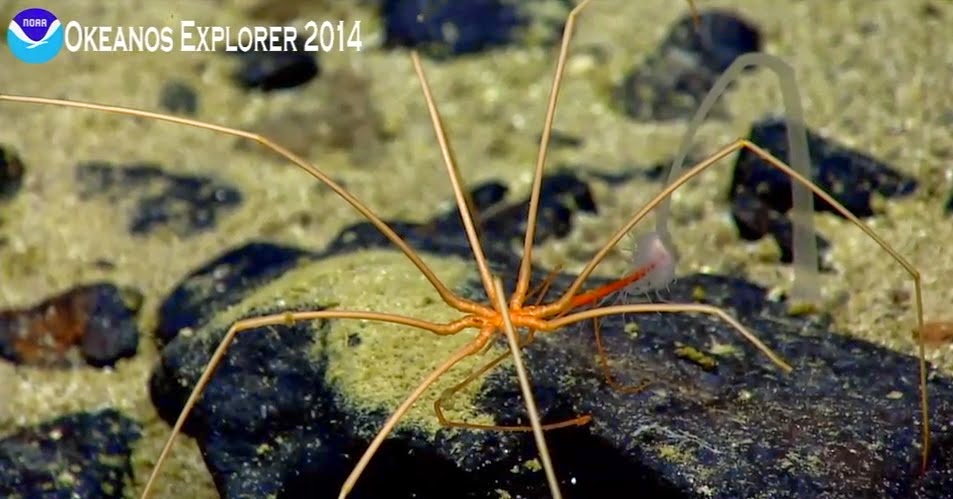
A panoply of Pycnogonid (sea spider) biology from the latest round of Okeanos Explorer

So, after a few days of bad weather, we finally finished this last round of the 2014 Okeanos Explorer's dives into the North Atlantic! 

BUT we were not left high and dry! There was an unusual abundance of GREAT observations! But wow! there were some SPECTACULAR SEA SPIDER aka Pycnogonid biology events seen! Especially on the last few dives.. 


I don't know a lot about pycnogonid biology, but its a pretty sure bet that a lot of what they do is poorly known, especially in deep-sea species. 

Most of the observations below took place below 1000 m, most were probably between 1000 and 2000 m.  Some pretty rarely seen (or maybe first time) sightings. 

Most of these were screen grabs I took.. but my thanks to the Facebook Underwater Screengrab group, Carina Tsottbauer (@CarinaDSLR) and Nicole Morgan (@coralnerd)! for their help! 

1. From Atlantis II Seamount. This Daddy Pycnogonid with a brood clutch of eggs!

2.  From Nantucket Canyon. This pycnogonid with an arcturid isopod on its proboscis (ID thanks to Tammy Horton). Not sure why its there. Possibly food or??


3. From Physalia Seamount! A big sea spider, possibly Colossendeis, caught in the act of extending its proboscis into this large solitary hydroid! Woo! An in situ feeding observation! 


4. From Physalia Seamount, a pycnogonid in this sediment depression! Possibly feeding on a burrowing anemone? 

5. This pycnogonid in Nantucket Canyon hanging out with some single cup corals.. 


6. From McMaster Canyon! A swimming pycnogonid! 
Wow! at first I thought this might be novel.. but thanks to Twitter (@tammy_horton) and quick communication with Tammy Horton, curator of the Discovery collection at Southampton, and deep-sea arthropod biologist extraordinaire! It turns out that there ARE some records of swimming sea spiders in the scientific literature from 1977!! 


Wednesday, August 27, 2014

Giant Deep Sea Amoebas! Meet the Xenophyophores!!

So, following up with all of the NOAA deep-sea Okeanos Explorer stuff, I've found that I am just FASCINATED by these things called Xenophyophores!! The name means "Bearer of foreign bodies".

But what are they? To put it they simply, they are giant, deep-sea amoebas that live in large, sediment "houses" called "tests" (similar to the way that echinoderm skeletons are also known as tests).

Footnote on the classificaiton: a quick survey of the various Protist classifications tells me that even calling these organisms "amoebas" is probably incorrect. But the nuances of this dynamic are for another day..

This one group, the Xenophyophorea live in the deep-sea.. DEEP in the deep-sea! Xenophyophores were observed as deep as10 KM (over 6 miles!) in the deepest of marine trenches (the Mariana) and occur in almost ALL of the world's oceans (except the Arctic).

They are considered among the world's largest living SINGLE CELLED organisms.

Xenophyophores create these large tests which they inhabit. The tests come in a variety of forms. There are 42 known species in 13 genera. As I understand it, xenophyophores are considered as a subgroup within the Foraminifera (these are amoeba-like unicellular organisms with tests).

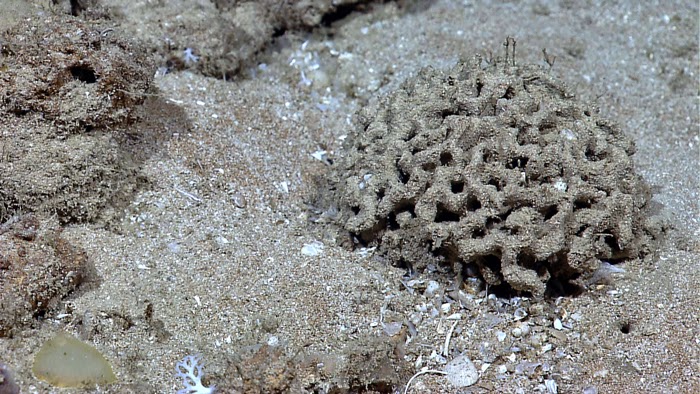
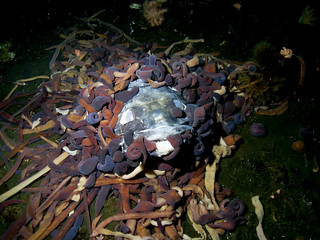
Here's a variety of xenophyophore tests spied by the Okeanos Explorer below..but other patterns include big leafy structures and more network-like arrays of tubes. They vary quite a bit...
                              From the NOAA Photo Library here.                            
From the NOAA Photo Library here
From the Gulf of Mexico, NOAA photo library
Here's some fun facts!  Several different sources including the "Paleoecology and ecology of Xenophyophores" by Lisa Levin and others cited below...

1. How Big Are They?? So, here's the thing. I've read plenty of accounts that jump to the conclusion "These are the MONSTER AMOEBAS!!!" But what a lot of these accounts seem to forget is that the large sizes considered by a lot of popular accounts are the TESTS (i.e., the skeletons).

To be sure, these structures can be pretty big (for something made by amoebas!) The example below is apparently about 25 cm (almost a foot!) across!

Most of the accounts I've read sort of assume (and I suppose this is reasonable) that the animal inhabits ALL of the test all the time, or perhaps with pseudopods or tentacles extended throughout? Frankly, none of the accounts I read could clarify how much of the test, the actual organism inhabits.

However, One estimate (here) indicates that the test volume might be as little as < 1% "protoplasm" (which if I understand the terminology includes cytoplasm, etc.).. so, the actual organisms are probably not as monstrous as some folks would think. I would imagine its quite difficult to measure an amoeba for something like this.


2. What Do They Eat?
  So, when you think of big deep-sea amoebas, perhaps automatically we think "oh WOW! Wouldn't it be NEAT if they actually could eat ANIMALS?" Just like in the movies??  And in truth, there ARE marine amoebas which probably devour animals ... but to date, very little evidence is available on the full range of what xenophyophores actually eat. and the truth is sadly not likely to be as romantic as some would think...
One paper by Laureillard, Mejanelle and Sibuet from 2004 studied the xenophyophore Syringammina corbicula and utilized a study of various lipids and amino acids to look at their nutrition. Their study showed that bacteria were present in great abundance!

Xenophyophores have strings of mucus which are deployed along the test which build up feces and sediment called stercomes. It was suggested that a flora of these bacteria were present in abundance on these mucous threads. Perhaps being farmed and being utilized as a source of food.

Their mucous threads also are constantly pulling and trapping particles from the surrounding area, presumably in part to provide further nutrition.

Here is an Scanning Electron Microscope Image of a stercome showing up close details of what's on them...

So, there seems to be a heavy dependence on poop and other "marine snow" that falls down to the bottom.. as well as bacterial/microbial growth. But very little is known about feeding in xenophyophores, so who knows what else they do??

3. What are those structures (tests) made of? 
Tests on xenophyophores are made up of a patchwork of different bits. Sediment, but also the shells of other marine organisms such as radiolarians, other foraminiferans, and so on...

The test is the outer "crunchy" later... Within the test are a series of tubes called granellare, through which the animal's cytoplasm and etc. flow through...

These tests are actually an important part of xenophyophores ecological role, as they provide habitats and such.....

4. Ecology!
Probably the most interesting thing that I've picked up about Xenophyophores?? Is how potentially important they are to deep-sea ecosystems. Xenos are VERY abundant in the deep-sea, sometimes reaching up to 2000 per 100 square meters!

Lisa Levin published this neat paper in 1991 about their roles in deep-sea communities.  Basically it turns out that where xenos are found, there are "hotspots" of animal diversity!

The pic below shows two big xenophyophore tests with brittle stars on them...
Why might a cluster of xenophyophore tests represent a "hotspot" of animal diversity?? They apparently present both food AND habitats for a plethora of deep-sea animals!

Examples of how animals use these tests?
  • Habitats for worms, copepods, crustaceans, ophiuroids, and even snail embryos!
  • Peanut worms that live IN "dead" tests
  • Eggs from various animals (worms or snails) on xenophyophore tests.
  • Suspension feeding colonial animals called bryozoans sometimes are found "intergrown" on tests
  • Some xenophyophores found ON sea urchins.
  • Some amphipod crustaceans are thought to prey on the xenophyophores
  • Plus other MORE! Possibly/probably associated with the bacteria growing on the surface?? 
5. Mystery fossils: Xenophyophores??
So, one of the aforementioned articles by Levin on Xenophyophore paleoecology makes the case that tests and other modern examples of sediment structures by these organisms can explain various trace fossils, and other mysterious fossil structures.

Perhaps one of the best known is that of the fossil ichnogenus (like an organism name but for a trace fossil) Paleodictyon!

Paleodictyon was famously studied by oceanographer Peter Rona who made it an obsession of his career. It has covered by many other natural history blogs such as this and this. 

Basically.. a trace fossil which looks like this.
This is seen throughout the deep-sea in many places. The above image from the Gulf of Mexico but its been seen throughout the deep-sea, sometimes as deep as 3700 meters!!

Its also been seen in the fossil record.. dating back to the Paleozoic...  The parallel and similar appearance has led to much debate over whether the same type of organism has created these patterns in the sediment.. namely, did a xenophyophore or something similar create them?? 
And anyway, there's a LOT more on them in this regard and there seem to be more questions than answers.... A neat group of critters! (can I use that for amoebas?) 

Tuesday, October 29, 2013

5 Worms that will give you the creeps! Happy Halloween!

WHY DO WORMS GIVE US THE CREEPS??
The "worm" body plan is a successful one. A head. Bilateral symmetry. Long body. That makes a lot of sense. The head takes the lead and you've got a long, slender body which facilitates success for moving through crevices and such. This has been thought by some to be the body plan for the very first metazoan predators (although not all with the body plan are predators).

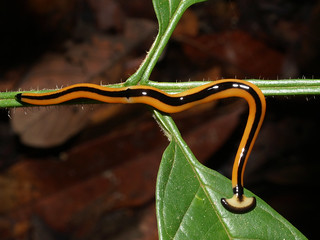
Land Planarian
Image by Divaholic
There's versatility in feeding and life modes... and the body plan is observed in multiple PHYLA (major grouping) of animals (e.g., annelids, flatworms, etc) and even in other groups which don't primarily have a "worm" like body plan (e.g., aplacophorans in molluscs, sea cucumbers in echinoderms, snakes in vertebrates).

Curiously, there's something ABOUT animals with this body shape that seems to freak people out.


Is it the body shape? Something left over from our "metazoan" brain from a LONG time ago?

People hate snakes. They always use 'mealworms" (actually beetle larvae) on monster and horror films and TV (totally harmless btw).   Heck, earthworms are HARMLESS (at least to people) and you can still totally squick most people out by dangling one in front of them!
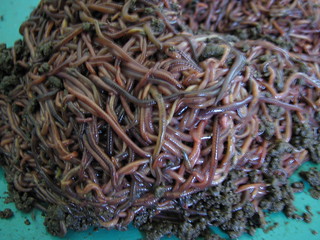
monster worm ball
Image by Mely-o
So what if we looked at worms that are actually PREDATORS? That feed on prey in really graphic ways??

Its Halloween week! Here's FIVE disturbing predatory worms! 

Imagining ANY of these as human sized or above would be cause for alarm!


1. Bobbit Worm-Raptorial Predator!

Bobbit Worm
Lets start with an easy one.  By this point, a LOT of people know about Bobbit Worms. I've written about them before.

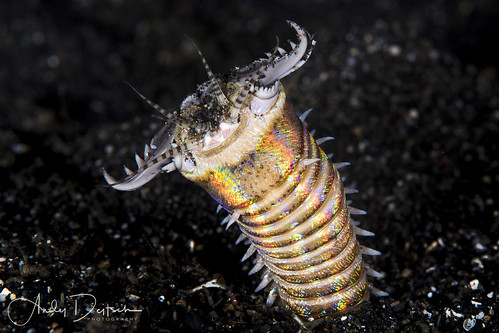
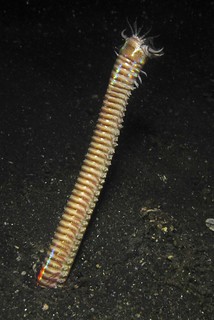
Short version: Tropical, shallow-water predators.  Up to 6 or more FEET long. They lie in wait and pounce on prey with their spring-loaded jaws. They feed on fish and other vertebrates!
Bobbit worm stretch
Image by MerMate
There's plenty of video... but here's a nice one...


So, I know 46 year old men who STILL get freaked out by Bobbit Worms. Even after all the reassurances and graphic photo evidence PLUS the knowledge that they will never go SCUBA diving in the tropical Pacific!!

Wanna see WORSE than the Bobbit worm?? Let's GO!

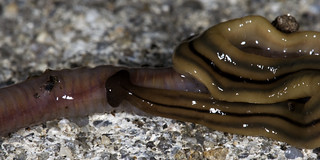
2. Ribbon Worms-Long distance Death!
Worms dining on a fish head

Ribbon worms, also known as Nemerteans, are an obscure phylum of worms that are similar in appearance to flatworms (below) BUT one of the big differences is that Ribbon Worms possess a CRAZY long proboscis!

Basically the proboscis is an extended feeding structure used for a FAST grab which in some cases, extends easily 100% of the worms body LENGTH! 

Ribbon worms really need to be seen to be appreciated. So here's some video!

A terrestrial species....


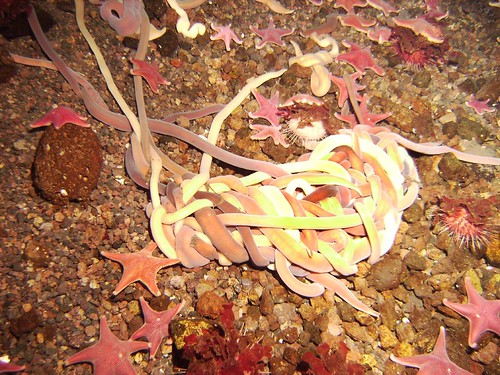
But not all nemerteans are small, cryptic beasts. Some species, such as the Antarctic Parborlasia are HUGE. I wrote about them in this post about Weird Antarctic Invertebrates. They are upwards of THREE FEET LONG. And are about as wide around as a garden hose!
Worm snarl
Image by Icy_Sea_Slugs
and they EAT everything. In both the picture above and the one near the top, there's a dead fish under all those worms!

Ribbon worms are CRAZY abundant and are almost certainly important to the ecosystems they inhabit but they're often difficult to find...

3. Marine Flatworms! Eating from the inside out
Image from this website on introduced Netherlands invertebrates
Feeding in this worm, is to put it mildly, HORRIFIC.  The marine Euplana gracilis is a flatworm that consumes its prey by LITERALLY sucking out its guts, while the prey is still ALIVE! 
I'll let the video's author comment:
In this video, Euplana attacks a shrimp-like amphipod by wrapping around its back and completely immobilizing it. Sticking its tube-like pharynx through a segment of the amphipod, the flatworm then consumes and digests its internals--a process that takes about half an hour. Once finished, it abandons the empty carcass and goes into a resting period until its next meal. On the outside, an amphipod that's been eaten doesn't look that different from a normal amphipod...except for the fact that it's, well, dead.
Videographer: Dean Janiak (Smithsonian Environmental Research Center Benthic Ecologist)

4. LAND Flatworms! Eat em' while they're alive!
Flatworms that live on the land are seen uncommonly but they're there. And they are mean, vicious predators. I wouldn't have known or even thought to think that, but here we go...

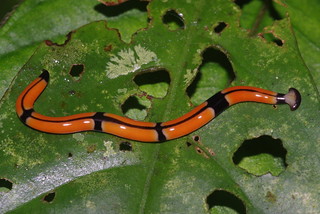
Here is Bipalium, a widely known genus of terrestrial flatworm. Originally from Asia, they've since been introduced all over the world. In their natural habitat, they have these really gorgeous, bright colors....
Land planarian (Bipalium sp.)
image by pbertner
Bipalium feeds on earthworms, so much so that they will inspire an immediate escape response whenever they are put in contact with one (see the video below).

Ever see an earthworm literally JUMP in sheer terror? Watch this...


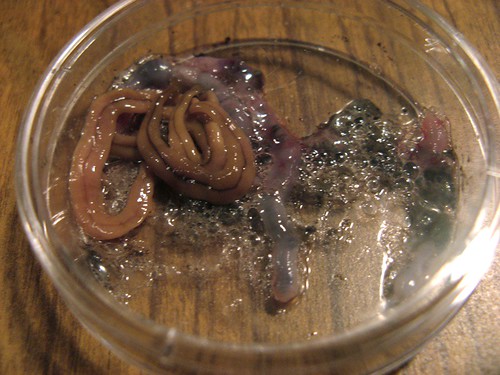
Here's the feeding dance blow by blow...  The worm's head approaches the worm and applies digestive enzymes. It physically begins digesting its prey WHILE THE PREY IS ALIVE...
Planarian Dissolves Its Earthworm Meal
Image by Amuderick
It digests its meal as a dissolved earthworm milkshake...
Ewwww!
Image by Cornell Fungi
BUT its not just the one to one predation which is a concern. TOO many of these predatory land flatworms can actually affect the large-scale ECOLOGY of a region if they devour all the earthworms!

As summarized nicely in the video. No earthworms?  No aeration of the soil. No crops.
Flatworms: An Invasive Flatworm Hunts Earthworms from Shape of Life on Vimeo.

5. LEECHES! 
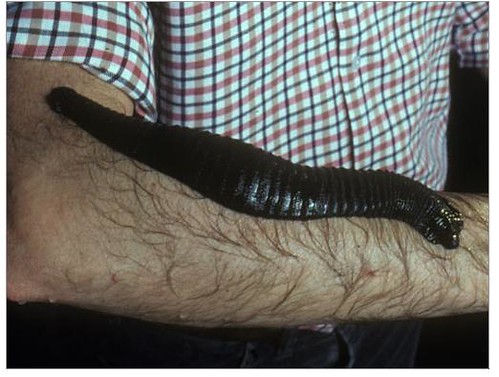
giant amazon leech
Image by uezane
There's marine leeches, terrestrial leeches and of course, freshwater leeches such as the Giant Amazon Leech pictured above! It reaches a length of frakking 18 inches long!!  and feed on mammals that happen to stop by to drink...

While many leeches do the blood sucking thing- others are purely predatory, feeding on earthworms and other comparably sized animals.  Here is a pretty amazing pic of a leech eating a tiny toad! 

Here's some marine leeches!   One from Lembeh, Indonesia.
marine Leech - Lembeh
Image by Christian Loader
and another from Singapore
Unidentified animal: fish leech?
Image by Ria Tan and Wild Singapore! 
Honorable Mention to Whale Worms!
When I say "whale worms" No, I don't mean, yet another post about Osedax, I mean worms that live IN the INTESTINES OF WHALES! (and other cetaceans)
thanks to Miriam for letting me borrow her pic to the Tokyo Tapeworm Museum & fr providing scale
As a tantalizing and horrifying tip, the tapeworm that parasitizes a whale's intestine has SIX sets of reproductive organs and is over 30 METERS (90 FEET) LONG! 

But that's for another day....


Tuesday, September 17, 2013

Who Named the Bobbit Worm (Eunice sp.)? And WHAT species is it.. truly??

Bobbit-Worm
photo by Hendra Tan

There's a certain few marine invertebrates, which for various reasons, capture the imagination of the public and manage to get a foothold into popular culture. Bathynomus-the giant deep sea isopod!  Sea Pigs, such as Scotoplanes and their relatives-weird looking deep-sea sea cucumbers. 

Among this pantheon of photogenic and/or striking bunch of marine animals is a formidible polychaete worm- in the genus Eunice, also known as the BOBBIT WORM!

Here's video of this animal's remarkable prowess (more videos are here). These worms  reach 3 m (~10 FEET) long and are raptorial predators which use spring loaded jaws to capture their prey... One record holder indicates a worm which was nearly SIX meters in length when collected! 

Yes. That's basically a worm the size of a large SNAKE with jaws to match!

This animal has been getting increasingly more exposure as various sites have been introducing marine invertebrates into their blogs and such. This is a good thing for those of us who study marine invertebrates. An animal once known only to specialists is now becoming accessible to everyone..

I've noticed increasingly however that many of these newer accounts of the Bobbit Worm are missing something.

Where did such a distinctive NAME come from?  Wired asked where the name came from! And they were not answered.  Even my colleagues at Deep-Sea News asked and were not answered! 

This question has even been probed in scientific journals by scientists! This has led to more questions!

Where does the name "Bobbit Worm" Come from?? 
In 1993 a case hit the headlines with such a resonant act, it came to be one of the defining news pop culture items of the decade. A woman, Lorena Bobbit, cut off her husband's penis with a knife. The penis was re-attached.  You can read all the gory details on Wikipedia.

In the late 90s, circa 1993-1995, I was a grad student/ curatorial assistant in Invertebrate Zoology at the California Academy of Sciences.  (I'm ancient like the hills!)  I was working through my Masters and had not yet left for my PhD.

Part of my time there involved my helping two of the curators, Gary Williams and Terry Gosliner, who were experts in soft corals and nudibranchs, respectively, identify starfish for their upcoming book on Indo-Pacific animals.

During the research for the book, Gary and Terry returned from a trip to the research dive to the Philippines where they spied a crazy thing. A great story that was told one brisk Friday in San Francisco!

(story recreated here with new images) A GIANT worm with spring loaded jaws the size of a SNAKE jumped OUT of its burrow and grabbed a freakin' FISH while it was swimming by! Images below by Eunice Khoo (Mer Mate)
Bobbit wormBobbit worm stretch
Bobbit worm attack
Image by Jason Isley
I didn't believe it. But there it was.

Bear in mind. Digital cameras were just becoming available. HD underwater Video was nowhere nearly as good as it is today. YouTube was non-existent. The WWW was around but didn't have the size and scope it was today. Most people didn't even KNOW polychaetes were any larger than about a foot long at most. If you saw polychaetes in a coffee table book or marine biology photo magazine you were pretty lucky. The only people who ever saw these huge monstrous worms were divers, scientists and maybe the locals.

Eventually on one of their trips back, Gosliner and Williams managed to collect a specimen AND a picture of the animal, which they caught a picture of and put into their book, published in 1996...
(and which is quite good with many verified identifications. Go here to pick up a copy
The specimen had been identified to genus, Eunice sp. but not to species (I'll explain more below), but Terry Gosliner felt that it a special beast worthy of distinction! And hence the name... (excerpt below from their book)

So, Dr. Terry Gosliner, curator of mollusks and world expert on nudibranchs was the man who coined the name BOBBIT WORM. At the very least, this is the first account of the name in the literature. 
The timeline and scenario is consistent
  • When divers started looking for books to ID the critters they were seeing, they went to Gosliner et al.'s 1996 ID guide. There were other Indo-Pacific field guides around, but none used the term. 
  • As we entered the era of YouTube, Flickr and kajillion pictures of the Bobbit Worm, how did an obscure 90s reference make it into such common use? The book named the animal and it circulated. 
  • Terry Gosliner verifies himself as the name's originator!
Some clarification on various myths that have arisen....
  • The Bobbit worm name is based on the act of the knife cuttin off the Bobbit Junk. Further analysis (inappropriate blade type, the worm named for a phallus, etc.) is over thinking it. 
  • Other various stories about female Bobbit worms attacking the genitalia of male Bobbit worms are not just wrong but WAAAY wrong. Polychaetes don't have penises. 
  • And there are no reports (that I know of!) of Bobbit worms attacking tropical men swimmin' around with their junk out!

So, what species of polychaete IS a Bobbit Worm??
One major misconception that HAS arisen however, is that because the Bobbit worm is big and obvious that we know what it is! i.e. what species it is...
Eunice (Polychaete?) Worm Detail
Image by Mark Atwell
After Gosliner & Williams collected the worm, they sent it to the Smithsonian's world polychaete expert Kristian Fauchald. He identified it to Eunice but stopped short of the species.

Why? Because the group is... complicated and this has some bearing on exactly WHAT a Bobbit worm is. Allow me to explain.

We often see the species name Eunice aphroditois used as the species name for the Bobbit Worm, such as here in Wikipedia and in many other places.  But this is almost certainly an oversimplification.

Since its original use, the common name has been largely applied to almost any large, predatory polychaete, which most untrained "citizen scientists" such as divers, aquarists, etc.  are generally unable to distinguish.

For example, is this a "proper" Bobbit worm?  It looks close, but lacks the same kind of jaws. So, probably not. But its not unsual for big, attractive polychaetes to get labelled "Bobbit Worms"

This for example is another species of Eunice (I think..) but is it a "Bobbit worm"?
9522 Bobbit worm
Image by Ken Traub aka Diverken
The genus Eunice itself, contains OVER 350 accepted species found all around the world! Go here to see a list of them.  Even if you pare down that list to ONLY the really big ones as was done in this article you're still looking at a HUGE number of species that have since fallen under the umbrella term "Bobbit worm."

In fact, one hugely complicated problem is the definition of the "Eunice aphroditois" species concept itself. A problem outlined here by Sergio Salazar-Vallejo and colleagues.

The problem breaks down like this:
The 'Proper" Bobbit Worm was a species originally observed from the Philippines and may or may not be the same species frequently observed in Indonesia and thereabouts in videos and such. In fact, if you read the description above, it was originally thought to be a new species and still may be!

This paper by Anja Schutlz further outlines methods that we might further understand the questions surrounding the question "What species is the Bobbit worm??" Population genetics of the world populations and further sampling of species from around the world.. (as well as people who can identify them correctly).
The stuff of nightmares
Beautiful photo by Eric Cheng! 
So, conceivably we have not even SEEN the TRUE Bobbit Worm (i.e. the animal originally named as such) as a proper species yet!

But because the common name "Bobbit Worm" seems to have become rather liberally applied to most large eunicid worms, its likely that name will stick. Not just to Indo-Pacific eunicids but to others..

and THAT is the rest of the story...  (old-timers joke!)

Tuesday, July 2, 2013

Beautiful & Creepy Things about Tunicates! Echinoblog Off Topic!

Magnificent Ascidian
Image by Leander Wiseman
Today, a little off topic time for some tunicate love!

For those who are not familiar, tunicates are actually members of the same overall group to which humans and all other vertebrates belong! A subgrouping, called the Tunicata within the larger phylum Chordata. Honestly, the relationship is pretty basic info which you can find with a quick Google search

Most times, tunicates are small, out of the way or encrusting (i.e., covering surfaces over a wide area) but can be very abundant, carpeting areas until nothing else grows there..such as this one (Botrylloides diegensis) which is an invasive in San Francisco Bay from Asia.
Chain sea squirt (Botrylloides diegensis)
 Image by Luis A Solórzano, KQUEST
Under many conditions, tunicates are ugly and kind of bland colored things that are common components of fouling communities. Its species such as this one which earn the oh so lovely common name "sea pork"(Amaroucium californicum). And so, they get a bad rap. 
Amaroucium californicum
image by Jkirkhart35
But tunicates are often gorgeous and attractive animals. PLUS, they do weird and unusual (if kinda creepy) things! Let's go see! 

1. Some Basics
This shows two siphons: one is where water goes IN and the other is where it goes OUT.

Kidney closeup (Polycarpa aurata)
Image by Arne Kuilman, from Anilao, Philippines
Food gets caught in the "Pharyngeal basket" (=the "filter" for its filter feeding) where it gets moved down to the stomach. A pretty simple overall anatomy. But note, it has well-developed organs that you would find in a proper animal.  This is important later...
From the Marine Life Information Network
This gives you a general idea of the animal as a whole (not sure if this is the exact same species but you get the general notion)
Sea Squirts
Image by Prilfish
 Basket Close ups! 
Green entrance
Image by Steve de Neef
Cross section! the space between the 'tunic" and the feeding basket
IMG_2969
Image by "stupidhead"
2009_0502_111050
Image by Star Tsai
INSIDE the basket!
Alien tunicate, Eastern Fields, Papua New Guinea
Image by Eric Cheng
Tunicate-1
Image by Christian Loader
Roots
Image by Steve de Neef
2. Some Diversity... 
Some tunicates are individuals
_MG_4419
Image by bybegone
Whereas other forms are colonial...
A ball of Bluebells
Image by Patrick Nilsson

Botrylloides magnicoecum from Australia. And yes, those are apparently the REAL colors.
Magnificent Ascidian
Image by Leander Wiseman
Botrylloides leachi from Australia
Leache's compound ascidian - Botrylloides leachi
Image by John Tumbull
clear tunicates 2 edited
Fantastic image by Pat Sinclair
Other tunicates are more....unusual in appearance (I think these are solitary)  BEHOLD! Sea Tulips! Pyura spinifera from Australia!
Here's only a few...
Pyura Spinifera
Giant sea tulip - Pyura spinifera
Here's a LOT of them
Sea Tulips
Image by Richard Ling
Another stalked tunicate, Oxycorynia fascicularis from Anilao in the Philippines
Oxycorynia fascicularis, Stalked Tunicate, Anilao, Philippines
Image by Optical Allusion
Stalked GREEN tunicates! Same species? Oxycorynia fascicularis
Stalked green tunicates
Image by Mer Mate-Eunice Koo
And although I've been focusing on shallow water, I can't get past tunicates without the obligatory showing of the famous DEEP-SEA predatory tunicate (Megalodicopia hians) !! The IN siphon is modified into a mouth and the OUT siphon kicks out the tunicate poop!   Let's let the British narrator take us away!


3. The predatory tunicate is a great segue for the vice versa! People EAT tunicates. As I've outlined here Its called the "sea pineapple" among other things in Asian cultures, but different species (called 'sea violets') are eaten by Europeans..
Sea squirts
Image by sjbutterfield2
MMmm........tunicates and kimchi....
Sea Pineapple
Image by Mark Deibert Photography

4. Tunicates are a little creepy 
If tunicates have similar enough tissues (historecognition) ie. are similar enough two physically different individuals can physically FUSE together.

Why say it, when you can SHOW it?

the description from the video:
This video shows a fusion event in progress between compatible individuals of the sea squirt, Botryllus schlosseri. At the beginning, terminal parts of vasculature, called ampullae, which surround the colony, have come into contact (one colony is on the top right, the other on the bottom left, out of the field of view). The ampullae push into each other repeatedly, and finally the cell layers between two ampullae fuse, and results in both individuals sharing a common circulation. 
Fusion can best be seen on the top left, but occurs in several places in the region of interaction. The decision to fuse or reject is based on whether the two colonies 'match' each other, analogous to how humans accept or reject transplants.
See this essay for more.  But bear in mind, tunicates may look simple like sponges-but they aren't! 

Sponges don't have tissue, so those videos where they grind em' up and they get back together?

Not that hard for animals that are still essentially just colonies of cells. Proper ANIMALS with tissues don't typically do stuff like that.  The fusion shown in tunicates above?  That's like you and your family, suddenly fusing into one big amorphous pile. Squicky, eh?

Go here to learn more about this.

5. Where can I learn MORE about tunicates?
*Did you know that tunicates accumulate the metal Vanadium in their body tissues? go here to learn more.
*The Dutch ascidian Site! 
*The Tunicate Web Portal! 
*Will tunicates be used as biofuel? 
and my colleague Jarrett Byrnes writes a blog that often involves tunicates!