Showing posts with label commensals. Show all posts

Wednesday, July 13, 2016

Astropyga The Radial, Fiery Star Butt Urchin! Observed insights from Flickr & YouTube!

A happy July week to all of you! So, as we enter into the lull of the summer I present to you some choice Echinoblog image and video picks from various image streams that show off one the internet's most frequently photographed sea urchins! The diadematid ASTROPYGA! 

Common names of these urchins include "radial urchins" and "fire urchins." But many refer to echinothuriids in the genus Asthenosoma as "proper" Fire Urchins, for obvious reasons.. but mainly because they are VERY painful to get stung by..

Astropyga also appears to have a rather painful array of spines but I'm unsure if these pack quite the toxic wallop that Asthenosoma does..

Astropyga includes four known species, one in the tropical East Pacific and another in the Indo-Pacific and two in the tropical Atlantic. All are known to occur primarily from relatively shallow to mesophotic depths as we saw recently on a Bishop Museum expedition to the "Twilight Zone" (here) 

But even within the widely occurring Indo-Pacific species. A. radiata there appears to be quite a bit of color variation from the dark colors seen below to the lighter ones.

The genus name can be broken down to "Astro" meaning star and "pyga" which refers to rump or buttocks.. so the name literally translates to "Star Butt"!!.

Why? Well, you see this giant bulb on the surface? That's an extension of the intestine called the anal sac. That's where the POOP comes out! I've talked about that here.  So, basically some wry taxonomist looked at the anal sac and the pentagonal symmetry and decided "yes. The STAR ASS!"
Fire urchin
Flickr and Youtube are GREAT for picking up on natural history observations. Yes, there's always the lack of scientific rigor but sometimes divers just make simple observations. And THAT can be the start of knowledge.

All the images below are probably A. radiata from the Indo-Pacific.

Astropyga scavenging on dead fish! (Lembeh)
Based on a round up of papers I could locate, A. radiata has been reported primarily as a scavengers, feeding on algal debris and other stuff from sediments, etc. But if this image is accurate (and not posed) they occasionally much on dead fish as well. This is actually consistent with other sea urchin feeding habits, so I feel comfortable in presenting it here..
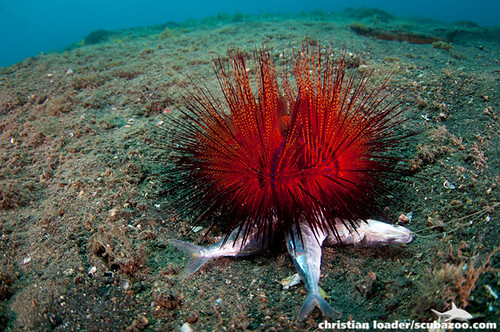
Radial Sea Urchin feeding on dead fish - Lembeh

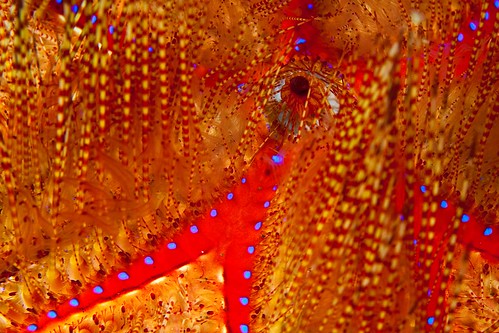
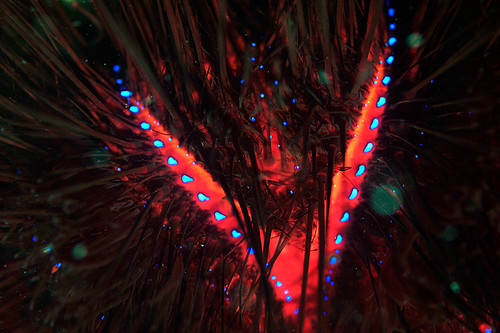
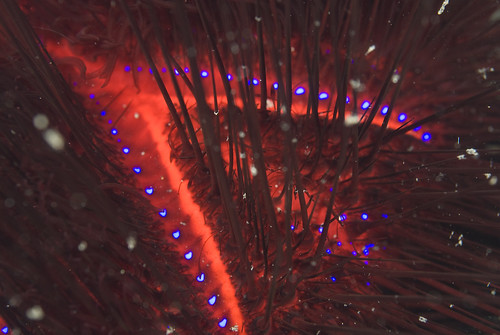
Blue Iridescent Spots! Its been speculated that these are photoreceptors but they've not been tested and its unclear exactly what their function is.. But they immediately stick out when observed on an otherwise bright red sea urchin! 
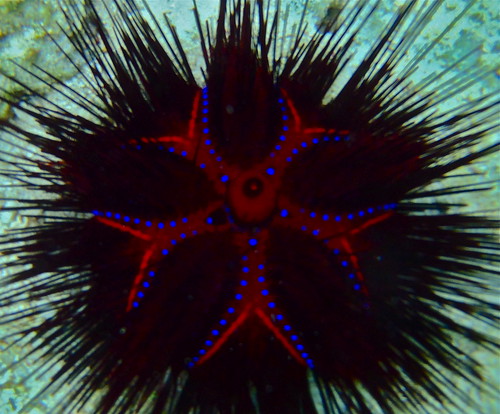
Astropyga radiata, Red sea urchin
Fire Urchin
75
magnificent urchin

Spawning!
This speaks for itself. As with other echinoderms I've shown here (such as the sea cucumbers) just because you see white fluid being emitted its not actually clear what sexes of the species are present. The fluids likely represent BOTH sperm AND eggs. 
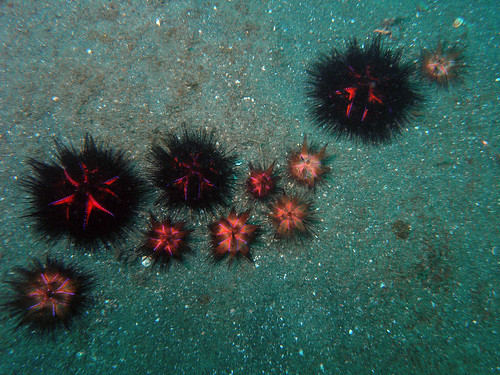
Sometimes this species form large aggregations, which are most likely to help facilitate their reproduction and sexy time!
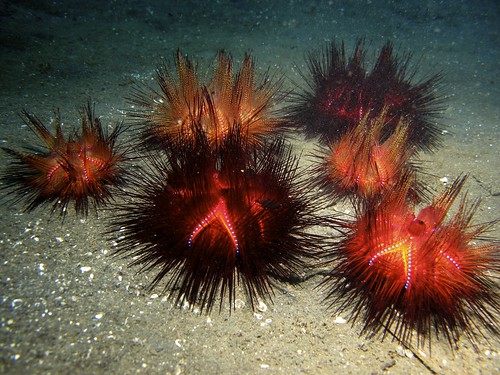
Urchins unite!Magnificent Urchin family
Astropyga moves surprisingly quickly!
While I haven't actually seen one of these alive and close up, its pretty clear that even for sea urchins they are capable of a surprisingly brisk sprints! and across some unusual terrains to boot! 

That's quite a lot of coordination of spines and tube feet at play.. 

here's a bunch of them in what looks like a mating aggregation, moving en masse!

Better yet! here's Astropyga moving in TIME LAPSE!

my first underwater timelapse from prodtv on Vimeo.

Crustacean Relationships! 
Sea urchins are basically big spiny balls that seldom move and surprise! surprise! There never seems to be a shortage of OTHER, smaller animals that can take advantage of this as "habitat."

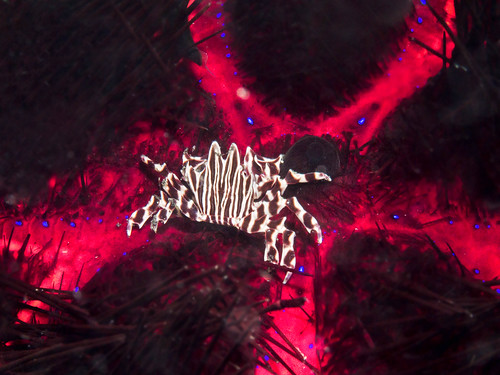
 Crab Commensals!  These don't seem to be as bad as the crabs on Asthenosoma, (the proper fire urchins) simply because these don't seem to "dig" themselves into the urchin surface. Spines on Astropyga seem long enough to provide adequate protection as-is...
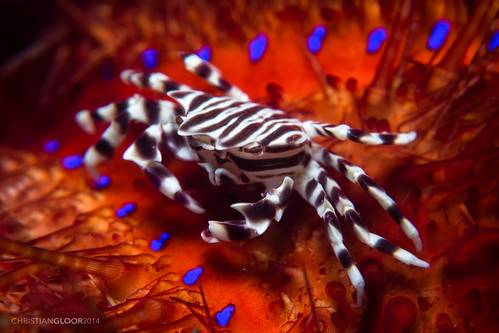
Walking on fire!
ZEBRA CRAB ON FIRE URCHIN, LEMBEH STRAIT

and vice versa?? Probably one of the most unusual things I've seen imaged by divers since Flickr and YouTube became a thing has been this.. Crabs in the family Dorippidae that PICK UP urchins, sea anemones and carry them on their carapace in order to use them as sort of a defense as they walk along the sea bottom.
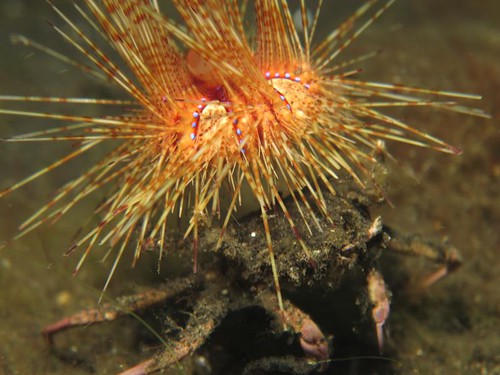
IMG_1077
But why explain? When you can just watch...

...and of course.. POOPING!
And finally, one of the things that we LOVE to watch urchins doing? POOPING! Something that is arguably part of their namesake!  Here's the time I corrected New Scientist on their mistaken urchin pooping picture! 

Here's a whole post on echinoderm anuses for your reading pleasure! 
Here's a lovely shot entitled "Radiant Crap" by Eunice Khoo!
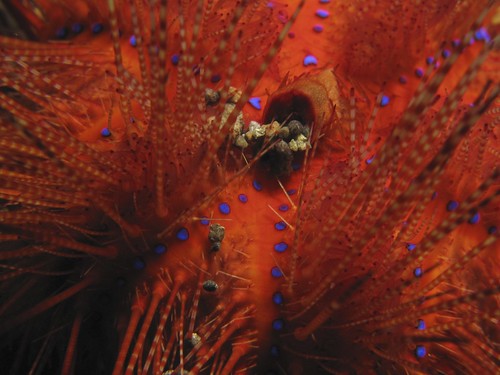
Radiant crap!
And of course there's pooping AND commensal crabs! TOGETHER.
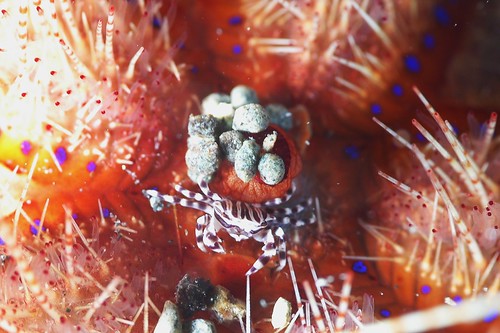
Urchin crab - Zebrida adamsii - T Tebal

Monday, February 27, 2012

Bacteria in the Belly of the Beast! Prokaryote Diversity in Abyssal Sea Cucumbers!

(photo from the USNM Invertebrate Zoology Collection)
This week a follow up to an earlier blog I wrote in October last year about microbes in the guts of deep-sea holothurians!

This new paper is by Teresa Amaro, University of Aveiro in Portugal and her colleagues and has been recently published in Deep-Sea Research I vol. 63: 82-90. (she also wrote the earlier paper that I wrote about above)

This paper focuses on this lovely echinoderm champion-the sea cucumber Molpadia musculus-which occurs throughout the North Atlantic, buried in deep-sea (circa 2000-5000 m depths) mud.
(photo from the USNM Invertebrate Zoology Collection)
Molpadia are infaunal deposit feeders-that is they live buried in the mud, head down with mouth directed into the soft, muddy goo... (the mouth is shown below-this is the part that faces into the mud! Lovely, yah?
(photo from the USNM Invertebrate Zoology Collection)

Their "tails" presumably face upward to permit the feces to vent out on the surface, following ingestion of the mud/sediment...
(photo from the USNM Invertebrate Zoology Collection)

Molpadia can occur in very high biomass and in great abundance on the deep-sea floor with some 220 individuals per square meter!!

Bacteria and Archaea on the Deep Benthic Floor!
So, you've got a big, living dirt-eating vacuum cleaner buried in the mud of the deep-sea floor. What are they doing down there?? What are they interacting with? Are they Eating?
(photo from the USNM Invertebrate Zoology Collection)

For years, it had been noticed that there is actually quite a lot of microbial life present in the oceans. Scientists have been using methods known as DNA fingerprinting to recognize the amount of life that is present on deep-sea bottoms.

The diversity we focus on here, emphasizes two of the major Kingdoms in the overall Tree of Life-The Archaea and the "Bacteria" or the Prokaryotes-those with less developed cells relative to the eurkaryotes. Note in the diagram below.. "Eurkaryota" refers to organisms with full and complete cells, such as algae, protists and all the animals.
(Image from Wikipedia)

The prior blog that I wrote about this showed that there different "kinds" of microbial life present not only on the sea bottom but actually IN the guts of these deep-sea sea cucumbers.

Amaro's newer paper now shows that there is an astonishing diversity of microbes associated with the gut contents in Molpadia musculus! And details the distribution and diversity of the kinds of microbes present.

Amaro and her colleagues surveyed the abundance of different prokaryotes both in the sediment (measured from sediment cores) and at different points along the gut of Molpadia and found this....
(Fig. 2 from Amaro et al., 2012)
First (top-Fig. 2a) , that the actual amount of prokaryotes (this includes both bacteria and archaea) was highest in the top 1 cm of sediment.

Second (bottom-2b) That after survey the abundance along the animal from the gut to the end, the greatest amount of prokaryotes was actually found in the oesophagus (i.e., the front end of the intestine) of the animal.

The latter result likely shows the result of digestion with most of the food (i.e. bacteria) being digested as it proceeds to the midgut and so on...

Both of these results make sense. Prokaryotes are settled out on the surface and the oesophagus (the front end of the intestine) is where all of that enters into digestion.

What kinds of bacterial diversity did they find?
The authors counted the diversity of bacteria in terms of Operational Taxonomic Units (OTU)s-that is a general term that refers to the different types of organisms or species present.

They found 28 to 71 OTUs in the surrounding sediments
but about 33 to 105 in the sea cucumber itself!
(Fig. 4 from Amaro et al, 2012)

The authors further compared the abundance and composition of the bacterial OTUs (i.e., the diversity) between the sea cucumber and the surrounding sediment.

Now, if the surrounding bacterial were food-one would expect the same diversity in the sea cucumber as in the nearby sediment.

BUT, as it turns out, about 40% of the bacterial OTUs were uniquely associated with the gut contents and were ABSENT from the surrounding sediments!

Some Further Dynamics from the paper...

1. Prokaryotes decrease in abundance along the gut. From the above Figure 2 we see the abrupt decrease of abundance of prokaryotes from the oesophagus to the hind parts. This was a 6-fold reduction from the oesophagus to the hind gut.

This suggests that GREATER than 80% of the total were digested by the animals.

2. Archaea vs. Bacteria in the Hindgut. They also found that among the prokaryotes-bacteria accounted for only about 55% of the total number found in the oesophagus but only 35% in the hindgut, BUT archaeans actually increased in the hindgut! Why? The authors suggest that the different kinds of prokaryotes are used differently across the intestine..

3. But do the prokaryotes keep Molpadia fed? Well, in a word: No.

It turns out that these bugs only contribute about 0.5% of the total organic carbon used by individuals in the study. The authors conclude that Molpadia, at least, does not rely in any significant way, on prokaryotes for their food requirements.

4. So, if not food-then what are they for?? As indicated above- the DNA fingerprinting identified the fact that the "bugs" in the surrounding sediment were significantly different from those in the sea cucumber itself.

So the authors conclude that the animal carries the prokaryotes around in its gut as commensals-possibly to facilitate digestion in a manner similar to how termites and some mammals (such as ourselves) carry around a prokaryote fauna to facilitate digestion. (think of it as yogurt for sea cucumbers!)

And so there we have it. Some deep-sea sea cucumbers are just big bags filled with prokaryotes that feed on mud and ooze!

Tuesday, February 21, 2012

What can the Internet do for Biodiversity? Let's study COMMENSALS!! Some biology can't be studied from samples!

Hostess with the Mostest
(photo by MerMate)
The Internet is amazing!

But often one gets the impression that a lot of people haven't quite realized the potential for discovery.
What can something as simple as humble as a photostream or video channel do for science?

Especially for something like exploring biodiversity? For looking at the many different kinds of animals -some that have yet to be discovered?

What makes the Internet so potentially important is YOU. Everyone out there. A nearly infinite amount of eyes, cameras, videos, talent, and interest.

What does that mean? That means that some people have the good (nay excellent!) graces to take pictures (and/or videos) of moments and/or species in places that many scientists just aren't or can't be. I believe the buzzword is "crowd sourcing".

Sources like Flickr and YouTube thus become great treasure troves of potential discoveries.  Moments and relationships caught of the live animals doing their thing!

So, today I thought I would use some videos and images to demonstrate some commensal relationships between sea stars/starfish) that most people don't often see because they are best seen in the wild when the animals are left to their own devices.

........But then, some incredible individual took a picture or video of it!

And in conjunction with a little bit of narrative (on my part) there is another layer of appreciation of these images as more than just aesthetically pleasing-but a representation of something in nature that everyone can enjoy. GO!

1. Fish Living commensally among the oreasterid Protoreaster nodosus


This video was exciting! I'd never heard of fish living in and around asteroids and have yet to discover prior accounts.

Was this unique or does it happen all the time? Are fish juveniles tied to sea stars? Is this important to their life cycle?

Note also the tiny little brittle stars living on the spines! Probably Ophiactis savignyi-a species of ophiuroid that may literally live everywhere!
Cool star 2 (photo by Mermate)

2. The benthic ctenophore Coeloplana living on the surface of Echinaster luzonicus
Benthic ctenophores on Echniaster  luzonicus (Coeloplana astericola)
(photo by Arne Kuilman)

So, what are these?

Ctenophores are usually found swimming in the water column like this (intro to the group in the video)

But some of the really WEIRD ones live on tropical bottoms and look like this.. (note the feeding tentacles emerging out of the two top "lobes")

But some of these benthic ctenophores are these worm-like forms and they actually live ON sea stars, such as this Echinaster luzonicusBenthic combjelly on Luzon seastar  (Coeloplana astericola)
(photo by Arne Kuilman via Flickr)
I don't know if they are necessarily rare..but people don't see them often. They can be difficult to see and who thinks to look for what is basically a bottom-living jellyfish??

On top of all this- the benthic ctenophores themselves almost never preserve well. So scientists have relativelly little data on them. When I learned about these in Invertebrate Zoology way back when, there was only a footnote about these critters.


If we were lucky-we MIGHT see one in our lifetime. Now-everyone can!
Parasitic flatworms Hostess with the Mostest
(photo by "MerMate" on Flickr)
Here's one close up..

Sea Star (Starfish) Rider
(photo by Mark Atwell via Flickr)

3. This looks like a polychaete and/or a flatworm living on another specimen of what looks like Echinaster luzonicus (Taiwan? or the Philippines?)
2010_0703_100935
(photo by Star Tsai via Flickr)

4. And finally,the shrimp Periclimenes that lives in and around various big tropical sea stars.

They're all called P. soror in the pictures but there seem to be so many-I'm not entirely sure its the same species.. But here's a bunch...

This one living on the ophidiasterid Linckia laevigata in Komodo, IndonesiaSoror Shrimp on Blue Starfish (photo by Fiona Ayerst)
this one on the Crown of Thorns-Acanthaster planci..4113 Commensal shrimp on crown-of- thorns

(photo by Diver Ken)
Periclimenes soror on Acanthaster ellisii
(photo by Olin Feuerbacher)
This one looks like a shrimp living in/around the uncommon oreasterid Halityle regularis
Pin Cushion Star and Periclemenes Shrimp
(photo by Shaun-in-Munich)
On/around the mouth of a "cushion star" so..Culcita?Shrimp On Cushion
(photo by pummkin)
In and around Echinaster luzonicus (oreasterids aren't the only ones with shrimp!)Who's the star?

(photo by MerMate)

If you had collected any of these shrimp without the asteroid (or vice versa) it would have been difficult to make the animal-animal association. What function do the shrimp serve? What do they get out of it? Protection?

These images may seem just like holiday snaps-but to some scientist-they may demonstrate some new species/behavior/relationship!

So, if you're in some exotic part of the world and have some weird, neat picture that you've never seen before let a biologist who knows a thing or two-take a look! You never do know...

And uh... for those with more...mercantile motivation, scientists don't do it for the money (and mostly don't have a lot to give away).

Tuesday, August 9, 2011

Spiny, Dangerous Sea Urchins and the Fish that Love them!

(Figure 2 from Moore & Auster, 2009)
Today, a neat bit of natural history from a short paper by Jon Moore at Florida Atlantic University and Peter Auster at the University of Connecticut published in the Peabody Museum of Natural History 50(2): 381-386 in 2009!

The paper is based on submersible (ROV) observations by the authors on three North Atlantic seamounts in the deep-sea (1410 to 1475 meters). The paper highlights an association that you simply wouldn't have seen if you had dredged these up in a net.

The observations are focused on deep-sea "pancake" urchins aka members of the Echinothurioidea! I wrote up a post on these years ago as one of Deep-Sea News' "best" Deep Sea species.. here. But the short version is this:

-Body Soft and collapses into flat shape when out of water (hence the term "pancake" urchin).
-Poisonous spines on top!
-Very old and were recognized from the fossil record before they were identified from living animals!
check ? Okay...

It turns out that in addition to all of that? Some FISH actually like to live on and around them! Specifically, baby CUSK eels! (family Ophidiidae).

(Figure 2 from Moore & Auster, 2009)
This pic shows the juvenile eel identified as Barathrites living in relationship with the echinothurioid urchin Hygrosoma petersi at 1488 m at Yakutat Seamount.


The urchin here is about 17 cm in diameter (fish is about 9 cm long).

Usually, these associations were of single eels living in and around the urchins, pecking at food and bits in the sediment-while swimming in and out around the spines and such.
 
(Figure 3 from Moore & Auster, 2009)
Moore and Auster believe that this is sort of a commensal relationship. The fish presumably gets some protection while it safely eats and forages. The urchin doesn't seem to get any obvious benefit..but doesn't seem too perturbed by the fish either...

Not every urchin gets some freeloading fish living in and around them!

Moore and Auster report that of the 37 urchins they observed, 89% of them (i.e., 33 urchins) did NOT have commensals.
(Figure 4 from Moore & Auster, 2009)
However there WERE different taxa that played host to baby cusk eels.. Their figure 4 shows a tiny little fish in association with another genus, Araeosoma fenestratum. Note that this is the proper name for the animal in their Fig. 4! Thanks to Dave Pawson. for the information!

Its important to point out that its only the juvenile cusk eels that seem to practice this "hiding among the sea urchins" type of behavior. Adult cusk eels apparently get quite big (62 cm in length! that's about 2 feet long!)..and yeah, no one's seen them hiding behind a 17 cm sea urchin!

What's kind of interesting about this behavior is how you see a similar KIND of behavior among completely unrelated fish in shallow water! Poisonous sea urchin spines just got that somethin' somethin'!!!

Shallow Water fish relationships
To compare, here is Diademichthys lineatus a relatively familiar shallow-water clingfish that lives in and around the spines of the well-known Diadema.

How closely associated are these fish? The name "diadem" refers to a spiny crown (i.e., the sea urchin) whereas "ichthys" refers to fish and "lineata" refers to the pattern on the body.. But their name is literally tied to their habitat!

According to a paper by Hiroko Sakashita in 1992, which was written about them here the relationship between this shallow-water species and their hosts are a bit more exploitive with juveniles feeding on body parts (pedicellariae and sphaeridia) as well as copepods that also lived as commensals..

As the animals grow into adults, their diet changes and they go after food that is more independent of the sea urchin.. clams and other small invertebrates elsewhere...


So..in both cases..it seems as if the fish get what they will out of it but then "outgrow" their hosts as they mature.

Bah! Isn't that just like a fish?

Tuesday, May 10, 2011

Three Things You might not have known about the Blue Linckia! aka Linckia laevigata


This week-thanks to questions from some of YOU-the Echinoblog pubic! I dug up some information on Linckia laevigata-aka the Blue Linckia.
For such a well-known species, I was surprised at how little was known about it..

And so here is the Echinoblog's "Three things you might not have known about Linckia laevigata!"

1. Linckia laevigata's reproductive strategy is NOT well- suited to a heavy fishery.
Linckia laevigata aka the Blue Linckia aka "finger starfish" occurs widely throughout the tropical Pacific and Indian Oceans in shallow-water reef type settings.

Sadly, most people have likely become familiar with this species because its collected and dried in the thousands and made into garishly-colored ornaments, such as the ones below...
Linckia laevigata is heavily trafficked in the aquarium trade and can be seen in many tropical fish tank videos...

Based on data from a paper by Micael, Alves, Costa and Jones from 2009, it turns out that Linckia laevigata is THE most commonly collected seastar in the aquarium trade.

Their survey indicates that Linckia laevigata accounts for 3% of the TOTAL global trade in marine invertebrates!!

Most specimens are taken from the wild throughout its Indo-Pacific range. It can be commonly encountered and easy to collect. Few if any are the result of captive breeding programs.

So, even though this species is not eaten-it is harvested and given the sheer numbers of individuals that are taken (even for a common species)-ya' gotta ask the question- "How Long Can that last???"


Yamaguchi both surveyed individuals in the field and also grew out juveniles and inferred growth rates based on the overall changes in size of those lab-grown specimens.

So, it turns out that from the time that a larvae is spawned the average juvenile (larvae) may take up to TWO YEARS for it to actually settle out and transform into an (small) adult!
Plus-smaller individuals were often absent from population surveys-suggesting that the number that reach breeding age (i.e., are "adults") is relatively low.

A large sized animal (and these approach about 1.5 feet in diameter) could easily be several years old...

So-bottom line is that these guys grow slowly and have a low turnover rate with few juveniles ascending into "adulthood" at a given time..

It seems likely that the reason for the abundance of these animals is largely due to long-term accumulation of those adults over time. And when those guys are wiped out-they're gone.


Yamaguchi noted that days after releasing marked individuals for his study-several of the tagged animals had vanished-likely taken by "reef-gleaners"....

2. Feeding & Ecology.
Probably one of the most widespread and incorrect assumptions (like this one) about tropical sea stars, such as Linckia laevigata is that it eats clams and meat in a manner similar to cold-water starfish species such as Asterias forbesi or Pisaster ochraceus. I have complained about this misunderstanding in other blogs..


So, here's the thing-L. laevigata feeds on bacterial biofilm, algae and/or whatever nutritious goo it can get its stomach on. They are considered herbivorous.

This is an intrinsic part of their biology. Some papers such as this one by Laxton (1974-I told you information was few and far between!) determined that L. laevigata's ecological significance may lie in its relationship to become more widespread following algal growth on coral following a big predatory binge by the coral eating Crown-of-Thorns Starfish (Acanthaster planci).

Yes, some of the more experienced aquarists are probably saying "But I have seen and fed this species clam meat (or fish or whatever) before..." And yes-that may be true-but honestly, how long do those animals live after that???

My guess is that feeding L. laevigata clams without any of their primary food-would be like feeding any human pork rinds for a whole year. It might be "food" but it would be a slow death...

3. Linckia laevigata plays host to a multitude of other animals (both parasitic & commensal)

There are actually quite a few OTHER invertebrates that live either as commensals or as outright parasites on L. laevigata.

I've reactions by people that this is some kind of bad thing. Truth is, these critters would only be found on a healthy animal. Discovering one of these is basically like an extra bonus-so, best to leave em' be...

Probably one of the most noticeable is Thyca crystallina-a parastic snail that lives attached to the (usuallly oral) surface of an individual starfish. Data on this relationship can be found here in a paper by Hugh Elder (1979). The snails are attached to the coelom via a proboscis.

Most of these attached shells are apparently female and the degree of infection of Thyca tends to be correlated with the degree of water movement with more active water associated with fewer Thyca per individual Linckia..

Here is a closeup...

and a more complete picture of where they live..
Another associated invertebrate? Is the commensal shrimp, Periclimenes soror


And yet another include the polychaete worm Asterophilia culcitae (and here's a bunch more pix)

Surprisingly-there was more known about some of the parasites than about Linckia itself!

What other roles do the parasites/commensals play? How else is Linckia important ecologically?