Showing posts with label Anal sac. Show all posts

Wednesday, July 13, 2016

Astropyga The Radial, Fiery Star Butt Urchin! Observed insights from Flickr & YouTube!

A happy July week to all of you! So, as we enter into the lull of the summer I present to you some choice Echinoblog image and video picks from various image streams that show off one the internet's most frequently photographed sea urchins! The diadematid ASTROPYGA! 

Common names of these urchins include "radial urchins" and "fire urchins." But many refer to echinothuriids in the genus Asthenosoma as "proper" Fire Urchins, for obvious reasons.. but mainly because they are VERY painful to get stung by..

Astropyga also appears to have a rather painful array of spines but I'm unsure if these pack quite the toxic wallop that Asthenosoma does..

Astropyga includes four known species, one in the tropical East Pacific and another in the Indo-Pacific and two in the tropical Atlantic. All are known to occur primarily from relatively shallow to mesophotic depths as we saw recently on a Bishop Museum expedition to the "Twilight Zone" (here) 

But even within the widely occurring Indo-Pacific species. A. radiata there appears to be quite a bit of color variation from the dark colors seen below to the lighter ones.

The genus name can be broken down to "Astro" meaning star and "pyga" which refers to rump or buttocks.. so the name literally translates to "Star Butt"!!.

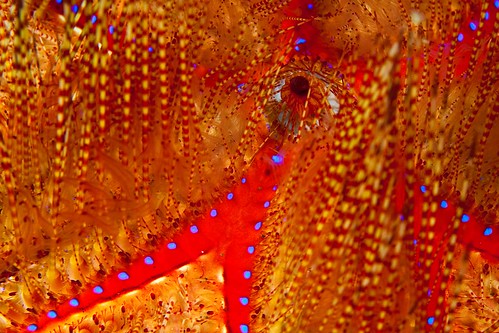
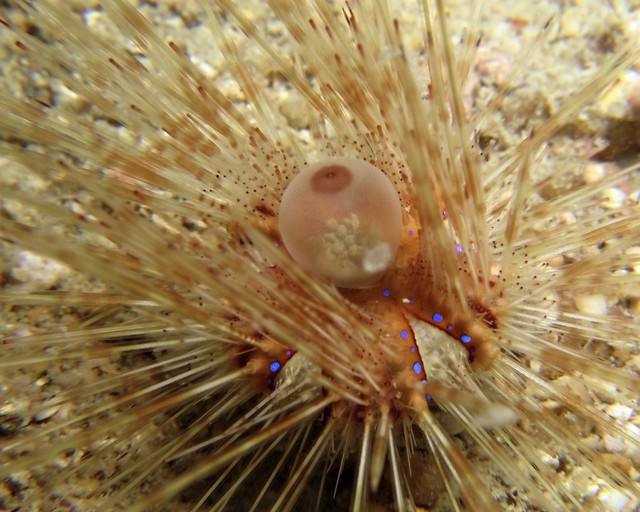
Why? Well, you see this giant bulb on the surface? That's an extension of the intestine called the anal sac. That's where the POOP comes out! I've talked about that here.  So, basically some wry taxonomist looked at the anal sac and the pentagonal symmetry and decided "yes. The STAR ASS!"
Fire urchin
Flickr and Youtube are GREAT for picking up on natural history observations. Yes, there's always the lack of scientific rigor but sometimes divers just make simple observations. And THAT can be the start of knowledge.

All the images below are probably A. radiata from the Indo-Pacific.

Astropyga scavenging on dead fish! (Lembeh)
Based on a round up of papers I could locate, A. radiata has been reported primarily as a scavengers, feeding on algal debris and other stuff from sediments, etc. But if this image is accurate (and not posed) they occasionally much on dead fish as well. This is actually consistent with other sea urchin feeding habits, so I feel comfortable in presenting it here..
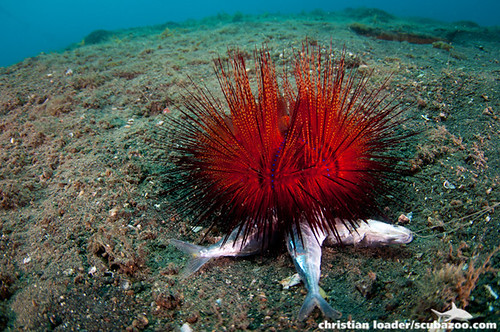
Radial Sea Urchin feeding on dead fish - Lembeh

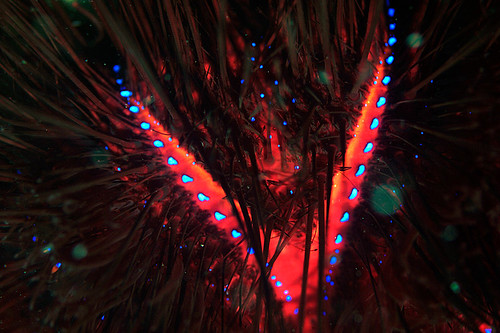
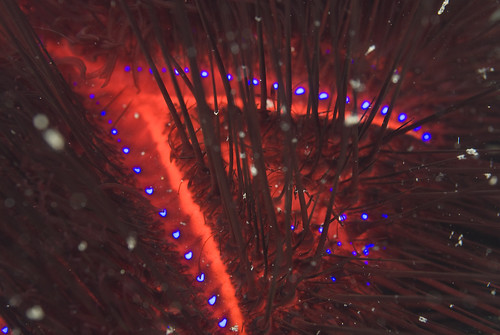
Blue Iridescent Spots! Its been speculated that these are photoreceptors but they've not been tested and its unclear exactly what their function is.. But they immediately stick out when observed on an otherwise bright red sea urchin! 
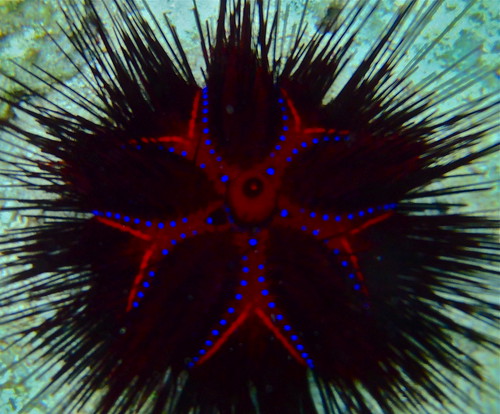
Astropyga radiata, Red sea urchin
Fire Urchin
75
magnificent urchin

Spawning!
This speaks for itself. As with other echinoderms I've shown here (such as the sea cucumbers) just because you see white fluid being emitted its not actually clear what sexes of the species are present. The fluids likely represent BOTH sperm AND eggs. 
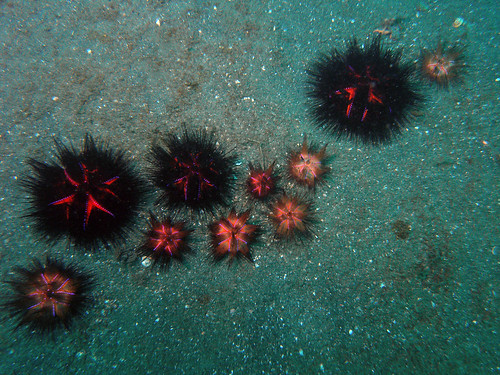
Sometimes this species form large aggregations, which are most likely to help facilitate their reproduction and sexy time!
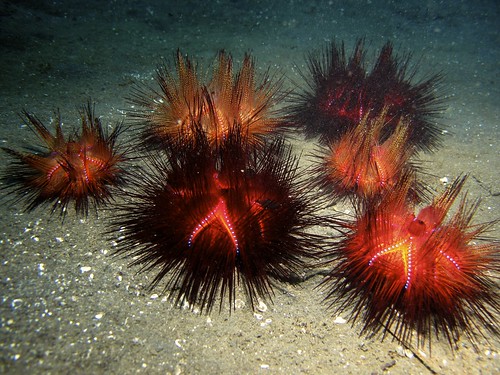
Urchins unite!Magnificent Urchin family
Astropyga moves surprisingly quickly!
While I haven't actually seen one of these alive and close up, its pretty clear that even for sea urchins they are capable of a surprisingly brisk sprints! and across some unusual terrains to boot! 

That's quite a lot of coordination of spines and tube feet at play.. 

here's a bunch of them in what looks like a mating aggregation, moving en masse!

Better yet! here's Astropyga moving in TIME LAPSE!

my first underwater timelapse from prodtv on Vimeo.

Crustacean Relationships! 
Sea urchins are basically big spiny balls that seldom move and surprise! surprise! There never seems to be a shortage of OTHER, smaller animals that can take advantage of this as "habitat."

 Crab Commensals!  These don't seem to be as bad as the crabs on Asthenosoma, (the proper fire urchins) simply because these don't seem to "dig" themselves into the urchin surface. Spines on Astropyga seem long enough to provide adequate protection as-is...
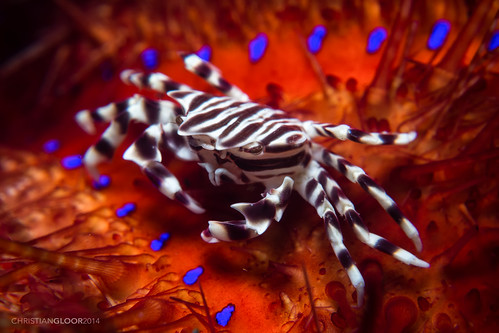
Walking on fire!
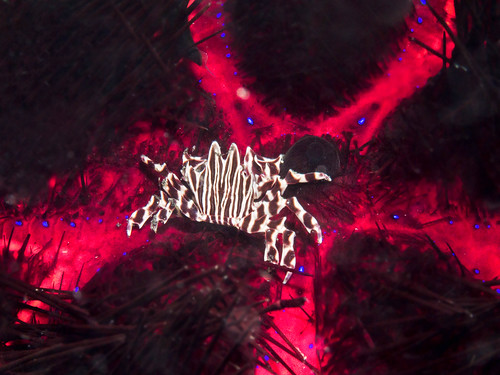
ZEBRA CRAB ON FIRE URCHIN, LEMBEH STRAIT

and vice versa?? Probably one of the most unusual things I've seen imaged by divers since Flickr and YouTube became a thing has been this.. Crabs in the family Dorippidae that PICK UP urchins, sea anemones and carry them on their carapace in order to use them as sort of a defense as they walk along the sea bottom.
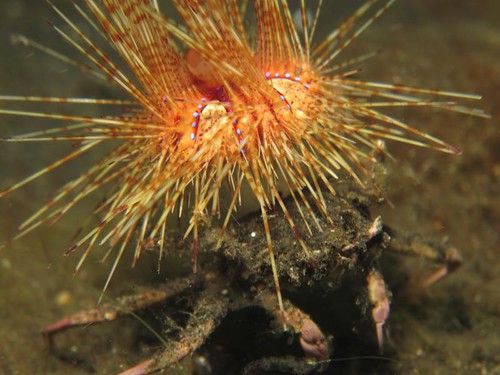
IMG_1077
But why explain? When you can just watch...

...and of course.. POOPING!
And finally, one of the things that we LOVE to watch urchins doing? POOPING! Something that is arguably part of their namesake!  Here's the time I corrected New Scientist on their mistaken urchin pooping picture! 

Here's a whole post on echinoderm anuses for your reading pleasure! 
Here's a lovely shot entitled "Radiant Crap" by Eunice Khoo!
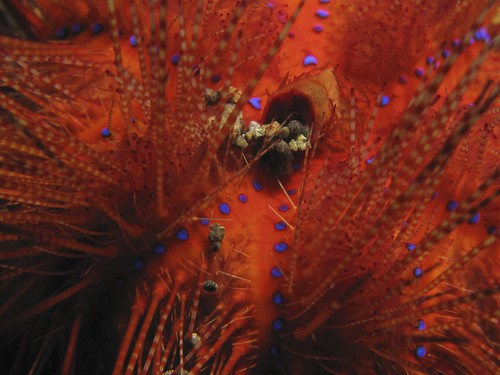
Radiant crap!
And of course there's pooping AND commensal crabs! TOGETHER.
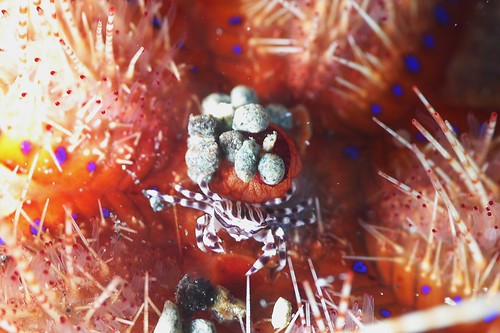
Urchin crab - Zebrida adamsii - T Tebal

Tuesday, April 26, 2016

The Diversity of Echinoderm Anuses!

Juvenile urchin
This week, in the category of "one of those posts only Echinoblog could write"! Let us explore the vibrant diversity of echinoderm anal structures!! Perfectly SAFE for Work! even though it contains the word "anal" and "anuses" several times! WOO!!

Echinoderms are pentaradial (aka pentameral). That is they show a form of radial symmetry wherein their body always occurs around a top-down axis in five parts (although arms, etc. may vary).

As a consequence, the overall dynamic of their life mode is different from an animal with bilateral symmetry. No face, no "front" or "back". Thus, the way food moves through the body is different depending on where the mouth is located and consequently, where the anus is located!!

Since each living class of echinoderms has a fairly unique shape and body morphology, each group has a bunch of unusual specializations that function to facilitate the expulsion of poop!

To be honest, not every member of each class below has what is shown below. These are unusually prominent examples..but it still begs the question "What is it used for?"  How many other animals have so many unusual anal adpations??

5. Crinoids: Anal Chimneys & Pyramids
So, crinoids are suspension feeders. They almost kind of resemble plants. Most living ones are known as "feather stars" and are basically cups with arms for filtering water. But earlier forms of crinoids are known as "stalked crinoids" which have a stalk. I had a gallery of the older Paleozoic ones here a few weeks ago..

Here's a living one from the recent Okeanos Expedition to the Marianas region to give you an idea of what they look like..

So, the mouth in stalked crinoids is inside that cup at the base of where all those arms converge. The anus for these animals is ALSO in the cup. So, there's likely a strategy/adaptation for these animals to push the poop/excreta OUT of the anus, such at it does not end up getting "re-eaten" by the mouth...

According to Fossil Crinoids by Hess et al.  there were several fossil (Paleozoic) forms which had fairly straightforward strategies for dealing with ensuring that poop was discharged FAR from the mouth..

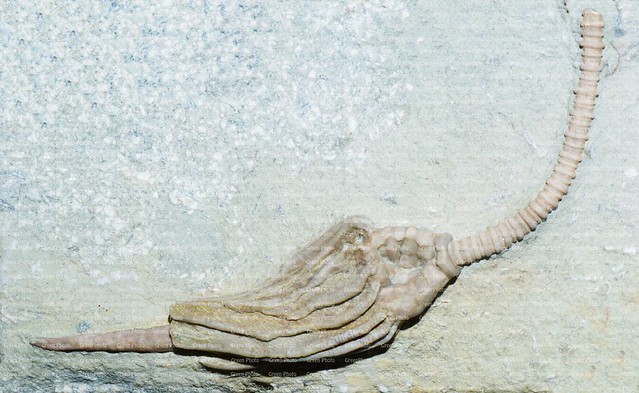
For example, here is the Mississippian Uperocrinus nashvillae with an explanatory diagram from Fig. 37 of Hess et al's book. Basically that huge pointed structure on top? That's called the anal tube  (or sometimes in other animals.. an anal pyramid or even an anal chimney!)

These extended structures serve to project the anus (and the excreted poop) well AWAY from the mouth (the feeding arms would come off right at that wide "ledge" around the center of the specimen..


There was a surprising diversity of these structures. Here's another one called Macrocrinus verneuilianus which is a fossil from the Carboniferous (the Paleozoic). The drawing below is taken from the Wooster Geologist blog and they point out that the elongate anal tube (in the lower left hand corner) aka the anal chimney may have even served an additional function beyond simply transporting poop away from the mouth:
The tube allowed waste products to be whisked away far from the mouth of the crinoid, which was at the base of the arms. Some researchers suggest that the long tube served another function as well: it may have helped stabilize and direct the filter-feeding fan of outstretched arms in a stiff current, something like the tail of an airplane or a panel on a weather vane.
Macrocrinus mundulus, Macrocrinus, Batocrinidae, Monobathrida, Crinoidea, Echinodermata, Deuteriostomia, Bilatera, LOCALITY- Montgomery Country - Indiana - USA, CARBONIFERO,

One last weird crinoid is this one: Bicidiocrinus wetherbyi
Another Mississippian (i.e Paleozoic) stalked crinoid.. and this is kinda weird. So, there's the cup and the arms and that cone is the anal cone (=tube, pyramid, chimney, etc.) BUT it also has this weird additional protective "spiniferous canopy" around it!!

The diagram on the right shows this fully "reconstructed"..

and the reconstruction from Hess et al. Fossil Crinoids-which is a GREAT book for these useful facts!                              
Ultimately, there is probably a WHOLE blog post or 5 about Paleozoic crinoids and what we know about their paleoecology.. I briefly touched on the snails that parasitize their anuses here.... 

One LAST MINUTE ADDITION: David Clark (@clarkeocrinus) provides this ASTONISHING Proteriocrinus with a very considerable anal chimney!! which looks to extend nearly the length of the cup and arms!
4. Sea Urchins: (Diadematidae) Anal Sac
Probably one of the best known but most poorly recognized of the various echinoderm anal structures is the ANAL SAC in diadematid (diadematoid?) sea urchins.

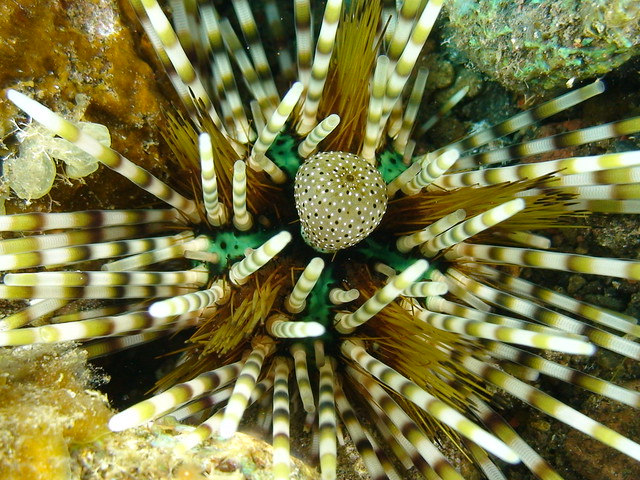
This includes Diadema, Astropyga, Echinothrix and all of urchins in this family. Usually these are tropical and characterized by long, sharp spines AND a very distinctive "anal sac" present on the TOP of the body.

The problem is that many people see this big eye-shaped ball on the top of the sea urchin body and assume that it is an eye of some kind...
Echinothrix calamaris urchin ind12b 0149
I can tell you most DEFINITIVELY that this structure is NOT the eye. I actually explained in great detail here how this was actually the unusual ANAL SAC which is characteristic of this type of sea urchin for an error in New Scientist.

That said, they DID publish a WONDERFUL picture by David Fleetham of Astropyga radiata venting poop OUT of the anal sac!!

Basically, this is a transparent or translucent bulb or sac extension from the anus through which feces passes on its way out of the body.

See those little round things that look like corn kernals? Sea urchin poop!
Here's another great pic found on Flickr, taken by Eunice Khoo of what looks like a small Astropyga sp. clearly showing poop THROUGH the transparent walls of its anal sac (aka anal cone).. 

Very nice capture. 
Juvenile urchin
But why take my word for it??  Go ahead and watch it here in this video of what looks like either Diadema or Echinothrix..  The poop event takes place at about 0:15 into the video.
               
But its not JUST shallow-water diadematid urchins that have this anal sac. Here's a deep-water Aspidodiadema from the recent Hawaiian Okeanos expedition. I talk a bit about these here

These were videos of these animals from 2000-3000 METERS below the surface. Aspidodiadematid urchins are classified in the same general group as diadematids. and they too seem to have this anal sac or cone...

3. Ophiuroids: Alas..brittle stars got no anus. In fact, food goes in and goes out the SAME hole: the MOUTH. So..bummer.
Brittle star oral side

2. Anal (or Epiproctal) Cone
Sea Stars/Starfish in a larger group called the Paxillosida (the mud and/or sand stars) have a specialized structure which sits right on the center of the disk called the anal or epiproctal cone.

A brief anatomical note- Although historically called an "anal cone" these starfish don't actually have a complete gut and so, the opening on the disk center is not actually the anus since it doesn't connect with the interestine. Hence the name "epiproctal":  EPI is Greek for "upon" and PROCT is Greek for "anus".. hence the cone or structure UPON the anus..
The cone is basically an outpocketing of the body, extending UPWARDS through the sediment
From (Fig. 2 from Shick 1976)
To quote myself from a few years ago:
Observations of Ctenodiscus under hypoxic conditions led to the illustration above. Basically, its thought that the cone gets more enlarged as hypoxia and hydrogen sulfide increases. The extension of the cone extends through the surface, with the tip at the surface. For your typical 6.0 cm diameter animal, these animals can have a cone that can attain 3 to 4 cm and extend 2 to 3 cm above the mud. It can leave this extended for over an hour. As the picture suggests, it can move around and push through sediment as the mud shifts, and etc. So, it can move around.
This also serves to make the top surface of the animal thinner, allowing easier gas exchange and opening up a channel to the surface water above the sediment surface!!
From Shick 1976 Marine Biology: http://link.springer.com/article/10.1007/BF00387613#page-1
So, in truth, the "anal cones" in these mud stars is NOT really an anus. Its where the anus would be located in other species..and so the labelling of this stucture is kind of a misnomer.. as they are not really used for defecation.

Other "mud stars" such as this deep-sea (3000-6000 m) Porcellanaster also have well-developed "anal cones". These starfish sit buried in sediment with these projections sitting up through the sediment. 
In contrast this shallower water Astropecten armatus has a much less developed anal or epiproctal cone. This is also related to the fact that it occurs in shallower water and tends to bury itself in somewhat less sediment compared to the above two species..
from CSU Fullerton: http://biology.fullerton.edu/biol317/ftm/ft_s15_cat_4_25_15.html

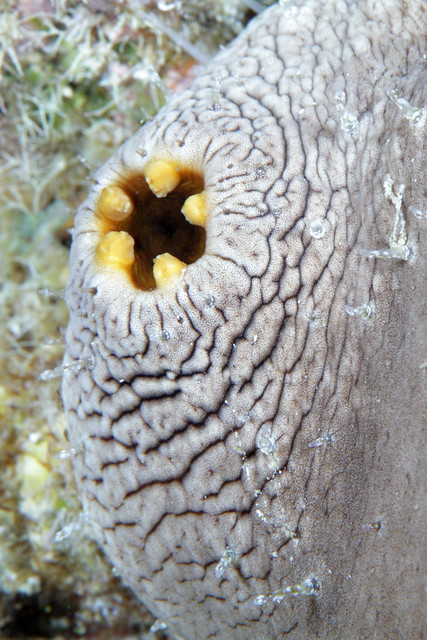
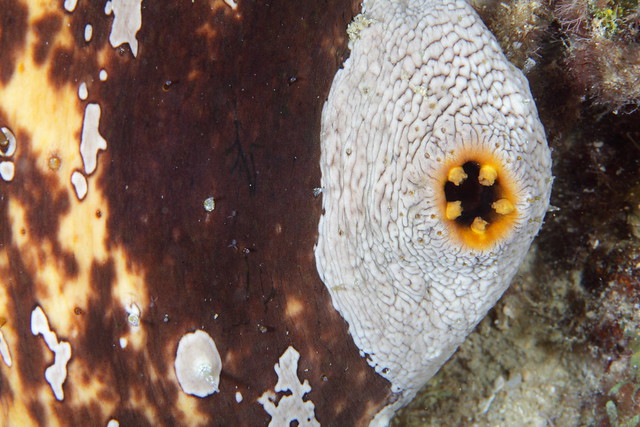
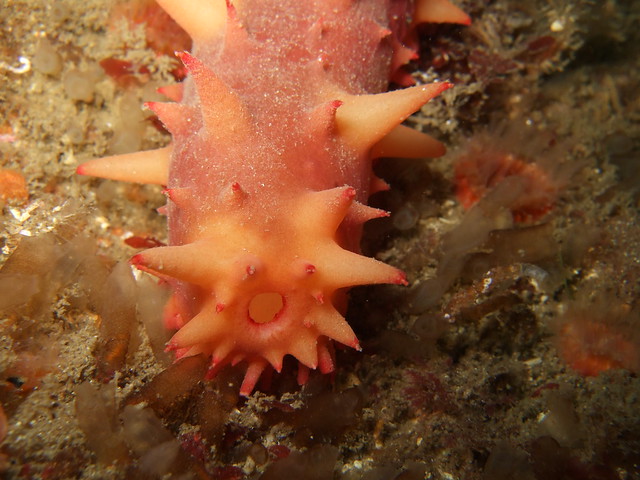
1. Sea Cucumbers (Holothuroidea): Anal Teeth
And finally, one of the best known of echinoderm anal defenses: the anal teeth in sea cucumbers!

I've reported on these before. There's at least one interpretation that these structures are defensive in nature and work to keep pearlfishes (and likely other commensals or parasites) from inhabiting the cloaca.

There's quite a few crabs and shrimps that live in and around sea cucumber anuses. See more here.
Sea Cucumber Anus

Sea Cucumber Anus

Sea cucumbers get kind of a special award for using their cloacal and other "ass end" chambers most efficiently..especially since some species can actually FEED and BREATH as water passes through the anal opening!! Read more about that here.
DSCF2985.JPG

So there you have it! The Astonishing Anuses of the Echinoderm World!