 |
| the red stalked crinoid Proisocrinus ruberrimus |
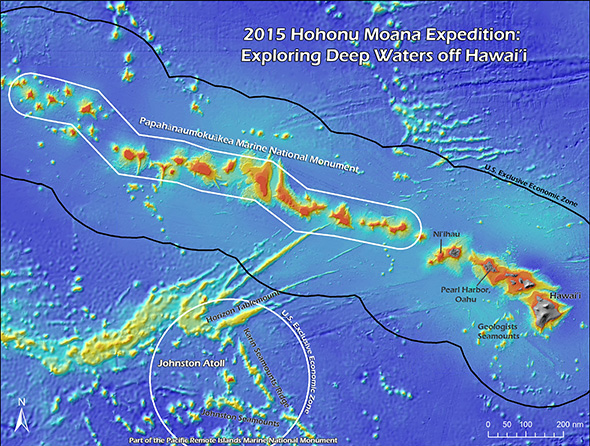
Papahānaumokuākea Marine National Monument and the ship has gone into port at Pearl Harbor to prepare for the third leg of the research expedition starting August 28th, surveying the main Hawaiian Islands and Geologists Seamount!! YOW!
In the meantime I also wrote a Mission Log for the last leg about starfish here.
What sorts of COOL inverts did we see in the last 7 days?? Here are the ones that caught my eye...
1. Benthic Ctenophores on Sponges Galore!
Many of you know that my blog showcases some of the most extraordinary examples of invertebrate diversity that I can find. I have talked before of my love of benthic comb jellies (aka ctenophores), which most people, if they experience them at all, encounter them in shallow water (here).
Long story short: these are similar to jellyfish, most are swimmers, but some are specialized to living on the sea bottom or other substrates.
They occur in the deep-sea but are VERY poorly known there. Here are what are undoubtedly NEW observations. Possibly even a new species of these animals living on glass sponges between 1000-2000 meters!


Here's a tight shot showing only a few with their tentacles extended. These tentacles were actually measured by the folks on the ROV. They can get to be OVER A METER (3 feet!) LONG!

2. The Rare(ly encountered) starfish Pythonaster sp.!
Exciting to me was the discovery of one of the "holy grail" of deep-sea starfishes: A species in the genus Pythonaster! NOT PREVIOUSLY KNOWN FROM HAWAII! Or for that matter, this far in the Pacific!!
We have seen a different species of Pythonaster in the Atlantic on previous Okeanos cruises (here), but those were known from older records. Not only were these new, but now we had pics of them FEEDING on a sponge!! AMAZING!
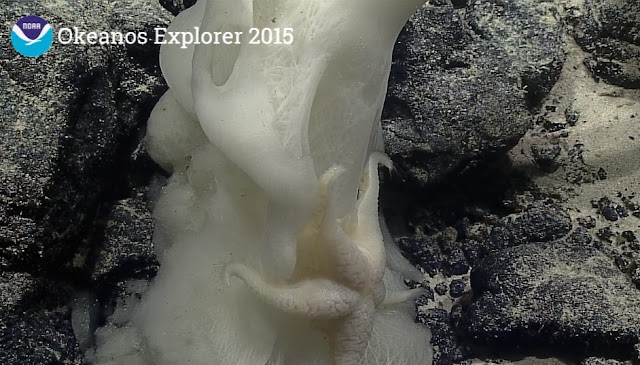
Worldwide, there are less than maybe 10 specimens of this genus known!

3. A bizarre community of deep-sea tunicates, barnacle plates and...????
So, the last day the ROV from Okeanos Explorer was deployed they investigated a channel between west Nihoa and West Pac where the water current was quite strong.
They encountered sponges (of course!) but curiously also a number of other bizarre members that formed an unusual deep-sea community.

These are those brown potato shaped things in the picture above. Note how they are all clustered together in neat, almost ordered serial rows.
Weird.

Also observed were these odd little yellow blobs, which formed long, reticulating networks. It was unclear what these were. Maybe more tunicates?? sponges??

But they were ALL OVER the place!! see all those long drippy yellow threads?? THOSE were all of those little yellow/gold blobs...

Basically, it came down to the act that we were seeing these giant barnacle plates ALL OVER the bottom in HUGE abundance. Here's a close up, but you can see them above in the pictures.
But WHERE WERE THE LIVING ONES?

FINALLY the Okeanos Explorer team discovered them!! They were apparently giant deep-sea forms in the genus Chirona, But they were nowhere NEARLY as abundant as they were turning up in the barnacle "mounds". What happened?? Weird.

4. PURPLE CRITTERS!
Some animals in the deep sea are purple.
A purple squat lobster. Not sure if they got a name to it.


5. Nice Shots of the Slime Star Hymenaster! But which one?
I have written about the oh-so lovely and unusual members of the Pterasteridae before (here). And we see them in deep-sea habitats all over the world.
But in the Indo-Pacific there is a HUGE expanse with MANY, many more species to be considered!
Here is a species observed by Okeanos Explorer just a few days ago! The hole, which opens and closes is called an osculum.


Purple slime sea star (video)
#Okeanos pic.twitter.com/iXyTpN0fVt
— Steven Hornik (@shornik) August 17, 2015
I've studied Hymenaster in Hawaii before. This one, from an expedition I was on in 2001, was identified as Hymenaster pentagonalis, described by Walter K. Fisher in 1905


Or this ONE?? Deep Sea MYSTERIES!!???
Many other cool critters seen-but I leave you with an assortment of weird glass sponges....


What will the next leg of the Okeanos Expedition discover??


