Showing posts with label pythonaster. Show all posts

Friday, August 21, 2015

Okeanos Round up! Last week in the Papahānaumokuākea Marine National Monument!

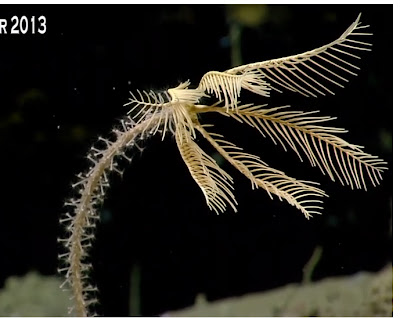
the red stalked crinoid  Proisocrinus ruberrimus
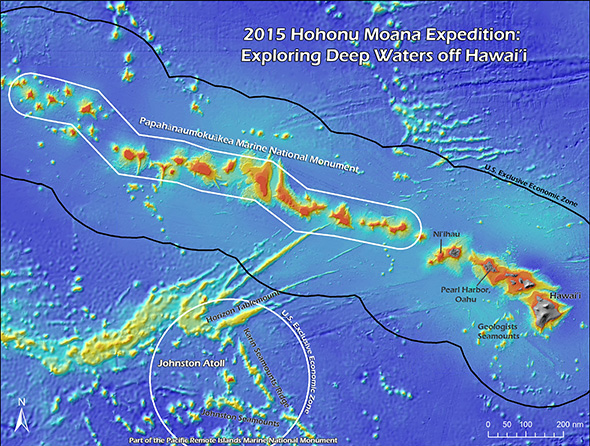
So, sadly, the Okeanos Explorer's first leg has come to a close as it has concluded its survey of the 
Papahānaumokuākea Marine National Monument and the ship has gone into port at Pearl Harbor to prepare for the third leg of the research expedition starting August 28th, surveying the main Hawaiian Islands and Geologists Seamount!! YOW!
What sorts of COOL inverts did we see in the last 7 days?? Here are the ones that caught my eye...
1. Benthic Ctenophores on Sponges Galore! 
Many of you know that my blog showcases some of the most extraordinary examples of invertebrate diversity that I can find. I have talked before of my love of benthic comb jellies (aka ctenophores), which most people, if they experience them at all, encounter them in shallow water (here). 

Long story short: these are similar to jellyfish, most are swimmers, but some are specialized to living on the sea bottom or other substrates.

They occur in the deep-sea but are VERY poorly known there. Here are what are undoubtedly NEW observations. Possibly even a new species of these animals living on glass sponges between 1000-2000 meters!

Here's a tight shot showing only a few with their tentacles extended. These tentacles were actually measured by the folks on the ROV. They can get to be OVER A METER (3 feet!) LONG!

2. The Rare(ly encountered) starfish Pythonaster sp.!
Exciting to me was the discovery of one of the "holy grail" of deep-sea starfishes: A species in the genus Pythonaster! NOT PREVIOUSLY KNOWN FROM HAWAII!  Or for that matter, this far in the Pacific!!

We have seen a different species of Pythonaster in the Atlantic on previous Okeanos cruises (here), but those were known from older records. Not only were these new, but now we had pics of them FEEDING on a sponge!!    AMAZING!
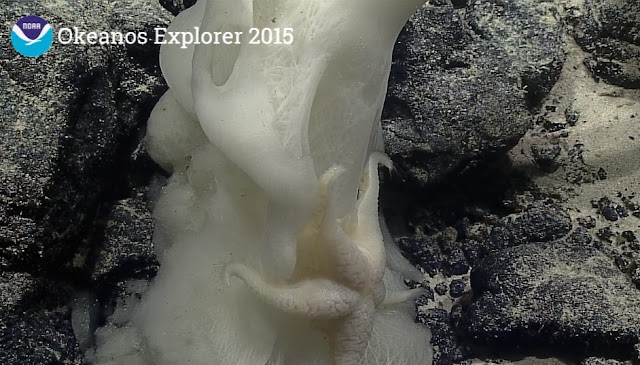
NOTHING has been known about the biology of Pythonaster. In one picture, we now have MORE information on its biology than we've known since this animals' description in 1885!!!

Worldwide, there are less than maybe 10 specimens of this genus known!

3. A bizarre community of deep-sea tunicates, barnacle plates and...????
So, the last day the ROV from Okeanos Explorer was deployed they investigated a channel between west Nihoa and West Pac where the water current was quite strong.

They encountered sponges (of course!) but curiously also a number of other bizarre members that formed an unusual deep-sea community.
This community was made up of tunicates (Chordata-the same phylum to which humans belong!) aka sea squirts. These are filter feeders but not one of the usual species of tunicates one expects to find between 1000 and 2000 meters!!

These are those brown potato shaped things in the picture above. Note how they are all clustered together in neat, almost ordered serial rows.

Weird.
Also observed were these odd little yellow blobs, which formed long, reticulating networks. It was unclear what these were. Maybe more tunicates?? sponges??  
But they were ALL OVER the place!!  see all those long drippy yellow threads?? THOSE were all of those little yellow/gold blobs...

One other part of the mysterious west Nihoa community (and indeed all over the place): The  mystery of the dead barnacle graveyard??

Basically, it came down to the act that we were seeing these giant barnacle plates ALL OVER the bottom in HUGE abundance. Here's a close up, but you can see them above in the pictures.

But WHERE WERE THE LIVING ONES?
FINALLY the Okeanos Explorer team discovered them!! They were apparently giant deep-sea forms in the genus Chirona, But they were nowhere NEARLY as abundant as they were turning up in the barnacle "mounds". What happened?? Weird.

4. PURPLE CRITTERS!
Some animals in the deep sea are purple.

A purple squat lobster. Not sure if they got a name to it.
The stoloniferous octocoral Clavularia.
The gorgonian Victogorgia sp.
and this cute little jellyfish, which thanks to George Matsumoto at MBARI I know is called Crossota millsae!!

5. Nice Shots of the Slime Star Hymenaster!  But which one? 
I have written about the oh-so lovely and unusual members of the Pterasteridae before (here). And we see them in deep-sea habitats all over the world.

But in the Indo-Pacific there is a HUGE expanse with MANY, many more species to be considered!

Here is a species observed by Okeanos Explorer just a few days ago! The hole, which opens and closes is called an osculum.

and thanks to Steve Hornik(@shornik ) this VIDEO!
I've studied Hymenaster in Hawaii before. This one, from an expedition I was on in 2001, was identified as Hymenaster pentagonalis, described by Walter K. Fisher in 1905
It emits a healthy defensive mucus!!
So, what is this purple one???
Or this ONE??  Deep Sea MYSTERIES!!???


Many other cool critters seen-but I leave you with an assortment of weird glass sponges....
What will the next leg of the Okeanos Expedition discover??

Tuesday, August 6, 2013

Echinoblog's Okeanos Explorer Deep-Sea Round Up!

So this week was one of the biggest Marine Biology Events EVER! It was on TV almost ALL DAY (and for the next several days) and involves some of the Earth's most mysterious and unusual animals!

I am of course talking about the 2nd leg of NOAA Okeanos Explorer Northeast US Canyons Expedition 2013!!!  (disclaimer: I am not an employee of NOAA)
Quick Summary: NOAA has a research vessel which travels the world deploying a robot (Remotely Operated Vehicle or ROV) equipped with many HD cameras and a huge ability to record images from the deep-sea.

The Okeanos Explorer has been to Indonesia and many other locales, such as the Galapagos and the deeps off the Caymans, but is currently operating off the east coast of North America, surveying and studying a series of deep-sea canyons and seamounts as seen here.  Those on the legs I've seen (2nd leg?) are in white arrows...
Original Image for this map here
Here is their telemetry which gives you an idea of where they've gone. Some of their dives are VERY deep, down to nearly 3300 meters!!

The Okeanos Explorer is the mothership for the robot (the ROV) which is tethered to the ship as such.. there is an accessory ROV which aids in navigation and so forth...

All of these operations are monitored from a neat control center back on the mother ship...

The AWESOME thing about the OE program is that the HD video from the ROV via the ship can be BROADCAST LIVE OVER THE INTERNET!! 

And so for the last week we have been listening to the awesome narration of two experienced deep-sea scientists: Dr. Martha Nizinski, a deep-sea crustacean specialist at the National Systematics lab in Washington DC and Dr. Amanda Demopoulos, a research ecolgoist/ geologist for the United States Geological Survey
Those who have tuned into the LIVE REALTIME video broadcast have been able to watch "over the shoulder of scientists" as NEW deep-sea habitats are explored!!

What's even more fantastic? Many deep-sea biologists, some world experts in the field, are actually listening in via phone, or via internet forums. I'm one of the world's experts on starfish and I'm monitoring via Twitter (@echinoblog) and via conference call.

Each day of the expedition can go anywhere from 5 to 7 hours. So there's a LOT of footage. So here.. I present some of the highlights of new discoveries and neat, weird deep-sea animals from the last few days of video footage.

There's still more to come and undoubtedly, I've undoubtedly missed some but this gives you a nice overview of new discoveries and awesome stuff from the 1000+ meter deeps off the east coast of North America!

My thanks to Dr. ChrisKellogg (@drchriskellogg) whose "Screen Grab Fu" was FAR superior to mine!

A NEW cold seep community in Nygren Canyon!
A cold seep is a place where toxic materials, such as sulfides, hydrocarbons or methane leech out the bottom and into the water (see here for more info). Animals and other organisms take on special adaptations, such as the ability to absorb and process these toxic materials, so that they can live there in a similar fashion to the way special worms and clams live in hydrothermal vents habitats.

These animals are heavily studied and are important to ecologists as well as physiologists and even scientists researching astrobiology (those that explore how life on other planets originated in extreme habitats)

Cold Seep habitats are unusual and when found, they are often monitored by the scientific community for study because of their potential importance.

This Stalked Crinoid with weird projectons
Stalked crinoids are an older form of crinoids and resemble animals seen in the fossil record (here for some examples)

and certainly the OE expedition saw its share..
What was weird about this one?  look closely...
The stalk is COVERED by tiny little protrusions!!
 
Parasites? Commensals Part of the animal?  A new species?  MANY questions! 
Sea Spiders aka Pycnogonids crawl on deep-sea corals and other cnidarins
Here's one on a sea pen
Another crawling on some deep-sea coral


Weird & Rarely Seen Deep-sea starfish species!
This starfish, called Pythonaster, is known from fewer than 6 specimens in the entire world. This is the 2nd time this animal has been observed alive and the FIRST time it has been observed alive in the Atlantic. 
Here is a plate of this animal from the HMS Challenger Expedition, which described it in 1889!! 
This starfish, Neomorphaster, is better known to scientists, but seeing it alive like this? That's not something that happens often.
This looks to me like the starfish Hymenaster, a member of the Pterasteridae, aka the "Slime Stars" which you can go here to read more about!  See that little center hole on top? That's called the osculum. and that's where the slime comes out! It opens and closes to allow water in and out.

Starfish Eat a LOT of stuff
I've written about deep-sea coral eating starfish before (go here). I've described more than a few species of deep-sea predators. Here's Evoplosoma hanging on and probably feeding on whatever that grey stuff is (probably some octocoral)

Is this why so many Neomorphaster are missing two arms???? 


Brittle Stars Live on EVERYTHING
They live on other echinoderms-such as this stalked crinoid
This deep-sea octocoral...


Other animals we saw a lot of....
Barnacles! Deep-sea barnacles are thought to be old relative to their shallow relatives..

Glass Sponges!  aka the Hexactinellida.  These are literally animals made of glass fibers. Their bodies take on really remarkable shapes. There were a lot of these. Especially on Mytilus Seamount. 

This one floats on a long stalk!

whew! Anyway this doesn't scratch the surface of ALL the weird and wonderful things that were seen during the expedition. 

Go HERE to see the Expedition log 

Daily Expedition Updates are HERE.

What more amazing creatures and ecologies will they discover??