I am of course talking about the 2nd leg of NOAA Okeanos Explorer Northeast US Canyons Expedition 2013!!! (disclaimer: I am not an employee of NOAA)
Quick Summary: NOAA has a research vessel which travels the world deploying a robot (Remotely Operated Vehicle or ROV) equipped with many HD cameras and a huge ability to record images from the deep-sea.
The Okeanos Explorer has been to Indonesia and many other locales, such as the Galapagos and the deeps off the Caymans, but is currently operating off the east coast of North America, surveying and studying a series of deep-sea canyons and seamounts as seen here. Those on the legs I've seen (2nd leg?) are in white arrows...
 |
| Original Image for this map here |

The Okeanos Explorer is the mothership for the robot (the ROV) which is tethered to the ship as such.. there is an accessory ROV which aids in navigation and so forth...


The AWESOME thing about the OE program is that the HD video from the ROV via the ship can be BROADCAST LIVE OVER THE INTERNET!!
And so for the last week we have been listening to the awesome narration of two experienced deep-sea scientists: Dr. Martha Nizinski, a deep-sea crustacean specialist at the National Systematics lab in Washington DC and Dr. Amanda Demopoulos, a research ecolgoist/ geologist for the United States Geological Survey

What's even more fantastic? Many deep-sea biologists, some world experts in the field, are actually listening in via phone, or via internet forums. I'm one of the world's experts on starfish and I'm monitoring via Twitter (@echinoblog) and via conference call.
Each day of the expedition can go anywhere from 5 to 7 hours. So there's a LOT of footage. So here.. I present some of the highlights of new discoveries and neat, weird deep-sea animals from the last few days of video footage.
There's still more to come and undoubtedly, I've undoubtedly missed some but this gives you a nice overview of new discoveries and awesome stuff from the 1000+ meter deeps off the east coast of North America!
My thanks to Dr. ChrisKellogg (@drchriskellogg) whose "Screen Grab Fu" was FAR superior to mine!

These animals are heavily studied and are important to ecologists as well as physiologists and even scientists researching astrobiology (those that explore how life on other planets originated in extreme habitats)
Cold Seep habitats are unusual and when found, they are often monitored by the scientific community for study because of their potential importance.
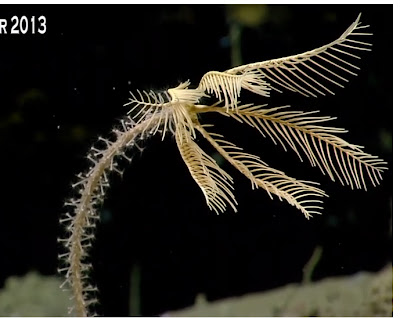
This Stalked Crinoid with weird projectons
Stalked crinoids are an older form of crinoids and resemble animals seen in the fossil record (here for some examples)
and certainly the OE expedition saw its share..


Parasites? Commensals Part of the animal? A new species? MANY questions!

Here's one on a sea pen


Another crawling on some deep-sea coral


Weird & Rarely Seen Deep-sea starfish species!
This starfish, called Pythonaster, is known from fewer than 6 specimens in the entire world. This is the 2nd time this animal has been observed alive and the FIRST time it has been observed alive in the Atlantic.
This starfish, called Pythonaster, is known from fewer than 6 specimens in the entire world. This is the 2nd time this animal has been observed alive and the FIRST time it has been observed alive in the Atlantic.

Here is a plate of this animal from the HMS Challenger Expedition, which described it in 1889!!


This looks to me like the starfish Hymenaster, a member of the Pterasteridae, aka the "Slime Stars" which you can go here to read more about! See that little center hole on top? That's called the osculum. and that's where the slime comes out! It opens and closes to allow water in and out.


Starfish Eat a LOT of stuff
I've written about deep-sea coral eating starfish before (go here). I've described more than a few species of deep-sea predators. Here's Evoplosoma hanging on and probably feeding on whatever that grey stuff is (probably some octocoral)

Here is the starfish Solaster which I've written about as a predator on other sea stars (go here)

Is this why so many Neomorphaster are missing two arms????


They live on other echinoderms-such as this stalked crinoid

This deep-sea octocoral...


Barnacles! Deep-sea barnacles are thought to be old relative to their shallow relatives..


Glass Sponges! aka the Hexactinellida. These are literally animals made of glass fibers. Their bodies take on really remarkable shapes. There were a lot of these. Especially on Mytilus Seamount.


This one floats on a long stalk!

Go HERE to see the Expedition log
Daily Expedition Updates are HERE.
What more amazing creatures and ecologies will they discover??


