Showing posts with label Hexactinellida. Show all posts

Thursday, August 10, 2017

Okeanos Explorer Communities & Deep-Sea Discoveries!


I'm BACK! After a month at sea with 2.5 weeks worth of dives I've safely returned to "home base" in Washington DC! I was out in the central Pacific with NOAA's R/V Okeanos Explorer on their Laulima O Ka Moana expedition, exploring the deep-sea of the Marine National Monument in the Central Pacific! 


1. Forest of the Weird: Land of the Glass Sponges!
This was probably the most amazing thing I have seen in awhile! (at least since that Basket Star community in the Marianas a few years ago!)

So, the key thing about nearly ALL Of these sponges? Many of them are what's called GLASS SPONGES aka members of the Hexactinellida. That means they have bodies which are made out of silicon oxide!

These often have bizarre and weird shapes. I have done a post about these before here in 2015.

Here's a highlight video of the discovery-basically water currents ran at an ideal rate at the top of this geologic feature making it IDEAL for what seems to be a huge abundance, if moderate diversity of glass sponge species!

Note also how all of them are turned into the current!! We were in this "forest of the weird" for the remainder of the dive (over an hour) so there was quite a lot of it..
Here's few more that show off the crazy architecture.. These varied in height from one to four feet in height..

2. The Carnivorous Sponge Field
This area was kind of the opposite to the one above. Rather than big and obvious, it was quite dense and discontinuous, being present on one big boulder to another...

But what was amazing was that this was composed of a different type of sponge in the family Cladorhizidiae. (possibly in the genus Asbestopluma..) Cladorhizids are not glass sponges and have physical properties more like what's seen in many other sponges. EXCEPT...

...that they are CARNIVOROUS!!!

Wait.. WHAT? Yup. MOST sponges are filter feeders. But in this group, they use glue or spines to capture prey, which are then digested by the animal in question. We've seen different types of these carnivorous sponges before, including some possible new species..  These sponges kind of look like a feather.. a central stalk with fine hairs or spines coming off the sides

Similar to this species in the NOAA benthic inverts guide...

Here..they were present in HUGE densities.. alongside some frond-like bryozoans! and some stoloniferous zoanthids (a sea anemone like cnidarian)  These actually seemed to be pretty thin at first but got bigger, longer and thicker as we encountered them!

Yes.. I suppose I'm overhyping them..but that's basically a "killing field" of carnivorous sponges!  with these projecting into the
Interestingly, this shot above looks like there might be a snail on one of those sponges..so even more going on!

3. This Amazing Farreid Sponge/Acanthogorgia Wall! 
Shallow-water dives can be VERY productive but because of the nature of Okeanos Explorer we tend not to do many of them relative to the really deep dives (>1000 m).

The one we did at Johnston Atoll did NOT disappoint!

This large block and several like it had this AMAZING side flanked on one side by sponges in the Farreidae, but then on another side covered by octocorals in the genus Acanthogorgia!

The coral side (Acanthogorgia) was relatively high current...
versus the "sponge side" which was relatively low current...

and many critters were to be found amongst the corals (such as this... sea slug)

3. Astrophiura! the "sea star ophiuroid" Probably one of the MOST memorable observations for me OUTSIDE of the starfishes was this weird little brittle star!

One of the videographers, Bob, saw it adjacent to the base of one of the sponges. And there it was plain as day!

These animals are TINY. Maybe dime sized. So, the D2 camera's caught a really RARELY ENCOUNTERED and SMALL species.. (about 2000 m depth)
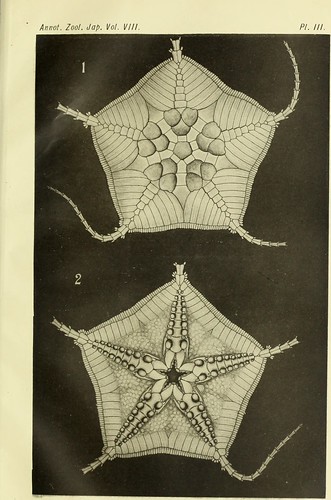
This genus of brittle star was described in the 19th Century by Walter Percy Sladen, the author of the HMS Challenger sea star monograph. He hypothesized that it was some kind of "missing link" between brittle stars and sea stars... (since been disproven)

Here is some imagery of as illustrated by H. Matsumoto.. It has rather famously been shown in echinoderm books as an example of a bizarre form.  Its shape is very similar to those caymanostellids and is thought to be an adaptation to lying flush on the substrate..

Astrophiura kawamnrai n. sp.
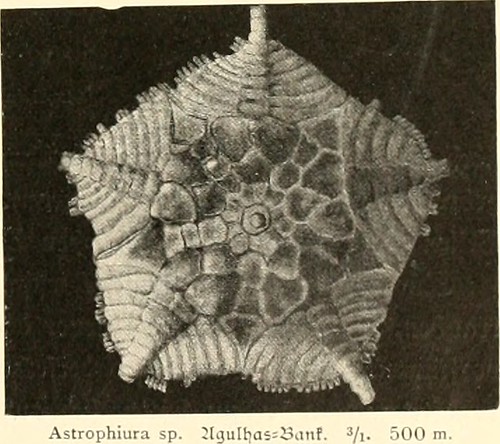
Image from page 210 of "Aus den tiefen des weltmeeres" (1903)
Image from page 662 of "Annotationes zoologicae japonenses / Nihon dōbutsugaku ihō" (1897)


4. Pumpkin Sized Echinothuriids Sea urchins! 
This dive started out pretty uneventfully up slope along a cone, resulting in the discovery of a pretty amazing colony of plexaurid corals

As I've mentioned with some of the OTHER high density communities- not only were there corals present but LOTS of other animals living among them.. 

One of the most remarkable? These HUGE echinothuriid urchins!!  For those who might not be familiar.. these are aka "pancake" or "tam o shanter" urchins. You can see more about them here (with links therein). 

Basically, these are soft-bodied sea urchins which often have poisonous spines and little walking legs.

But the ones we saw on this peak? just ENORMOUS.

The lasers are 10cm across,(about 4 inches)..so, okay this one is only about 8 inches across
but we panned across to another ledge and found a few more...
This darker brown one ended up being about 2 laser lengths..so about 8 inches across! that's basically the size of a small pumpkin! do they get bigger?

Wikipedia lists the "largest" species at 14 inches (36 cm) but did not elaborate on species..(will need to check). But if that's the upper limit, then 8 inches is definitely monstrous!


5. A deep-sea... NUDIBRANCH??
This one was quite a surprise, because I had largely thought that sea slugs were limited to relatively shallow depths, much less PROPER nudibranchs which are overwhelmingly found in nearshore settings.

This looked pretty bigh on camera and was about 5 inches long? when we collected it..

Amazingly, there is one genus of proper nudibranch in not only the Antarctic but in the deep-sea: Bathydoris!  I'm not sure quite yet what they eat but will find out!


How will the species we collected compare??? Stay tuned! (and thanks to Vanessa Knutson for her help with the ID!)

That's a quick recap of some of the non-sea star events..but I'll post more as opportunity permits!  THANK YOU to the crew of the Okeanos Explorer, NOAA and my science team colleagues for inviting my participation!


Friday, August 14, 2015

This Week in Okeanos! A digest of Hawaiian deep-sea invertebrates seen over the last week!

Over the last few days, the R/V Okeanos Explorer has deployed its Remotely Operated Vehicle, the Deep Discoverer into some of the deepest waters in the Hawaiian Islands region, specifically in the Papahānaumokuākea Marine National Monument!  Many of the study areas have never been studied before.

The Okeanos Explorer's primary objective here is to map and document the communites which form the habitat and primary fauna of this region. And so, a majority of their time goes towards studying the many, MANY deep-sea sponges and corals which make up these habitats. 

The main page for the NOAA Hawaiian Expedition can be found here.

Their LIVE feed can be found here.


I've been tweeting the LIVE stream of the Okeanos' various discoveries and last week I documented the many, MANY different types of glass sponges seen by the Okeanos Explorer. 

This week I thought I would just digest some of the various discoveries made which I thought warranted a place in today's post! Although most of the screengrabs here are mine, I am ETERNALLY grateful to the Facebook Underwater screengrab group! 

1. Is this the world's LARGEST KNOWN SPONGE??? (Glass sponge or otherwise??)

Here was a pic of the ROV Deep Discoverer NEXT to the sponge. it was approximately 3.5 m long X 2.5 m tall, that's about 11 feet x 8 feet LONG!
Sponges and corals are known as "ecosystem engineers" because they play host to numerous other species and essentially become huge hubs of biodiversity. Many, MANY other animals live on these sponge colonies: brittle stars, starfish, squat lobsters, etc. the list goes on...


SOMETIMES, the community is a little more permanent than others. Here's a shrimp which lives inside this "glass cage" sponge. This species mates and lives inside the sponge for the rest of its life...

This story, of the "Venus flower basket" which is a pretty obvious deep-sea invertebrate "love story" is seen in the genus Euplectella. One can find more accounts of this story all over, such as here. 


2. Starfish FEED on glass sponges!
You wouldn't think there would be much on a glass sponge to eat, being composed primarily of... glass (see last week) but there IS that syncytium, the weird cytoplasm like stuff that covers the glass skeleton and a starfish has gotta eat.. 

Some goniasterid that is not clearly identifiable..
A "wolf pack" of Henricia sp. approaching on and feeding on this fallen glass sponge..

3. There are multiple species of deep-sea starfish which feed on corals too! 
One of my primary research interests and one of my favorite things to watch are deep-sea goniasterid starfish feeding on corals. I worked on these for my PhD and have described several new species of these animals (here) and here.  and even here

In Hawaii, there are several species of coral-devouring sea stars. Many of them display a fairly prominent border of spines around their body...

Calliaster pedicellaris
                          
Evoplosoma, probably E. forcipifera
and a new species I described last year, Hippasteria muscipula! 

4. Special Weird Deep-Sea Treats! The Bottom-living or "dandelion" siphonophore!!
A siphonophore is a gelatinous animal that is a sort of colonial jellyfish closely related to the Portuguese man-o-war. Siphonophores are best known as swimmers in the pelagic or open ocean. In the deep-sea, there are some species which live near the sea bottom and float above the surface, dragging their tentacles along the surface..
If the weird beast above seems kinda familiar, you may have seen another species of this "dandelion" siphonophore in other news....such as this one from Africa which has been making the news rounds as a weird "spaghetti monster"

The mystery of the million barnacle plates! The bottom was littered with millions of barnacle plates, but WHERE ARE THE BARNACLES??
 We did see a few, but were they even the same species??

5. and my personal favorite..a sea urchin called Aspidodiadema hawaiiensis! A strange sea urchin that looks like the spider robot from Johnny Quest! I've mentioned these before in my post about HURL's deep-sea Hawaiian urchins
                       
These seem to move around via a combination of their tube feet and these long bowed spines which seem to extend to the surface.
Also of interest are the beak-like structures near the base. These are called pedicellariae and given how large and prominent they are, I would speculate that they are extended for defense. Perhaps to protect the tube feet??
I also love these animals because they resemble the "robot spy" from Johnny Quest! 
And yeah, post this week was a bit late. Laptop in the shop! More next week! 

Wednesday, August 5, 2015

Deep-Sea Glass Sponges of the Hawaiian Islands! Okeanos Explorer Sponge Digest!!

OKEANOS EXPLORER!! Since July 10th one of NOAA's primary research vessels has undertaken research in the Hawaiian Islands region, but it has only been since Sunday (August 2) that the Okeanos Explorer has begun live-streaming their video of the deep-sea (> 1000 m) bottom communities of the Hawaiian Islands. 


A lot of their research in the area involves studying and characterizing the bottom communities-that is the organisms which make up the life living on the deep-sea bottoms.

This includes a variety of colonial animals such as coral (actually a catchall term which includes different types of cnidarians such as sea fans, soft corals and antipatharians) and many, many different kinds of sponges!!
Sponges are animals, and although they are considered among the simplest they are FAR from the simplest to understand. Sponges, as a general concept, occur in the family tree of life just before proper body tissue have developed but just after cells have come together to act together as part of a greater body. There's a huge variation in the body plan of sponges but most typically use some kind of inorganic material to form a supportive skeletal structure. 

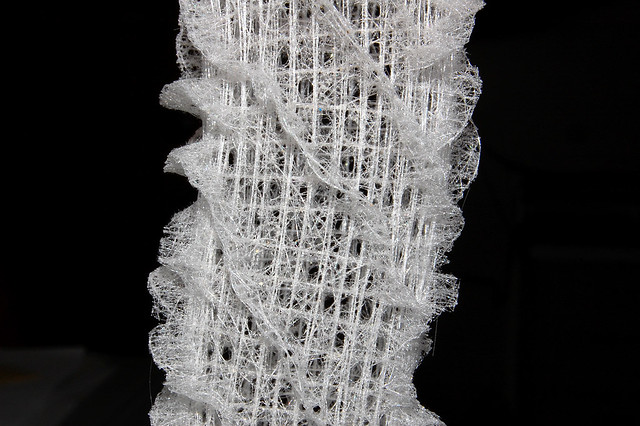
For example, one grouping: the Hexactinellida aka the "glass sponges" have skeletons which are made primarily out of lattices of silicon oxide, in other words.. glass. 

Glass sponges are weird. In addition to their glass skeleton, which is demonstrated here in the shallow-water Euplectella
Venus' Flower Basket (Euplectella aspergillum)
Their skeleton is composed of the skeleton which is covered by an organic substance known as a syncytium. A syncytium operates at nearly a cellular level being composed of amoebocytes (i.e. independent cells) rather than formally developed tissue. 

In spite of their relative simplicty, the skeletons are complex and there's a LOT of variation in hexactinellids. They live in shallow and deep water. Mostly deep. There are over 500 species ranging from relatively shallow habitats to deep-sea habitats in 2000 to 6000 meter depths!

A LOT of these glass sponges are members of deep-sea habitats!  Here's a pic of the sea bottom at about 600 m or so? From off the island of Kona. These are ALL glass sponges. and each of those stalks anchoring them into the sediment?? Glass. Practically fiber optic cable! 
The Okeanos Explorer has been seeing a LOT of these glass sponges! They form an extensive part of the deep-sea habitats in the Hawaiian Islands region.

Some, such as this one called Regadrella has a more vase-like shape..
BUT the opening (called an osculum) is covered with an intricate glass covering called a sieve plate..
Others like this new genus/species is just kind of crazy looking. LOTS of weird textures and interesting folds attached to a stalk.
Another one... but with a slightly different morphology I think..
One thing to realize is the two red dots: These are 10 cm across.  That means this thing is HUGE!
                           
Here was the dead broken stalk from another different species. A big one.

For size comparison, here's the stalk versus the ROV. EASILY 2m long! (6 FEET!)

This one gives you some idea of how the stalk looks on living glass sponges. These aren't the same as the one above..but general notion..

If by the way you've always wondered what the texture of these stalks might be like? go pull some fiber topics out of your wall! Did you know that glass sponges are actually studied as inspiration for better fiber optics?? (here)

Although most sponges are filter feeders, some of them, such as these inoccuous looking cladorhizid sponges are actually carnivorous!!  These are likely predators on other animals!  These were unknown in the Hawaiian Islands region and are a new record for this group!
If you'd like to learn more about predatory sponges, my friends at MBARI have a TERRIFIC video about them

Sponges are also interesting in that, although they are animals, they don't really move and often serve as habitat or perch for various OTHER animals...

Numerous little crustacea, such as shrimp and copepods such as the ones shown below inhabit these large glass sponges for example..
This feather star has seen fit to use this glass sponge, Farrea sp. as a perch for filter feeding
and of course OPHIUROIDS!! You can't have a deep-sea sponge assemblage without brittle stars! (in this case.. ophiacanthids)
What sorts of things will we see next week? WOO!