Showing posts with label deepsea. Show all posts

Thursday, August 10, 2017

Okeanos Explorer Communities & Deep-Sea Discoveries!


I'm BACK! After a month at sea with 2.5 weeks worth of dives I've safely returned to "home base" in Washington DC! I was out in the central Pacific with NOAA's R/V Okeanos Explorer on their Laulima O Ka Moana expedition, exploring the deep-sea of the Marine National Monument in the Central Pacific! 


1. Forest of the Weird: Land of the Glass Sponges!
This was probably the most amazing thing I have seen in awhile! (at least since that Basket Star community in the Marianas a few years ago!)

So, the key thing about nearly ALL Of these sponges? Many of them are what's called GLASS SPONGES aka members of the Hexactinellida. That means they have bodies which are made out of silicon oxide!

These often have bizarre and weird shapes. I have done a post about these before here in 2015.

Here's a highlight video of the discovery-basically water currents ran at an ideal rate at the top of this geologic feature making it IDEAL for what seems to be a huge abundance, if moderate diversity of glass sponge species!

Note also how all of them are turned into the current!! We were in this "forest of the weird" for the remainder of the dive (over an hour) so there was quite a lot of it..
Here's few more that show off the crazy architecture.. These varied in height from one to four feet in height..

2. The Carnivorous Sponge Field
This area was kind of the opposite to the one above. Rather than big and obvious, it was quite dense and discontinuous, being present on one big boulder to another...

But what was amazing was that this was composed of a different type of sponge in the family Cladorhizidiae. (possibly in the genus Asbestopluma..) Cladorhizids are not glass sponges and have physical properties more like what's seen in many other sponges. EXCEPT...

...that they are CARNIVOROUS!!!

Wait.. WHAT? Yup. MOST sponges are filter feeders. But in this group, they use glue or spines to capture prey, which are then digested by the animal in question. We've seen different types of these carnivorous sponges before, including some possible new species..  These sponges kind of look like a feather.. a central stalk with fine hairs or spines coming off the sides

Similar to this species in the NOAA benthic inverts guide...

Here..they were present in HUGE densities.. alongside some frond-like bryozoans! and some stoloniferous zoanthids (a sea anemone like cnidarian)  These actually seemed to be pretty thin at first but got bigger, longer and thicker as we encountered them!

Yes.. I suppose I'm overhyping them..but that's basically a "killing field" of carnivorous sponges!  with these projecting into the
Interestingly, this shot above looks like there might be a snail on one of those sponges..so even more going on!

3. This Amazing Farreid Sponge/Acanthogorgia Wall! 
Shallow-water dives can be VERY productive but because of the nature of Okeanos Explorer we tend not to do many of them relative to the really deep dives (>1000 m).

The one we did at Johnston Atoll did NOT disappoint!

This large block and several like it had this AMAZING side flanked on one side by sponges in the Farreidae, but then on another side covered by octocorals in the genus Acanthogorgia!

The coral side (Acanthogorgia) was relatively high current...
versus the "sponge side" which was relatively low current...

and many critters were to be found amongst the corals (such as this... sea slug)

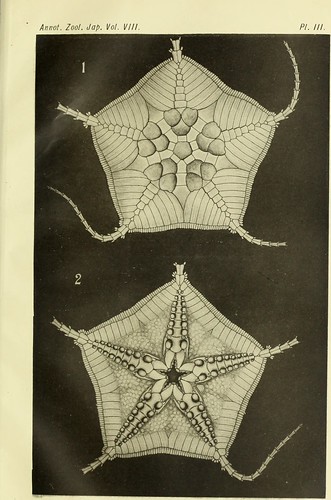
3. Astrophiura! the "sea star ophiuroid" Probably one of the MOST memorable observations for me OUTSIDE of the starfishes was this weird little brittle star!

One of the videographers, Bob, saw it adjacent to the base of one of the sponges. And there it was plain as day!

These animals are TINY. Maybe dime sized. So, the D2 camera's caught a really RARELY ENCOUNTERED and SMALL species.. (about 2000 m depth)
This genus of brittle star was described in the 19th Century by Walter Percy Sladen, the author of the HMS Challenger sea star monograph. He hypothesized that it was some kind of "missing link" between brittle stars and sea stars... (since been disproven)

Here is some imagery of as illustrated by H. Matsumoto.. It has rather famously been shown in echinoderm books as an example of a bizarre form.  Its shape is very similar to those caymanostellids and is thought to be an adaptation to lying flush on the substrate..

Astrophiura kawamnrai n. sp.
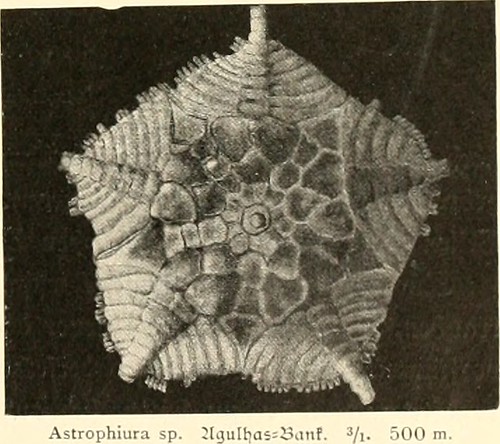
Image from page 210 of "Aus den tiefen des weltmeeres" (1903)
Image from page 662 of "Annotationes zoologicae japonenses / Nihon dōbutsugaku ihō" (1897)


4. Pumpkin Sized Echinothuriids Sea urchins! 
This dive started out pretty uneventfully up slope along a cone, resulting in the discovery of a pretty amazing colony of plexaurid corals

As I've mentioned with some of the OTHER high density communities- not only were there corals present but LOTS of other animals living among them.. 

One of the most remarkable? These HUGE echinothuriid urchins!!  For those who might not be familiar.. these are aka "pancake" or "tam o shanter" urchins. You can see more about them here (with links therein). 

Basically, these are soft-bodied sea urchins which often have poisonous spines and little walking legs.

But the ones we saw on this peak? just ENORMOUS.

The lasers are 10cm across,(about 4 inches)..so, okay this one is only about 8 inches across
but we panned across to another ledge and found a few more...
This darker brown one ended up being about 2 laser lengths..so about 8 inches across! that's basically the size of a small pumpkin! do they get bigger?

Wikipedia lists the "largest" species at 14 inches (36 cm) but did not elaborate on species..(will need to check). But if that's the upper limit, then 8 inches is definitely monstrous!


5. A deep-sea... NUDIBRANCH??
This one was quite a surprise, because I had largely thought that sea slugs were limited to relatively shallow depths, much less PROPER nudibranchs which are overwhelmingly found in nearshore settings.

This looked pretty bigh on camera and was about 5 inches long? when we collected it..

Amazingly, there is one genus of proper nudibranch in not only the Antarctic but in the deep-sea: Bathydoris!  I'm not sure quite yet what they eat but will find out!


How will the species we collected compare??? Stay tuned! (and thanks to Vanessa Knutson for her help with the ID!)

That's a quick recap of some of the non-sea star events..but I'll post more as opportunity permits!  THANK YOU to the crew of the Okeanos Explorer, NOAA and my science team colleagues for inviting my participation!


Tuesday, June 27, 2017

BIG NEWS!!! Echinoblog Will be ON Okeanos Explorer!!

Some EXCITING news! I have signed on to join NOAA's research vessel Okeanos Explorer as the Biology co-Lead for their July Expedition Broad casting from (approximately) July 13 to August 1! 
http://oceanexplorer.noaa.gov/okeanos/media/exstream/exstream.html
This expedition will research the coral habitats around the Johnston Atoll unit of the Pacific Remote Islands Marine National Monument (PRIMNM) spending about 2.5 weeks performing ROV operations, mapping and exploring the biology and geology of the Johnston Atoll region! 


Those of you who follow me on Twitter know that I have live-tweeted the Okeanos Explorer dives for a couple of years (here)  in addition to providing identifications for the Facebook Screengrab Group as well as blogging about highlights observed during the dives (here). 

I have been a long-time "shoreside scientist" contributor providing identifications of starfish/sea star identifications as well as whatever knowledge about deep-sea echinoderms (or other animals) I can contribute.

Will you still be live-tweeting your dive? 
Unfortunately, I won't be providing quite the same level of social media coverage since I will actually be working ON The ship, but when I can, you'll definitely continue to see me on Twitter. Its going to be busy onboard the Okeanos Explorer-but I will try to tweet as opportunity permits.

But I WILL be tweeting about as many aspects of the experience as I have an opportunity to!

Will you be Answering Questions via Social Media???
Yes! If you leave questions in the comments of my blog or on Twitter/FB (@echinoblog) with #askEchino (along with #Okeanos) I will try to answer your question when I am aboard ship during the live stream.  So, I probably won't immediately answer questions until I start the live stream. Questions answered will be at my discretion. 

I will share more on my Twitter feed as information becomes available. 

Thursday, October 13, 2016

New Species of Sea Stars from the North Pacific and BEYOND!


You may recall back in 2009 when I accompanied the Monterey Bay Aquarium Research Institute (MBARI) on a 10 day cruise exploring the North Pacific on the Juan de Fuca and Gorda Mid Ocean Ridges off the Oregon coast. Here was the cruise website.  I blogged about it here.
When we returned from the expedition I was VERY excited because we had collected MANY specimens and several were either new records of rarely seen species or outright NEW species!

I would like to give a big shout out to MBARI because almost EVERY thing they send me turns out to be a NEW species!  Here's a new coral-devouring star I named after MBARI geologist Dave Clague  and here was a poraniid starfish that was observed climbing up a black coral (antipatharian) to devour it

One of my favorite undiscovered starfish was this one, Paulasterias macclaini which I had to describe a whole FAMILY and genus in order to accommodate it!  This species was named for Dr. Craig Macclain, at Deep-Sea News, who had invited me on the cruise.


Well, describing that 6 rayed star took quite a bit of effort but there were many, MANY more species to understand!!!
We also collected many of the more 'non-descript' stars that we encountered as well as several others which turned out to be UNDESCRIBED species!! 

And YES its literally taken me almost 6 YEARS to get all of this done. As I've discussed before (here), it can sometimes take quite awhile for a species to be formally described.


The starfish I reported on in my Zootaxa paper are members of the Goniasteridae, the most diverse family of sea stars, which includes over 260 species in 65 genera!  Most goniasterids live in relatively deep-water (continental shelf and deeper) but historically, there haven't been many of them known from abyssal and lower bathyal (i.e., >1000 meter) depths.

Only recently have we been seeing better collections of these animals from these depths. As I've reported below, some were collected from below 4000 meters!

Sibogaster nieseni! 
The first few specimens of this species were collected by the Monterey Bay Aquarium Research Institute from Taney Seamount (off the coast of San Francisco) from abyssal depths (over 3000 meters!).

It is named for one of my former advisors from San Francisco State University: Professor Tom Niesen (now emeritus)! Author of the Marine Biology Coloring book and noted intertidal naturalist/ecologist along the California coast! 

He gave me my first shot at grad school and happily, his advice and instincts correctly guided me through my early years as a Masters degree student!
photo by J. Sharei
It seemed VERY appropriate to name this species, from off central California, after someone who has done so much to educate others about the significance of the invertebrates of the coast!! 

Interestingly, as I was in the process of writing it up, I suddenly became aware of multiple specimens of similar individuals from OTHER oceans in museums where I was NOT expecting to see them!

This one for example, turned out to be almost identical to the Pacific one I was working on but was from the tropical ATLANTIC! and even one from the deeps of Indonesia... 
Also, unusual is how, such a moderately big animal (about 4 to 5 inches in diameter) could have gone undescribed for so long?  But given how deep it was found (2100 to 4175 meters !) its been well "hidden"! 

This species is likely the deepest member of the Goniasteridae known.


Ceramaster pointsurae! 
This was a tiny little species that I think we collected as part of something else.. perhaps sampling sediment or some other part of the physical environment.

BUT it turns out that it is likely a new and distinct species with some resemblance to the shallow-water species of Ceramaster (aka the cookie stars) in shallow waters..

This species was found during my 2009 trip on the President Jackson Seamont at about 1975 meters! 

This species is named for the Moss Landing Marine Laboratories retired vessel, the Point Sur which was finally retired in 2014. 
I spent many a day sorting deep-sea invertebrates on the deck of the Point Sur and I was saddened to hear about its retirement.

Bathyceramaster careyi! New genus and NEW species! 
Figuring this one out required a bit of detective work, as it turns out...

Several years ago when I was working as a technician for the California Academy of Sciences, I had the pleasure of studying a newly deposited collection of deep-sea starfishes from Oregon State University.

It turned out, that one of the species in the collection was a rarely known species called "Mediaster elegans" collected by oceanographer Drew Carey. To the best of the knowledge of the workers at the time, it was thought that this was a new occurrence, since the original specimens were only known from South America (collected in 1905). 

But as it turns out, after comparing Carey's specimens with the newly collected material by MBARI AND the original type series (i.e., the specimens on which the species was based) it turned out there were actually TWO species present, "Mediaster elegans" (original name) AND this one!  And the one seen by Carey in 1972 was actually undescribed! So, what I'd argue was actually "Mediaster elegans" turns has not actually been seen until now...

and not only that, it had to be placed into a new GENUS in order to be correctly described! 

Boom! NEW genus described! New SPECIES described!
This species was ultimately found to occur throughout the North Pacific between 1700 and 3363 meter depths! 

With this one, named for Dr. Andrew Carey, formerly of Oregon State University! 
The gut contents described by Carey's paper in 1972 suggests that this species feeds on deep-sea sponges.

The paper outlines several goniasterids from the North Pacific at depths below 1000 meters, including several which have not been seen since their description. 

Now that the new genus Bathyceramaster has been described, I can also follow up with a note I made on one of the recent Okeanos dives to Wake Island! 

This white goniasterid we saw at about 2000 m MIGHT be Bathyceramaster, but I'd need to more closely examine the surface to be sure. But if the closeups of the surface texture were correct.. I think maybe??
New discoveries that lead to new questions!! 

What are they eating down there? How do they get so big? Why do some of these species always seem to be alone when you see them? 

My thanks to the Monterey Bay Aquarium Research Institute, the California Academy of Sciences'  Department of Invertebrate Zoology and the Museum national d'Historie naturelle in Paris!