Showing posts with label nudibranch. Show all posts

Thursday, August 10, 2017

Okeanos Explorer Communities & Deep-Sea Discoveries!


I'm BACK! After a month at sea with 2.5 weeks worth of dives I've safely returned to "home base" in Washington DC! I was out in the central Pacific with NOAA's R/V Okeanos Explorer on their Laulima O Ka Moana expedition, exploring the deep-sea of the Marine National Monument in the Central Pacific! 


1. Forest of the Weird: Land of the Glass Sponges!
This was probably the most amazing thing I have seen in awhile! (at least since that Basket Star community in the Marianas a few years ago!)

So, the key thing about nearly ALL Of these sponges? Many of them are what's called GLASS SPONGES aka members of the Hexactinellida. That means they have bodies which are made out of silicon oxide!

These often have bizarre and weird shapes. I have done a post about these before here in 2015.

Here's a highlight video of the discovery-basically water currents ran at an ideal rate at the top of this geologic feature making it IDEAL for what seems to be a huge abundance, if moderate diversity of glass sponge species!

Note also how all of them are turned into the current!! We were in this "forest of the weird" for the remainder of the dive (over an hour) so there was quite a lot of it..
Here's few more that show off the crazy architecture.. These varied in height from one to four feet in height..

2. The Carnivorous Sponge Field
This area was kind of the opposite to the one above. Rather than big and obvious, it was quite dense and discontinuous, being present on one big boulder to another...

But what was amazing was that this was composed of a different type of sponge in the family Cladorhizidiae. (possibly in the genus Asbestopluma..) Cladorhizids are not glass sponges and have physical properties more like what's seen in many other sponges. EXCEPT...

...that they are CARNIVOROUS!!!

Wait.. WHAT? Yup. MOST sponges are filter feeders. But in this group, they use glue or spines to capture prey, which are then digested by the animal in question. We've seen different types of these carnivorous sponges before, including some possible new species..  These sponges kind of look like a feather.. a central stalk with fine hairs or spines coming off the sides

Similar to this species in the NOAA benthic inverts guide...

Here..they were present in HUGE densities.. alongside some frond-like bryozoans! and some stoloniferous zoanthids (a sea anemone like cnidarian)  These actually seemed to be pretty thin at first but got bigger, longer and thicker as we encountered them!

Yes.. I suppose I'm overhyping them..but that's basically a "killing field" of carnivorous sponges!  with these projecting into the
Interestingly, this shot above looks like there might be a snail on one of those sponges..so even more going on!

3. This Amazing Farreid Sponge/Acanthogorgia Wall! 
Shallow-water dives can be VERY productive but because of the nature of Okeanos Explorer we tend not to do many of them relative to the really deep dives (>1000 m).

The one we did at Johnston Atoll did NOT disappoint!

This large block and several like it had this AMAZING side flanked on one side by sponges in the Farreidae, but then on another side covered by octocorals in the genus Acanthogorgia!

The coral side (Acanthogorgia) was relatively high current...
versus the "sponge side" which was relatively low current...

and many critters were to be found amongst the corals (such as this... sea slug)

3. Astrophiura! the "sea star ophiuroid" Probably one of the MOST memorable observations for me OUTSIDE of the starfishes was this weird little brittle star!

One of the videographers, Bob, saw it adjacent to the base of one of the sponges. And there it was plain as day!

These animals are TINY. Maybe dime sized. So, the D2 camera's caught a really RARELY ENCOUNTERED and SMALL species.. (about 2000 m depth)
This genus of brittle star was described in the 19th Century by Walter Percy Sladen, the author of the HMS Challenger sea star monograph. He hypothesized that it was some kind of "missing link" between brittle stars and sea stars... (since been disproven)

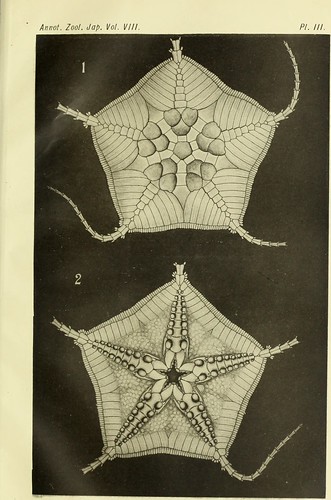
Here is some imagery of as illustrated by H. Matsumoto.. It has rather famously been shown in echinoderm books as an example of a bizarre form.  Its shape is very similar to those caymanostellids and is thought to be an adaptation to lying flush on the substrate..

Astrophiura kawamnrai n. sp.
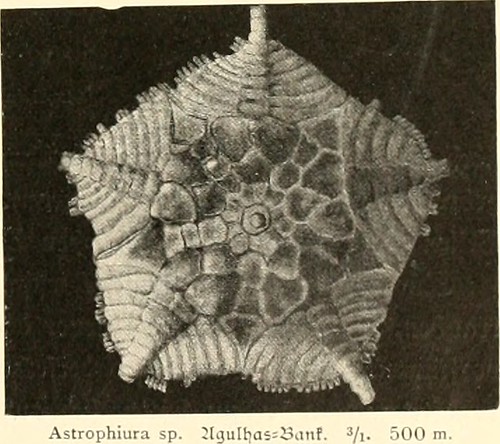
Image from page 210 of "Aus den tiefen des weltmeeres" (1903)
Image from page 662 of "Annotationes zoologicae japonenses / Nihon dōbutsugaku ihō" (1897)


4. Pumpkin Sized Echinothuriids Sea urchins! 
This dive started out pretty uneventfully up slope along a cone, resulting in the discovery of a pretty amazing colony of plexaurid corals

As I've mentioned with some of the OTHER high density communities- not only were there corals present but LOTS of other animals living among them.. 

One of the most remarkable? These HUGE echinothuriid urchins!!  For those who might not be familiar.. these are aka "pancake" or "tam o shanter" urchins. You can see more about them here (with links therein). 

Basically, these are soft-bodied sea urchins which often have poisonous spines and little walking legs.

But the ones we saw on this peak? just ENORMOUS.

The lasers are 10cm across,(about 4 inches)..so, okay this one is only about 8 inches across
but we panned across to another ledge and found a few more...
This darker brown one ended up being about 2 laser lengths..so about 8 inches across! that's basically the size of a small pumpkin! do they get bigger?

Wikipedia lists the "largest" species at 14 inches (36 cm) but did not elaborate on species..(will need to check). But if that's the upper limit, then 8 inches is definitely monstrous!


5. A deep-sea... NUDIBRANCH??
This one was quite a surprise, because I had largely thought that sea slugs were limited to relatively shallow depths, much less PROPER nudibranchs which are overwhelmingly found in nearshore settings.

This looked pretty bigh on camera and was about 5 inches long? when we collected it..

Amazingly, there is one genus of proper nudibranch in not only the Antarctic but in the deep-sea: Bathydoris!  I'm not sure quite yet what they eat but will find out!


How will the species we collected compare??? Stay tuned! (and thanks to Vanessa Knutson for her help with the ID!)

That's a quick recap of some of the non-sea star events..but I'll post more as opportunity permits!  THANK YOU to the crew of the Okeanos Explorer, NOAA and my science team colleagues for inviting my participation!


Saturday, October 29, 2016

#SEASLUGDAY2016: Nudibranchs eat ALL THE THINGS!


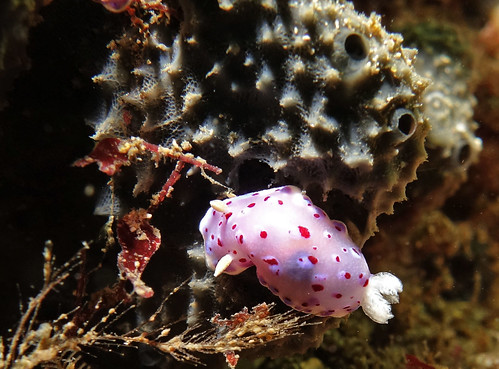
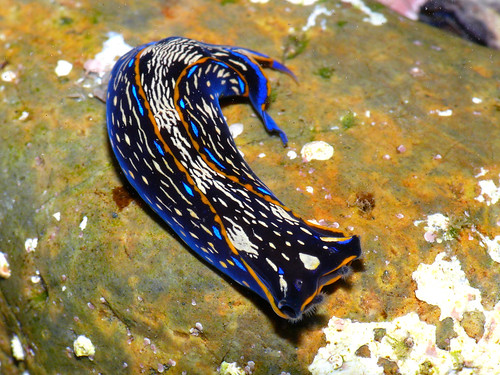
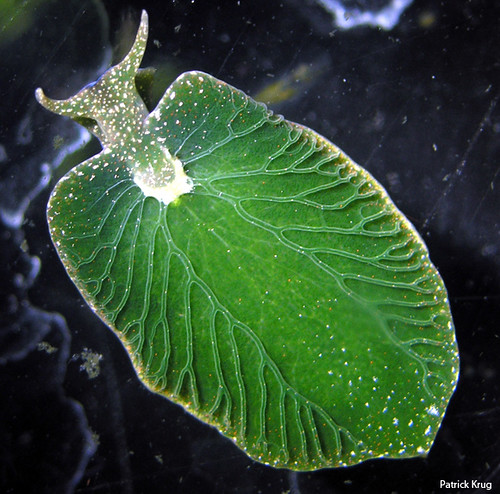
This year's Sea Slug Day I thought I would show off the VAST array of feeding diversity in sea slugs, mostly focusing on nudibranchs. (Not all sea slugs ARE nudibranchs).

Elysia chlorotica

But when it comes to "proper" nudibranchs, it turns out that they are mostly, if not entirely, carnivorous! That's right, instead of the image of "delightful little dainty, clowns of the sea" that most people seem to have of nudibranchs, perhaps we should instead think of them as hungry little monsters that chow down on all manner of other animals!  Muhahah!
Note: this image probably does not accurately represent the feeding biology of dorid nudibranchs
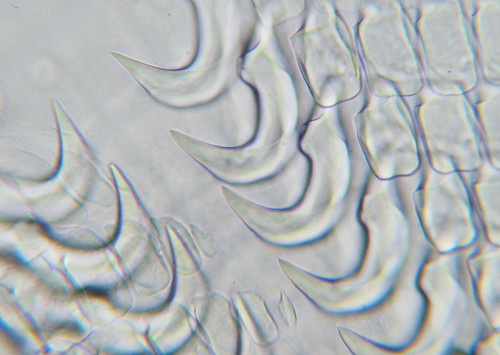
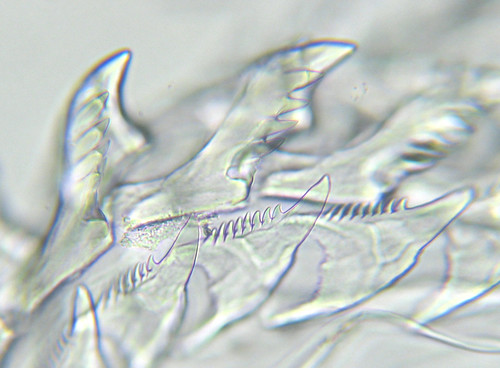
Food and feeding in nudibranchs appears to be diverse. But like most snails, nudibranchs feed using what's called a radula, which is a belt-like structure which is modified from taxon to taxon to rasp or else assist in food or prey capture.

Some microscope images of nudibranch radula are below (images by Jeff Goddard)
Sea slug scythes
Business end of Flabellina trilineata
Nudibranch feeding (and prey) are a HUGE topic and I'm almost certainly NOT capturing the full range. But for your SEASLUGDAY pleasure, here's some great imagery and unusual accounts of what nudibranchs eat...which really does include EVERYTHING.

5. Echinoderms (such as brittle stars)
I begin with that most sinister of predatory nudibranch: the echinodermativore! To be sure, the number of sea slugs that are known to feed on echinoderms is a relatively short list-but probably one of the most gorgeous is this Indo-Pacific one: Kalinga ornata!
KALINGA ORNATA (40mm)
Here's a GREAT Japanese video of K. ornata below feeding on a brittle star (possibly Ophiocoma scolopendrina?)
4. SHRIMP! I wrote about Melibe on SeaslugDay last year. and I've already shown this video of Melibe viridis capturing this shrimp.. but its VERY impressive. So you get it again...
3. Bryozoans & various Cnidarians (hydroids, anemones, etc.)!  Among the most typical of foods fed upon by nudibranchs are the many, many types of encrusting and/or otherwise sessile animals that live on and around nudibranchs, ranging from small, colonial animals to huge tube-shaped sea anemones! 

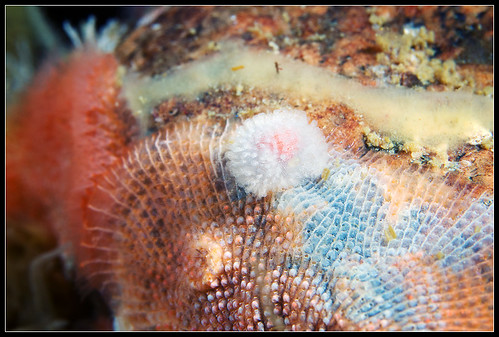
Here's a nice pic, for example, of a dorid nudibranchOnchidoris muircata feeding on a bryozoan colony. Bryozoans aka "lace animals" are a phylum of colonial invertebrates that form very delicate skeletons. They are fairly common in many areas as encrusting, colonial forms.. MANY nudibranch species seem to feed on them...

Not sure which species this is..but you can see they've pretty efficiently cleared off the living tissue from the bryozoan skeleton
Onchidoris muricata

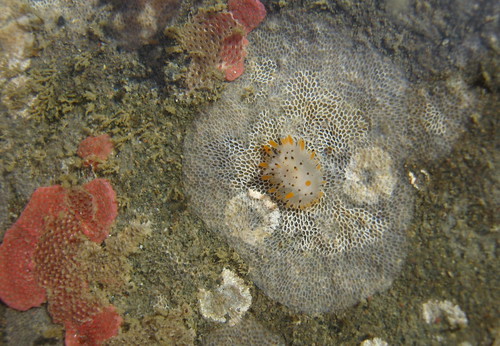
This species, Crimora coneja was imaged in Oregon feeding on the bryozoan colony here. You can see the stark white regions around the nudibranch where it has fed, versus the lighter, fuzzier areas around the edges.
Crimora coneja (Whiskey Creek)
Here's a GREAT video of Corambe steinbergae, from the west coast of North America showing this species moving across the bryzoan colony and feeding on the zooids. The nudibranch is even sort of camouflaged so that it appears hidden against the bryozoan colony.. 
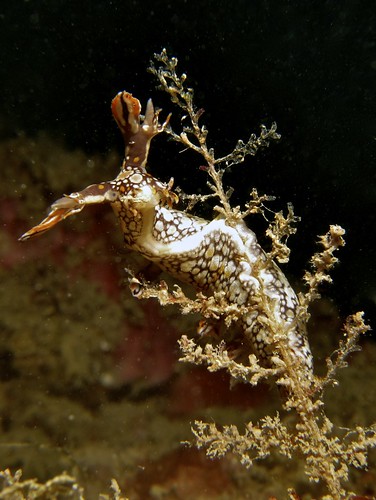
Here's a lovely aeolid nudibranch of some kind feeding on a hydroid. One of the NEAT things about these is that many of these nudibranchs have whats called kelptocnidae which means that these slugs can actually STEAL the stinging cells from the hydroids and transfer them to their OWN body as defense!! You can read more about this here.
Curvey snakey
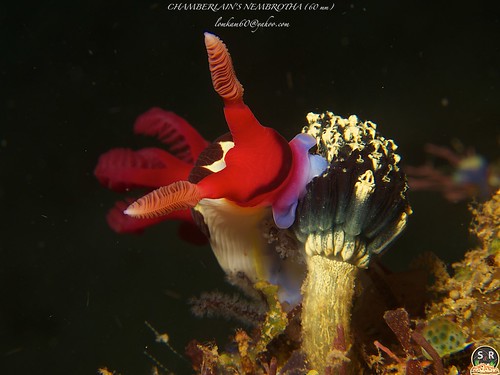
And there is much, much more... tunicates are also potential prey for nudibranchs!
NEMBROTHA CHAMBERLAINI (60 mm) feeding
As are sponges! In some cases, the nudibranchs can absorb the chemical defenses of the prey and utilize them for their own defense!
Pastel picture - Thompson's nudibranch - Chromodoris thompsoni

Nudibranch feeding on sponge from BIOPIXEL on Vimeo.
When we are looking at big solitary animals.. we enter the realm of animals such as the slug Tritonia and various sea anemones and sea pens... These are pretty significant predators and ellicit a fairly extreme response from they prey... The slugs in the next two videos are quite big 6 to 12 inches long.


AND as long as we are mentioning cnidarians as prey items, here's the pelagic (i.e. swimming) sea slug Glaucus atlanticus feeding on Porpita porpita (blue button jellies)


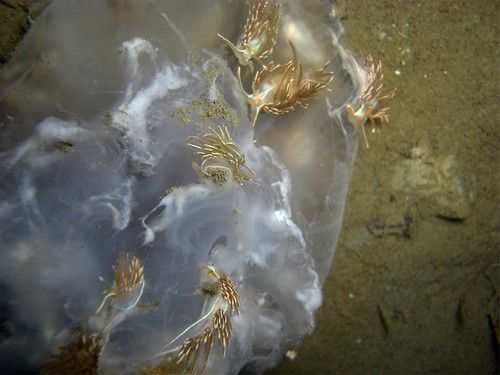
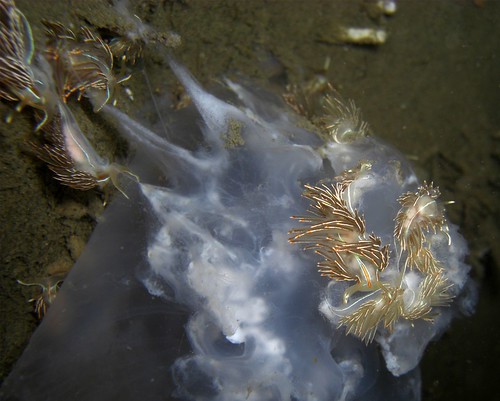
Here's a bunch of aeolids devouring a fallen Moon Jelly...
CIMG1076
CIMG1070

2. OTHER NUDIBRANCHS
Its always interesting how many people are fascinating not just by predation but "cannibalism" which when applied to the animal world seems to mean when one "type" of animal feeds on the same or similar "type" of animal. (i.e. sea stars that feed on sea stars) and not just one species feeding on itself (as it does in humans).

Its not as common but there are several noteworthy nudibranch predators that feed on OTHER nudibranchs...

The formidible Navanax from the North Pacific for example.. They seem to be quite effiicient at swallowing their prey whole! If these were the size of say, a dog or a wolf we would be VERY afraid of them!

 I've always loved the name of this nudibranch. It has a nice ring to it!
Navanax!!

and this one, attacking and  COMPLETELY SWALLOWING the sea hare, Aplysia sp. 
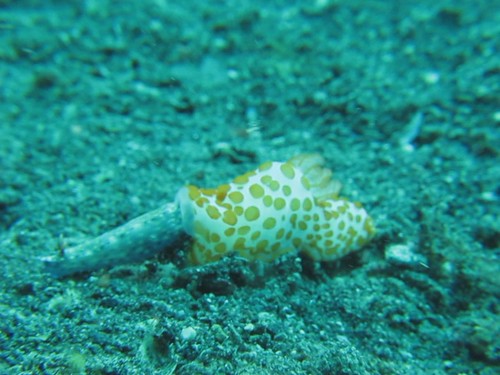
In the tropical Indo-Pacific, there is another formidable predator, those slugs in the genus Gymnodoris, which as we'll see feed not only on other sea slugs but have progressed up to vertebrates as food!


Gymnodoris rubropapulosa

1. SLUG EAT FISH! 
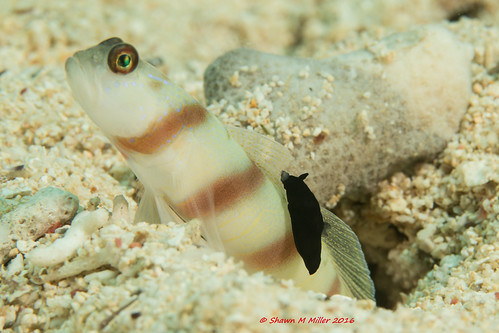
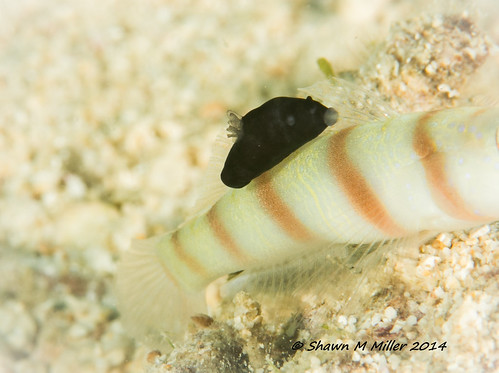
This really WAS the most amazing thing to discover. It turns out there's a dorid nudibranch called Gymnodoris nigricolor (name translates into the "black Gymnodoris) which attacks and EATS the FINS of certain FISH!

These slugs basically crawl onto a goby and begin to eat their way down a fin spine, gnawing off the meat on the fin. Some have called this behavior parasitc but I think of it as more predatory. I suppose its really kind of both.

My friends over at BlennyWatcher have a nice little account of this with links, etc. here. I've included a VIDEO of this behavior at the bottom!
Gymnodoris nigricolor - Nudibranch, Okinawa
Gymnodoris nigricolor nudibranch  - Okinawa, Japan

Sunday, June 26, 2016

Stunning Highlights from Okeanos 3rd leg of the Marianas Expedition!!


This last week has been a busy one-made even more momentous with all of the very AMAZING observations made by this last leg of the Okeanos Explorer as it explores various seamounts and other sites in the Marianas Islands! A whole bunch of information on the geological setting and the various study areas can be found on their website here. 
The entire mission overview can be found on NOAA Okeanos Explorer pages here and of course the LIVE VIDEO is on click away! (when they are broadcasting-usually from about 6pm to midnight Eastern time)

But what are some of the more SPECTACULAR animals they have been seeing?? Here's a highlight of the ones I consider just singularly amazing!

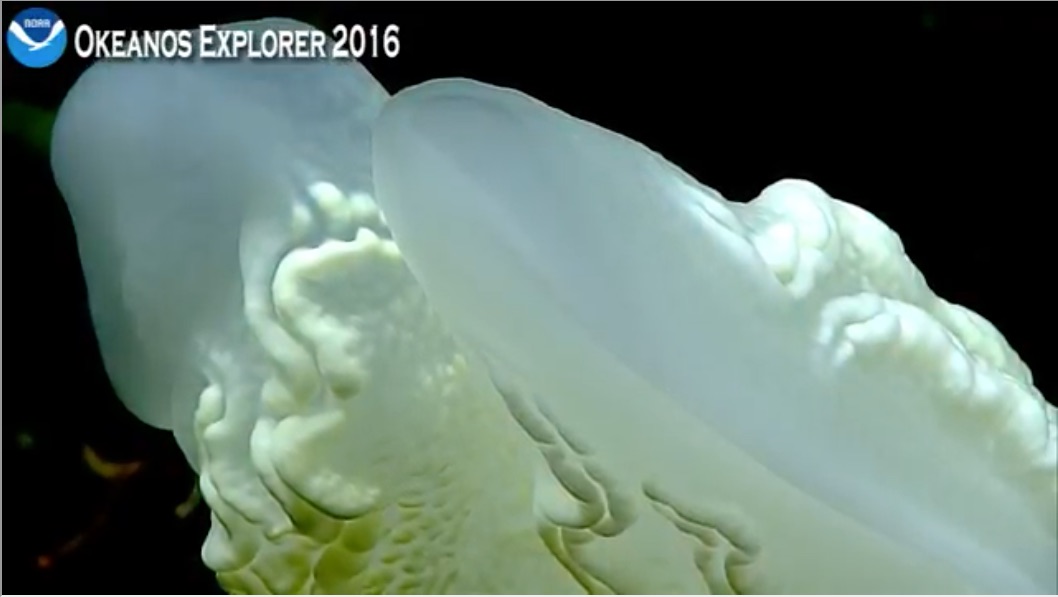
1. Big White Lyrocteis-like Benthic Ctenophore (aka comb jelly)
The last year or two has seen a HUGE awareness of these strange animals. Basically they are the bottom version of swimming comb jellies aka ctenophores. Although gelatinous, they are possibly VERY distinct from proper jellyfish.

We have seen a fair number of these on earlier Okeanos dives (as we see here) and I've written a post (here) about Lyrocteis aka the "Harp comb jelly" which occurs widely in the Pacific.

This newly discovered white animal has a very different surface texture and so far has NOT been observed to extend its feeding tentacles! It has the same "rabbit ears" or "harp" shaped body as Lyrocteis but is it even the same thing??   Interesting!


2. Stunning sea anemone in the family Aliciidae! 
This one was just stunning and weird all at the same time. It kind of looks like a strange gelatinous Christmas Tree! From Ahyi Seamount, 275 meters

Fortunately Dr. Chris Kelley of HURL had seen one of these before. The withdrawn version of a seldom seen sea anemone in the family Aliciidae.

Here's a picture from the HURL database showing it extended. You can see the knobs on the body. Beautiful..but wow. Unusual.


3. The Sea Anemone (from) Liponema! 
ANOTHER bizarre sea anemone. These go by the common name "pom pom anemones" or "tumbleweed" anemones... Why? Because they actually have a very loose connection to the bottoms and can actually ROLL along when they want to move!!

This pic from Pagan Volcano and Supply Reef from about 336 m
Here's a separate species called Liponema brevicornis doing JUST that thing! Rolling along the bottom like a big pink fuzzy snow ball!! 
Image borrowed from Actinaria.com http://actiniaria.com/liponema_brevicornis.php
4. Neat looking sea anemone called Isactinernus! About which it seems there is very little known.... But it has these very distinct tentacled lobes 

Here it is OPEN (seen on Pagan Volcano, 345 m)
and here it is CLOSED (this was seen on Supply Reef)

5. The Ever Majestic swimming sea cucumber Enypniastes! 
This splendid picture taken in the famous Mariana Trench from a dizzying 5, 775 meters!  DEEP!

6. SEA URCHINS GALORE!! 
Here's a stunning urchin with Christmas colors! Caenopedina probably C. pulchella based on what I've been able to find on it.. 


Handsome red cidaroid sea urchin from Moag Crater, 327 meters

An aspidodiadematid urchin, possibly Aspidodiadema from Eifuku Seamount, 420 m. Want to learn more about these urchins with crazy long spines that act as walking legs?? GO HERE.
 7. And some New Species of Snails...
This is what's called a slit shell snail or a member of the family Pleurotamariidae. Long story short: deep-sea snails but with similar shells observed in the fossil record. This gives them "Living Fossil" status and their beauty and color makes them valuable to shell collectors..

The one the Okeanos Explorer has been seeing? Probably a new species according to Chong Cheng at JAMSTEC (@squamiferum on Twitter).
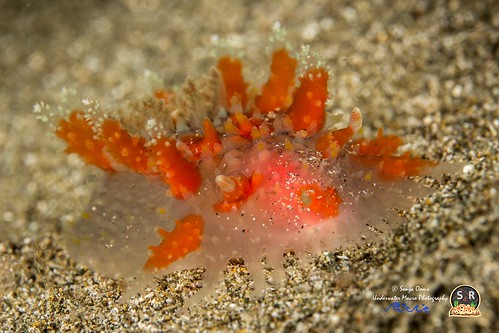
and this STUNNING nudibranch, probably the genus Kaloplocamus, according to Dr. Terry Gosliner at the California Academy of Sciences! 

Those yellow balls on the body extensions? Apparently those are luminescent organs! Not previously seen in this genus..making this a very likely NEW species (thanks to Dr. Gosliner for the determination!)

And anyway.. THERE's MORE to COME!