Showing posts with label North Atlantic. Show all posts

Tuesday, September 23, 2014

Let's Meet the Deep-Sea Stars of the North Atlantic Canyons! Your Guide to Starfishy Okeanos Exploring!


 This week a special OKEANOS Explorer Treat!              

Owing to a fantastic combination of various technologies: deep-sea subersibles, HD cameras, quick and efficient internet transmission and the wonder of social media, not only do we have LIVE streams of deep-sea biology and exploration via the R/V Okeanos Explorer, BUT we have for the ability for almost ANYONE to tune and watch discoveries as they happen! AND watching and observing the scientists making these discoveries as they happen!

Thanks to Twitter and even a special Facebook Group that takes screengrabs of things seen by the ROV we now have a unique circumstance:  Exploration of the deep-sea being seen by everyone!! and not just scientists!!

But, the starfish you encounter on these dives are not exactly common place. Starting to learn about them first entails knowing which ones are which! Not an easy task given how poorly known how some of these species are. Some of these have never been seen alive! And that's where I come in.

And so as my BIG GIFT to people (scientists AND non-scientists) who are following the Okeanos Explorer  2014 LIVE deep-sea feed, here is a gallery/field guide of deep-sea starfishes observed along the North Atlantic east coast!! 

To be clear, this list of starfish species that is known from the deep-sea Atlantic region (>1000 m in this case) is likely INCOMPLETE.. It is biased by what I've been able to identify and the limits of the known science of each species. So, yes we WILL still probably see things that are not on this post. And eventually, these things will see publication...as many are new records.

A caveat about use: This is mainly for use in the North Atlantic along the east coast of North America. Some of the genera (e.g., Novodinia, Hymenaster, Pteraster) occur world wide so you'll see them in deep-sea pictures in many places. Some, such as Porania pulvillus may also occur in very shallow water, which is unusual. But you can' t necessarily expect to find all of these species in say, Hawaii or even the nearby Gulf of Mexico.  Where species occur is often a funny thing in biology, likely dependent on a number of factors that make those places suitable for a specific species.

My thanks in advance to Dr. Chris Kellogg (@DrChrisKellogg ), Carina M. Gsottbauer (@CarinaDSLR) AND the members of the Facebook Underwater Screengrab Group for their diligence!

1. Tremaster mirabilis (Asterinidae)
Here's an animal we don't know much about. Go here to see more of what this species looks like. It occurs widely in the Atlantic, the South Pacific, the Indian Ocean, the Antarctic in fairly deep water. Video images from OE were the first time that I'd ever seen this species alive. Its been imaged alive in tropical Pacific but never quite this nicely...
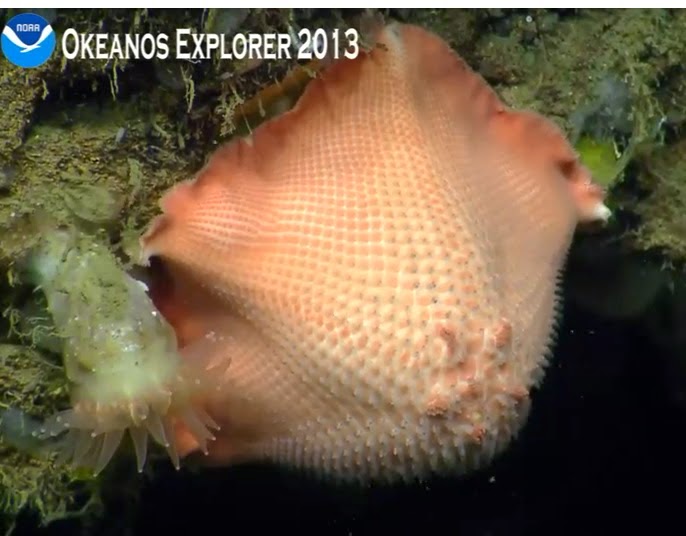
                            
2. Chondraster grandis (I think). (Poraniidae)
We don't know much about this. Someone collected it and named in back in 1878 but we really don't have any info about its biology. Its living color wasn't even really known until recently.

The body form in these is very unusual. Very soft and has kind of the texture of a mango.

Which brings us to this mystery. Same animal... I think?  But TWO colors?? Is one a new species? Or could the body color simply be variation??  This is where collected specimens permit us to examine the body and perhaps extract DNA to study the possibility that there could be separate species being seen...

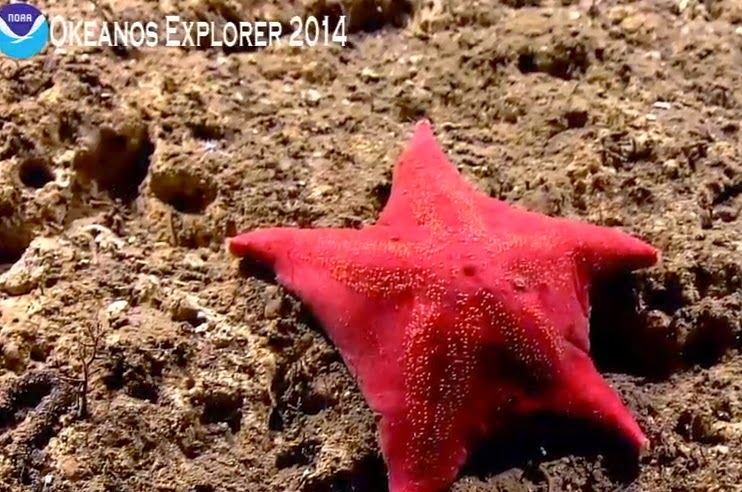
3. Porania pulvillus (Poraniidae)
I have previously written about this species from shallower water, feeding on various cnidarians based on crowd-sourced images!   Whereas once thought of as a fairly passively feeding species, new observations now suggest its a bit more of a predator than had previously been thought. 

The white patterns show the papulae (or gills) as well as folds in the skin of the body. The entire body is overlain by a kind of thick tissue which makes it soft. So, like Chondraster grandis, this species also feels kind of like a mango if you touch it. 
Interestingly, here is a shallow-water individual (from Norway) of what I think is the SAME species for comparison. Similar pattern but different color!  Based on the museum specimens, morphologically, these are nearly indistinguishable. but does this indicate a separate species??
               

4. Neomorphaster forcipatus (Stichasteridae)
This is by FAR one of the most commonly encountered species during the Okeanos Explorer expeditions.

We don't know much about the actual biology of this species. We don't know anything about how/what it eats or what/how it reproduces or even anything about its ecology.  The genus Neomorphaster also occurs in the eastern Atlantic in the deeps off Europe.

These are deep-sea members of what is mostly a Southern Hemisphere group, the Stichasteridae.
Stichasterids are a basal group within the  Forcipulatacea (i.e., an early branching within the evolutionary history of the group), a large group of starfishes which also includes the common starfish Asterias as well as the brisingids and 6 rayed starfish below. A post about their family tree is here. 
                             
5. 6-armed starfish? Ampheraster? or Unknown Asteriid/pedicellasterid?
This one is kind of a mystery. It could be several possible genera or species. The names probably mean nothing to most people. But basically, this is likely a distant relative of Asterias. But we've not collected one. So uncertainty remains. It could be new! Or it could be known. I briefly discussed this in an earlier Okeanos post here. 
                             
6. Novodinia americana? (Brisingidae)
BRISINGIDS!  My favorite critters! These are actually starfish which use tiny little wrench-like structures called pedicellariae to capture food as water currents  carry it through their arms. Sort of like velcro. See my full article on brisingids here. 

Brisingids are notoriously difficult, if not impossible, to identify from pictures. Usually, you can't because the features used to identify it need to be studied under a microscope.

Fortunately,  Novodinia has a large swollen arm region around the disk with very thick spines as you can see below..

7. "Brisingid" Not sure which...
BUT after you get past Novodinia, the identifications of different brisingid sea stars becomes pretty difficult since none of the diagnostic features are visible from pictures..There are MANY encountered in these deep-sea habitats and probably several species which are not easily registered from pictures.

But they remain striking members of the deep-sea community.. Go here to see more of this
8. Evoplosoma sp. (Goniasteridae)
Evoplosoma!  A deep-sea octocoral predator! Often seen feeding on various bamboo "corals" (i.e. members of the Isididae). I wrote at some length about these here.  There's several species of this genus in this region and its difficult to make the call on these from pictures.
                            
From one of the recent dives:  you see all those bare branches on this bamboo coral?? That's Evoplosoma chowing down on the "meat" of the coral... Its not unusual to see them climbing high up into the branches of such a colony..

9. Ceramaster granularis? (Goniasteridae)
A so-called "cookie star" This species might be the shallower-water C. granularis or maybe something else?  Likely, feeding on encrusing organisms or the "goo" on the substrate but we really don't know.
                             
10. Pythonaster, probably  P. atlantidis
This was a RARE one. Barely known from 2 or 3 specimens, this is probably one of the FIRST living pictures of this species ever taken! We know NOTHING about its biology.

I wrote about it in more detail here.  Let's hope we see another one in the next few weeks!
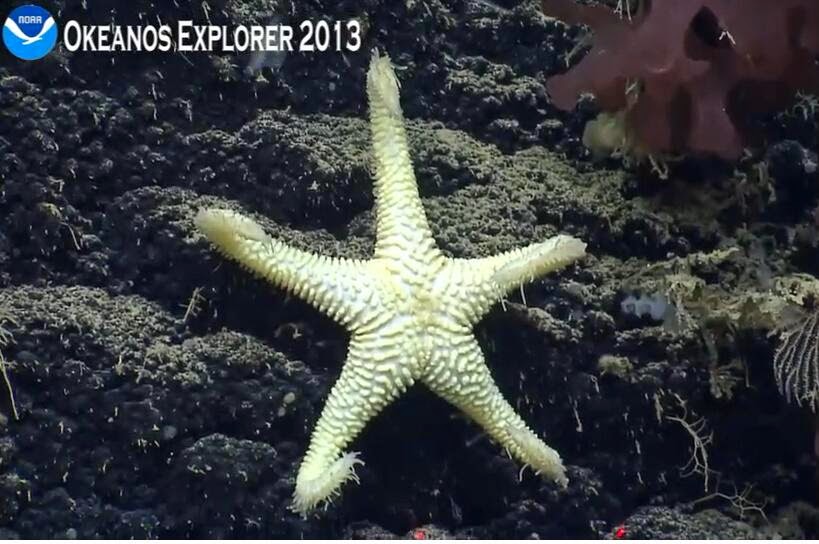
11. UPDATE: Likely a smaller individual or different species of Pythonaster 

Work on these is ongoing..
12. Hymenaster? (probably)
This genus of sea star, is widespread around the world's oceans. Another poorly known group of animals..but with a very distinctive appearance and the ability to produce mucus as a defense mechanism! Go here to see more on this..
13. Pteraster sp. 
The other genus of "slime star" with shallow and deep-water members. The link about slime stars is here.. Note the osculum.. the opening that allows water in and shoots mucus out! 

14. Peribolaster (Updated!)
I initially thought this was Lophaster, but it turns out, something else.. probably a new species! A member of the Korethrasteridae
15. Solaster sp. 

16. Henricia sp. 1
I have not written much about this group because the genus Henricia is a huge mess for taxonomists (i.e., people who describe new species and new diversity)..  Why?  Because these starfishes are all VERY similar in appearance to one another on a widespread scale! There are at least 2 species in this region. 

Yes, species in this group occur all around the world. VERY widespread. But even in a very specific area, they can be nearly identical in appearance.  So, unfortunately, unless the species is highly unusual (has > 5 arms, etc.) these are quite difficult to tell apart...

So, is that it?? Have I revealed ALL the STARFISH SECRETS???   Nope.  But knowing the names is the START of knowledge! I encourage everyone to let me know if you see any on these dives that is NOT on this post. Or if you see ANY of these species doing something, eating, spawning etc. 

Tuesday, July 22, 2014

Deep-Sea Poop, Amoebas, Basket Stars, Pinwheel Crinoids and MORE! Pics from the NOAA Deep-sea Photo Archive!

Gulf of Alaska 2004 Expedition. NOAA Office of Ocean Exploration 
This week I have been researching images from deep-sea video on the home page for the NOAA Photo Library, which has housed ALL of the deep-sea and other imagery from NOAA's deep-sea expeditions since 2003, including those of the Okeanos Explorer!

Many of you know that I have participated in the last two R/V Okeanos ROV dives as an onshore advisor. I often identify asteroids (i.e. starfish) and provide other information as I am able. I've only helped them out since 2013 but found lots of their images useful for my research.

You can find NOAA-Okeanos dive screengrab recaps on my blog here for 2013 and here for the recent 2014 dive. 

Those of you on my Twitter account (@echinoblog) have been watching me post links to various pictures as I have been reviewing these pics.. There are literally THOUSANDS of pictures of deep-sea biology, geology and history !!!  Who would be crazy enough to go through all of it one by one???  Yes. Me!

So, for your education and infotainment I have cherry picked many noteworthy images and have showcased them below. (note that ALL images have original links below them)! Enjoy!

Giant Amoeba Houses??
Here's a cool structure made by a giant amoeba called a xenophyophorean! (deep-sea Galapagos) Take a moment to consider that a UNICELLULAR organism could have made this! (and yes, they will eat proper animals!)
From the 2011 NOAA Okeanos Explorer Program, Galapagos Rift Expedition 2011 
But in contrast, what about this from Indonesia??? A Mystery?? Another xenophyophorean?? 
From July 2010 NOAA Okeanos Explorer Program, INDEX-SATAL 2010


Basket Stars Behaving uh... badly? 
What is going on here? I've honestly never seen TWO basket stars so close to one another. What are they doing? Fighting? Doin teh sex? The gorgonocephalid equivalent of a backrub?   Only they know for sure.  (North Atlantic)
From Lophelia II 2008: Deepwater Coral Expedition: Reefs, Rigs, and Wrecks 
Brittle Stars Doing Crazy Things! 
From the Atlantic... Probably just filter feeding, but I don't know that I've ever seen so many of them with their arms all curled up like that just FLAT on the sediment. Weird.
From the Lophelia II 2008: Deepwater Coral Expedition: Reefs, Rigs, and Wrecks 
and more of the same...
from Lophelia II 2008: Deepwater Coral Expedition: Reefs, Rigs, and Wrecks 

Here is what we call in science "a fancy pants brittle star" (note the gorgeous red and white pattern though) on a really extended whip coral (aka antipatharian). Video from the Bahamas in 2009. 
From Bioluminescence 2009 Expedition, NOAA/OER 
And still MORE!
From 2009 Bioluminescence 2009 Expedition, NOAA/OER 
PIN WHEEL CRINOID?? 
A cool looking "pin wheel" stalked crinoid (Hyocrinidae) from Indonesia, a new species currently being worked on by colleagues in Paris. This is what it looks like "open"
From NOAA Okeanos Explorer Program, INDEX-SATAL 2010 
and curiously, this species retracts its arm in repose like this! As the kids say these days "That is pretty whack! "
From NOAA Okeanos Explorer Program, INDEX-SATAL 2010
BIG PACKS OF FILTER FEEDING ECHINODERMS! 
Stalked isocrinid crinoids! From the Marianas Arc, Pacific Ocean! All turned into the current!! 
 Image courtesy of Submarine Ring of Fire 2006 Exploration, NOAA Vents Program 
Also from the Marianas Arc, Pacific Ocean: A crazy huge field of basket stars (Gorgonocephalidae)..
Image from the Submarine Ring of Fire 2006 Exploration, NOAA Vents Program 
Some translucent Swimming Sea Cucumber intestine showing POOP?? 
 from NOAA Okeanos Explorer Program, Mid-Cayman Rise Expedition 2011 
Is this Sea Cucumber Poop??
Exotic Indonesian Sea cucumber poop?  Or possibly from an Acorn Worm? (below)
 From NOAA Okeanos Explorer Program, INDEX-SATAL 2010 
From NOAA Okeanos Explorer Program, INDEX-SATAL 2010
Deep-Sea Urchin POOP! 
Here is a great shot of an Echinothuriid urchin (aka the pancake or tam o shanter urchin) taking a poop!! A Gulf of Mexico species. Contrary to what the labels on the website say, this is defecation and NOT gametes being released.
NOAA Okeanos Explorer Program, Gulf of Mexico 2012 Expedition 
 Deep-sea Urchin Poop! 
NOAA Okeanos Explorer Program, Gulf of Mexico 2012 Expedition 
and a special non-echinoderm poop bonus! Acorn Worm POOP! 
Images from Indonesia.. Worms leaving unique castings in the sediment...
From NOAA Okeanos Explorer Program, INDEX-SATAL 2010 
What I hope is that this will provide a spotlight on NOAA's very EXTENSIVE library of images!

MANY valuable and interesting things in there! Enough for many more posts. But what's most amazing? A lot of it is UNPUBLISHED stuff!!

But its hard to make a guess as to what kinds of things you will find (sometimes because you don't know what you are looking for)  This provides a taste of the diversity and abundance of tantalizing images. Sponges! Corals! Worms! Even protists!
                              

Friday, February 22, 2013

Extra! Solaster feeding caught forever in the museum!

A cool find that a student (Eric T.) fr. American U. found while working on a project.. Solaster endeca with the arm from what looks like Asterias rubens
 Here is the predator alive...
Solaster endeca
and the prey (where the arm comes from)
Asterias forbesi, dorsal

Solaster is one of the few starfish which is known to feed primarily (at least in some species) on OTHER starfish!  Here was something I wrote awhile back on the Pacific Solaster dawsoni...

morning sun star- solaster dawsoni
and here is a nice pic of the North Pacific S. dawsoni feeding on Hippasteria
expl1022
It is so fearsome that EVEN the sunflower star Pycnopodia RUNS from it!

and here's a nice bit about when starfish are eating and uh... overreach...


NOM! NOM! NOM!

Tuesday, September 27, 2011

Tilting at Windmills to Tilting at "Killer Starfish"! Ecology vs. Hyperbole!


So, last week the UK newspaper-The Telegraph provided this interesting bit of news...
one of the few times that sea stars have managed to get some front page coverage! The story has been picked up by a bunch of other news sites as you can see on Google...

The quick and dirty version? There is a prominent offshore"wind farm" on the Kentish Flats, about 6 miles off the coast of Whitstable, Kent (this is on the Southeast coast of the UK). More on this here.
There are plans to increase the number of these wind turbines (essentially big windmills) from 30 to 47.

Fisherman are outraged! Why?

The article states that installation of these windmills riles up/disturbs the seabed and this apparently leads to areas that are "swamped with starfish" (presumably the predatory Asterias rubens).
(Asterias rubens image from Wikipedia)
This then leads to concern by the nearby coastal towns that these starfish will prey upon Whitstable's big cash "crop"... OYSTERS!
One fisherman was quoted:
Studies show how wind farms attract starfish that eat oysters and if that happens they will wipe out most of the oyster population here and ruin our tourist industry.

Vattenfall (the company who oversees the windfarms) should have come to the fishermen of Whitstable and asked us what the least damaging place for the wind farm is.

I supply native oysters to 14 Michelin-starred restaurants every week. What will happen to my livelihood if I can no longer do that? It could wipe out our native industry and destroy Whitstable tourism in one hit.
As much as I enjoy seeing press about my favorite animals, I also dislike some of the irrational hyperbole compounded by inaccuracies (and contradiction with science) that seems to infect "popular" articles.

My "take" here would be that the very acrimonious statements by the fishermen seem to come from the long-time enmity that has historically existed between oyster fisherman and the "common starfish" Asterias rubens which is one of the most evident predators of shellfish, such as oysters and mussels.

But the relationships among Asterias and other invertebrates in this ecosystem are MORE than the "killer starfish eat oysters" meme that the article tries to capitalize on..

But are the statements tilting at windmills??? (or windfarms as the case may be!)

Let's find out!!


Much of the data from this post comes from some classic work (1955!) by D.A. Hancock on the feeding behavior of "starfish on Essex oyster beds" that you can find here as a pdf. A nice abstract of the paper can be found here.

So, basically I've assembled 4 points that reflect, uh..lets say some "inaccuracies" in the article. And some information that might shed further light on the ecological players.

I'll caveat of course, that I have no data on the specific ecological case. I'm merely taking a lot of established information and presenting it, so that the more... hyperbolic conclusions... are put into a different context...

1. Asterias rubens is not the ONLY animal that feeds on oysters!
Probably one of the most inoccuous but damaging pests to European oysters is the introduced Oyster Drill, Urosalpinx cinerea. Some info on it here..but short version, each individual can devour about 40 oyster spat per YEAR.

These often leave a nice, neat little drilled hole in the shell.
(from the Marine Biological Association site)

Starfish like Asterias rubens feed by humping over the shell and waiting out or pulling open shellfish valves until they can get their stomachs inside the shell. No drilling or hard parts involved....

Another pest to oysters is the slipper shell-Crepidula fornicata. The "fornicata" part is so-called because alternating mating pairs are often attached to one another. More info on this species here.
Slipper shells aren't predators on oysters but they attach to oyster shells and are thought to be significant competitors for food and other resources that oysters like.

An important consideration here is that Asterias feeds on Crepidula--sometimes preferentially!

Hancock actually had this to say in 1955:
Only when Crepdiula is relatively scare and oysters occur in fair numbers will more oysters be killed. Under the present condition in the Essex rives, Asterias is by no means the most important cause of mortality among oysters and oyster spat; it may even provide some measure of control over the pests such as Crepidula, Balanus (a barnacle), Elminius, and even the fearsome of the fearsome oyster drill Urosalpinx and may therefore be considered as beneficial to the oyster population.
And of course, there are OTHER starfish species, such as Crossaster papposus which can feed on small oysters and other shellfish.. but one important consideration??

These also feed on Asterias!!
here's a picture of just these few players and how they interact...
Bear in mind that these are only SOME of the players. There are likely many more species at play.... Asterias feed on mussels also. I don't know which food source the local populations prefer, but you can spend years working on the ecology of a region like this..

So, fishermen may visually SEE Asterias (or Crossaster) MOST frequently but probably not ALL of the influential animals that affect the oysters they prize so heavily..

Those little oyster drills probably do just as much (if not more?) to affect oyster crops as any starfish.

So, now you see more of the players...what about the game??

2. " and if that happens they will wipe out most of the oyster population here and ruin our tourist industry..." Do the starfish actually eat ALL of the OYSTERS like the fisherman guy was worried about??
So, let's maybe assume that somehow, all those other critters weren't POSSIBLY the cause of the oysters being eaten. Could Asterias by itself in a natural setting STILL be responsible?

This discussion assumes that Asterias rubens in its natural setting, where they interact with their native predators, competitors and environment.

If you introduce a predator like Asterias into an ecosystem, such as with Asterias amurensis in Australia where it has no natural predators or ecological relationships with prey (see this post and this one)-then uh..well, things can get out of hand..

But ecological theory has come quite a ways over the years and our understanding of how predators hunt (and how much energy is expended) leads to many considerations, such as....
  • Will predators always pursue the prey to the very end?
  • When do they "give up" before pursuing new prey?
  • How much energy is expended on different kinds of prey?
  • How does feeding on different prey structure the ecosystem in which the animal lives?
Under natural conditions, predators are generally not more abundant than their prey and cannot ultimately feed on ALL possible prey items (rendering their food source extinct).
(photo by Sue Scott, image from the MarLin Gallery!)

Several experiments with mussels and Asterias rubens in the Atlantic (such as this one by Norberg and Tedengren, 1995) do in fact show that starfish will "give up" on some mussels but not on others. What determines this is not clear-but it may involve variation of different species in different areas as well as shell shape, size and so on.

Other studies suggest that starfish such as Asterias or Pisaster affect the actual ecological structure of the areas in which they live. They devour mussels and/or other faunal members such as snail drills or barnacles that affect the amount of space that different animals settle onto.
This is the basis, in part of the keystone species concept, which I will get some other day...

So, they ARE important in affecting various mussels, oysters and what have you...

But will they eat up ALL the oysters just indescriminately? Nope.

They will likely devour many oysters-but its not even clear if Asterias will always (or even frequently) feed on the largest, showiest (and presumably most desirable for seafood market) oysters (which conceivably have stronger resistance to predation)....

One could argue that Asterias goes after weakened oysters or those with an optimal size for pulling open? Surprisingly, there is not nearly as much data on this as one would think..

3. So what COULD conceivably crash the oyster market in Whitstable, Kent??
There was no evidence in the Telegraph's account about why the fishermen might have been so concerned.. if the windfarms had truly led to an increase in starfish populations. But if you want to be worried about oysters?

This recent study indicates that oyster populations worldwide have plummeted indicating that up to 85% of oyster reef habitat has been lost.

The original paper (click here) shows the United Kingdom region as "Poor". But the overall reason for the decline seems to be due to multiple causes.. including harmful fishing practices, environmental abuse, and decline of environmental quality...

4. One final bit of picayune but thorough nitpicking....The starfish used in the article below?? Henricia sp. does NOT eat shellfish!

So, what we have here to me, seems to be a lot of overblown, hyperbolic fears, probably from years of perceived resentment that really, is probably kind of misplaced.

Instead of Don Quixote tilting at windmills, we have might more appropriately have Asterias' "Tilting at Starfish" (on windfarms)