Showing posts with label San Francisco. Show all posts

Wednesday, January 13, 2016

LyrocteisThe Imperial Harp Shaped Comb Jelly!

Picture by Robert F. Bolland from the Okinawa Slug site
Happy 2016! And a fine one it has been so far! I'm on my annual holiday travel to San Francisco visiting friends, family and my colleagues at the California Academy of Sciences..

During this visit, Curator Bart Shepherd, a colleague of many years from our days at Steinhart Aquarium indulged me in showing off this recent collection from the Academy's scientific expedition to the Philippines: the benthic ctenophore Lyrocteis! Possibly Lyrocteis imperatoris..
These are inspiring animals. They're not only big (about four to 6 inches tall) but they are also WEIRD things that nobody (other than scientists) ever gets to see, but now? thanks to social media and some excellent aquarium science.... these mysterious animals may actually get some time in the sun!  This aquarium in Japan has actually be able to breed them

But WHAT ARE THEY??
I have described and mentioned benthic or "bottom" ctenophores (= comb jellies) before (and recently! see here).

Long story short: Most comb jellies are midwater (=pelagic) swimming gelatinous animals... but SOME of them are unusual in that they have adapted to living on the sea bottom.. Some live on sea stars, while others on coral. 

Today I thought I'd just focus on this one genus: Lyrocteis the only member of the family Lyrocteidae. Lyrocteis includes two species, one from the Antarctic and one from the tropical Pacific.
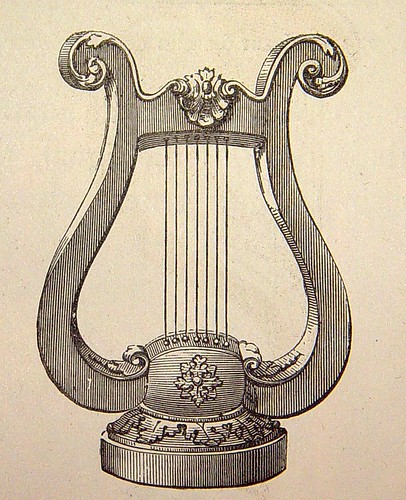
The name apparently refers to its resemblance to a Lyre. (think of the root word of "lyric" which means "of or for the lyre") Neat, eh?  and "cteis" which refers to the comb rows present in all "comb jellies"
1004182

There's not a lot known about them. They feed (see below) in a manner similar to the swimming species using long tentacles to capture food. When described in 1941 (here), they were labelled as "sessile" but the Antarctic species was described as being able to move 1 to 2 meters per day (here to see)

Here's an individual identified as the Antarctic species: Lyrocteis flavopallidus
                    Ctenóforo
2.... and the other one?
and there's a second species known from throughout the tropical Pacific called Lyrocteis imperatoris, described in 1941 by Professor Taku Komai at Kyoto Imperial University to honor Emperor Showa of Japan. The original specimen was apparently collected from Sagami Bay by the Biological Laboratory of the Imperial Palace. He described it as a "strange marine animal.."

This species is described mainly from the tropical Pacific. Possibly the Indian Ocean I suppose (based on the ones below) but none are known from the Atlantic.  Most of these live in relatively deep-water, at the lower edge of SCUBA depth to significant depths in the deep-sea (>500 m).

Its name in Japanese: 
kotokurage コトクラゲ

Here's the species we saw in the Hawaiian Islands during the Okeanos Explorer cruises in September. In theory.. there are only two species.. the Antarctic one and the tropical Pacific species.
So, this is possibly Lyrocteis imperatoris.. but exact details remain elusive.  A great MANY different color variations have been observed in observed specimens of Lyrocteis.. This makes biologists wonder if they are seeing multiple species??? Or perhaps one species with a lot of color variation??Dr. Komai, the scientist who described this species noted a great variation in color when originally collected.

Its possible (and even likely) that there is more diversity (i.e., more species) but the animals don't make it easy to study them.

Why? Because they aren't seen frequently and when they do, collecting is difficult. The individuals
aren't easy to sample and for whatever reasons, the body of these animals is extremely difficult to preserve..so intact specimens aren't generally available to study...

Here were some spectacular red ones from Okinawa..
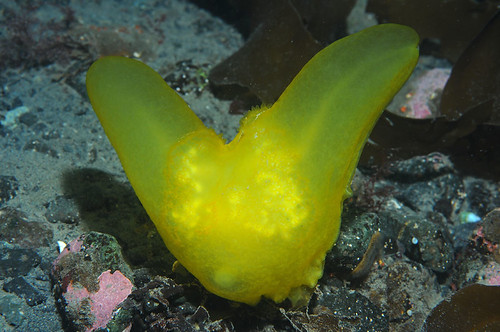
Bart Shepherd & the California Academy of Sciences Expedition to the Philippines encountered THREE color forms... the speckled one above and two others: a purple/red one and a yellow one...

and here's a South African species in the Indian Ocean. Another color and puffier..

Feeding! 
One of the nice things about our modern age is that video and image observations have become easy and of high quality

If you have Facebook, here's a feeding video of the Lyrocteis collected by Steinhart Aquarium from the Philippines..

Here's one of the purple south African species observed via video with its feeding tentacles extended...


Here's a nice one of a Japanese species with tentacles extended... from SHINKAYABLOG which translates to "deepsea" blog  This is basically similar to the way that swimming comb jellies feed...
This also explains the kawaii (cartoon mascot) for Lyrocteis imperatoris!   Note the feeding tetnacles catching the fish!!
from @deepsealife https://twitter.com/deepsealife/status/605369053209755648

Amazingly, someone is SO fond of these that they have made tiny magnets out of them!
3. The Story About its original discovery!!?
Dr. Komai, in his 1941 description of this species recounts an interesting story about "when" this species was discovered. Because apparently, although he described it in 1941.. he was NOT the first one to have encountered it!!
What makes the story of the discovery of this remarkable ctenophore more interesting is the fact that another specimen of evidently this form had been obtained previously from the same Sagami Bay and recorded by a Japanese zoologist, but without any idea of its real nature....
...in August, 1896, we find a short note in Japanese by T. N. (obviously Tokichi Nishikawa, the inventor of the famous cultured pearl) entitled " A curious animal" with rather good illustrations, one of which is reproduced in Fig. 3. The accounts and figures clearly show that the 'curious animal' was no other than a specimen of the present platyctenid.
" Nobody who saw it at that time could tell what it was. The real nature of this form thus remained enigmatic only to be made clear forty-five years later."
..and don't worry, I haven't given up echinoderms! But travelling makes you appreciate opportunistic topics!! 

Monday, August 17, 2009

I'm a biologist! What is there for ME do in San Francisco??

This week after writing a grant, getting two manuscripts off my desk, identifying bunches of starfish, plus a myriad of other echinoderm related tasks, I am taking a BREAK before I head off to Oregon and the North Pacific for some field work (which I will publicize again later this week..but here it is). and am in my hometown of San Francisco with a little time off.

So, other then friends, family and the crisp, bracingly cold beaches of Northern California, what sorts of pleasant distractions does a person with a PhD in starfishes pursue in San Francisco?

1. The California Academy of Sciences
I can almost never get away from this place (my alma mater)! Whether its their new exhibits and state of the art aquarium or my research visits to my colleagues in the Department of Invertebrate Zoology my visits to San Francisco almost always entail dropping in...

2. USED Science Bookstores!! Moe's (Berkeley) & Green Apple Books (San Francisco)

So, ya' looking for used SCIENCE textbooks at reasonable prices? Moe's used bookstore in Berkeley (on Telegraph Ave.) is HUGE and has a science section that has in the past satiated even MY raveous appetite for texts and references on marine biology, evolution, geology, invertebrate zoology and etc. I scored my set of Libbie Hymans' "The Invertebrates" here as well as several others.

The other really big place to score used books is Green Apple on Clement st. in San Francisco. Its not quite as good for science books but you can find a great many deals on used books here as well. And heck..they have OTHER books aside from science!

The Richmond Clement st. area also happens to be one of the most delicious and rich areas to score food in San Francisco. Dim sum, tasty coffees & cakes, Vietnamese sandwiches, and orgasmic pizza are all to be found nearby!

3. FOOD!!
Sushi & Noodles!

So, when I come to San Francisco, I almost inevitably end up having sushi at Ebisu or udon at its sister restaurant Hotei, both on 9th avenue near the Academy. Fresh fish, great service and authentic Japanese cuisine make this one of my favorite places to enjoy sea urchin!! I'm sure there are other great places in the city..but this one always wins in my book!

Pizza!
I grew up in this neighborhood..so I am just in LOVE with the different kinds of Pizza you can find in the Sunset on Irving (near the Academy). My favorites include Pasquale's Pizzeria which creates a fresh but thin crust versus the more thick crust Milano Pizzeria. The smells coming out of either of these places sets off my pizza-based pleasure brain receptors! mmmmm....
4. Comic Books!
I always visit my friendly neighborhood comic-book shop when I visit SF. Amazing Fantasy on Irving is another San Francisco tradition and has been in that same location for over 20 years..

After this week..off to Oregon & the North Pacific!

Wednesday, August 20, 2008

Echinoblog: Foggy San Francisco Edition

This week I am visiting San Francisco to tie up some research loose ends at the California Academy of Sciences and get in some R & R.
Note the substantial difference in August weather in San Francisco, CA !! vs. the very sunny, hot, 90ish degree, humid weather one encounters in Washington, DC!! That is actual FOG. I don' t get to see REAL fog any more. So..I'm jazzed to have it around this week!

The New California Academy of Sciences
The Academy is just recently returning to its historic home in Golden Gate Park after about 6 years or so in downtown San Francisco at an interim facility. The new building is a fantastic engineering feat! And you can read about it everywhere, including Wired , USA Today, and heck! Even Popular Mechanics!
Although there has been a LOT of PR, much of the internal details are still hush-hush. But here's a snippet. They introduced two of the alligators (one of which was a rare white, albino alligator speceis) to their new Swamp Pit Exhibit while I was visiting.
and of course, there's always Flickr...

I have a long history with the Invertebrate Zoology & Geology Department at the California Academy of Sciences. My masters degree research was performed here in conjunction with San Francisco State University.

Back in 1995 or thereabouts, I began volunteering in IZ & G and later began working as a "curatorial assistant" and ended up sorting, identifying and curating the entire asteroid+ophiuroid collection. So, you could say, I "cut my teeth" here...
I still return regularly to collect data, tie up some loose ends and regularly identify specimens for the CAS collections. And with the growth of the CAS collections-they always have something for me to do..
People

I also visit to enjoy professional discussions with the first-class research staff, including my former advisor Dr. Richard Mooi, one of the world experts on sand dollars, sea urchins and echinoderm phylogeny in general. Here's a shot from his new office!

Other luminaries in the department that I always enjoying talking to:

Peter Roopnarine. The new paleontologist/paleobiologist/all-around math dude. He writes this nifty climate change blog but mostly works on evolution, paleoclimate and various aspects of bivalve systematics and evolution.

Terry Gosliner, who works on the systmatics of nudibranchs-primarily in the Indo-Pacific but his work carries him all over. Terry's opisthobranch lab is the largest and one of the most productive for his group in North America.

Rebecca Johnson, a postdoctoral scholar in Terry Gosliner's lab.

Gary Williams, octocoral specialist and current department chair.

Collections staff: Bob Van Syoc & Jean deMouthe-Collection Managers, Liz Kools and Chrissy Piotrowski (collections technicians) are also ever-welcome to put up with my demands and listen to my off-beat stories!!

Collections
The CAS-IZG collections have an interesting mix of fossils, minerals, and of course, one of the largest collections of west coast and Pacific invertebrates to be found anywhere in the world.

Echinoderms make up a huge chunk of those collections and many of their holdings are closely tied to the history of marine biology and natural sciences in California.

Here for example, is a specimen of Heliaster kubiniji, an asteroid from Baja California collected by Ed "Doc" Ricketts of Cannery Row fame.

Echinoderm holdings are strongest for fossil & living echinoids and asteroids with good collection representation for holothurians and crinoids. Most of the fossil collections for echinoderms is relatively young, but there's some older material available. Click here to check out their online collections database.

The new facility is awesome with new wet-lab space, metal compactor cabinets and shelving, secure climate controlled areas and inevitably, Wi-Fi all around for immediate database access.
Oddly enough, enormously huge, mutant amphipods keep on finding their way into things!!


I'll post a few more pix over the next few days!!