Showing posts with label astropecten. Show all posts

Tuesday, December 10, 2013

SAND ANGELS! Astropecten The starfish that dig it!

Astropecten articulatus, Stafford Beach, Cumberland Island National Seashore, Camden County, Georgia 1
Image by Alan Cressler
So, y'a know how people do this snow thing? SNOW ANGELS?  Drop yourself in some powder and go wild!
Well, la-dee-da! Starfish can do that TOO! Except, not in snow. not in the winter. Not on land.  In sand. in mostly tropical shallow to temperate waters. So there.

I am referring to the widely known "sand star" called Astropecten, which includes over 100 species present all over the world, in tropical to temperate waters.   Go here to see some awesome pics of Japanese Astropecten and related spp. Most occur in shallows but some live in deeper-waters.
IMG_5929wa
Image by Kevin Bryant
Astropecten is often confused with Archaster typicus aka the "fake Astropecten" aka the "typical star" aka the "other sand star." Go here to see the difference. But one important difference? you will NEVER catch Astropecten pseudocopulating! Bfah!

Here's a nice image of Astropecten indicus from Singapore, illustrating the animal next to the star-shaped impression it makes in the sand.
Plain sand star (Astropecten indicus)
Image by Kok Sheng
Here is an excellent photo sequence of a species of Astropecten from Iran, showing a full range of sitting on the sand and burying itself.
Hiding Starfish
Image by Hamed Saber
Burial in Astropecten can be quite rapid. It accomplishes this via a combination of its pointed (rather than suckered) tube feet in conjunction with its many spines which are moveable and are used to help push itself into the sand. Astropecten is among the fastest of known starfish. 
Image below of an Astropecten from Singapore.
Orange sand star (Astropecten sp.)
Image by Wildsingapore. 
Pictures are nice. But why stop there?  Here's a quick 30 second video of Astropecten from Singapore burying itself and vanishing before your very eyes!
                               
Which famous Simpsons gif meme does Astropecten remind you of?

This one is probably one of the best videos of Astropecten burying and reburying itself. A video from the Enoshima aquarium of A. polyacanthus

Although they dig, they are not, strictly speaking, infaunal. They live buried right under the surface of the sand...
Astropectinidae>Astropecten Sea star 39
image by Bill & Mark Bell
Where, they are often digging through the sediment trying to find goodies to eat, such as this clam. But really whatever they find, they will swallow and devour. Note that Astropecten and its relatives LACK an eversible stomach (that you might see in other starfish). So they literally can ONLY swallow their prey..   This image is fr. A. aurantiacus in the N. Atlantic somewhere..
Prédation Astropecten aurantiacus

As I mentioned, Astropecten occurs widely around the world. And is quite diverse.  Here is Astropecten articulatus from Georgia (south coast of the US)
Astropecten articulatus, Stafford Beach, Cumberland Island National Seashore, Camden County, Georgia 1
Image by Alan Cressler
Astropecten sp. from Singapore. Cool racing stripes! 
Painted sand star (Astropecten sp.)
Image by Wild Singapore
Here's a pic of Astropecten latespinosus from Japan
Image by Yoichi Kogure! 
The substrate/sediment type can vary also.. Some live in very fine sediments, such as this Italian Astropecten, possibly A. irregularis
Piramidi_013
Image by comunerimini
Astropecten aurantiacus in sandy sediment...
Star Fish/ Astropecten aurantiacus
Image by Archipelagos Institute of Marine Conservation
Whereas others live in fairly coarse, sandy type sediments.. such as this Astropecten bispinosus from Greece.
Astropecten
Image by sarsifa
Astropecten sp. Not sure where this was taken..I think the Mediterranean? But again, coarse sediment.
Sea star , Astropecten sp.
Image by Dimitrious Poursanidis
Astropecten sp.
Image by Dimitrious Poursanidis
What's that you say? You wanted to see more fabulous video of Astropecten from around the world burying themselves in sand? YOU GOT IT.


Tuesday, January 22, 2013

Time Lapse Starfish Videos!

So, between travel, being sick, yesterday's massive Inauguration Day festivities and playing catchup, this week has been crazy!

So here are some neat starfish time lapse videos to keep you informed and entertained!

The awesome video of the tropical shallow-water "chocolate chip star" Protoreaster nodosus, foraging for organic particles and other food on the sea bottom.
Stars of the Sea from Karin Brussaard on Vimeo.

The foraging behavior of the predatory Chilean/Patagonian cold/temperate water Cosmasterias lurida (Stichasteridae)


Some classic videos from the Shape of Life series showing behavioral complexity. Read this article frorm awhile back to see what's going on...
Echinoderms: Sea Star Time-lapse: Eating Dead Fish from Shape of Life on Vimeo.
Echinoderms: Sea Star Time-lapse: Don Wobber's Film from Shape of Life on Vimeo.

Here's a nice HD time lapse of a tiny aquarium asterinid starfish. Note stomach extended and the places where the algae is absent from the glass.
A day in the life of a starfish from Rate My Funeral on Vimeo.

An unusual video that shows what happens when you drop a bunch of Patiriella (bat stars) and let them run free! Starfish show up at about 1:19 (its mostly set up prior to that)


Here's a nice little vid showing Archaster typicus (different from Astropecten-you can tell between the two  by going here to see the differences)  in an aquarium burying itself into gravel


By comparison here is a species of Astropecten from Singapore doing its thing!


The giant Pacific sunflower star (Pycnopodia helianthoides) is fast enough that you can see it moving without time-lapse. What happens when you speed it up a bit? 


Hopefully next will be all caught up and I'll be back to posting more!

Wednesday, July 25, 2012

What are the FASTEST known Starfish??

Plain sand star (Astropecten sp.)
thanks to WildSingapore for their Astropecten pic!
What is the FASTEST known starfish??
People are always interested in the upper limits of our world. The biggest! The smallest! The most dangerous!

Where echinoderms are concerned, I've tried to answer a few of these. The biggest starfish can be found here.    The largest brittle stars found here. 

But people always seem a little surprised when they see something like a starfish in motion! Most times, starfish move slowly if at all and so if people see one being the lamborginhi of echinoderms, it generally provokes some curiosity...

So, this week a new open access paper by E.M. Montgomery and A.R. Palmer in the Biological Bulletin looks at locomotion in the bat star, Patiria miniata but provides a very handy dandy comparison of movement rates in several well-known sea star species (the paper itself we shall discuss another day....).

Why should we care?? Doesn't this all seem like kind of an...odd thing to know? Indeed. But rate of movement is actually an important bit of information in understanding feeding biology, ecology, and food webs. How fast do the predators go compared to their prey?  How far could an adult travel on its own and disperse its gametes in a discrete amount of time?   So, yeah. Its worthwhile...

It should be noted that most of the rates outlined below are based on a clip motivated by predators. So, its not necessarily clear what their "average cruising speed" would be..

Some general trends..

  1. Sea Star movement rates vary from 0.3 mm/s (milimeters per second) in the "sun star" Crossaster papposus to a breathtaking 50 mm/s!!!
  2. Most of the observed species (which are intertidal-shallow species like Patiria miniata or Leptasterias) seem to run on the slow to moderate side, about 0.3 to 1.3/2.0 mm/s and are medium-sized but relatively few of the smallest or largest species were included.
  3.  Diversity isn't well sampled and we really only know the movement rates of VERY few species (17 out of 1900 species!).
  4. Its thought that larger size does have some relationship to speed and some of the fastest species listed are also among the largest..
Here's a breakdown of speeds in starfish in milimeters per second!

Honorable Mentions:
I should just say that while these seem reasonable-it seems like there are faster species out there. These  just seem to be well-known and as more information becomes available there's likely to be starfishes that put these guys to shame...

Astropecten aranaceus and others.  Speed: 2.5 (error+/-0.8)
Astropecten is the "proper" sand star. They occur on unconsolidated sand/sediments where they sit and wait, buried until prey comes along. They occur in shallow-water, tropical to temperate water habitats all over the world. 

There are many species..many of which are deceptively fast...Here is a nice video of A. aranaceus which is found primarily in European waters..

But here is Astropecten polyacanthus from the tropical Indo-Pacific. Look at that thing go!


Asterias forbesi and Asterias rubens (Asteriidae). Speed: 2.0 mm/s and 3.3 mm/s
These two species are the most commonly encountered in the North Atlantic-so on the east coast of the United States and in Europe. These are the classically known "starfish prey on a bivalve" type of starfish that you see in the intertidal.

Here's video from Massachusetts showing Asterias moving around at a decent but relatively slow clip..

Oreaster reticulatus (Oreasteridae).  Speed: 3.3 mm/s
This species is the well-known "cushion star" found in the tropical Atlantic-Gulf of Mexico, Bahamas, etc. Its primarily an opportunistic omnivore feeding on algae and other organics present on the bottoms.

This was honestly kind of a surprise. On the spectrum of starfish that are known for speed-this one isn't one of them. But the original account observed them in undisturbed, natural settings, so perhaps there is some bias on my part...
Oreaster sea star with the right number of arms

TOP FIVE FASTEST KNOWN Starfish!
Of the known movement rates listed in Montgomery and Palmer's paper these were the 5 highest with embellishment from what I've seen etc.  Bear in mind this is 5 of the best known species, out of nearly 1900 different species-so..there's possibly (probably) faster or at least, comparably fast taxa out there....

5. Protoreaster nodosus (Oreasteridae). Speed: 4.6 mm/s (deviation +/- 1.2) 
This is the well-known "Chocolate Chip Starfish" that occurs in the tropical Indo-Pacific. This species  is often encountered in the aquarium and tropical tourist trade. It is related to the "Cushion star" O. reticulatus above..and similarly, feeds on microalgae and lives on loose, sandy bottoms.

The video doesn't show them at their quickest but its something..

4. Acanthaster planci (Acanthasteridae). Speed: 8.3 mm/s (deviation +/-2.5) 
This is the infamous Crown of Thorns Starfish which occurs throughout the tropical Indo-Pacific from Hawaii and Baja California all the way to the east coast of Africa in the Indian Ocean. Its a large, fast, coral eating predator..

No wonder it moves so quickly...

3. Archaster typicus (Archasteridae). Speed: 12.7 mm/s (deviation +/- 5.4)  Here's one that a lot of people probably don't realize.  This is the "fake Astropecten". I outlined a blog awhile bag about how to distinguish it from "proper" Astropecten here. 

Archaster is parallel/convergent with Astropecten (below) but live in a similar habitat buried or semi-buried in loose sediment/gravel...There's a nice account of biology here by my friends at Wild Singapore..


2. Pycnopodia helianthoides (Asteriidae)Speed: 20.4 mm/s
Pycnopodia is found only on the west coast of the United States from Alaska to southern California. Its a big animal-up to about 2-3 feet in diameter.

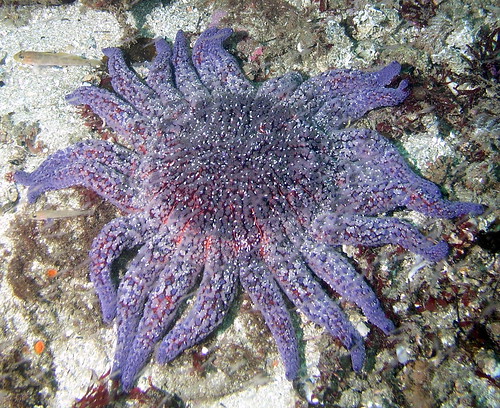
Its a big animal and boasts 15,000 tube feet on its 20-30 arms. Its a feared and voracious predator on mollusks, sea urchins and other invertebrates, which can actually smell it coming and will move out of the way when they do...

It has THE reputation for being the fastest starfish known.. but as we shall see, this is not the case...
Giant Sunflower Star
here's some footage of this formidable species in motion!


1. Luidia ciliaris and friends (Luidiidae). Speed: 50 mm/s !!
Luidia is a genus of "sand star" that lives in tropical to temperate, usually shallow sandy habitats all over the world. They are predators that feed on mollusks, sea urchins and other invertebrates.

L. ciliaris occurs in the North Atlantic around Europe-the UK and so thereabouts..
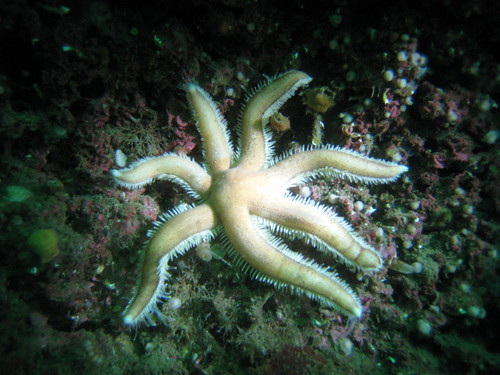
7 Arm Starfish

So, not what you thought! Pycnopodia has gotten the reputation as the "fastest starfish" in the world.
But NOT so! It would seem that Luidia spp. overall seem to be among the fastest of sea stars with a rate of movement just short of twice as fast as Pycnopodia!

Diver and photographer Neil McDaniel (who has contributed to the Echinoblog before) has graciously tested movement rates and found that under duress  Luidia foliolata is about 25% faster than Pycnopodia. Luidia foliolata travels at a rate of about 46 mm/sec vs. about 35 mm/sec in Pycnopodia.

Perhaps something to do with living primarily on sandy sediments??

But why talk when I can show you...
Here's Luidia maculata from Lembeh (Indonesia).  Note however, that this one has some commensal crabs that seem to be in on the action..


Even the 5-armed species are pretty light on their tube feet... Luidia clathrata from Isle of Palms, South Carolina..

Starfish from paul zoeller on Vimeo.

Thanks to Neil McDaniel for his contribution to this account!

Tuesday, April 24, 2012

Pt. 2! Snails and the Starfish that love to eat them!

More escape responses! This time snails (i.e., gastropods) and some "extreme" behavior on their part to get away from predatory starfish!

Japanese Astropecten vs. snails!

The neat snail escape response to the sand star Astropecten begins at 1:30!  Honestly, I've never seen a snail pull the ol' push myself out of the way with my foot maneuver!


Pycnopodia vs. abalone! 

Here's a few videos of abalone escaping the large Pacific Pycnopodia helianthoides!


This one shows that even brief contact with a sunflower star will ellicit the escape response..

Scale Worm Helps Snail! Biting Starfish (Pycnopodia)!  I missed this one I don't know-but COOL!  the good part begins at 0:55


And here's an escape response ellicited by the sea slug Dendronotus!


Tuesday, April 26, 2011

Telling Apart Sand Stars: Archaster vs. Astropecten! Two Common Trade Species

So today, I thought I would finally indulge those of you who are in constant puzzlement over how to tell the difference between two of the more common "sand stars" found throughout the Indo-Pacific!

This is a surprisingly common question and its not just my colleagues who repeatedly ask me this -I frequently see these two species mistaken for one another in tropical aquarium and "shell collector" magazines, websites and so on..

Hopefully, the names of these two species can be consistently applied. And that's generally good for everyone in the long run...

Know Your Sand Stars! Convergence between Astropecten and Archaster?
So, first, we are talking about TWO different species from two different families in two entirely separate orders.

Astropecten in the Astropectinidae, Order Paxillosida (I will refer to the species Astropecten polyacanthus for simplicity's sake).

Astropecten is distributed worldwide and occurs primarily in the shallow-water tropics-but also to a certain extent in temperate to cold water (occasionally in deeper depths)

Here is a nice video example of Astropecten (prob. A. polyacanthus) very efficiently burying/unburying itself...


I should add the caveat that there's just over 100 species of Astropecten throughout the world and a fair number of them are present in the tropical Indo-Pacific.. So, there may be SOME variation if you are looking at different species of Astropecten wherever you may be reading this..

Archaster in the Archasteridae, Order Valvatida. Found in shallow water throughout the tropical Indo-Pacific . Archaster also makes a point of burying itself into sediment... (yeah-there's no single video that is as good as the one above..so these will have to do!)


In spite of belonging to two completely different and distant groups of starfish, BOTH live in sandy bottoms with loose, unconsolidated sediment and possess the ability to dig and hide under that sand or sediment.

As a consequence these taxa display a number of superficial similarities that are adaptations for each respective species to live buried in a sandy, muddy or otherwise unconsolidated bottom environment.

In vertebrates, you would see this same kind of relationship-called convergent evolution between dolphins (which are mammals) and fish (which are not). Several consistent morphological features, which appear similar, but that arise in very separate evolutionary groups as adaptations to a particular way of life.

In the case between dolphins and fish-the fins and smooth lemon drop shape are adaptations to life swimming through the water.

In the case of these starfish-the location of the spines and the certain similarities in body shape are independent adaptations to digging through sediment.

Hence..the word "sand star" could apply to both. (And that's why I dislike common names...)

These two species are frequently mistaken for one another. and Archaster is apparently quite common and abundant.. So usually, people mistake Astropecten for Archaster

So, How Do We Tell Them Apart?

1. The Radial Plate series (aka the carinal plates)
So-if there's one immediate and obvious character to use-its the distinctive central row of plates on each arm.
Indicated below in blue
This is versus Astropecten which basically has NO distinctive radial line or series of plates... Its just a big jumble...

2. Suckered vs. Pointed Tube Feet
Another immediately obvious difference between the two..

Archaster has actual suckered tube feet.... As seen here on this video..


This is as opposed to Astropecten which have pointed or knobby ends on their tube feet..
3. Body Shape and Spines on the Outline of the Body.

Archaster only has big flat spines on the lower side of its body that flank the oral surface.. If there are spines on the upper surface, they are small and tiny..
Plus..the body itself is shaped rather distinctively. with the rather long-tapering arms
There is more of a prominent angle formed between the surface and the side of the body. Also, the top surface is more flattened...
In contast, Astropecten can have broader more triangular arms. This can vary by species-but if you find an Astropecten in the tropical shallow waters of the Indo-Pacific, it will look very similar to this...
Arm is more triangular. And many species of Astropecten will have a very prominent perimeter of spines around the body's edge.

There is more of a curved angle formed by the top and the lateral side. And you'll often find the top surface to be more swollen and curved. Not as flat as you would find in Archaster...
4. The Spines are Different.
Note that these spines are round and sharp rather than flat and blunt.
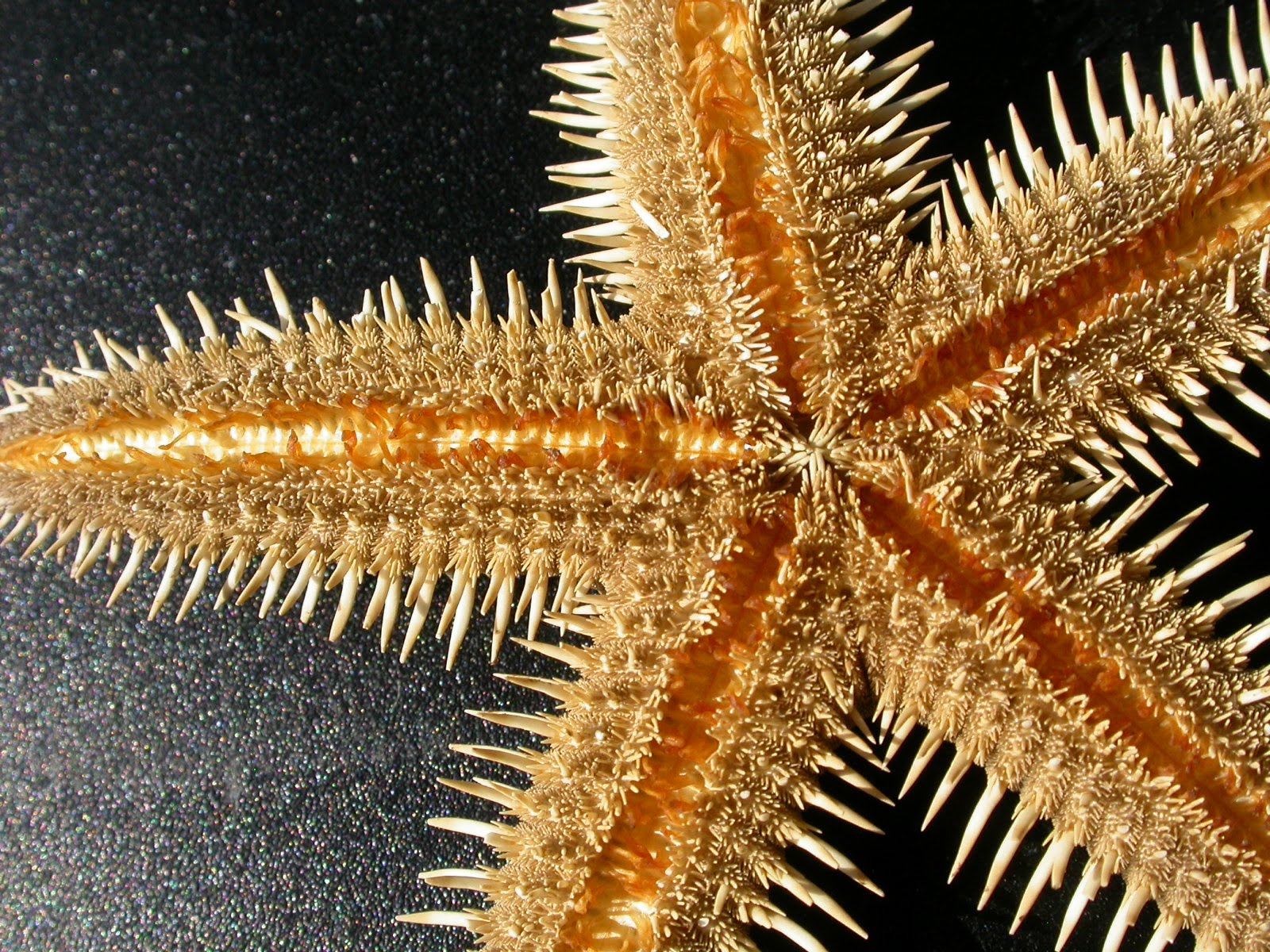
You can especially see the difference in the abundance and the type of spines on the bottom (oral) surface...
In Archaster, the spines are flattened and blunt!!
To the seasoned expert, there are actually MORE differences than this. But these were the characteristics that I thought were the easiest to tell apart for those who are simply observing the exterior.

It turns out Archaster is probably one of the more heavily fished starfish species. Not only for aquariums, but one also sees this species on sale for arts & crafts and shell-collector websites and ebay.. but Astropecten turns up as well.. This pic gives you an idea of where this species ends up...

What might the impact be of overfishing these species? The first step is knowing which one is which...

Thursday, December 23, 2010

Holiday Treat! Japanese Astropecten burying/unburying video!

I just HAD to post this.. VERY cool Japanese Astropecten unburying itself in reaction to some food.. A little holiday treat!!

Tuesday, November 23, 2010

ASTROPECTEN aka SAND STAR videos!!!

I had hoped to put together something more ambitious this week, but alas, forces have worked against me. But NEXT week and for the few weeks? Something SPECIAL ..as the Echinoblog blogs from EUROPE!! As I work from the world famous Museum national d'Histoire naturelle in PARIS, FRANCE!!

But for now, enjoy these very keen videos of the sand star Astropecten which is found in various tropical shallow water environments on sandy bottoms around the world...

From Japan, an outstanding video of what looks like Astropecten polyacanthus gliding gracefully over a sand bottom to a French sound track!


From Tarifa, Spain, a neat vid of what is identified as Astropecten aranciacus...


An Astropecten sp. from Changi!

Painted sand star from Ivan Kwan on Vimeo.


and another one from Japan, being flipped over and turning back...

Thursday, January 14, 2010

More Exotic Hawaiian Starfish! Valvaster and Astropecten!

Today, MORE Exotic Hawaiian starfishes sent to me to ID!! Thanks to Gordon Hendler (Los Angeles County Museum) who found the specimens and Cory Pittman, who photographed the specimens! Let me caveat that Astropecten (family Astropectinidae) is VERY hard to identify from pictures! In a professional sense, having vouchers is the best way to ID them.. First, Astropecten polyacanthus Like all Astropecten (there are 2 in shallow-water Hawaii), this species burrows into the sea bed and live under a fine veneer of unconsolidated sediment, where they feed on various small, molluscan fare..snails, clams, etc. This beast is about 2 inches in diameter and was collected in Maui from about 9.0 m. It is distinguished from the 2nd species by having spines in each interradius and adults should only have one spine per superomarginal plate (but this is difficult from pictures)A second specimen (also discovered by Hendler/ photographed by Pittman) from Maui at about 10 m is possibly a Astropecten triseriatus myobrachius. This specimen was only about an inch in diameter. This species differs slightly, in having 2-3 spines per plate and is missing the spines pointing aborally (i.e., upward) in each interradius.. Although, this seems like A. t. myobrachius to me, its entirely possible that this is some kind of juvenile of the species above with smaller features. THESE are the kinds of FACTORS that make taxonomic identification difficult (and challenging)! Valvaster striatus (family Ganeriidae), has been known for awhile (described by Lamarck in 1816) but we know NOTHING about it except for the name. Its definitely a RARELY encountered, but thankfully, easy to identify, species in Hawaii (known from Oahu and Maui), but is known widely throughout the Indo-Pacific including Guam, the Philippines, Australia, and the Indian Ocean. in less than 20 m depth. Found and photographed by Cory Pittman.We DO know something about the etymology of its name, of course. Notice that on the side of the animal, are large bivalved pedicellariae, which are sort of like big clamps that sit on the lateral side of the animal (see white circles below). Hence Valv for the valves on each pedicellariae and -aster for star.. And the adjective striatus refers to the striated patterns on the body surface Color in this species varies....This one is darker with green where others are more red... This animal was from Guam and is a borrowed image from Gustav Paulay's excellent FMNH site on Indo Pacific animals. 

Note that this one in Wikipedia? NOT Valvaster (looks like an oreasterid or a goniasterid). Pls. make a note of it! Have a great weekend everyone!

Monday, July 20, 2009

All about hitode (ăƒ’ăƒˆăƒ‡) & momiji. The Blog about Japanese Starfish Names!!

(all starfish photos by Yoichi Kogure)
So, last week, I discussed the brooding astropectinid starfish Trophodiscus almus, a unique species that broods its young on the top surface and has the Japanese name komochi-momiji.
At first, I thought that the name translated to "starfish (momiji) with babies" (but see below!)

WAIT! WHAT ?

I thought the word hitode (which incidentally translates to "palm") was the word for starfish??
I also wondered how these seemingly formal Japanese names were formulated??
Well, My good colleague, Dr. Yoichi Kogure at the Japan Sea National Fisheries Research Institue in Niigata Japan (shown here) saw my plea and proceeded to clarify!!

1. How are these Japanese names decided??
There are no strict rules for these names but apparently, there is a long tradition for the use of certain names. According to Dr. Kogure:
...most of the Japanese common names have been proposed in encyclopedias or picture books. In fact, we can see some wood prints of starfishes with common names in the encyclopedia published in the Edo period. The attached picture is the sea star and sand dollar in the encyclopedia published by Ryoan Terajima, a Japanese medical doctor in the Edo period, in 1712.
Wow!!! LOOK at that!! Astropectinids recognized from 1712!!!! I'll have to check but this might one of the OLDEST recognized names of starfish!!

2. What is the difference between momiji and hitode???

So, we now have TWO Japanese words for "starfish". Hitode and momiji.

For example this species (Ctenophoraster diploctenius) has the Japanese name: udenaga-kagitoge hitode

This translates to: udenaga=long arm kagitoge=hooked spine and hitode=starfish
(see the Japanese name from a recent paper here.)

(all starfish photos by Yoichi Kogure)
It turns out that momiji translates to "maple leaves tinged with bright red" and is the Japanese word for "astropectinid (or at least astropectinid-like) starfish"!!! The name apparently refers to starfish with this particular body form.
To quote Dr. Kogure:
The name momiji is short for momiji-hitode or momoji-gai. As you know, hitode is the most common use of the Japanese word to indicate sea stars. The word gai or kai means shellfish in Japanese. Our remote ancestors considered that the sea star was one of the groups of seashells. The Japanese common names of sea stars have hitode in most of the species, or momiji in some groups. For example, we can see the word momiji in some astropectinid sea stars and goniasterid sea stars such as Pseudarchaster parelii (aka-momiji: red sea star).
3. Examples!
Below is Ctenopleura ludwigi, whose Japanese common name is oh-nise-momiji.

Oh translates to "large" and nise translates to "pseudo"...so the "Large fake astropectinid" which possibly reflects its superficial resemblance to Astropecten.
(all starfish photos by Yoichi Kogure)
This Japanese species-Astropecten latespinosus has a pretty well flattened body. Japanese name is hira momiji.
Hira means "flat"..so "Flat astropectinid" (to contrast-the latin latespinosus refers to the lateral fringe of spines around the edge of the body)
(all starfish photos by Yoichi Kogure)

Astropecten kagoshimensis with Japanese name: kurosuji-momiji

kurosuji translates to "striped with black" which, well....seems kind of obvious:
(all starfish photos by Yoichi Kogure)


Dipsacaster pretiosus -another deep-water Japanese astropectinid starfish with Japanese name: hadaka-momiji

Hadaka means "naked" and likely refers to the featureless surface around the edge of the animal.
(all starfish photos by Yoichi Kogure)

Leptychaster anomalus with Japanese name: usu-momiji. Usu means "thin" (and the animal is indeed quite thin)
(all starfish photos by Yoichi Kogure)

..and the related Leptychaster arcticus?? Japanese name is kita-usu-momiji

Kita refers to "northern" (L. arcticus is a species that lives in an Arctic/subArctic band) and follows the Leptychaster format for "thin" = usu
HUGE thanks to Dr. Yoichi Kogure for his help and information that contributed to this post!