Showing posts with label Asterinidae. Show all posts

Tuesday, May 16, 2017

Tremaster mirabilis! Five things I have learned about a Fantastic Starfish!

Baker Island
Back in 2008 I wrote a post about a great looking starfish that I wanted to know more about, a weird looking deep-sea star called Tremaster mirabilis!  

Its a striking looking animal and its not unusual for odd looking animals to have some kind of story attached to it..and as we learn more about it, the more intriguing it becomes! 

The species name "mirabilis" is Latin for "wonderful" or "to marvel at" and as we'll see the genus name Tremaster has an equally appropriate descriptive etymology! 

Since I wrote that introductory post in 2008 not only have I learned more about it-but we've now seen it ALIVE all over the Atlantic and  the tropical Pacific thanks to the livestream videos of Okeanos Explorer!

Brief Introductory Details: Tremaster is a starfish in the family Asterinidae, that puts in the same family as "bat stars" and a bunch of other sea stars you probably recognize from shallow waters and home aquariums. Go read this account on this huge and diverse group, which I wrote a while back...
Bat star
image via Flickr by Ed Bierman
But one of the people I/we owe the MOST to is a diligent and smart-as-a-whip young researcher named Ms. Katie Gale (more at her website here) who was working in the deep-sea biology/ecology & reproductive biology lab of Dr. Anne Mercier at Memorial University in Canada! 

Katie published this great paper on feeding biology and ecology of deep-sea asteroids collected off the coast of Canada in the North Atlantic in Deep-Sea Research in 2013.  I blogged it up here.

During the course of Katie's research she collected a fair amount of cool "anecdotal data" which amounts to singular observations and some other stuff which furthers the "natural history observation" of a starfish about which we know very little!   So her observations along with some further observations from the 2017 research legs of the NOAA Okeanos Explorer, some further homework on my part and voila!

Let us learn MORE about the weird starfish Tremaster mirabilis!

1. It eats coral (possibly)
Probably one of the BIGGEST questions I had for such a strange looking sea star! As we'll see, this species is seen quite a bit and yet one of the most immediate questions about it seemed elusive!

Fortunately Katie Gale was quite lucky and was able to capture and image of this specimen of T. mirabilis taken by the fine people who operate the Remotely Operated Vehicle ROPOS/DFO. Gale's paper cites this image showing our mysterious starfish feeding on CORAL! 

Specifically the octocoral Acanthogorgia!  
Tremaster mirabilis occurs widely around the world and of course, its always possible that there is variation in feeding or that possibly the animal in the picture has somehow been caught doing something completely else that we have no clue about-BUT our best guess is that its feeding. So, we continue on with that notion..

BUT we have THIS image taken on Whaley Seamount during Leg 3 of the Okeanos Explorer mission at 875m!

Could its location on the rock surface be because its near a yummy food source? Another coral predator to add into our understanding of deep-sea coral ecosystems???


2. Time lapse movement and?? 
This probably seems like a common sense thing-we KNOW starfish move albeit VERY slowly. and can actually show some behavioral complexity (here) 

Katie nabbed some of this GREAT video showing this species moving around its aquarium and more importantly NOT attacking this sea anemone in the aquarium.

This is actually an important point because we know MOST starfish CAN move but they often don't.

So, ACTUALLY capturing it doing so gives us some insight into what they do when we aren't watching them..
Tremaster mirabilis and Flabellum
Katie for example caught THIS unusual variation in posture:  Could this be avoidance of the bottom somehow? Filter feeding? Some kind of stress response? 
Tremaster mirabilis
Note in this image that the "skirt" is lifted compared to the in situ Okeanos images below where the animal is flush with the bottom..
Tremaster mirabilis
What is it doing?? This is a bit of a A mystery. 

and on Pau Pau Seamount and elsewhere Tremaster  is CRAAZY abundant! Are they moving around to feed? to reproduce?  How does all of this come together??? These behavioral bits add to our understanding but also to the mystery!

If we sped the movement of this "constellation" of Tremaster mirabilis up, would we still see no movement? or  is it a Times Square of Deep-Sea Starfishes??? 

3. One species lives in at LEAST THREE Oceans?
It USED to be that everything we knew about this species was taken from museum specimens and indeed we are STILL dependent on samples from throughout the world for new records of where many species live.

There is some question about whether or not this one species "Tremaster mirabilis" is actually one species or possibly several 'cryptic' species disguised by the fact that all the individuals observed all appear to be the same.

 The external characters vary only slightly and its not unusual for a widely occurring species to demonstrate some... variation throughout its range. However, when we examine dead museum specimens we are often missing data such as color and behavior which can be important.  Especially when its range where it lives is at least THREE oceans!

Tremaster is a moderately occurring deep-sea species.. occurring roughly between 200 and 600 m

Thanks to submersibles such as Okeanos Explorer we now have VIDEO and ON SITE (in situ) observations of LIVING animals!

Tremaster mirabilis is supposed to be one species..but as you can see there is a SLIGHT difference in body form..

North & Central Atlantic: An image from Nygren Canyon (top) and the lower image from Puerto Rico. Note there's more of a "skirt" around the edge versus the Pacific ones.
Throughout the tropical Pacific
Here's a brilliant deep-orange one seen on the recent Okeanos leg from Jarvis Island..

And interesting brick colored one from Pau Pau seamount
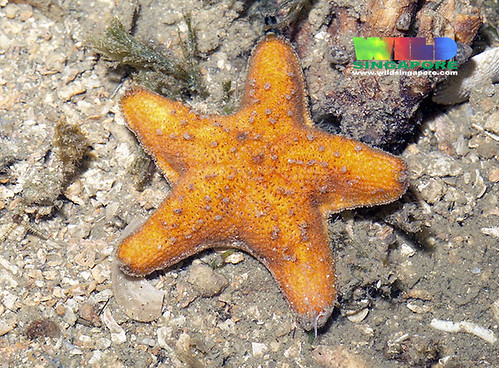
and this interesting lighter colored individual from Baker Island..

Other Records show this species in New Caledonia and throughout the Pacific. I've not yet seen it from the Indian Ocean however..

Another place where Tremaster shows up? Antarctica and nearby...

4. There are Jurassic Fossils
As if dealing with living animals weren't enough, these intriguing beasts show a CLEAR relationship to at least TWO Jurassic fossils!

Bear in mind that the Jurassic is quite a LONG time ago. These sea star were living in the world's oceans while dinosaurs roamed the Earth!

AND like its modern descendents-these were quite spread out. Antarctica versus Switzerland!

Here's Protremaster felli, from the Jurassic of Antarctica! Described by Andrew Smith and T. H. Tranter in Geology Magazine 1985


and YET another "Tremaster" like fossil sea star, described in 1981 from the Jurassic of Switzerland: Mesotremaster  zbindeni described by famed Swiss paleontologist Hans Hess!
Image from the Wikipedia file: https://commons.wikimedia.org/wiki/File:Mesotremaster_felli.jpg
Close up of the plate detail showing a familiar pattern for "Tremaster" like asteroids...


4a. Interesting Evolutionary History...  I had also mentioned briefly in my account of the importance of the family Asterinidae (here)  And well, Tremaster is possibly VERY important to the evolution of starfishes. It has a history showing them in the Jurassic.. and to those in the know.. these show a close resemblance to several weird deep-sea species! 


5. What does "Tremaster" actually mean? And"brood chambers"??
FINALLY! What does the genus "Tremaster" actually MEAN anyway? "aster" is obviously "star" but it turns out "Trema-" refers to "aperture" or OPENING!

When Addison Emery Verrill described this genus in 1880 he made allusion to these FIVE openings present in each interradius! These were one of the distinctive characters he used to diagnose his (then) new genus!! and "mirabilis" of course refers to "wonderful"

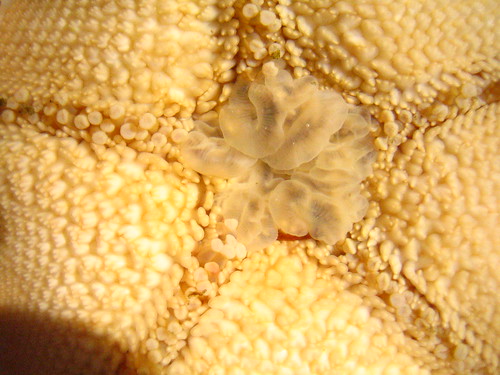
Here's a photo of the underside of a Tremaster specimen.. the openings are indicated by yellow circles!
So, as it turns out if you look more CLOSELY at these openings, they are actually OPENINGS into chambers present INSIDE and THROUGH the body wall and open up on the TOP:


Here are images of a dissected individual from the underside showing these openings (i.e. these are close ups of what's in the yellow circles above)
According to the author who described this species (and subsequent literature), there are actually BROODED young in these chambers! Its not clear to me if they are simply embryos or actual juvenile individuals. Strangely enough, these have not been documented..at least not in the literature that I could locate. and I have yet to actually spot them. But perhaps I've simply not been looking at the right ones...

Thus, the openings appear to provide an opening for water to circulate into these chambers which could serve any number of purposes.. Possibly to aerate the "brood" chambers? Or perhaps they assist in the degree of arching the dome-like shape is capable of??  Filter feeding? Predation??

One of the great things about science is how it marches on! Its been 9 years (!!) since I wrote that first post and I LOVE that what in addition to what I've learned from reading, there has ALSO been genuine progress in learning NEW information on the biology of these animals..  And one of these days we will more FULLY understand it and its strange signficance!

Also GREAT to see that animals like this INSPIRE! Here is a GREAT illustration of this species by "Cartoon Neuron" on Twitter...

Wednesday, June 24, 2015

Better know The Asterinidae: Familiar & Unfamiliar!

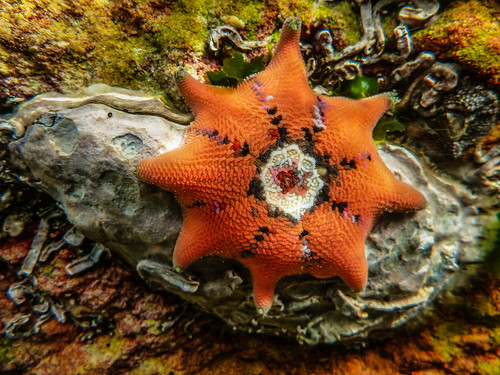
Asteroidia | Asterinidae | Patiriella calcar [Variegated Sea Star] - Flat Rock, Ballina, NSW
A lot of times on the blog, I talk about weird and often unfamiliar groups of echinoderms. But today I thought I would talk a little bit about a family of sea stars, the Asterinidae, which its most likely that most people have seen at some point. They're familiar and as a result, we know quite a lot about some of them..

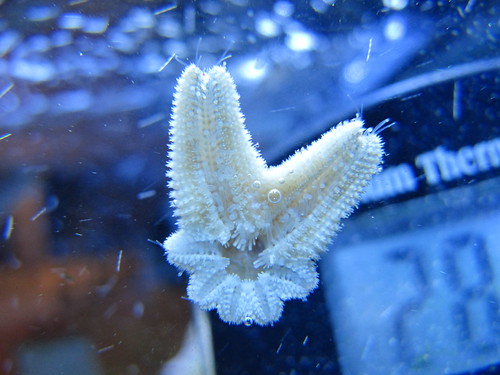
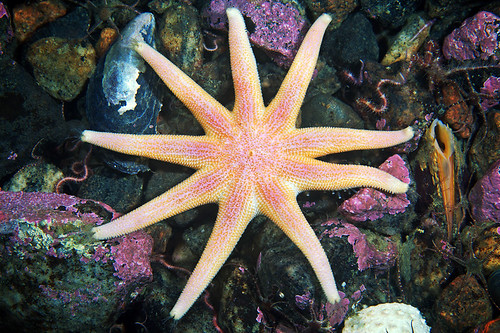
Members of the Asterinidae include some 150 species in over 25 genera spread out all across the world. Everywhere from the deep-sea to under rocks in the tropical Atlantic and Pacific. Most have five rays, whereas others, such as Meridiastra calcar from Australia can have up to 8 or 9..
Meridiastra calcar #1, Blackmans Bay
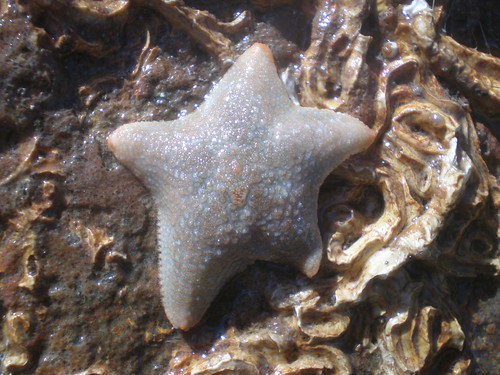
The many species go by several familiar common names: Bat star, cushion star, Knitted star..

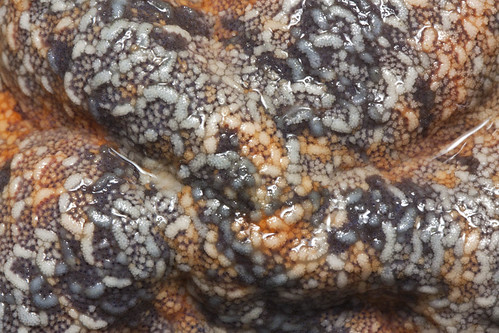
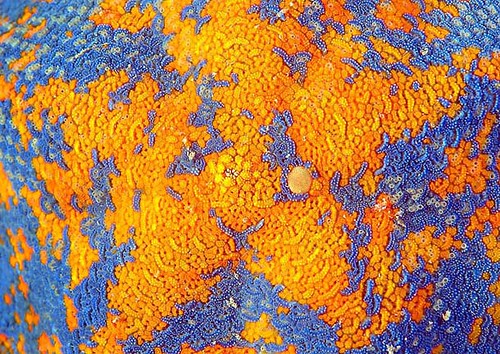
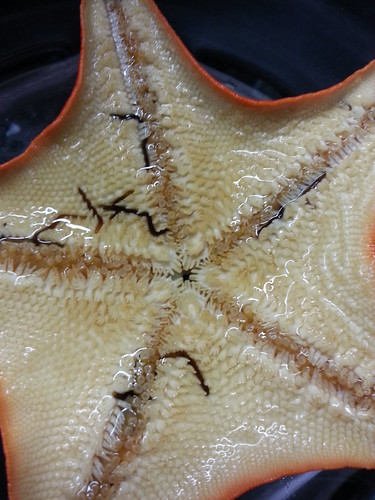
This is actually a good place to identify the very distinctive patterns in asterinids.. namely, these crescent or "knitted" looking plate patterns on the body surface..
Asterina miniata, Bat Star, Dorsal Surface
               Starphish Asterina (patiria pectinifera) Japan sea, Far East, Primorsky Krai, Russian Federation
In fact, the Japanese word for sea star.. hitode, which means palm, may actually be BASED on an asterinid (Patiria pectinifera).

But for once, there's quite a lot known about them! So here's five subjectively interesting facts about them!
1. They live everywhere
Asterinids occur all over the world with many in shallow water habitats, including under rocks in places as diverse as the North Atlantic. They often live under rocks, or hidden away in cryptic habitats..

There is a HUGE diversity of these tiny little guys. Some are able to reproduce asexually but others just seem to get around.. Being small and easily transported...
serennig - Asterina gibbosa - cushion star
to tropical habitats in Singapore...
Crown sea star (Aquilonastra coronata)
This Callopatiria granifera was a species I observed in Cape Town South Africa!

But honestly, one of the places you are MOST likely to encounter them is here.. in a tropical reef aquarium. These tiny ones are most likely in the genus Meridiastra or Aquilonastra.

Again, this is one of those species which is small and easily transported.. Living rock is a GREAT place for them to turn up..

This aquarium species is asexual and once one gets into your aquarium, you're most likely going to have a bunch of them after too long...

So, you can encounter shallow water asterinids almost all over the world! Australia, South Africa, South America, Antarctica, North America, etc, etc.

But as with most starfish groups, there are often weird deep-sea members... Both of these get to be pretty big sized animals.

I've mentioned these briefly before.. the flat one on the left is called Anseropoda, which is SO flat that it feels like a cloth rag when you pick it up!  We know very little about it.. Sometimes, small ones are so thin that light shines through them! Its name literally means Ansero for "goose" and "poda" for foot.. So, Goosefoot starfish! These can get to be almost 1.5 feet across!

The one on the right, is called Tremaster mirabilis. Katie Gale and her colleagues found that these will feed on coral in the North Atlantic. As a species it occurs widely around the world including the North Atlantic, the South Pacific and near Antarctica.


 2. Funky Feeding
Asterinids practically EMBODY the classic feeding mode of stomach eversion in sea stars! Here's a classic video I've been showing since the blog started!  It shows the stomach extended out onto the glass and feeding on the algae and other good stuff.  Most other asterindis feed in a similar fashion...

Sea star stomach (Bat star)

BUT some are neat ambush predators!! One species in New Zealand.. Stegnaster inflatus pretends to be a cave and can actually AMBUSH tiny swimming crustaceans!!

One of these days, somebody needs to actually make a video of this thing feeding!
This image from SeaFriends in New Zealand


3. Reproduction! Lots of it!  Asterinids are one of the most heavily studied sea stars because of their many reproductive strategies...

Some, such as this "Asterina panceri"(Asterina gibbosa) actually BROOD their young
Asterina pancerii birth
From Byrne 1996, Fig. 4h

and I've reported in the past on this other brooding species, which live inside their mother and whose babies will actually EAT one ANOTHER! 


And of course when all else fails, there's always dividing yourself!  Asexual or fissiparous reproduction is why those tiny aquarium stars are so numerous! 
asterina6361_281111
IMG_3451

3.  Commensal Worms! In the Pacific Northwest species, Patiria miniata, its been know for quite some time that there's actually a species of polychaete worm (Ophiodromus pugettensis) that actually lives on the underside!!
Ophiodromus pugettensis

This is one of the better studied species of asterinids, but there's many other species of Patiria and other species such as Patiriella and Meridiastra which have a similar surface morphology and are conceivably "habitats" for other animals...

4. They are important to the Evolution of Sea Stars!

Here's figure 2 from our paper...
Yeah, I know the image is hard to read, but basically, what I wanted to show was how the Asterinidae seems to show close relations with several other groups of sea stars, including the big multi-armed predators, the Solasteridae
Solaster endeca
and the enigmatic Antarctic Perknaster.. 

Also, the aforementioned Tremaster mirabilis? Sea stars which resemble this species can be found from the Jurassic!  And its position in the tree seems to suggest it might be... interesting..

and of course, there's more I haven't summarized here.. their phylogentic history relative to their various interesting features, etc.. but that's another post!

Tuesday, August 13, 2013

Tiny Starfish hermaphrodites with live cannibal babies!

A very local speciality.
Image by Nuytsia@Tas
Data for this post was derived from Maria Byrne's 1996 paper in Marine Biology: "Viviparity and intragonadal cannibalism in the diminutive sea stars Patiriella vivipara and P. parvivipara (family Asterinidae) vol. 125: 551-567 which is a pretty neat piece of work that set the groundwork for their paper in Biology Letters which was just published today! Today's post has been reported in the news (here) .

Our story begins with an overview of two unusual and quite tiny starfish! Some details:

  • Occur in Tasmania (Southern Australia) 
  • Two species, Parvulastra vivipara and P. parvivipara occur on rocks and surrounding areas.
  • One of those starfish, P. parvivipara is among the world's smallest adult sea stars. 

Indeed! Look how cute and tiny they are!
Tiny endemic.
Image by Nuytsia@Tas
But the  truth is that these tiny little starfish have all kinds of shocking sex secrets!

1. Both Species of Parvulastra are self-fertilizing hermaphrodites. 
I have written about similar species in the same genus (Parvulastra) here. 
Yes, that's pretty much self explanatory. Individuals are simultaneously both male and female AND if need be they can fertilize themselves. 

They typically have between 6 to 8 female gonads and 1 predominantly male gonad. However the amount of sperm present would not be expected in those species which are exclusively self-fertilizers-so SOME outcrossing (ie sex with other individuals) does occur.
Patiriella vivipara
Image by Nuytsia@Tas

2. Parvulastra broods juvenile starfish in a brood chamber (aka "live birth" aka viviparity)
Several species of starfish are known to possess "brooding" behavior (I've written about them here). That, is the adult "carries" either internally or externally several tiny juvenile starfish with it until they are ready to move off on their own as full adults.

Each adult Parvulastra carried multiple juveniles across a range of sizes. Here was one example of a clutch containing 30 individuals from ONE large individual. Number varies with size..
scale bar= 1.0 mm, From Byrne 1996, Fig. 4e
These further images from Byrne's paper give you an idea of where they are located. Essentially throughout the body cavity between gonads. This differs from other species which can have them living around the mouth or in other locations.
From Byrne 1996, Fig. 4a
So, eventually, those little baby starfishes have to leave the comfort of the mother's body cavity. This happens when they reach about 25-30% of the parent's body diameter.

The downside of having brooded juveniles is that they tend not to go very far from the adult. In other species, the larvae would be dispersed over wide distances but here, they are retained or crawl away, staying near the parent.. 

Eventually, they exit via openings in the abactinal body wall called GONOPORES. 

But what motivates the exit? 

3. Those juvenile starfish are cannibals! (aka intragonadal cannibalism)
Life is harsh and these starfish know it better than anyone. The gonads in these animals are pretty small which implies that food for the juveniles isn't really enough to keep them sustained on their own..

So, as soon as the brooded juveniles develop a mouth they begin feeding on their siblings in the body cavity! In the specimens examined several of the larger brood individuals, which contained traces of the smaller ones in their gut contents in addition to other observations..

Several possible reasons may motivate the departure of the smaller juveniles from the brood space. Temperature or any number of factors.

Byrne speculated on one reason that juveniles may vacate in order to avoid being fed upon by their larger siblings.. Here is a cartoon supplied by the Echinoblog Art Dept. which illustrates this notion (which to be honest was mentioned as only one sentence by Byrne in her paper).
Thus starfish join the illustrious ranks of those animals which have active, intrachamber type young which feed on one another including sharks, fishes and salamanders and insects-although there's a bunch more..

4. Exit to the Outside World! 
Ultimately, then we see various brooded juveniles vacating the brood space via the gonopores (which flex and open) with the tiny juveniles emerging on the surface and eventually moving away...
Fr. Byrne 1996, Fig. 8b
Thanks to the intragonadal cannibalism however, sometimes you get a REALLY big one which continues to grow INSIDE the parent.  Ultimately reaching a size at which it cannot physically escape on its own..  

Yikes! Talk about living in your parent's basement! 
From Byrne 1996, Fig. 4h
5. Reproductive Impact on Populations
As indicated above, a recent paper by Carson Keever and others has found some significant drawbacks that this unusual reproductive behavior will have on populations of Parvulastra.
  • Self-fertilization by hermaphroditic adults and brooding behavior causes strong inbreeding and "genetic poverty"
  • There was nearly a complete loss of genetic diversity among all populations of Parvulastra and given the very restricted geographic range of these species+ the very limited way they can disperse their juveniles across wide distances there's little potential for populations to expand.
  • Thus, these live-brooding species with little to no gene flow display a high risk of extinction
So, there is serious concern about these species to withstand any kind of temperature or climate shift. The populations of these live-bearing starfish species is pretty small and pretty restricted. Potentially any kind of abrupt habitat change could wipe out these starfish with these unusual life modes..