Showing posts with label Anseropoda. Show all posts

Wednesday, June 24, 2015

Better know The Asterinidae: Familiar & Unfamiliar!

Asteroidia | Asterinidae | Patiriella calcar [Variegated Sea Star] - Flat Rock, Ballina, NSW
A lot of times on the blog, I talk about weird and often unfamiliar groups of echinoderms. But today I thought I would talk a little bit about a family of sea stars, the Asterinidae, which its most likely that most people have seen at some point. They're familiar and as a result, we know quite a lot about some of them..

Members of the Asterinidae include some 150 species in over 25 genera spread out all across the world. Everywhere from the deep-sea to under rocks in the tropical Atlantic and Pacific. Most have five rays, whereas others, such as Meridiastra calcar from Australia can have up to 8 or 9..
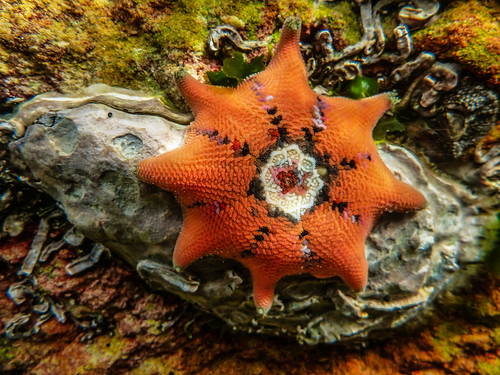
Meridiastra calcar #1, Blackmans Bay
The many species go by several familiar common names: Bat star, cushion star, Knitted star..

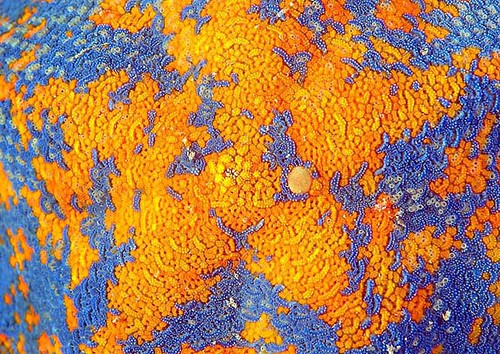
This is actually a good place to identify the very distinctive patterns in asterinids.. namely, these crescent or "knitted" looking plate patterns on the body surface..
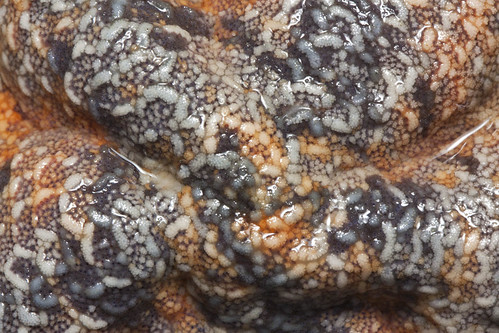
Asterina miniata, Bat Star, Dorsal Surface
               Starphish Asterina (patiria pectinifera) Japan sea, Far East, Primorsky Krai, Russian Federation
In fact, the Japanese word for sea star.. hitode, which means palm, may actually be BASED on an asterinid (Patiria pectinifera).

But for once, there's quite a lot known about them! So here's five subjectively interesting facts about them!
1. They live everywhere
Asterinids occur all over the world with many in shallow water habitats, including under rocks in places as diverse as the North Atlantic. They often live under rocks, or hidden away in cryptic habitats..

There is a HUGE diversity of these tiny little guys. Some are able to reproduce asexually but others just seem to get around.. Being small and easily transported...
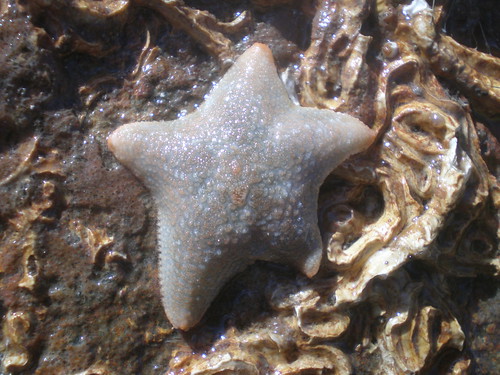
serennig - Asterina gibbosa - cushion star
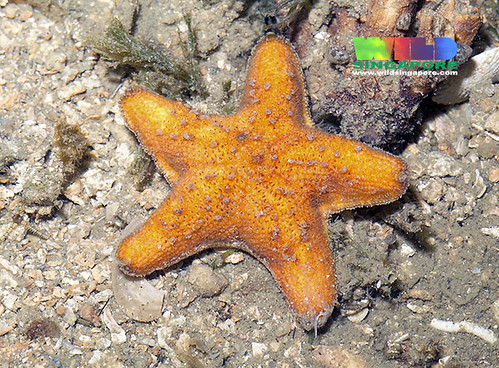
to tropical habitats in Singapore...
Crown sea star (Aquilonastra coronata)
This Callopatiria granifera was a species I observed in Cape Town South Africa!

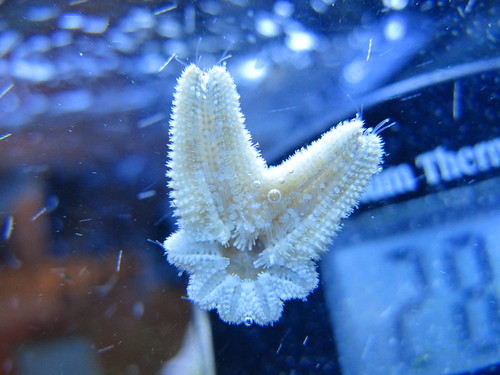
But honestly, one of the places you are MOST likely to encounter them is here.. in a tropical reef aquarium. These tiny ones are most likely in the genus Meridiastra or Aquilonastra.

Again, this is one of those species which is small and easily transported.. Living rock is a GREAT place for them to turn up..

This aquarium species is asexual and once one gets into your aquarium, you're most likely going to have a bunch of them after too long...

So, you can encounter shallow water asterinids almost all over the world! Australia, South Africa, South America, Antarctica, North America, etc, etc.

But as with most starfish groups, there are often weird deep-sea members... Both of these get to be pretty big sized animals.

I've mentioned these briefly before.. the flat one on the left is called Anseropoda, which is SO flat that it feels like a cloth rag when you pick it up!  We know very little about it.. Sometimes, small ones are so thin that light shines through them! Its name literally means Ansero for "goose" and "poda" for foot.. So, Goosefoot starfish! These can get to be almost 1.5 feet across!

The one on the right, is called Tremaster mirabilis. Katie Gale and her colleagues found that these will feed on coral in the North Atlantic. As a species it occurs widely around the world including the North Atlantic, the South Pacific and near Antarctica.


 2. Funky Feeding
Asterinids practically EMBODY the classic feeding mode of stomach eversion in sea stars! Here's a classic video I've been showing since the blog started!  It shows the stomach extended out onto the glass and feeding on the algae and other good stuff.  Most other asterindis feed in a similar fashion...
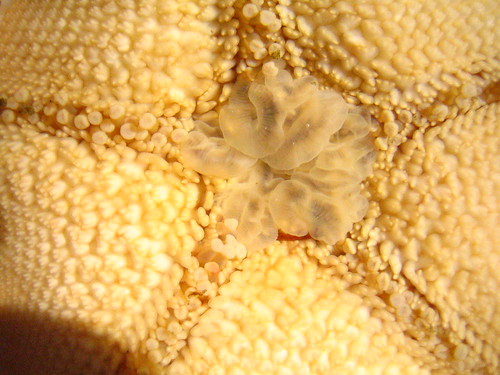
Sea star stomach (Bat star)

BUT some are neat ambush predators!! One species in New Zealand.. Stegnaster inflatus pretends to be a cave and can actually AMBUSH tiny swimming crustaceans!!

One of these days, somebody needs to actually make a video of this thing feeding!
This image from SeaFriends in New Zealand


3. Reproduction! Lots of it!  Asterinids are one of the most heavily studied sea stars because of their many reproductive strategies...

Some, such as this "Asterina panceri"(Asterina gibbosa) actually BROOD their young
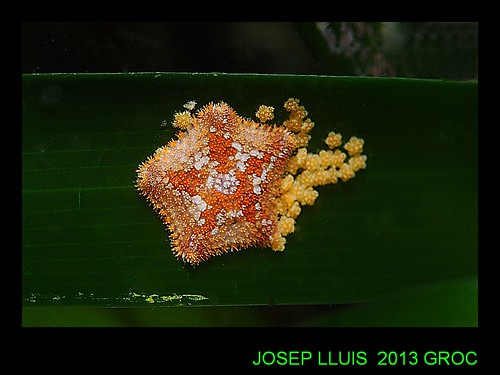
Asterina pancerii birth
From Byrne 1996, Fig. 4h

and I've reported in the past on this other brooding species, which live inside their mother and whose babies will actually EAT one ANOTHER! 


And of course when all else fails, there's always dividing yourself!  Asexual or fissiparous reproduction is why those tiny aquarium stars are so numerous! 
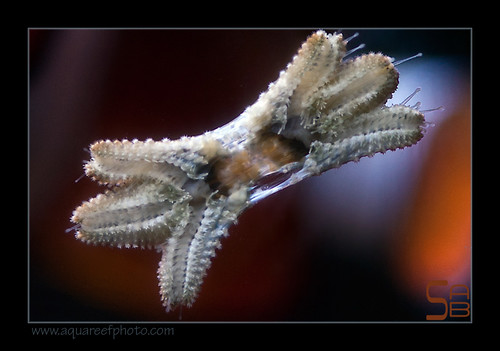
asterina6361_281111
IMG_3451

3.  Commensal Worms! In the Pacific Northwest species, Patiria miniata, its been know for quite some time that there's actually a species of polychaete worm (Ophiodromus pugettensis) that actually lives on the underside!!
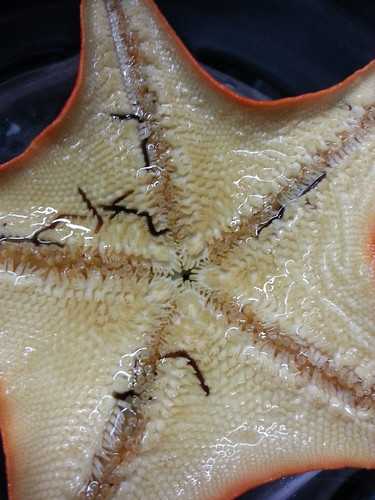
Ophiodromus pugettensis

This is one of the better studied species of asterinids, but there's many other species of Patiria and other species such as Patiriella and Meridiastra which have a similar surface morphology and are conceivably "habitats" for other animals...

4. They are important to the Evolution of Sea Stars!

Here's figure 2 from our paper...
Yeah, I know the image is hard to read, but basically, what I wanted to show was how the Asterinidae seems to show close relations with several other groups of sea stars, including the big multi-armed predators, the Solasteridae
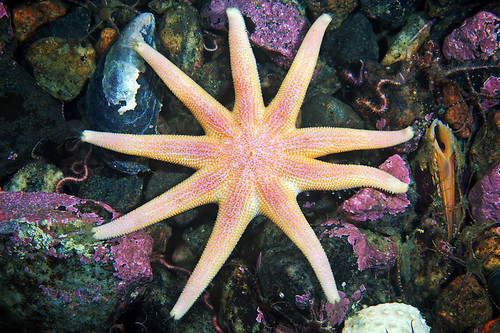
Solaster endeca
and the enigmatic Antarctic Perknaster.. 

Also, the aforementioned Tremaster mirabilis? Sea stars which resemble this species can be found from the Jurassic!  And its position in the tree seems to suggest it might be... interesting..

and of course, there's more I haven't summarized here.. their phylogentic history relative to their various interesting features, etc.. but that's another post!

Wednesday, March 26, 2014

Echinoblog Travelog: Japan: the things I will miss.... Pt. 5 (final)

Just got back from Japan and the 15 hour flight just wiped me out... so today is pictures!
                                        
 See-through starfish! (Anseropoda petaloides)
 Densenman! 
Matching Socks!
Sweets! but not chocolate or the usual western types...
Nakano Broadway...
 and some of its unique and interesting goods... (cleared and stained fish skeletons for sale)
KAIJU! Ultrakaiju Gomora! (and other Japanese science fiction)
Starfish Kaiju (weird deep-sea starfish!, this one, Hymenaster is about a foot across)
FOOD! Ramen and gyoza!  (mm... tempura not pictured)
And special mention to KABOBS! After a long day of running around Tokyo? These are surprisingly satisfying....


and of course, big expensive toy robots! (shown here is Big Dai X)

Until next time Tokyo! 

P.S. These are surprisingly accurate....
 

Tuesday, December 6, 2011

Food & Starfish in Paris-Some of my Favorite Things!

My trip to the Museum national d'Histoire naturelle in Paris has been amazing!

This week-Some of my favorite things...

I'lle flottante-my favorite French desert. Basically, its egg whites made into a merangue and then placed on top of egg yellows mixed up with sugar.
Its rich beyond imagining-and the only reason I can handle it-is because I only have it when I visit Paris! Believe it or not, I've had larger and more sophisticated versions of this creamy wonder.. mmmmm....

*Ahem*But as far as echinoderms go..let's go look at some STARFISH (asteroids, sea stars, whatever...)
and other critters..

Here's a pic of me holding one of the world's LARGEST starfish-

1. Thromidia gigas from Madagascar!
You may remember this beast as one of the species listed in my "what are the largest starfish" post (click here to see!).

2. Sphaeriodiscus bourgeti! A funny looking beast that looks more like a cookie or a rubix cube type puzzle than an animal... This species lives in deep-sea habitats off the west coast of Africa in the tropical Atlantic. Sometimes, I honestly wonder how something with this shape can be alive at all.. (you will hear me re-iterate this question again below...)
Here is a jar with a few more smaller specimens..Colors and etc. are gone but that's their shape when alive. Ya' gotta wonder how they live shaped like modern art that you would find in an artsy French garden somewhere...
3. Luidia! A beautiful multi-armed species of the sand-star Luidia! This specimen is from Madagascar-but generally, these starfish live on sandy bottoms where they prey on mollusks and other smaller, slower sand-dwelling critters.

Interestingly-the patterns are part of the animal's body structure and don't fade in preservation. They are big animals and easily reach 1.5 feet in diamter..
We've seen something closely related to this species in some spectacular video...


4 Asterodiscides tessellatus aka the "Firebrick" or "ToeNail" star!
Each armtip has the signature smooth armored plates.
This video shows a similar species


5. Anseropoda spp. Among the most bizarre is the FLATTEST of the sea stars. Most of these live in the deep-sea. I've shown you pictures of them alive from Hawaii..
The genus of these animals hails form "Anseros" and "podia" which translates from the Latin to "goose-foot" which is what the body of these things resemble...

But its hard to convey from submersible camera shots, just HOW THIN and FLAT these starfish are...
For example, here's a dried specimen of another Pacific species.. the top.
the bottom...
and now, here's the SIDE...
Here's yet another species, but this one with multiple arms! (about 7). The top.
The bottom surface.. (note the mouth at center and the tube foot grooves radiating out from it) The arms and body are somewhat damaged..but hopefully you can make out the general shape..
Here's what the animal looks like if you pick it up. It so thin that light actually shines THROUGH it.
Seriously. How is something like that even ALIVE??? Amazing. and wonderful...

Annnnd..let's not forget our friends-the closely related ophiuroids (brittle stars)...(this one is Amphiophiura liberata)
And where would be if we didn't end with some kind of deep-sea sea cucumber? Not QUITE sea pigs..but close.... Here's some Oneirophanta mutabilis!
For some reason..I am always around places that have giant deep-sea crabs.

How many people can say that keeps happening to them??

More next week!