Showing posts with label New Zealand. Show all posts

Tuesday, June 10, 2014

The Hippest Post you Know! New Hippasteria species!

Research! People often speak of the rigors, hardships and even agony of their research. The long days in the field to the writing and so forth.. But what a lot of folks don't often spotlight is how damn satisfying it is (at least for me) to see something you've been doing for several YEARS come to fruition in a paper! 

Case in point is my newest starfish monograph, just published a week ago in the prestigious Zoological Journal of the Linnean Society!  You can go here to find it (sorry-paywall).

This was part of a project that began years ago in 2011 or so, as I discovered several of the specimens described below in the collections at the Muséum National d'Histoire Naturelle during one of my visits to study their starfish from far and distant lands! 

This, then combined with a project I was working on with my colleague Dave Foltz at Louisiana State University and eventually snowballed, adding on Marc Eleaume, my colleague from Paris and Kate Neill from the New Zealand Institute of Water and Atmospheric Research (NIWA). 

What's it all about?? 
You may remember a post I wrote last year about some work I did with my colleagues where we discovered that the starfish species Hippasteria phrygiana was not simply one species in the Atlantic but in fact one species that was found across THREE OCEANS! (here to see the full story)

Part of this work involved not only Hippasteria phrygiana, but testing whether or not the OTHER species of Hippasteria were the same! And what about other potentially new species?? Were those new?? 

My colleagues, especially Dave Foltz analyzed tissues sampled from samples of multiple Hippasteria species taken from all around the world. From the Atlantic to the North Pacific to New Zealand (South Pacific) to Kerguelen Island in the southern Indian Ocean! 

We sampled for genes and compared them using analysis software to get this tree, which showed us which were the mostly strongly supported species..
We ended up with 7 species, 3 of them were new to science!  Of the other 4, H. phrygiana we kinda changed (see below) and here. Hippasteria californica had some weird dynamics (see below, Hippasteria heathi was a "good" species but we found out that it had cousins which were found WAY beyond where  it was found and the final species Hippasteria lepidonotus turned out to have been "oversplit" into the genus Cryptopeltaster. That is, it turns out to be a redundant name which was likely created because of the deceptive amount of differing morphology in that species (and thus thought to be more different than it actually was).  

So, let's see some new species!!  Many Hippasteria related species are predators of deep-sea coral predators and I've described other new starfish species related to these, which you can read about here.  

1. Hippasteria muscipula
This one is the biggest and neatest of the new species I described.. A big, massive critter about 30 cm (about a foot across)! 

It was collected from various tropical Pacific localities: Hawaiian Islands, New Zealand south of New Caledonia in deep-water. 425 to 1500 meters!

What's cool about it?? The name.  The species has these very big and toothy pedicellariae (aka claw like structures on the surface, possibly used for defense)
The species was Hippasteria muscipula after the pedicellariae's resemblance to the Venus fly trap (Dionaea muscipula)!
One other cool thing we found? The specimen from New Caledonia had its stomach wrapped around a deep-sea "coral" called Metallogorgia, which is kind of an odd looking gorgonian that looks like a living wire hanger! Possibly feeding on it??  Interesting. 

2. Hippasteria tiburoni
This new species was a little tiny thing collected by the Monterey Bay Aquarium Research Institute from Pioneer Seamount in the North Pacific (southwest of San Francisco) in 2005
This species was distantly related to Hippasteria heathi, which occurs primarily in the Aleutians..
This species was named for its "collector" the now defunct Remotely Operated Vehicle Tiburon which served science and MBARI well between 1996 and 2008!
Hippasteria tiburoni, despite its size was observed feeding on deep-sea bamboo coral!!  Ain't it an awesome little critter?? 

3. Hippasteria mcknighti
The third new species we described was found among specimens sent to us from the New Zealand Institute of Water and Atmospheric Research.  It resembles the North Pacific Hippasteria heathi but the genetic and morphological data support it as being distinct..

4. Big Taxonomic Changes! 
The rest of the paper addresses multiple taxonomic changes (i.e. names of species).  Among the most significant of these was the big discovery of how wide-ranging a species, Hippasteria phrygiana turned out to be!!   This was a species found in THREE OCEANS! 

The problem with this discovery was that historically, folks would often describe a new species if it was not previously known from that part of the world and sometimes there are widely occurring animals which do form regional subspecies. It depends.
                    
But in this case, thanks to our genetic data, we could tell that a great many described species, which were likely separated as distinct species based on minor differences are in fact, just minor variation of one wide-ranging species!

In this case nearly a dozen species, were found to be "redundant" or were applied to Hippasteria phrygiana throughout different parts of the world. 

We also looked at the other species of Hippasteria, H. californica which occurs in deeper water habitats than H. spinosa... 
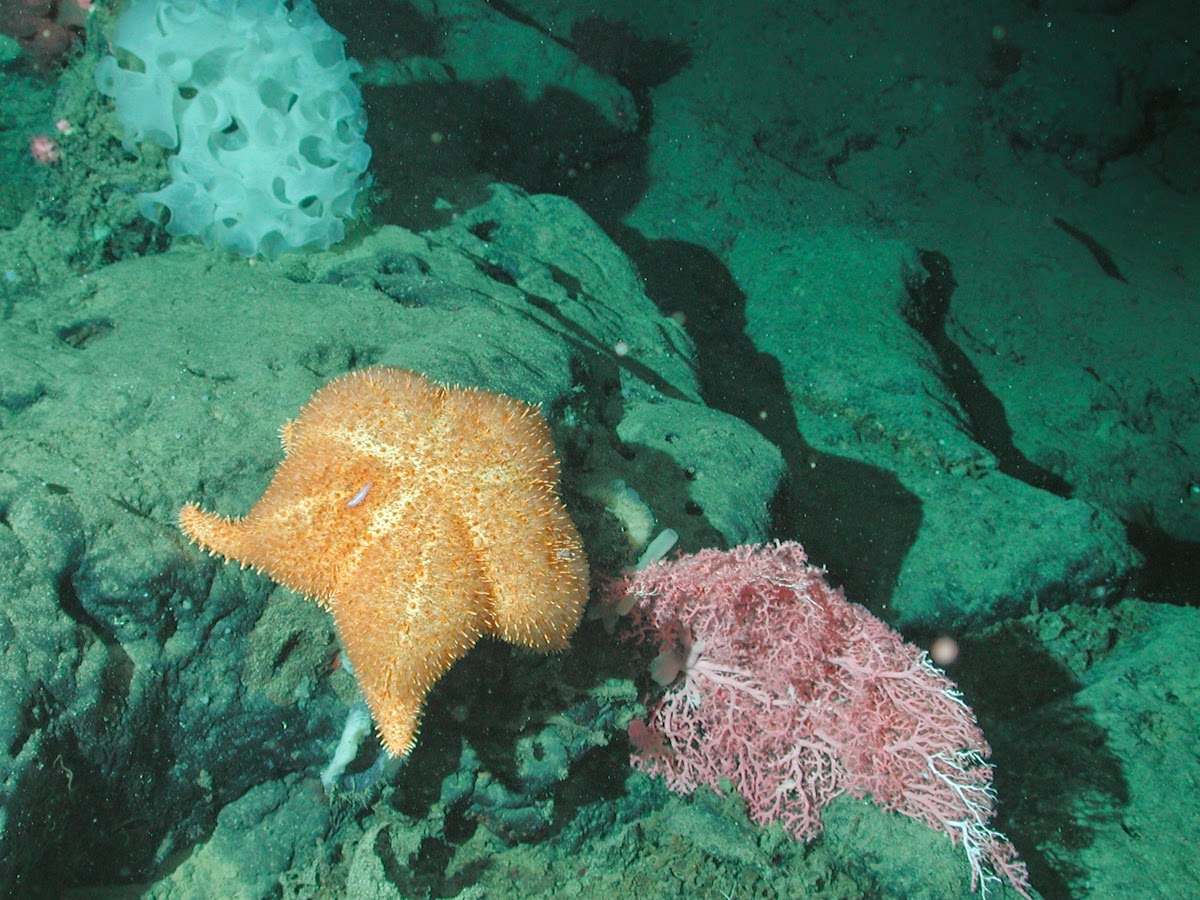
Image by Dr. Steve Lonhart Via SIMON
What we had found, up this point had been pretty consistent with what had been known until we found two individuals of this species which were revealed by genetics to have been Hippasteria californica BUT in SHALLOW WATER habitats in British Columbia AND which looked like H. spinosa!

Weird.
Image by Neil McDaniel (check out his website here)
STRANGE! And a mystery that we shall have to investigate for another day....

OTHER Related Posts:
New genera and species of Hippasteria related starfish species! 

Deep-sea Corallivore Video from MBARI!

Tuesday, May 28, 2013

New "Tam O Shanter" urchins (aka the Echinothurioids!) from Deep-Sea New Zealand!

Araesoma thetidis
In February of this year, my friends at the New Zealand Institute of Water and Atmosphere (namely Owen Anderson) published a new paper describing not one but SEVEN new species of deep-sea sea urchins! Here in the journal Zootaxa.

The original NIWA press release is here.  These urchins have been getting all sorts of keen press, including here in the N.Z. Herald and here in The Sun.  And of here on New Zealand's Maori news..


and I thought.. EVERYONE needs to know more about these exciting urchins! and so today is a bit of a "refresher" on echinothurioid sea urchins!

I wrote a short summary about these for Deep Sea News several years ago...(here)  and wrote a short bit about the commensal relationships between these urchins and fish here.

The quick summary version is:
  1. Mostly deep-sea urchins found all over the world (many in greater than 1500 m depths-in NZ they range from 100 to 5000 m!), but with some shallow water relatives (aka the Fire urchins, I'll save these for another day)
  2. They often have very sharp and poisonous spines. And yes, the deep-sea ones too...
  3. They "walk" around on the sea bottom with special spines that have hoof like tips
  4. They were described FIRST as fossils and the living animals were found AFTER...
When the animals are alive they look kind of like this:
Deep Sea Urchin - Submarine Ride 2540 Feet
An Atlantic species by Hankplank
On this purple species from the Pacific (Tromikosoma maybe? this isn't one of the new ones described by Anderson), you can see the white hoof-like spine tips that the urchins use to "walk" along the bottom..
Spiny sea urchin
Image by Neptune Canada
Here is a pic showing the oral surface (ie the bottom). The mouth is at center and as you can see it is surrounded by spines with those white "hoof" like tips. These are what the animals use to "walk" along the bottom of the sea floor.
Sea Urchin underbelly
Also by Neptune Canada

Here's the spine close up showing the "walking tip"
Image from the NIWA Benthic Inverts Facebook page
Or sometimes like this Atlantic Phormosoma placenta which has the mysterious floating "bags" (containing spines).
Image from SERPENT project here


But sadly, when they are brought up on the deck of the ship, the water rapidly drains from their very soft body and they are often left as a shadow of their former self....
From the NIWA page on this story
As a result of this "deflated" appearance, they are often called a variety of names: "pancake urchin", "leather urchin", "bag urchin", or "beret urchin." However in Anderson's new paper he feels a new common sobriquet would be most accurate-the Tam O Shanter urchin!!!

For those who are not as keen on Scottish headwear, a "Tam o Shanter" is a cap, sort of like a beret (wikipedia here)  and you can sort of see the resemblance.
Tam O' Shanter
Image by DrHaggis
dsc_0055 (2)
Image by H2omom.2006
Even alive, looking down on one, you can sort of see the resemblance..(note however this is not one of Anderson's new species)
Sea Urchin and Brittle Stars
Image by Neptune Canada!
Owen's paper (here) describes a whopping SEVEN species in two genera. That's pretty significant given that MOST of these urchins were described in the early part of the 20th Century/late 19th.

These were all discovered and described by looking at a variety of different characteristics. Some as straightforward as body color as well as spine shape and location. But some characteristics are more subtle. These are the individual pieces of pedicellariae-little claw like structures that are present on all sea urchins..which were studied using a Scanning Electron Microscope to yield distinct shapes...
Fig. 28 from Anderson 2013
He also reviewed the many echinothurioid urchins in the New Zealand waters, in addition to the seven known species, Anderson described/reviewed a further nine species (7 were new) culminating in a count of some 16 species of these urchins in the region!, including this beauty... Araeosoma thetidis!! (described by Hubert Lyman Clark in 1909)
Figure 28 from Anderson 2013
What other species will be found?  Here's a brand new report about two new sea pens! 

Tuesday, March 15, 2011

Putting Tags on Starfish! Where do they go? What do they do? How fast do they do it?


This week-a neat paper from Miles Lamare and team (who are mostly from the University of Otago in Dunedin, New Zealand) about using electronic tagging to study individual movement in the temperate-water New Zealand asteriid starfish Coscinasterias muricata in a 2009 issue of the Journal of Experimental Marine Biology and Ecology (click here).

As much as the idea of tagging echinoderms has come up (and this is actually one of the most common professional inquiries I receive) its not been done very much.

Largely, because its very difficult to stick a pin, tag, flag or any kind of inorganic device into an echinoderm without any number of deleterious effects, including:

-seriously affecting its behavior
-killing it
-causing the arm/spine/limb to be cast off and regenerated and/or variations thereof

.......and so on.

But technology has progressed and the authors introduce the usage of this handy little electronic tag (the DST-milli electronic tag) made by Star-Oddi. The tag is programmed with electronics that record water temperature, and depth every 5 minutes.
The authors attach these tags to the animal with a metal wire to which the tracker tag is attached so that the animal looks like so...
Figure 1 from Lamare et al.

They tested the behavior of the species and essentially, their findings indicated that there were no apparent behavioral changes in feeding and etc.

So, what happened next? They chose 3 individuals with the goal in mind of tracking their movements relative to their feeding behavior and environmental factors. The paper mainly addresses the kinds of data that can be obtained with the tag (as opposed to Coscinasterias behavior) but they did discover a lot...

1. Where they went! and how fast! The Data
So, as it turns out Coscinasterias muricata is fast.

Individuals vary-but on average they seem to be capable of 15.6 meters/day.

This still pales in comparison to the west coast sunflower star (Pycnopodia helianthoides) which is practically a starfish lamborgini at the rate of 3 meters (possibly 2 from other sources) a minute as outlined here-I'll let you do the math)

And that's MUCH faster compared to The Crown-of-Thorns (Acanthaster planci) which can go 2.3 to 4.3 m/day versus the much smaller and slower asterinids (i.e., bat stars) Patiria pectinifera (1.5 to 3.7 meters/day) and Patiriella regularis (5.7 meters per day).

Why is speed important? Read on below...

We see from the data above that different individuals of this species can travel quite a bit and over a pretty broad vertical distance (four to 14 meters). So, what's going on?

2. The Salinity Story
It turns out that C. muricata displays "vertical migration" which is to say that it TRAVELS back and forth from deeper to shallower regions in order to forage for its favorite food, the blue mussel, Mytilus galloprovincialis, which live in the intertidal.
Their direct observations showed that of the ndividuals observed, 92% of these were present in water LESS than 1.0 meter! with fewer and fewer numbers being present throughout deeper adjacent regions.

But based on the tracking info, two of the individuals showed some variation. One occupied deeper water below the mussels and then migrated into shallow water for short periods of less than a day and at intervals of about five days. Another occupied shallow depths for the first week before moving on to deeper depths.
Another important behavior they noticed was how physical factors, such as salinity affected the behavior of the observed individuals. As a species, Coscinasterias muricata is VERY intolerant of low salinity and experiments suggest that individuals WILL die in a relatively short period if salinity is not maintained.

So, if there's freshwater runoff or a storm-it will retreat from shallow water.

Figure 6 below charts the position of each of THREE individuals relative to salinity, temperature, height above the "mussel line" and the amount of rainfall (on the bottom) versus the day during a two week period.


NOTE in the top "blue" box and the bottom box. The depth inhabited by the animals DECREASES when rainfall is highest (i.e., the dilution of salinity is lowest).

Salinity also gets higher as you get deeper...

So, as a physical influence, the salt water layer influences how C. muricata forages for food! An influence that is apparently very significant to the animal's biology..

The authors note something of particular interest... that the animals begin their descent BEFORE the deepening/formation of the low-salinity water layer!! This suggests that there are other physical cues (e.g., changes in wave action) to the animal, so that so that it KNOWS when to move!

This is kind of neat, because these are the KINDS of cues that are not obvious to us. Asteroids have a very different world of perception.
It turns out the aforementioned speed is also an important factor in understanding how the salinity motivates the animal's movement.

The speed of the animal..observed as between 1.78 and 23 meters/hour is faster than the rate at which the low salinity layer deepens during the weather!!

In other words- the starfish can outrace the "low salt" layer as it approaches!


I think most people interpret movement as a function of something observable-like predation. But in this case-maybe not so much?

Undoubtedly, the authors probably have more (or could have more) than this-but the paper's intent was mainly to see what they could learn using these new tags. Foraging behavior for an animal like this is important to marine ecologists. You can't exactly follow a starfish like a panther or a racoon.

And if our recognition of Pisaster (same family as Coscinasterias by the way..) as a keystone species is considered important to ecology-then understanding things like foraging patterns is also potentially significant to what's going on in marine ecosystems.

And just on a pure curiosity level wouldn't YOU like to know the secret lives of starfish?

Tuesday, September 28, 2010

Stichaster australis-A Pisaster-like parallel species!!

This week's blog is a strange collision of starfish and comic-book/science fiction geekery!

So, one of my favorite sci-fi notions is that of the multiverse or parallel earth-essentially that you can have a universe that is JUST LIKE the one you live in but differs in minor to substantial ways.

So, for example, one of my favorite graphic novels by famous comic book writer Grant Morrison
Which is basically about DC's famous Justice League (Superman, Batman, Wonder Woman) meeting their evil parallel counterparts!!

Batman vs. Owlman! Superman vs. Ultraman! Wonder Woman vs. Power Woman! As the image above suggests, each are parallel versions of each other!

Each is a parallel version of the respective character. In other words, you kinda recognize the ROLE of the character but the character itself is fundamentally different and seems out of place, compared to what you are familiar with...

And I realized..this is kind of a cool way to think about the parallel niches that you can see in starfish that live a WHOLE world away from one another. VERY similar. But VERY different!

EXPLAIN!

So, let's take the example of the New Zealand Stichaster australis...

Stichaster australis
is a shallw-water species that occurs along the rocky intertidal throughout the temperate regions in New Zealand.

Their main food is the abundant New Zealand green mussel, Perna canaliculus.

Apparently, S. australis is one of the mussel's primary predators in the rocky intertidal! Hmmm...where have we heard that before??

A 1971 paper (click here to see ref) that was studying the ecology of Stichaster australis by the famous ecologist R.T. Paine showed that this was similar to the North Pacific Pisaster ochraceus, in that S. australis played an important role in regulating mussel populations!
Paine experimentally removed S. australis from a rocky intertidal region for 9 months, resulting in the mussel expanding its vertical distribution by 40% of the space it had to grow into!!

Species richness of the area where Perna had "overgrown" decreased from 20 to 14 species

And when they removed Stichaster in conjunction with the other dominant organism-the kelp Durvillea antarctica, they found that the mussels had occupied 68 to 78% of the available space in the area!!

So, without the "control", of the predator or the space occupied by the kelp, the mussels would just spread out into the area and go as FAR as they could take it.

Okay.. So what?
I've mentioned the ecological role of the North Pacific Pisaster ochraceus as the typical example of what's called a keystone species aka a species whose presence has a "disproportionate effect on its environment"
Basically, removing Pisaster results in a similar cascade of mussels going amok! Diversity takes a nose dive, etc.

And what I've just described for Stichaster australis is pretty much the same thing! Except that they live at opposite ends of the Earth!

The intertidal habitat in New Zealand has a lot of close parallels to those in California or anywhere on the west coast of North America...

You've got mussels..except that in North America they are Mytilus spp.
and in New Zealand (Southern Hemisphere)..you instead have Perna canaliculus

In the North American system you have Macrocystis pyrifera
but in the southern hemisphere you have Durvillea antarctica

and finally, you have the asteriid Pisaster ochraceus in the Northern Hemisphere... with its distinctive intertidal skeletal morphology
And here's the stichasterid, Stichaster australis in the Southern Hemisphere.. with a curiously, SIMILAR appearance!
Here we have Stichaster in a big cluster. Various hypotheses on why they do this I've read have focused mainly on how these big cluster maximize reproduction...
...and here we have the rocky-intertidal Pisaster in a curiously similar cluster. Reasons I've heard offered why-have extended to resisting dessication...but I suppose maximizing reproduction is also possible....Thus, the ecological roles these two species appear the SAME but the players are different.

This actually extends beyond being different in a lot of cases. Several of these taxa are not even closely related!

Stichaster
australis is found ONLY in New Zealand and Pisaster ochraceus is found ONLY on the west coast of North America, and belong to two completely separate families!
(although admittedly, the families are related).

and yet, they have a similar convergent appearance, live in the same settting, feed on the same kind of food, and maybe even practice similar kinds of behaviors.
There are MANY more intertidal invertebrate species, including various snails and barnacles, that have similar parallels...

and course, New Zealand has MANY more starfish species intertidally-and relative to say, those in North America, their ecological roles are pretty poorly understood..

but in this instance, same role-but different players!! Not parallel earth-but parallel starfish!!