Showing posts with label New Caledonia. Show all posts

Thursday, May 26, 2016

BEHOLD: The GAME OF THRONES BRITTLE STAR! & new ophiuroids from New Caledonia!


As many of you picked up on last week, I've been busy working on starfish at Museum Victoria in Melbourne working with my colleague Dr. Tim O'Hara, one of the world's leading authorities on ophiuroids! aka the brittle stars and basket stars!

He's had a BUNCH of big research news drop lately (here's the link to last week)

While talking to Dr. O'Hara he informed me of of some neat, NEW SPECIES he's described from the deep-sea habitats of the South Pacific New Caledonia in late 2015! These were just too neat to pass up a post on!

I've reported in earlier posts (here) about working with Dr. O'Hara on echinoderms in the Paris collections! 

All of these species were published in the Memoirs of the Museum Victoria, vol. 73: 47-57 published in 2015. Co-authored by Caroline Harding, also at Museum Victoria!  This article is OPEN access and can be downloaded HERE. 

1. The Impeller Brittle Star


As Dr. O'Hara tells the story, he was once called upon to aid a ship's engineer during his attempted crossing of the Bass Strait on the yacht Irene. A similar looking impeller failed the yacht's engine thus indelibly impressing its shape onto his mind's eye!
                                                                                                                     
Fast forward many years.. and Dr. O'Hara is describing this new amphiurid brittle star from the deeps of New Caledonia.

The large shields on the disk trigger a memory that reminds him of the impeller's shape! and voila! 
Enter: Ophiodaphne impellera 


2. The Game of Thrones Brittle Star: Ophiohamus georgemartini!!
Probably the most STRIKINGLY amazing brittle star Dr. O'Hara described was this one, a new species in the genus Ophiohamus (family Ophiacanthidae), collected from a depth of 275 meters off New Caledonia!

Here's a nice shot of it holding onto this sponge stalk... Note that its most striking feature? Those big crazy spines that are coming off the disk!

If we take a closer look at those big thorny spines coming off the disk...
and compare them with the sharp thorns coming off the crown depicted on the cover art from Game of Thrones: CLASH OF KINGS!                                                                 This provided the inspiration for the Species name for THIS new species of brittle star!        
BOOM! Tim named this one in honor of the AUTHOR of one of his favorite shows: GAME OF THRONES!! 
Ophiohamus georgemartini!! 

3. Ophionereis sykesi (family Amphiuridae) in honor of his wife who as Tim O' Hara put it "has had to put up with him rummaging around the world's museum collections for years"

An animal with a gorgeous disk plate field which I'm sure is a fitting honor for the Mrs! 

4. And finally, Amphipholis linopneusti, described by Dr. Sabine Stohr in 2001.  

NOT a new species but an interesting one from the New Caledonia region in that its one of the few echinoderms that I know of which is actually sexually dimorphic!  That means there are actually ways of determining males from females using external characters! 

The lowermost basal arm spines of males are enlarged, sometimes flattened and hour-glass-shaped, whereas on the females they are cylindrical with a blunt rounded apex.  Its a subtle difference to be sure but it exists, which is more you can say for a lot of echinoderms! 


Monday, December 1, 2014

The Strange Deep-Sea Ophiuroids of Paris! Featuring Dr. Tim O'Hara!


Bonjour once again!! So, my trip to Paris has all but ended and I'll be returning to the United States in a few days. The trip has been a challenging one. The laptop crashed and was out of the loop for two weeks and left me without a computer for data collection and etc..

So, much of my trip has been "old school".. working with paper and notes labelling jars with species names as best as I can...
Although data collection has not been as efficient as I like, I have done the Paris Museum (my host) some good by identifying a massive number of specimens in the collection...
I not only got through many of these older specimens but several of the newer ones as well...
All said and done, I've identified around 900 specimen lots for the museum. Given that Paris probably contains the largest collections of asteroids in the world, that is no small feat!!

But one of the GREAT things about this trip is that my visit, inadvertently overlapped with a trip being undertaken by one of my colleagues. Dr. Tim O'Hara at the Museum Victoria in Melbourne, Australia!! One of the world experts on ophiuroid systematics and ecology! 

I have written about Tim's work before:
  1. This new species of the Australian starfish Tosia, which was described by one of his students.
  2. This fantastic biogeographic pattern in brittle stars which he published several years ago! 
  3. Tim was also the one who identified and, in part, documented "Brittle Star city"
Tim and I are friends from waaaay back. We worked together in the museum in 1999 before either of had our PhDs and its strange to think of that being almost 15 years ago...  

I had a great chance to learn about weird brittle stars from Tim and so I did!!

Learning about weird, deep-sea brittle stars with Dr. Tim O'Hara from Museum Victoria! 
Tim was working with deep-sea biologists at the Paris Museum who are interested in New Caledonia.  (I am one of them).  Some may remember that this time last year, a huge new marine reserve was created in the New Caledonia region. 

Thus, Dr. O'Hara's ecological and taxonomic expertise was brought to bear... not only to identify brittle stars...
but ALSO to share his new cutting edge research with the greater scientific community! A recent paper by Dr. O'Hara has used cutting edge "Next Gen" technology, using over 425 genes to reconstruct the "family history" of the Brittle Stars.  

Its noteworthy not only for the fact that he used an exhaustive amount of genetic data, but he was able to sample and identify ALL the brittle stars necessary for the study! Not an easy feat when you can count the total number of brittle star  taxonomy experts in the world on one hand! 

Here is Tim giving the presentation to a full room of French scientists and colleagues (myself included) in the Paris Museum...

The important part of ALL of Tim's work is being able to identify all of these strange, deep-sea brittle stars from distant parts of the world...  and he was happy to share several of these with me...

1. Amphiophiura insolita!! Don't know much about it, but its got a spectacular rose-like disk pattern...
This specimen of Amphiophiura bakeri was huge! Almost 2 cm across! It looked like an egg had grown five arms! 
2. These two different species of the deep-sea Ophiomusium make it easy to see why brittle stars are so difficult to work with and identify.


3. The tiny male living on the large female Ophiosphaera insignis!!  Notice all the white arrows.. Those point out the arms of the tiny, smaller male.  He lives on the female.

Its unusual for there to be two distinct sexes in echinoderms. In this case, it is thought that this might be a pattern similar to that observed in anglerfish. The male is essentially a parasite on the female. 


4. One of the strangest of deep-sea ophiuroids is almost never seen by most people. This is the ophiuroid Ophiomyces, which has this bizarre sac-like disk membrane..  


Its certainly freaky enough that its hard to believe that the picture really captures what the animal looks like, so here's an actual specimen. Its only a few cm across..
Here's one museum specimen, which as treated with metal for scanning electron microscopy...Its still kind of a surreal looking animal....
  

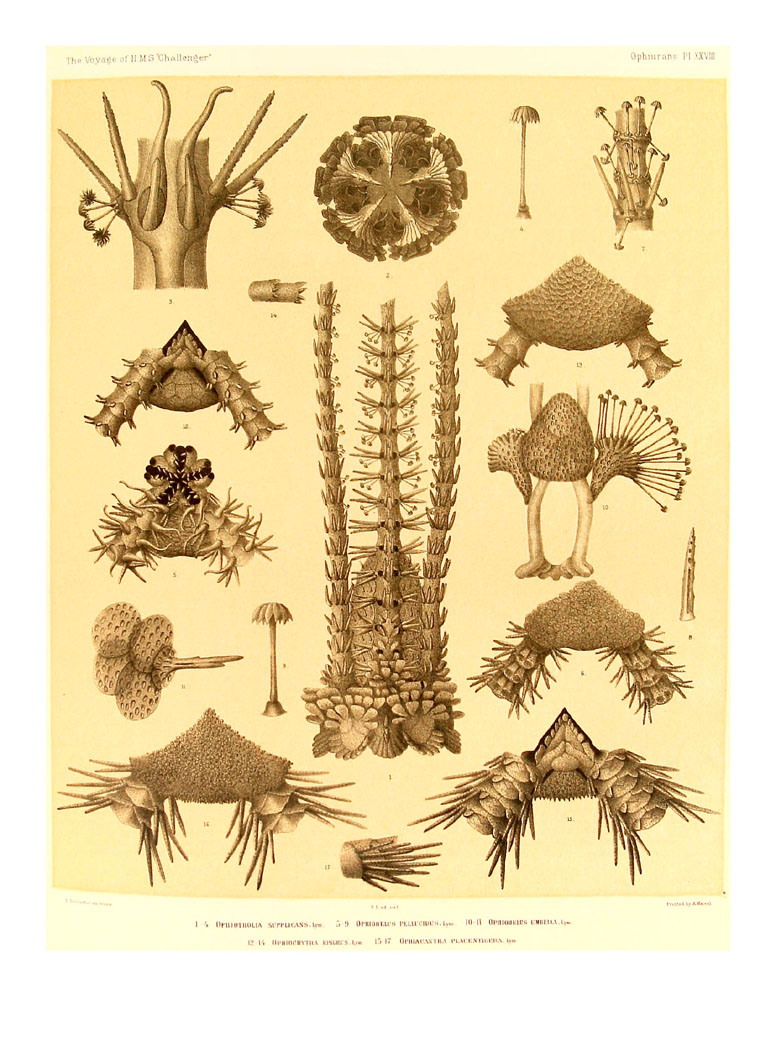
5. A related brittle star is this genus, Ophiotholia, which differs in having funny little hooks on its spines... but has a more distinctly conical disk and specimens are always found with arms locked upwards.

Again, a fairly small animal, only about 1-2 cm across. The drawn image on the left is from a plate of this species from the HMS Challenger vs. the right one which is an actual specimen...

       
And amazingly, thanks to all of his molecular work, Tim now also has a very good idea where these strange critters go in the big "tree" of ophiuroid evolution!! 

Ophiuroids are just a whole bunch of crazy sh*t that just makes my mind POP!!  

Tuesday, June 10, 2014

The Hippest Post you Know! New Hippasteria species!

Research! People often speak of the rigors, hardships and even agony of their research. The long days in the field to the writing and so forth.. But what a lot of folks don't often spotlight is how damn satisfying it is (at least for me) to see something you've been doing for several YEARS come to fruition in a paper! 

Case in point is my newest starfish monograph, just published a week ago in the prestigious Zoological Journal of the Linnean Society!  You can go here to find it (sorry-paywall).

This was part of a project that began years ago in 2011 or so, as I discovered several of the specimens described below in the collections at the Muséum National d'Histoire Naturelle during one of my visits to study their starfish from far and distant lands! 

This, then combined with a project I was working on with my colleague Dave Foltz at Louisiana State University and eventually snowballed, adding on Marc Eleaume, my colleague from Paris and Kate Neill from the New Zealand Institute of Water and Atmospheric Research (NIWA). 

What's it all about?? 
You may remember a post I wrote last year about some work I did with my colleagues where we discovered that the starfish species Hippasteria phrygiana was not simply one species in the Atlantic but in fact one species that was found across THREE OCEANS! (here to see the full story)

Part of this work involved not only Hippasteria phrygiana, but testing whether or not the OTHER species of Hippasteria were the same! And what about other potentially new species?? Were those new?? 

My colleagues, especially Dave Foltz analyzed tissues sampled from samples of multiple Hippasteria species taken from all around the world. From the Atlantic to the North Pacific to New Zealand (South Pacific) to Kerguelen Island in the southern Indian Ocean! 

We sampled for genes and compared them using analysis software to get this tree, which showed us which were the mostly strongly supported species..
We ended up with 7 species, 3 of them were new to science!  Of the other 4, H. phrygiana we kinda changed (see below) and here. Hippasteria californica had some weird dynamics (see below, Hippasteria heathi was a "good" species but we found out that it had cousins which were found WAY beyond where  it was found and the final species Hippasteria lepidonotus turned out to have been "oversplit" into the genus Cryptopeltaster. That is, it turns out to be a redundant name which was likely created because of the deceptive amount of differing morphology in that species (and thus thought to be more different than it actually was).  

So, let's see some new species!!  Many Hippasteria related species are predators of deep-sea coral predators and I've described other new starfish species related to these, which you can read about here.  

1. Hippasteria muscipula
This one is the biggest and neatest of the new species I described.. A big, massive critter about 30 cm (about a foot across)! 

It was collected from various tropical Pacific localities: Hawaiian Islands, New Zealand south of New Caledonia in deep-water. 425 to 1500 meters!

What's cool about it?? The name.  The species has these very big and toothy pedicellariae (aka claw like structures on the surface, possibly used for defense)
The species was Hippasteria muscipula after the pedicellariae's resemblance to the Venus fly trap (Dionaea muscipula)!
One other cool thing we found? The specimen from New Caledonia had its stomach wrapped around a deep-sea "coral" called Metallogorgia, which is kind of an odd looking gorgonian that looks like a living wire hanger! Possibly feeding on it??  Interesting. 

2. Hippasteria tiburoni
This new species was a little tiny thing collected by the Monterey Bay Aquarium Research Institute from Pioneer Seamount in the North Pacific (southwest of San Francisco) in 2005
This species was distantly related to Hippasteria heathi, which occurs primarily in the Aleutians..
This species was named for its "collector" the now defunct Remotely Operated Vehicle Tiburon which served science and MBARI well between 1996 and 2008!
Hippasteria tiburoni, despite its size was observed feeding on deep-sea bamboo coral!!  Ain't it an awesome little critter?? 

3. Hippasteria mcknighti
The third new species we described was found among specimens sent to us from the New Zealand Institute of Water and Atmospheric Research.  It resembles the North Pacific Hippasteria heathi but the genetic and morphological data support it as being distinct..

4. Big Taxonomic Changes! 
The rest of the paper addresses multiple taxonomic changes (i.e. names of species).  Among the most significant of these was the big discovery of how wide-ranging a species, Hippasteria phrygiana turned out to be!!   This was a species found in THREE OCEANS! 

The problem with this discovery was that historically, folks would often describe a new species if it was not previously known from that part of the world and sometimes there are widely occurring animals which do form regional subspecies. It depends.
                    
But in this case, thanks to our genetic data, we could tell that a great many described species, which were likely separated as distinct species based on minor differences are in fact, just minor variation of one wide-ranging species!

In this case nearly a dozen species, were found to be "redundant" or were applied to Hippasteria phrygiana throughout different parts of the world. 

We also looked at the other species of Hippasteria, H. californica which occurs in deeper water habitats than H. spinosa... 
Image by Dr. Steve Lonhart Via SIMON
What we had found, up this point had been pretty consistent with what had been known until we found two individuals of this species which were revealed by genetics to have been Hippasteria californica BUT in SHALLOW WATER habitats in British Columbia AND which looked like H. spinosa!

Weird.
Image by Neil McDaniel (check out his website here)
STRANGE! And a mystery that we shall have to investigate for another day....

OTHER Related Posts:
New genera and species of Hippasteria related starfish species! 

Deep-sea Corallivore Video from MBARI!

Monday, July 14, 2008

Akelbaster novaecaledoniae: Weird Starfish of the Month

Its time for cool weird starfish stuff!

Some pics from a cool starfish I described a few years ago...
Akelbaster novaecaledoniae Mah 2007 (click to see citation).

Where from: Off the shelf of New Caledonia in the South Pacific 225-400 m.

Taxonomic Breakdown: Asteroidea; Valvatacea; Valvatida; GONIASTERIDAE; Pentagonasterinae (related to the Australian Tosia and the Australian-NZ Pentagonaster).

The Name: The genus "Akelb-" is an anagram of the surname "Blake" and is named for Dr. Daniel Blake at the University of Illinois, Urbana-Champaign in honor of his contributions to starfish paleontology and evolution.
The Starfish: Actually...a pretty small animal. But almost perfectly pentagonal. Only about 2-3 cm diameter but... Wow. One of those animals that just doesn't look natural...

The Weirdness Pt 1: This thing is COVERED by PEDICELLARIAE. Pedicellariae are little claw-like like structures that starfish use to interact with it surroundings (here is a general explanation). But HOW different pedicellariae function in this species is unknown.
Pedicellariae are present on each top-facing marginal plate and even on the dorsal (i.e., the top) facing plates. and then turn it over..and POOM!! There's THIS:
The pedicellariae also cover over almost ALL the ventral-facing plates. Each actinal plate with a complete bivalve pedicellariae!! What are all those little mouth-like pedicellariae things for?? I wish I could tell you.

The Weirdness pt. 2!! The strangeness continues!! When you turn the animal on its side and you can see these two little pits sitting at the junctures between the top (superomarginal) plate series and the bottom (inferomarginal) plate series.
Let's take a closer look at those pits....

Each one of those knobs looks like some crazy spiny horn gone crazy!

What do these do?
In the living animals these are covered by tissue and are pretty tiny..
Mini-current flow turbines? Filter feeding? Aracane Lovecraftian secrets hidden away amidst the armpits of goniasterid starfish? I don't knwo yet..but finding new species like this is often just the FIRST STEP in a cool new story..