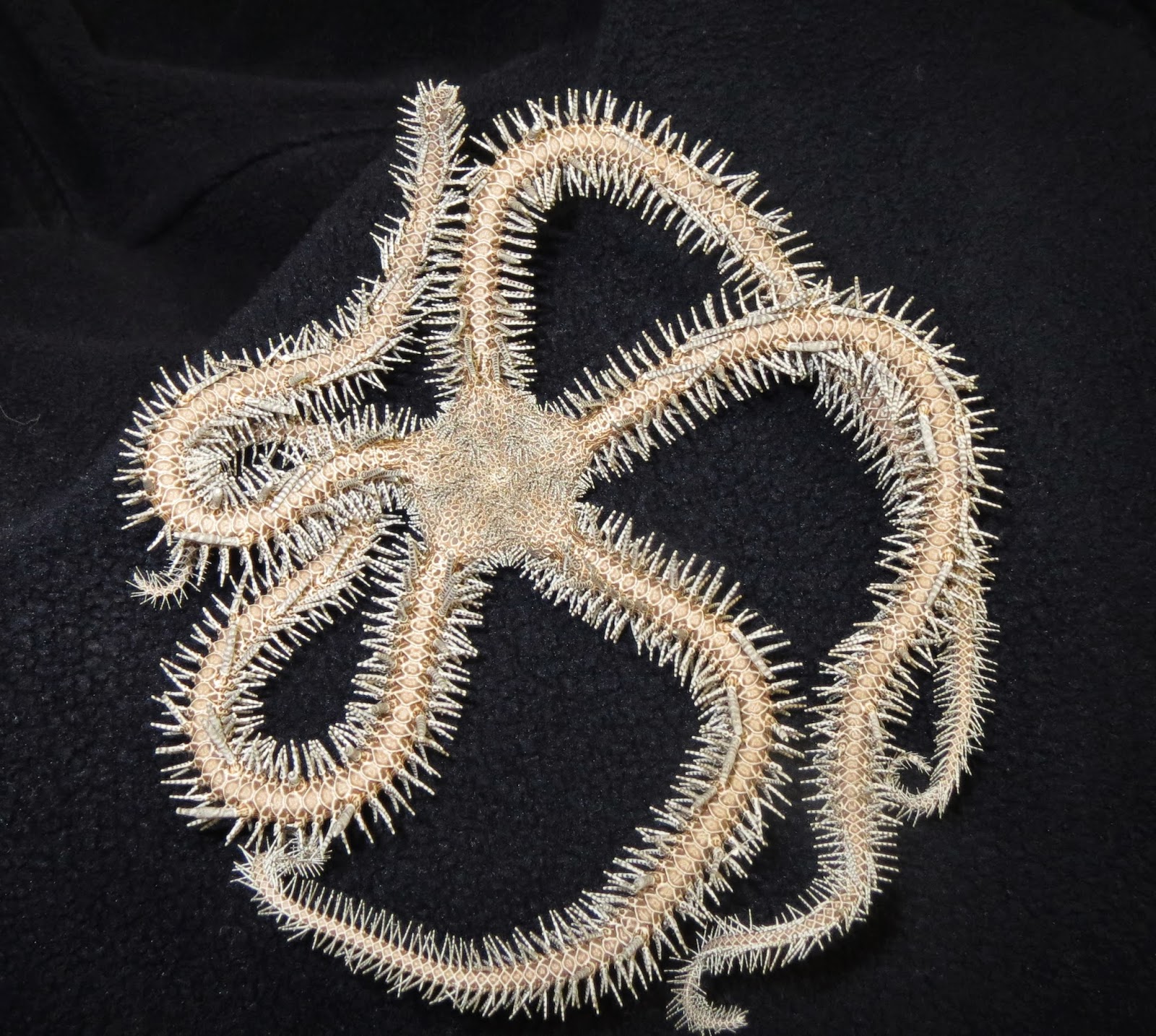
Showing posts with label Ophiuridae. Show all posts

Monday, December 1, 2014

The Strange Deep-Sea Ophiuroids of Paris! Featuring Dr. Tim O'Hara!


Bonjour once again!! So, my trip to Paris has all but ended and I'll be returning to the United States in a few days. The trip has been a challenging one. The laptop crashed and was out of the loop for two weeks and left me without a computer for data collection and etc..

So, much of my trip has been "old school".. working with paper and notes labelling jars with species names as best as I can...
Although data collection has not been as efficient as I like, I have done the Paris Museum (my host) some good by identifying a massive number of specimens in the collection...
I not only got through many of these older specimens but several of the newer ones as well...
All said and done, I've identified around 900 specimen lots for the museum. Given that Paris probably contains the largest collections of asteroids in the world, that is no small feat!!

But one of the GREAT things about this trip is that my visit, inadvertently overlapped with a trip being undertaken by one of my colleagues. Dr. Tim O'Hara at the Museum Victoria in Melbourne, Australia!! One of the world experts on ophiuroid systematics and ecology! 

I have written about Tim's work before:
  1. This new species of the Australian starfish Tosia, which was described by one of his students.
  2. This fantastic biogeographic pattern in brittle stars which he published several years ago! 
  3. Tim was also the one who identified and, in part, documented "Brittle Star city"
Tim and I are friends from waaaay back. We worked together in the museum in 1999 before either of had our PhDs and its strange to think of that being almost 15 years ago...  

I had a great chance to learn about weird brittle stars from Tim and so I did!!

Learning about weird, deep-sea brittle stars with Dr. Tim O'Hara from Museum Victoria! 
Tim was working with deep-sea biologists at the Paris Museum who are interested in New Caledonia.  (I am one of them).  Some may remember that this time last year, a huge new marine reserve was created in the New Caledonia region. 

Thus, Dr. O'Hara's ecological and taxonomic expertise was brought to bear... not only to identify brittle stars...
but ALSO to share his new cutting edge research with the greater scientific community! A recent paper by Dr. O'Hara has used cutting edge "Next Gen" technology, using over 425 genes to reconstruct the "family history" of the Brittle Stars.  

Its noteworthy not only for the fact that he used an exhaustive amount of genetic data, but he was able to sample and identify ALL the brittle stars necessary for the study! Not an easy feat when you can count the total number of brittle star  taxonomy experts in the world on one hand! 

Here is Tim giving the presentation to a full room of French scientists and colleagues (myself included) in the Paris Museum...

The important part of ALL of Tim's work is being able to identify all of these strange, deep-sea brittle stars from distant parts of the world...  and he was happy to share several of these with me...

1. Amphiophiura insolita!! Don't know much about it, but its got a spectacular rose-like disk pattern...
This specimen of Amphiophiura bakeri was huge! Almost 2 cm across! It looked like an egg had grown five arms! 
2. These two different species of the deep-sea Ophiomusium make it easy to see why brittle stars are so difficult to work with and identify.


3. The tiny male living on the large female Ophiosphaera insignis!!  Notice all the white arrows.. Those point out the arms of the tiny, smaller male.  He lives on the female.

Its unusual for there to be two distinct sexes in echinoderms. In this case, it is thought that this might be a pattern similar to that observed in anglerfish. The male is essentially a parasite on the female. 


4. One of the strangest of deep-sea ophiuroids is almost never seen by most people. This is the ophiuroid Ophiomyces, which has this bizarre sac-like disk membrane..  


Its certainly freaky enough that its hard to believe that the picture really captures what the animal looks like, so here's an actual specimen. Its only a few cm across..
Here's one museum specimen, which as treated with metal for scanning electron microscopy...Its still kind of a surreal looking animal....
  

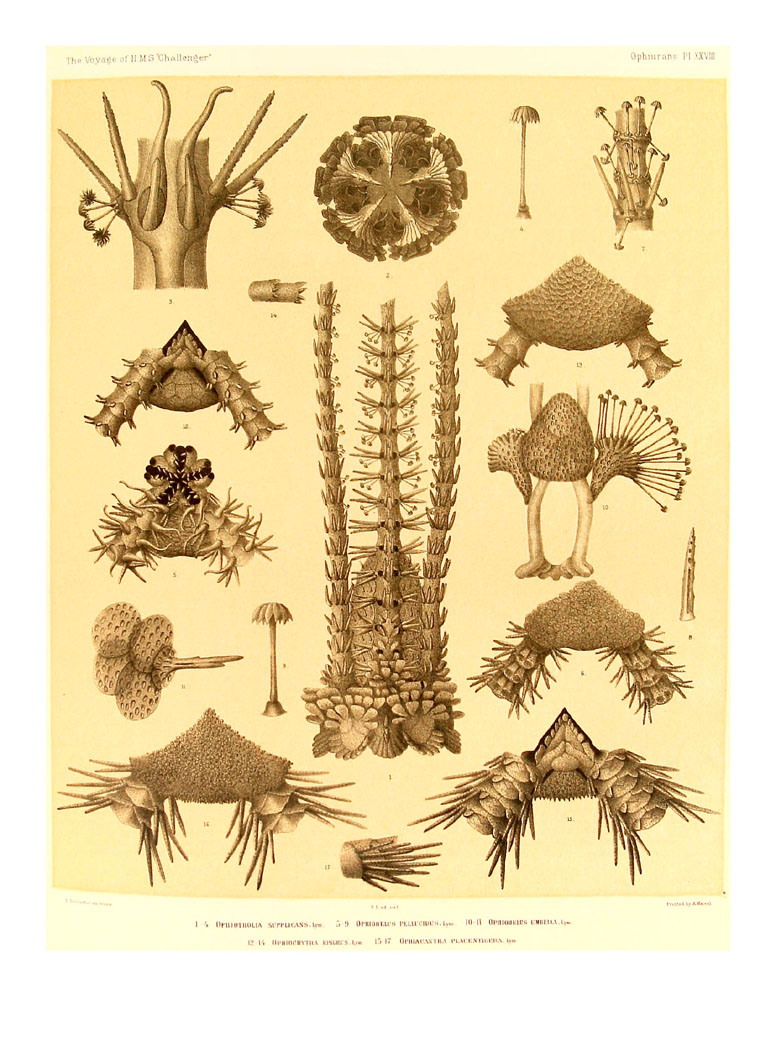
5. A related brittle star is this genus, Ophiotholia, which differs in having funny little hooks on its spines... but has a more distinctly conical disk and specimens are always found with arms locked upwards.

Again, a fairly small animal, only about 1-2 cm across. The drawn image on the left is from a plate of this species from the HMS Challenger vs. the right one which is an actual specimen...

       
And amazingly, thanks to all of his molecular work, Tim now also has a very good idea where these strange critters go in the big "tree" of ophiuroid evolution!! 

Ophiuroids are just a whole bunch of crazy sh*t that just makes my mind POP!!  

Tuesday, November 5, 2013

Treasures of Paris 2013: Brittle Stars @Le_Museum!

PARIS! I'm here continuing my research at the world famous and awesome Museum national d'Histoire naturelle! (Twitter: @Le_museum) in Paris, France!

Many of my new species were found in these collections. I enjoy my visits to Paris, one of the most delightful cities in the world, and of course, the opportunity to collaborate with my echinoderm colleagues (whom I've profiled in prior posts!)
My work involves sorting through hundreds of asteroid specimens collected from the most exotic places in the world.. New Caledonia, Madagascar, the Solomon Islands...

I never pass up an opportunity to share these awesome collections (many are likely undescribed!). In the past, I've shown exotic sea urchins  and crinoids (stalked and unstalked)!

This time around I thought I would share another group with exotic members from distant locales: The brittle stars and serpent stars (aka the Ophiuroidea)!


So here's an assortment...

From New Caledonia, 480 meter depth: Amphiophiura bakeri!  The central disk is pretty much a solid ball... The actual animal is small, only about two inches across..

Here's a nice shot of Amphiophiura liberata from Fiji, 488-500 m. Yes, those five primary plates kinda got nipples on 'em. 

One of my favorites..identified as Ophiomusium, possibly O. scalare (thanks to Rafael).. But its from New Caledonia (about 300 m depth)


Here we have Ophionotus hexactis from the Kerguelen Islands (subAntarctic region). Yes. A SIX rayed brittle star. Not too many of those...

SPINY! 

Some species of euryalid ophiuroids (aka serpent stars) live on deep-sea coral (gorgonian) hosts. These were collected while still tightly wrapped around the branches...


and here's a huge brittle star (Ophiothrix longipeda) in a handsome glass-wood display case!

Why?  Because this was one of the original specimens prepared by the great French naturalist Jean-Baptiste Lamarck! 

Tuesday, October 18, 2011

The Haunting "Faces" (well...disks!) of Ophiurid Brittle Stars!

A couple of weeks ago, I introduced you to some festive, neat looking brittle stars from the tropics-mostly from the genus Ophiolepis!

Weird Antarctic Brittle Star love can be found here!

Well, I am STILL on that ophiuroid kick and wanted to show you guys even MORE of the strange and wonderous beauty of brittle stars. Except, today, I thought I'd show you some from the deep-sea!

These are all members of the family Ophiuridae, one of the world's most diverse groups that occur all over the world, but particularly well represented in the deep-sea (>200 meters) with many more new species likely to be discovered.

Most of the ones shown below belong to the genus Amphiophiura which is distributed throughout the world...but down at the bottom you'll see one of the more... UNUSUAL brittle stars that most people would ordinarily never get to see!

What's important to realize about most of these species is that, aside from the fact that we know they exist-we know almost NOTHING ABOUT THEM.

But they are interesting-and frankly, not everyone gets to see them like this-so I thought it fun to show the world! Plus, with Halloween just around the corner..I thought some weird echinoderms would add to the overall ambience!

So here's
Amphiophiura insolita (=Ophiura monaria) from Hawaii. The disk is about the size of a dime.
Amphiophiura pomphophora (from Japan-the Albatross Collection)
Amphiophiura coronata from the Caribbean (Puerto Rico!). Weird how the primary disk plates form that sort of pentagonal pattern on the center! Also, note how small it is-that's a penny in the background for scale!
When these are found, they can be abundant...but not much is known about them..

Amphiophiura bullata convexa from the North Atlantic
The animal's disk is strikingly dome-shaped and kinda looks like a soccer ball...

Amphiophiura superba (from Baja California, Mexico-the Albatross Collection). These can be quite thick and are surprisingly large. Sometimes, its hard to believe they are alive!
Stegophiura sterea from Japan!
And just for kicks.. what does the MOUTH and/or oral surface look like? Here ya' go!
and one of the strangest...a brittle star that LOOKS like a starfish... I give you..
Astrophiura marionae from off the Channel Islands in California!!
But other species in this genus are found all over the world.. Go here to see which ones!!Astrophiura is a weird beast and is unusual in that it displays a convergent/parallel/analogous appearance shared with the weird deep-sea starfish which are members of the Caymanostellidae.

A species of which was recently found by the recent California Academy of Sciences Expedition to the Philippines.
Some of the best echinoderms are the tiniest ones!
Until Next Time-Stay Outta Trouble!