Bonjour once again!! So, my trip to Paris has all but ended and I'll be returning to the United States in a few days. The trip has been a challenging one. The laptop crashed and was out of the loop for two weeks and left me without a computer for data collection and etc..
So, much of my trip has been "old school".. working with paper and notes labelling jars with species names as best as I can...
.JPG)

I not only got through many of these older specimens but several of the newer ones as well...

All said and done, I've identified around 900 specimen lots for the museum. Given that Paris probably contains the largest collections of asteroids in the world, that is no small feat!!
But one of the GREAT things about this trip is that my visit, inadvertently overlapped with a trip being undertaken by one of my colleagues. Dr. Tim O'Hara at the Museum Victoria in Melbourne, Australia!! One of the world experts on ophiuroid systematics and ecology!
I have written about Tim's work before:
- This new species of the Australian starfish Tosia, which was described by one of his students.
- This fantastic biogeographic pattern in brittle stars which he published several years ago!
- Tim was also the one who identified and, in part, documented "Brittle Star city"
Tim and I are friends from waaaay back. We worked together in the museum in 1999 before either of had our PhDs and its strange to think of that being almost 15 years ago...
I had a great chance to learn about weird brittle stars from Tim and so I did!!
Learning about weird, deep-sea brittle stars with Dr. Tim O'Hara from Museum Victoria!
Tim was working with deep-sea biologists at the Paris Museum who are interested in New Caledonia. (I am one of them). Some may remember that this time last year, a huge new marine reserve was created in the New Caledonia region.
Thus, Dr. O'Hara's ecological and taxonomic expertise was brought to bear... not only to identify brittle stars...

but ALSO to share his new cutting edge research with the greater scientific community! A recent paper by Dr. O'Hara has used cutting edge "Next Gen" technology, using over 425 genes to reconstruct the "family history" of the Brittle Stars.
Its noteworthy not only for the fact that he used an exhaustive amount of genetic data, but he was able to sample and identify ALL the brittle stars necessary for the study! Not an easy feat when you can count the total number of brittle star taxonomy experts in the world on one hand!
Here is Tim giving the presentation to a full room of French scientists and colleagues (myself included) in the Paris Museum...

The important part of ALL of Tim's work is being able to identify all of these strange, deep-sea brittle stars from distant parts of the world... and he was happy to share several of these with me...
1. Amphiophiura insolita!! Don't know much about it, but its got a spectacular rose-like disk pattern...

This specimen of Amphiophiura bakeri was huge! Almost 2 cm across! It looked like an egg had grown five arms!

2. These two different species of the deep-sea Ophiomusium make it easy to see why brittle stars are so difficult to work with and identify.


3. The tiny male living on the large female Ophiosphaera insignis!! Notice all the white arrows.. Those point out the arms of the tiny, smaller male. He lives on the female.
Its unusual for there to be two distinct sexes in echinoderms. In this case, it is thought that this might be a pattern similar to that observed in anglerfish. The male is essentially a parasite on the female.

4. One of the strangest of deep-sea ophiuroids is almost never seen by most people. This is the ophiuroid Ophiomyces, which has this bizarre sac-like disk membrane..
The above pic is from French Zoologist Rene Koehler's 1904 deep-sea ophiuroid monograph available here from the Biodiversity Heritage Library.
Its certainly freaky enough that its hard to believe that the picture really captures what the animal looks like, so here's an actual specimen. Its only a few cm across..

Here's one museum specimen, which as treated with metal for scanning electron microscopy...Its still kind of a surreal looking animal....


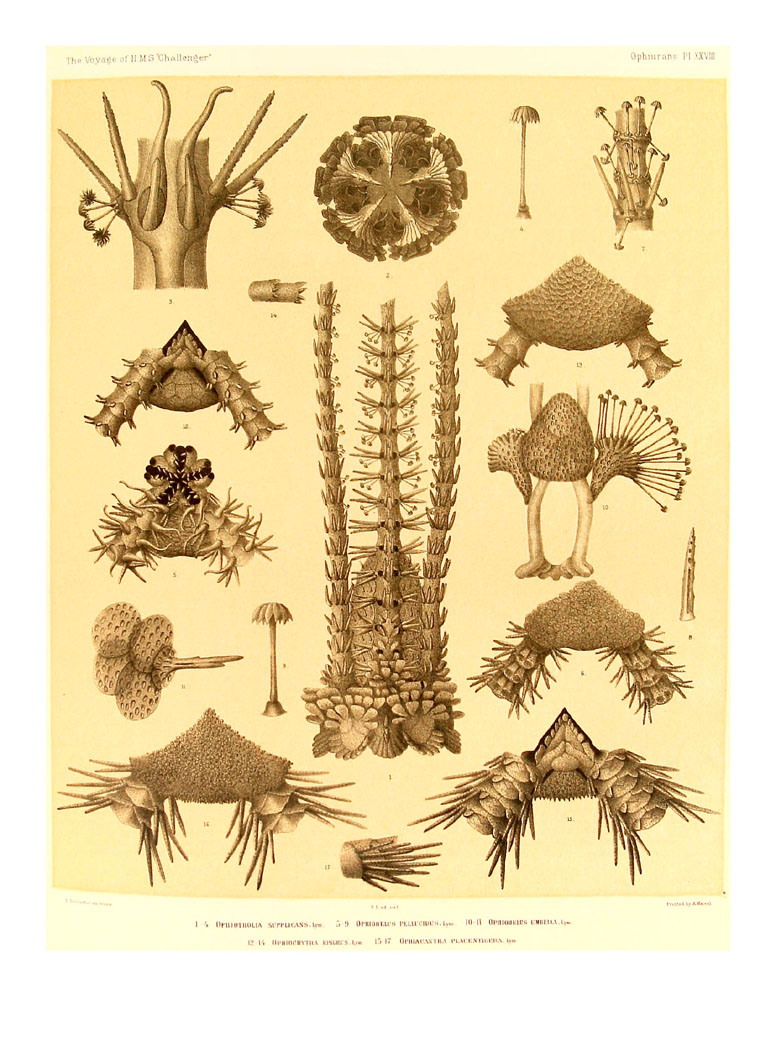
5. A related brittle star is this genus, Ophiotholia, which differs in having funny little hooks on its spines... but has a more distinctly conical disk and specimens are always found with arms locked upwards.
Again, a fairly small animal, only about 1-2 cm across. The drawn image on the left is from a plate of this species from the HMS Challenger vs. the right one which is an actual specimen...


And amazingly, thanks to all of his molecular work, Tim now also has a very good idea where these strange critters go in the big "tree" of ophiuroid evolution!!
Ophiuroids are just a whole bunch of crazy sh*t that just makes my mind POP!!