Showing posts with label research. Show all posts

Friday, March 18, 2016

Taxonomy Day 2016! Museum Collections are the Taxonomist Habitat!


TAXONOMY DAY will soon be upon us!  On March 19th Several years ago, biologist Terry McGlynn declared a DAY FOR APPRECIATING TAXONOMISTS! who had supported his work.

In Biology, Taxonomists are those scientists who IDENTIFY species and work towards classifying and understanding their evolution and "place" in the natural world. Which species is it? The common one? The one we eat? The poisonous one?? 

Much of our understanding of ecosystems and conservation STARTS with knowing which species is which! 


I recently discovered that the  NSF program funding for "Biological Infrastrucutre" aka.. natural history collections has been put on "hiatus" as of this month while it is "being evaluated for the long term resource needs and research priorities in the Biological Sciences Directorate."

If you have FEEDBACK to the "evaluation" for NSF's Collection in Support of Biological Research, please send email to them on the email address located here: https://dbinsfblog.wordpress.com/2016/03/16/csbr-fy17/

So, I don't know anything about the issues surrounding this hiatus BUT I thought that this year for TAXONOMY DAY, it would be a GOOD time to refresh the public as to what services natural history collections perform for both the scientific and "greater good" of society...

As I described in one of my last posts, the Natural History Museum is essentially THE HABITAT for the taxonomist (as well as many other scientists!)

1. Specimen libraries that help us ID and understand biodiversity


Most people don't realize that behind the exhibit floors of dinosaurs, shells, minerals and other awesome displays there are actually large collections of natural history artifacts- shells, plants, insects, skeletons, and many more specimens of different organisms and mineral specimens from all over the world. Some local, some from very far away.

Just to be clear, these aren't just "stored" to get them out of the way, these specimens are ACTIVELY STUDIED and researched by scientists all around the world. I would say that this is the primary function of natural history museums. They house and care for biological (and in some cases geological and cultural) specimens that serve the scientific community.

Collections like this one are RESEARCH centers for these kinds of natural artifacts. In the context of biology, if you want to know what some Antarctic fanged rotifer looks like? Find the museum with all the Antarctic rotifer specimens and compare yours with professionally identified one in the collection!

If you think you have some kind of fossil that you'd like to check as being from specific stratum of rock? Compare it against the one in the natural history collection!

At one of the museums' I've worked at, they actually have a representative of EVERY phylum of animal! So yeah, you wanna know what a loriciferan is? And finding one isn't convenient? You can go look it up and find it!

Identifying animals, plants, minerals, etc. aka "collection based research" has all sorts of pragmatic applications (note all of these are based on REAL cases):
  • Identifying economically important pests or invasive species
  • Long term environmental monitoring (such as this one in the Gulf of Mexico)
  • Identifying species used in medical research
  • Identifying species with direct economic importance (i.e. corals or shells for jewelry)
  • Geochemical analysis to study past environments
  • Identify toxic/poisonous/venomous species
  • Identifying bird feathers involved in airplane accidents
  • and of COURSE my favorite application of museum research collections: Identifying weird bugs from a crime scene to help locate a murderer! 
Natural history collections and museums are thus part of our "knowledge infrastructure." It is here that we begin to identify many of the organisms around us.. be they animal, plant, fungus, mineral...or "other"..

What makes Natural history collections so critical to taxonomy? This is frequently where  the vouchers or TYPE COLLECTIONS are deposited.
These are specimens that are the original material used by scientists to describe new species. As I've described earlier, these are sort of the "first issue" of a new species. Essentially the voucher showing the original "intent" or concept of a species by its original author

These type specimens are kept for collections of all sorts of plants, animals and fossils in natural history museums all around the world. They allow scientists and other researchers sometimes HUNDREDS of YEARS down the road to confirm what a particular species looked like based on a particular author's description..

Sometimes, this preserved material also retains useful DNA for subsequent extraction and study to understand ancient relationships or other study areas.

2. New Species are Described from Natural History Collections
So, if you remember from the recent Okeanos Explorer dives to the Hawaiian Islands, we saw on several occasions, THIS starfish species. A goniasterid, called Circeaster arandae, was a species I described in 2006! 
BUT When I found it, it was this. A dry specimen that had been sitting on a museum shelf for about 30 years with only a few collection notes. As I've mentioned in prior blog posts, it takes an average of about 21 years for a specimen to go from "shelf" to published description!!

And that doesn't count the time it takes to reach the "shelf"!! Thus, the museum collection plays one critical role in how biologists "find" new species. The natural history collection plays a role in providing a "stage" for a new "actor" (in this case a possible new species) to be discovered!! 

On multiple occasions I've described how I've descried new species from different parts of the world. I've got the new species I've described listed here and I'm up to around 31 of them by now.


Natural history museum collections are a natural place to describe new species because in many instances, you ALREADY have the other species present as a reference species for comparison as well as much of the literature.
So, whether this is just comparing the morphology (i.e., the external or internal appearance) or if you are taking DNA from tissues, museums with their many, MANY other specimens are often critical for such a study.

Once a new species is described. It remains with the museum until one of three things happens: the specimen fades away OR the museum collection fades away OR human society ends.

Either way.. vouchers for species are supposed to be kept "in perpetuity" and that's a LONG time...

I have literally met the 4th generation of descendants of scientists visiting the museum who had specimens deposited in the museum based on work finished in 1846!!!

3. Museum Collections: Where Scientists Gather
In places where collections are present, they serve as a focal point for scientists, politicians, and even activists and other folks to meet. You have the collections that everybody needs in one place. Travel often takes place at the same time (e.g., during the summer or winter when school is out) and before you know it, you've got a workshop or collaboration happening! New projects! New species!

During one of my last visits to Paris, a convergence of about half a dozen scientists from 4 countries led to a workshop on New Caledonian marine biodiversity!

These efforts benefit everyone as folks get their "heads together" to pool data and resources in order to solve bigger problems and to examine big issues in conservation, biology and other related fields.

4. Museums & their Collections are Research/Conservation Hubs
 Another aspect of research that ties directly to the collections: research and database hubs are often associated with museums. It makes sense that as researchers use additional tools, that these will be accordingly part of the modern museum infrastructure. Got the specimen with database information cataloged? Extracting tissue AND keeping track of that information are critical parts of the process.

As part of this whole dynamic, many, MANY government and non-profit organizations hang their hats in and around natural history museums. You've got biodiversity databases and taxonomic information?  Then you've got researchers and others who need to research that information and manage it.

5. Biodiversity Education
The collections motivate and spur a lot of research and research-related activities. But one of the greatest non-research things about natural history collections is their ability to inspire and educate!

Showing people "the real deal" is the often the BEST way to educate. Models and such are nice but when you are able to hold a 450 million year old fossil shell in your hands?  A REAL piece of history???

Plus, you often have scientists and educators who know their way around specimens and are more than happy to share the details and explain in the best way possible??

AND, many, many citizen scientist and natural history fans gather at museums. Many, MANY artists often sit and draw/illustrate specimens in the main display halls of many museums. Many citizen organizations meet at natural history museums..essentially inspired by the collections!!

Collections motivate all of the activities above! But remember that they don't necessarily happen on their own! Sometimes you can take one from column A and one from column B!!

How can you beat that??
So.. SUPPORT your natural history museum and their COLLECTIONS. They play an important role in supporting biology and research.

Even WITHOUT money for research activities, there's a lot of costs that go toward supplies.. labels, boxes, and most importantly trained personnel to help maintain the collections.

Supporting science and biodiversity:  the discovery and understanding of new life on the planet is the mandate of every natural history museum I know of!  Natural History Collections are ESSENTIAL to this. If you can support collections- PLEASE do so!  Happy Taxonomy Day!!

Tuesday, June 10, 2014

The Hippest Post you Know! New Hippasteria species!

Research! People often speak of the rigors, hardships and even agony of their research. The long days in the field to the writing and so forth.. But what a lot of folks don't often spotlight is how damn satisfying it is (at least for me) to see something you've been doing for several YEARS come to fruition in a paper! 

Case in point is my newest starfish monograph, just published a week ago in the prestigious Zoological Journal of the Linnean Society!  You can go here to find it (sorry-paywall).

This was part of a project that began years ago in 2011 or so, as I discovered several of the specimens described below in the collections at the Muséum National d'Histoire Naturelle during one of my visits to study their starfish from far and distant lands! 

This, then combined with a project I was working on with my colleague Dave Foltz at Louisiana State University and eventually snowballed, adding on Marc Eleaume, my colleague from Paris and Kate Neill from the New Zealand Institute of Water and Atmospheric Research (NIWA). 

What's it all about?? 
You may remember a post I wrote last year about some work I did with my colleagues where we discovered that the starfish species Hippasteria phrygiana was not simply one species in the Atlantic but in fact one species that was found across THREE OCEANS! (here to see the full story)

Part of this work involved not only Hippasteria phrygiana, but testing whether or not the OTHER species of Hippasteria were the same! And what about other potentially new species?? Were those new?? 

My colleagues, especially Dave Foltz analyzed tissues sampled from samples of multiple Hippasteria species taken from all around the world. From the Atlantic to the North Pacific to New Zealand (South Pacific) to Kerguelen Island in the southern Indian Ocean! 

We sampled for genes and compared them using analysis software to get this tree, which showed us which were the mostly strongly supported species..
We ended up with 7 species, 3 of them were new to science!  Of the other 4, H. phrygiana we kinda changed (see below) and here. Hippasteria californica had some weird dynamics (see below, Hippasteria heathi was a "good" species but we found out that it had cousins which were found WAY beyond where  it was found and the final species Hippasteria lepidonotus turned out to have been "oversplit" into the genus Cryptopeltaster. That is, it turns out to be a redundant name which was likely created because of the deceptive amount of differing morphology in that species (and thus thought to be more different than it actually was).  

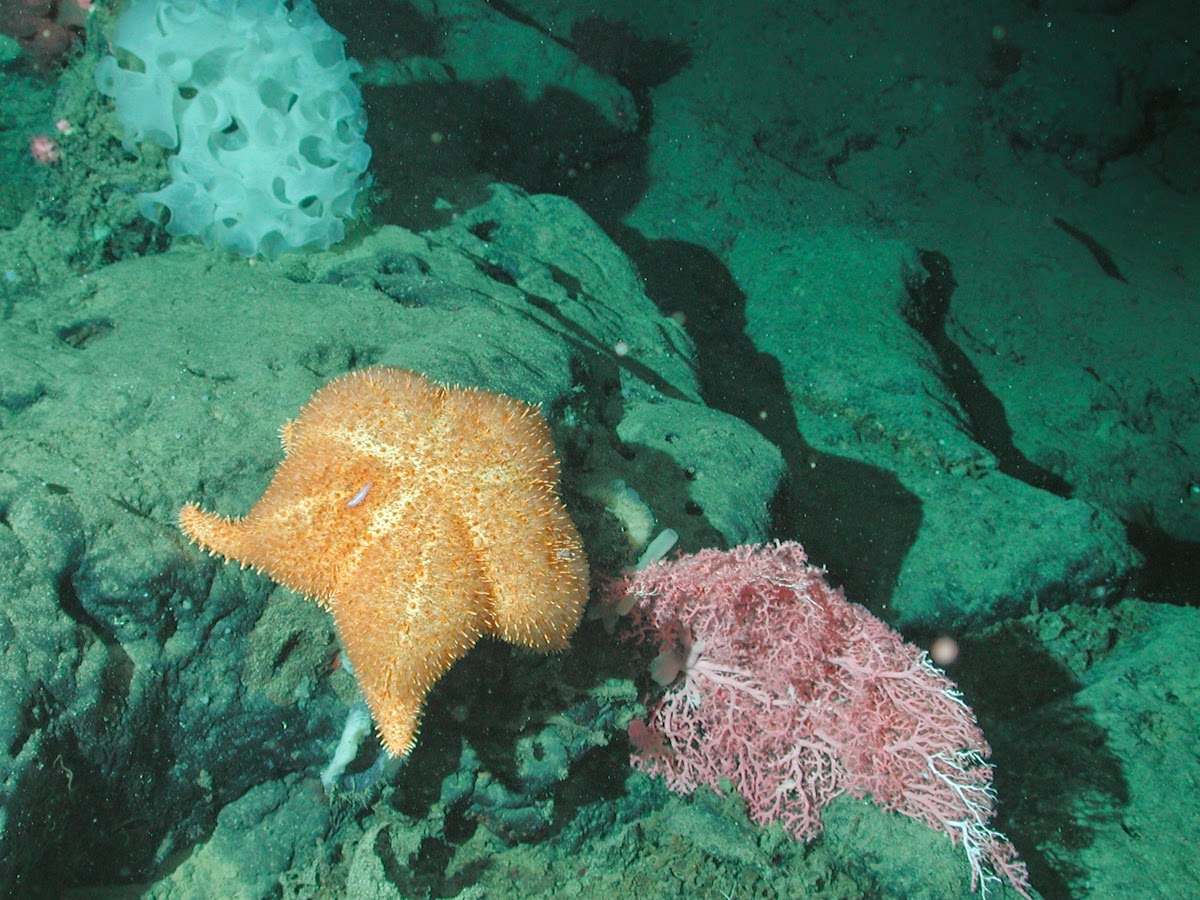
So, let's see some new species!!  Many Hippasteria related species are predators of deep-sea coral predators and I've described other new starfish species related to these, which you can read about here.  

1. Hippasteria muscipula
This one is the biggest and neatest of the new species I described.. A big, massive critter about 30 cm (about a foot across)! 

It was collected from various tropical Pacific localities: Hawaiian Islands, New Zealand south of New Caledonia in deep-water. 425 to 1500 meters!

What's cool about it?? The name.  The species has these very big and toothy pedicellariae (aka claw like structures on the surface, possibly used for defense)
The species was Hippasteria muscipula after the pedicellariae's resemblance to the Venus fly trap (Dionaea muscipula)!
One other cool thing we found? The specimen from New Caledonia had its stomach wrapped around a deep-sea "coral" called Metallogorgia, which is kind of an odd looking gorgonian that looks like a living wire hanger! Possibly feeding on it??  Interesting. 

2. Hippasteria tiburoni
This new species was a little tiny thing collected by the Monterey Bay Aquarium Research Institute from Pioneer Seamount in the North Pacific (southwest of San Francisco) in 2005
This species was distantly related to Hippasteria heathi, which occurs primarily in the Aleutians..
This species was named for its "collector" the now defunct Remotely Operated Vehicle Tiburon which served science and MBARI well between 1996 and 2008!
Hippasteria tiburoni, despite its size was observed feeding on deep-sea bamboo coral!!  Ain't it an awesome little critter?? 

3. Hippasteria mcknighti
The third new species we described was found among specimens sent to us from the New Zealand Institute of Water and Atmospheric Research.  It resembles the North Pacific Hippasteria heathi but the genetic and morphological data support it as being distinct..

4. Big Taxonomic Changes! 
The rest of the paper addresses multiple taxonomic changes (i.e. names of species).  Among the most significant of these was the big discovery of how wide-ranging a species, Hippasteria phrygiana turned out to be!!   This was a species found in THREE OCEANS! 

The problem with this discovery was that historically, folks would often describe a new species if it was not previously known from that part of the world and sometimes there are widely occurring animals which do form regional subspecies. It depends.
                    
But in this case, thanks to our genetic data, we could tell that a great many described species, which were likely separated as distinct species based on minor differences are in fact, just minor variation of one wide-ranging species!

In this case nearly a dozen species, were found to be "redundant" or were applied to Hippasteria phrygiana throughout different parts of the world. 

We also looked at the other species of Hippasteria, H. californica which occurs in deeper water habitats than H. spinosa... 
Image by Dr. Steve Lonhart Via SIMON
What we had found, up this point had been pretty consistent with what had been known until we found two individuals of this species which were revealed by genetics to have been Hippasteria californica BUT in SHALLOW WATER habitats in British Columbia AND which looked like H. spinosa!

Weird.
Image by Neil McDaniel (check out his website here)
STRANGE! And a mystery that we shall have to investigate for another day....

OTHER Related Posts:
New genera and species of Hippasteria related starfish species! 

Deep-sea Corallivore Video from MBARI!

Tuesday, May 13, 2014

New Paper! New Species! How the Blog Informed my Research!

When I started writing this blog back in 2008, one of the biggest questions I had was whether or not the blog would have ANY sort of impact on my primary studies in starfish diversity and evolution. 

 How could something that I thought would essentially be only an educational platform benefit my research??? 

Well, with a recent publication by myself and colleague Dave Foltz at Louisiana State University, which was just published in the journal Zootaxa, you can see how! 

So, the paper's primary focus was on the family Poraniidae, which is a small but unusual group of cold-water starfishes which have kind this weird fleshy covering over their skeleton. 

The surface of these animal is soft to the touch and they look sort of velvety like so.... (Porania pulvillus is shown).

Truthfully, no one has known much about them and as such, it was unclear what kind of relevance they had to the bigger scheme of biology.

A few years ago, starfish paleontologist Dan Blake described Noriaster barberoi from the Triassic of Italy. Triassic starfish fossils are incredibly rare and potentially provide insight into the early evolution and history of all starfishes. 

Dr. Blake identified these fossil starfish as members of the Poraniidae, making them potentially important in the "big tree" of starfish evolution.  
photo by Dan Blake, via the ATOL website.
Later, my work with Dave Foltz from 2011 showing the "family history" of one major group of starfishes, based on evidence from DNA suggested that their position in the big "family tree" might indeed be important to understanding the early evolution of all starfishes.

But we understood very little about the ecology and life modes of LIVING members of this group.

But usually, one of the first steps towards understanding these "family trees"  is to "straighten out" the many different kinds of genera and species in the Poraniidae. (or any discrete group of starfishes).

There's a LOT of stuff in a paper like this..so here are some highlights... 

There's an overview of known genera and species
Chondraster grandis? from the North Atlantic. We know almost nothing about this species..
Here is Poraniopsis inflata, which occurs along the Pacific coast from Japan to Alaska and south along the west coast of North America to California. A related species occurs widely in the Southern Hemisphere. 
Some new genera and species...
One of the delights in looking through big museum collections and specimens from an endless number of research expeditions is the possibility of finding a new species or even a new genus! 

In the bigger, evolutionary sense, this would be like finding a long lost member of your family you never knew about. Then, you need to figure out how/where/who it is...

Among the neat new species found? 

First was this weird thing from deep-sea habitats (roughly 1600 meters!) south of Macquarie Island on Hjort Seamount. This specimen was "hidden" among the collection of the US Antarctic Research Program and collected in 1965!! (you may recall I wrote of this collection awhile back)  I've found other new species from the US Antarctic Research Program... its the gift that keeps on giving! 

First..may I present the new genus and species:  Clavaporania fitchorum!
                                              
The new genus is named "Clava" or club shaped which refers to the spine and "Porania" which is the name from which the family Poraniidae derives its name.  The species is named for Mason & Lisa Fitch, who are ardent supporters of my research! 

The OTHER new, cool species we found was a tiny little (it was about 1.5 inches across) animal collected by the Monterey Bay Aquarium Research Institute (MBARI) from Davidson Seamount in the North Pacific from an astonishing 2669 meters!  I have much thanks to benthic ecologist Jim Barry and biologist Lonny Lundsten for their help in making the animal available to me. 
with new species, come NEW observations!  MBARI was working on/collecting this deep-sea "black coral" aka an antipatharian..

The new species (note the white arrow) was found among the other echinoderms present on the branches
                         
My take on the pictures was that this starfish was feeding on the fronds since to my eye, some of those fronds are gone..So, PREDATION??? 

I couldn't help notice that the animal had actually crawled UP into the branches. And from that I gave the animal its species name- Bathyporania ascendens.  The genus was Bathyporania  which comes from "Bathy" for depth and "Porania" which again is a the primary name for taxa in the Poraniidae. species is called "ascendens" for "ascent" or to climb because of the fact that it climbed up into the branches of this black coral...

This ecological observation nicely dovetailed with BLOG STUFF! Ahoy the Internet! I wrote this post in 2013 (last year) about what I thought might be a bunch of neat observations on feeding in poraniids based on observations present on the Internet...  such as Porania pulvillus shown here feeding on a sea pen.
From this EOL page via SERPENT
And the case I made there was simply this: Poraniids had always been thought of as fairly passive feeders. What if they AREN'T?? Maybe they feed more aggressively as predators?? 

And this line of thinking from the blog eventually made its way into a nice part of the paper discussion!  which for me, leads to a nice paradigm shift about this poorly known group of animals! 

The internet observations had colored and further fleshed out my published work! Who knows how it will be corrupted by blogging next? Woo!