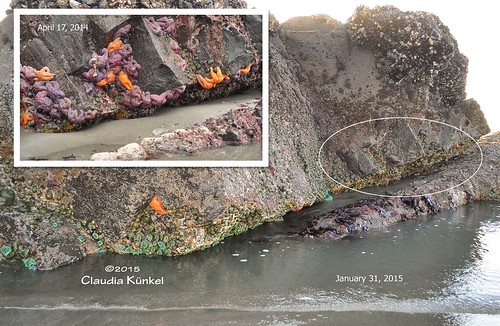
Showing posts with label starfish wasting disease. Show all posts

Friday, July 8, 2016

Pycnopodia Watch! Cautious Optimism about Sunflower Stars!

The Starfish Wasting Disease was first documented on the west coast of North America in 2009 and began to hit really hard in 2013 as I blogged about here and it became suddenly noticeable by MANY scientists on the west coast from Canada to California.  Due to a massive population explosion there followed a catastrophic die off in British Columbia which I documented here, with pictures courtesy of Jonathan Martin. 

In the intervening years, the Starfish Wasting Disease "event" had taken on a HUGE stage. UC Santa Cruz now monitors the health of west coast asteroids on their website (here). 

The first Sea Star Wasting Symposium was held earlier this year in Seattle. A meeting which I attended and reported on here. 

Perhaps one of the most significant losses following the massive starfish wasting disease epidemic that hit the west coast of North America (and possibly parts of the east coast) was the apocalyptic loss of the iconic sunflower sea star, Pycnopodia helianthoides.
When I was growing up on the west coast, there were sunflower stars that were HUGE!!  Tall tales would  report them reaching two and a half, then THREE feet across! But most were a good dinner plate size.

These animals were voracious predators and for starfish, moved quickly across the intertidal and subtidal...

Sunflower Stars are an ecologically important species. 

Unfortunately, populations of this species were DEVASTATED by the starfish wasting disease epidemic. More so than almost any of the other species, the sunflower stars were more often than not, completely removed from local areas along the coast.

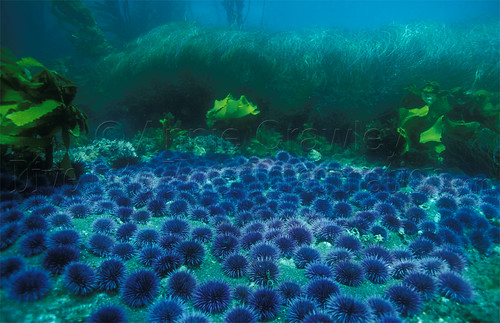
Ecologically this has had VERY significant ramifications. Recent ecological studies, such as this 2016 paper in PeerJ by Schultz et al   have indicated that green sea urchin abundance in British Columbia has increased FOUR FOLD!

This has agreed somewhat with anecdotal observations by naturalists on Twitter observing sea urchin abundance in California...
The exact reason is not clear. Possibly because the sunflower stars are not around? and the animals have just come out of hiding? Or have the stars been controlling the population structure of the urchins?  But it DOES seem to be related to the absence of the once abundant and mighty sunflower stars.

But Sunflower stars are also an ICONIC species..
In addition to be an ecologically important part of the intertidal and subtidal ecosystem, there's a lot to be said for how they really represented the North Pacific. Pycnopodia is an endemic, found nowhere else in the world.. and was often used as an example of the special and diverse fauna on the west coast of North America..

Some of the individuals which had been on display in public aquaria died within days. Some of these individuals had been around for over 20 years. Suddenly? Gone.

Those of us who are most familiar with the West coast fauna.. divers, naturalists, scientists, citizen scientists, beach goers, students, fishermen, anyone with an intertidal or subtidal ID guide was suddenly NOT seeing this species. It was and still is a significant and sad loss.

And so.. observations of THIS species have had a SPECIAL significance..

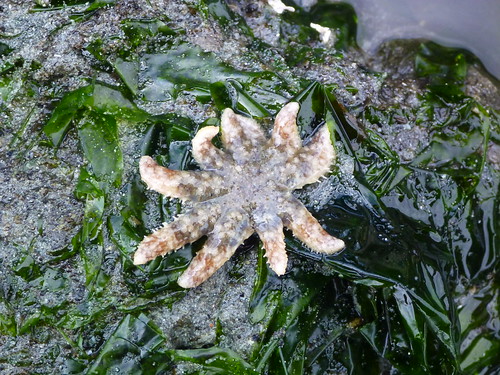
BUT today, a colleague of mine, Ms. Brenna Green observed THIS. A juvenile Pycnopodia helianthoides in Northern California!! According to her, one of the first she's seen in a good long while!!
A small individual. Only a few inches across. But still...

I was directed to iNaturalist which has been monitoring observations of ALL asteroids on the west coast.. There were only 60 observations of Pycnopodia since 2014!!- so only about 20 per year that are reported  Note also-some of those observations were from areas that are distant from the primary Sea Star Wasting Disease areas (such as Alaska).

Make no mistake, that's a very low number... but surprising considering that they were considered completely gone from some areas..

But they ARE still out there. And are still popping up..

An anecdotal skim of Flickr and Twitter shows that small sunflower stars have been popping up over the last year or so...
From Titlow, Tacoma, Washington from February 29, 2016
Sunflower Sea Star
Weir's Beach, British Columbia by Laura Verhegge (taken April 21, 2015)
Pycnopodia helianthoides

Recent accounts (such as this one) have documented a resurgence in populations of sea stars hit by starfish wasting disease (based on this paper).

But I would like to think that is SOME good news, even if this doesn't mean a full and immediate recovery..

Another significant issue? SIZE of the observed individuals
Here's one of the most critical parts of these observations: Most are consistently SMALL. Many of the "adult" individuals we were used to encountering were easily dinner plate size or larger have not really been encountered.. or if so, not regularly. 

Are the small sized ones a sign that they simply grow very slowly?  Or more ominously,  do they die as they reach a certain size??

On the upside, I have heard SOME anecdotal observations of adult (~40 cm) sized individuals being seen in Washington and in other localites...

Stay tuned! Research continues. 

In the meantime, for further news check out:


Tuesday, February 2, 2016

What's New in Sea Star Wasting Disease?

image by Jonathan Martin
So, my apologies for the delay between my last post and this one. Between traveling from the west coast, the blizzard and my laptop experiencing..."difficulty" I've missed one or two posts... But! here's what I have been up to...

So about two weeks ago I was in Seattle at the Sea Star Wasting Summit, hosted by the Seattle Aquarium!

This was an informal gathering of about 35-40 people who work on the west coast of North America, ranging from Alaska to Southern California to report on various aspects of Sea Star Wasting Disease (aka Starfish Wasting Disease aka Starfish/Seastar Wasting Syndrome).
The meeting brought together folks from a broad range of occupations that all have had some experience or contribution to our knowledge of the Starfish Wasting Disease phenomena: pathologists, veterinarians, ecologists, citizen scientists, aquarists, taxonomists, educators, and etc..
So, while I can't repeat everything that was discussed (some of it was still unpublished) here are some further insights...

What do we know?
1. Who? The disease seems to affect sea stars in the family Asteriidae most acutely. This includes Pycnopodia helianthoides (aka sunflower star), Pisaster spp (esp. P. ochraceus-the Ochre star), Evasterias troscheli (mottled stars) and Orthasterias koehleri (rainbow stars). Pycnopodia helianthoides, the sunflower star seems to have been one of the hardest hit...
Image by Jonathan Martin
140101_scuba_017

but ultimately the disease seems to affect nearly every shallow-water seastar species on the Pacific west coast. So that includes leather stars (Dermasterias), Bat stars (Patiria), sun stars (Solaster) and so on...

There were a few species which showed much lower incidence of being infected but its unclear if that's simply an artefact (i.e. they aren't seen that often to begin with), less vulnerable, but there is really no further data...
Image from this article in Vice: http://www.vice.com/read/the-wasting-0000650-v22n5
2. Where? The disease, as part of the larger event starting in 2008 is now known from southern Alaska, British Columbia, Washington, and Oregon down to Southern California (and apparently Baja California).
map from http://data.piscoweb.org/marine1/seastardisease.html
At the moment, almost all of our observations are from intertidal/subtidal observations. Nothing really substantial from "deeper" water...

There is another "die off" event on the east coast but it has not been as thoroughly evaluated, so not sure.  This 2012/2013 blog by Elena Suglia documents some of this phenomena 

3. What? Symptoms of the disease of course are widely known and have been outlined in detail here at the UCSC Seastar Wasting page. The disease begins with white lesions and tissue necrosis (as shown below) and leads to "wasting" or "melting" of the body into an ugly pool of tissue and ossicles... But there's MUCH more to be seen at Seastarwasting.org in terms of characterization, etc. 

There's a whole bunch of observations of these symptoms all over the internet Both from my prior blogs: Pycnopodia die off, and a further account here..  and many, MANY accounts of starfish wasting disease from Allison Gong's blog.

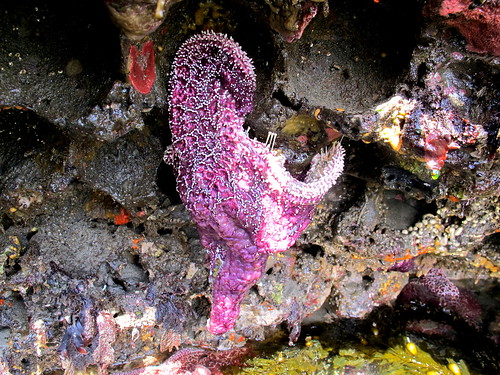
But, one important new clue: The Gonads! One of the interesting details which Ian Hewson reported at the SSW Symposium (link here) which was further reported in the news was this bit: the gonads in infected sea stars are often inflamed with tissues sometimes extruding from the gonopores (the openings through which the gametes are emitted). Note the white blobby bit between the arms of the purple Evasterias troscheli (mottled star) in the picture below...
image by Allison Gong
A further important consideration is that gonads and reproduction are tied to activity during certain times of the year as temperature fluctuates. This might also be an important consideration.

This is will likely be important in piecing together the actual cause of how the disease actually kills the sea stars, which remains poorly understood.

Challenges: figuring out what causes the disease is difficult and remains elusive.
So, by now many people have likely seen Ian Hewson et al.'s (2015) article showing identification of the Sea Star associated Densovirus (SSaDV) with the disease. Popularly reported here and in other news outlets..

This was an important first step. But its important to realize that we still do NOT KNOW that this is the actual CAUSE of the disease. 
Sea star with (likely) wasting syndrome
Probably one of the most important lessons I  picked up from the meeting was how careful the work of disease pathologists needs to be. 

Correlation is NOT Causation! 
Powerful genetic tools have allowed us to characterize the SSaDV virus and experiments show that it is ASSOCIATED with the disease. But we have yet to identify exactly HOW Starfish Wasting Disease actually works. In other words, what actually happens to the animal to initiate death?

Just because we have this "disease associate" does not actually mean that it causes the disease.. it could simply be present with the disease as part of the suite of entities (e.g., bacteria, protists, etc.) taking advantage of the sick animals. Or it could be something already present that has become fouled or modified by some other factor.

My take away message was that MULTIPLE lines of evidence (genetics, tissue analysis, external observations, etc.)  should all converge on the same conclusion. In other cases, pathologists are able to actually observe the agent (virus, bacteria, etc.) perform whatever action it takes to create the disease and thus the symptoms..

At this point, we are still working on what actually causes the "wasting symptoms" to occur. This is not to say we are clueless about it..but a definitive cause has not been shown.

One of the biggest issues we have right now? Understanding starfish biology.
     A LOT of the study of invertebrate physiology went "out of style" in the 1960s along with a bunch of natural history research. There are many instances when we just don't understand what "normal" is for sea stars (or their relatives for that matter).

And so..the other powerful tool at play? Careful critical thinking..

(and yes.. what this means in the real world is that NO zombie or science fiction disease movie is likely EVER going to be solved in two hours!!)

What Tools are being used?
   So now that I just got done saying a whole bunch of stuff about care and critical thinking, that is NOT to say that scientists are not throwing a whole arsenal of scientific tools at this problem to try and obtain as many different types of data as they can!

Dr. Felicia Nutter and student Eric Littman at Cornell University for example utilized sophisticated imaging techniques ranging from traditional X-rays to CT scans in order to look at the endoskeleton in afflicted sea stars, which it was thought, might be showing decreased skeletal density.
Image from http://phys.org/news/2016-01-imaging-technology-combat-disease-endangers.html
Other tools include the Illumina technology sequencer which was used to investigate the phylogenomics of the virus and other microbes present in diseased individuals. Long story short: Tissue are taken from infected animals, recover DNA (or RNA) is extracted and purified, these machines sequence it (i.e., analyze it), and this permits identification of the organisms present. This was how the SSaDV (the sea star virus) was identified and characterized...along with the many other bacteria and other ambient forms living in/on the sampled sea stars..

These are among the many types of tools being applied..but there are certainly many more that fall into the more traditional roles: taking tissue samples, aquaria and freezers for living animals and tissue specimens

But as mentioned above, all roads should lead to Rome.. and with any luck, the results from these studies should all be consistent with one another...

Are there/Will there be Ecological Effects??
So, although a LOT of the attention both public and scientific is on the disease itself, many folks often forget that the after effects of the disease will also be very significant!

Sea stars such as Pisaster ochraceus and Pycnopodia helianthoides occupy very important roles in marine ecosystems. Called keystone species, their presence and/or absence as predators is thought to have a HUGE effect on the organisms around them.. (I wrote up a little of this on Pisaster here)

So what happens when those predators are suddenly gone??

sea star shortage
There were no rigorous and statistical cases showing a clear "cause-effect" loss-of-predator-leads-to-increased-prey data presented. But in many cases there were anecdotal observations that "trophic cascades" might be starting... This one for example, allege that there has definitely been a shift in abundance of prey species..such as sea urchins as mussels.

That basically means that the loss of a predator triggers an increase in prey (here was an earlier blog post about urchin barrens).  
Purple Urchins

which then results in some other ecological effects in the ecosystem.. say, a decrease in kelp coverage (resulting from urchin overfeeding) which in turn results in the loss of kelp-inhabiting species and so forth and so on....

Some scientific observations suggest that we might be seeing some of this.. but not necessarily everywhere.  Environments across the coast vary.... so what you see in some parts of California might NOT be the same situation in some protected cover in Oregon....

Time, further data and experiments will tell..

Other Miscellaneous Questions! 

1. Are all the starfish on the coast extinct?   Is my favorite species (e.g., Pycnopida, Pisaster, etc.) extinct?? 
In NO instance is ANY of the species surveyed thought to be completely extinct. Some individuals and news agencies have either misreported or exaggerated the the impact of the disease. MANY populations have been decimated. Localized populations have been wiped out...but there STILL are healthy populations of all afflicted sea stars species.

So, some species are "locally extinct" which means that you might not see any at your favorite local rock pool or pier but there's no evidence for complete and total extinction.

2. What about the juveniles we are seeing? 
There are many reports (such as this one in Nat Geo and this one in the OregonLive) of smaller individuals of various species, Pisaster, Pycnopodia, etc. being seen widely along the west coast where adult starfishes have been wiped out by SSWD.

There were MANY reports of these out in the intertidal zones along the coast. The significance of the juveniles is unclear at this point.   Possible reasons and questions as to why we are seeing them:
  • They are now more obvious because the adults are gone (and we are looking)
  • They have become more bold because the adults are gone.
  • Are there more of them present now because of absent adults? 
  • How fast do they grow? Will they enter in the former adults ecological setting?
Sadly, there HAVE been reports that small individuals can contract the disease. But they don't all seem to have it. So what's going on?? This whole dynamic involving juvenile species remains poorly understood.

If you see any, you can report them to the Seastar Wasting Website here.

You can download a nifty GUIDE to identifying tiny juvenile sea stars HERE.

3. Is the worst over?   
Yes. It seems to be, but mainly because most of the adults which carried the disease are themselves all gone. Its unclear what factors are at play insofar as why some populations have been more heavily hit than others.

4. Do Any of the standard aquarium antibiotics work? 
Many of the standard aquarium drugs (antibiotics, etc.) seem to be most effective against the secondary bacterial infections which attack the animals after becoming sick. But unfortunately, they don't seem to curtail the actual disease much if at all.

5. Is Climate Change/Temperature a factor? 
I would say yes. And others would agree with me (here). There have been several informal experiments and observations of seasonality which suggest that higher water temperature is, at least, significant and worth investigating as a factor. But, at the time of this writing, a clear paper has not been published which establishes a rigorous link.

6. Is the wasting disease caused by Fukushima/Republicans/Democrats/Cthulhu/Extraterrestrials/ Atlantis/Inner dimensional beings from the 7th Parallel? 
Nope. Not even a little.

My thanks to Lesanna Lahner, Ian Hewson, Melissa Miner and the other participants at the Sea Star Wasting Symposium!

Standard caveat: i've done my best to represent a LOT of information. Any mistakes are my own.

Further Resources:
The Sea Star Wasting Site at UCSC:
http://www.eeb.ucsc.edu/pacificrockyintertidal/data-products/sea-star-wasting/

Ian Hewson's blog about SeaStar Microbial Ecology: https://seastarwastingdisease.wordpress.com/

iNaturalist: Tracking Sea Star Wasting Disease:
http://www.inaturalist.org/projects/pisaster-disaster-tracking-starfish-wasting-disease

A useful summary page from Sanctuary Integrated Monitoring Network (SIMoN)
http://sanctuarysimon.org/projects/project_info.php?projectID=100401

Monday, October 14, 2013

Why We Should be Concerned About a Mass Starfish Die-Off and/or Disease! Plus Updates and New Links!

P1050360
Image by Jon Martin
UPDATE: You can upload new pics of starfish wasting disease to this website (iNaturalist). Help track its progression!

Since I originally reported on the big Pycnopodia starfish die off in British Columbia, I've gone on to invoke Starfish Wasting disease which has led to much discussion and reporting of the issue all along the west coast of North America, including concerns invoking the die off of the east coast starfish Asterias, which is closely related.
Meeting of the seastars
Image by Jeff Goddard
New developments since I last wrote:

The disease (?) occurrence in British Columbia seems to be reported now from several places:
Whytecliff Park (video here),
Kelvin Grove (video here),
Howe Sound (account at Aquablog) ,
Croker Island, Sechelt Inlet and ... (I will continue to update).(thanks to Jon Martin, Neil McDaniel and others for their pics and records)

Could Wasting disease also be headed for Washington? (via KUOW.org)

The number of taxa seems to be broadening but is most acutely observed in Pycnopodia. But other accounts in BC waters have been seen in Mediaster, Dermasterias, and Solaster.
P1050449
image by Jon Martin
Other places starfish wasting disease is observed (e.g., California) it seems to be more focused on asteriids, such as Pisaster. An excellent summary of what the disease in California looks like can be found HERE.

Why Should We care? 
With all the media picking up the story and carrying it around to multiple outlets, at some point someone will get beyond the "weird news" twist that has been put on the articles and ask "So What?" Here are 5 reasons I think understanding why this die-off MUST be studied.

1. An Endemic Starfish Fauna.  
     A few years ago I wrote about the phylogenetic (aka the family tree) of forcipulate starfishes. The blog I wrote about it was here (w/paper cited within)

Basically, one of the important facts was that all of the asteriid starfishes in this area, including Pycnopodia (the sunflower starfish), Pisaster (the ochre star), Evasterias, Leptasterias, etc. on the Pacific coast of North America are ENDEMIC TO THE COAST.

That means, you could see a starfish which resembles Pycnopodia in Australia or Mexico and it will have LESS relationship to Pycnopodia than Pycnopodia has to Pisaster!

Bottom line: You won't find these starfish species anywhere else in the world. These animals are an important part of the marine ecology of the Pacific coast of North America.


2. Aesthetic & Cultural History
Ed Ricketts, 1937
Image by sjonnie van der kist
“What do they find to study?” Hazel continued. “They’re just starfish. There’s millions of ’em around. I could get you a million of ’em.”
“They’re complicated and interesting animals,” Doc said a little defensively.
The starfish on the west coast of North America have become iconic. Pisaster ochraceus, aka the Ochre Star is THE model for the Keystone Species in Ecology.  The starfish of the west coast were in John Steinbeck's famous novel Cannery Row as part of the rich career of Ed "Doc" Ricketts:
What if there weren't a million of em any more?  More on this below under #5-ecological impacts. These are animals which have become part of our culture. Conservation of these species is important.

Montastraea Cavernosa With Active Black Band Infection
Image by CIOERT
3. We don't know what causes it. At the moment, there are a bunch of ideas. Bacteria. Virus. Some
kind of microbe?  But as we see in Coral bleaching diseases, microbes are present.
They might be the cause OR they might be the RESULT of some shift in their surroundings? such as temperature or overall water quality. Sea stars DO have a natural microbial fauna (here) What if that fauna/flora goes bad because of changes in some greater part of their environment?

If this isn't a communicable disease per se but is instead more of a series of symptoms related to poor or changing environmental factors, which activates/corrupts/modifies that fauna, THAT could be a concern which leads us to our next point...


4. Canary in a Coal Mine- Global Warming? I think the thing that always concerns me about this whole thing is whether this whole phenomena-the die offs in British Columbia, the wasting disease observations in California and elsewhere - are all tied to a particular environmental change. I have written about echinoderms as the "canary in the coal mine" animals before..but for specific environments such as Antarctica. What if something is happening and this is an early warning that we aren't picking up on?

The original paper by Amanda Bates (here) observed that wasting disease seemed to be most acute when it was warmer.  What happens if Starfish Wasting Disease takes on the scale of the various coral wasting diseases?  Vigilance and data are an ongoing concern....

5. Widespread Ecological Impact. Here's the million dollar issue.. What happens if diseases change abundance or remove these species from their habitats? WHAT HAPPENS? What COULD happen?
Sea Stars
Image by Phil Williamson
Sunflower Star at Rest
Image by Daniel Johnson
The thing is, that BOTH of these species occupy important ecological positions. As mentioned earlier, Pisaster is a keystone species. The presence or absence of a keystone species in an ecosystem can dramatically change the interactions of that ecosystem. 

For example, Ochre stars (Pisaster ochraceus) removed from the intertidal would likely result in a significant overgrowth of mussels and other invertebrates which ochre stars typically feed upon. Mussels might come to dominate an ecosystem and prevent other animals from inhabiting that area. There could be a cascade of other consequences of course...

Similarly, Pycnopodia is a dominant predator of MANY other invertebrates species, sea urchins, abalone, snails, clams, etc.

But MORE than that there could be an unpredictable cascade resulting from fluctuating populations of any of these taxa. An increase in sea urchins, resulting from an absent predatory starfish, for example might result in additional sea urchin "barrens" (as I've described here). 

What is perhaps most concerning is how MANY starfish species seem to be affected. Many of their ecological roles are poorly understood but are likely to be important. The effect on the ecosystem is likely to be significant. 

Thanks to many discussions at Science Online Oceans this past weekend for discussions that inspired this post! 


Tuesday, September 3, 2013

Mysterious Mass Sunflower Starfish (Pycnopodia) Die-off in British Columbia

<i>Pycnopodia</i> detail

Today is a "report from the field" by Jonathan Martin, a research associate at Simon Fraser University, who is among other things, an ROV pilot, diver and photographer. His pictures can be found at this Flickr stream here.

Martin has recently sent me a series of images and video that show a massive die off of the sunflower
star, Pycnopodia helianthoides in the waters of British Columbia in 20-50 feet of water.

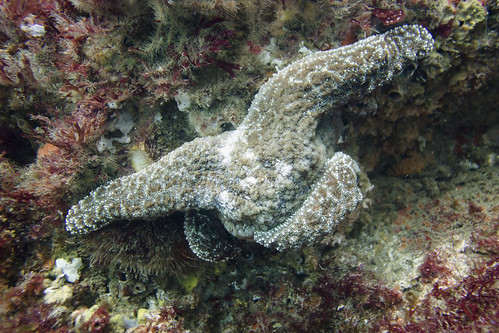
A picture of the sunflower star in a healthy state is above. Pycnopodia is a prominent member of the Pacific northwest intertidal/subtidal marine fauna. It boasts about 20-25 rays and can get to be quite large (about 2 to 2.5 feet across).

A couple of years ago I wrote about a huge Pycnopodia population explosion in British Columbia waters.

ALL pictures in today's post were provided by Jonathan (except where noted otherwise).

The Evidence: Images & Video

Here's a video transect made by Jonathan


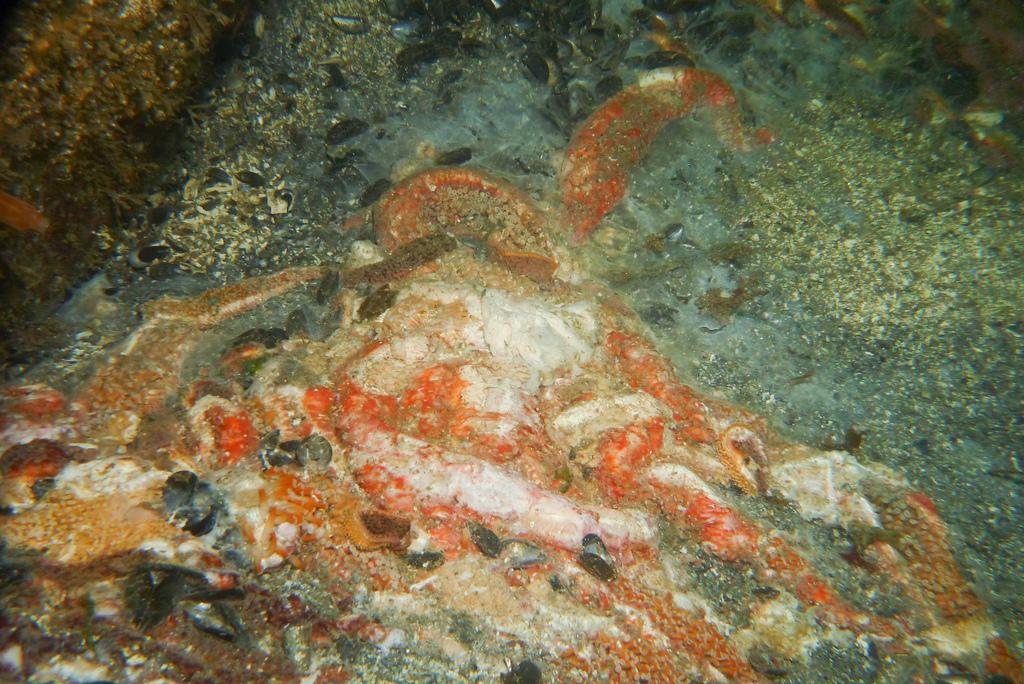
See all that white stuff on the bottom?? Those are decaying, white tissues and ossicles from sunflower stars. You can see the fleshy remains all around the bottoms.

His direct observations (dated August/September 2013):
I just got back from a dive out in West Vancouver though, and there seems to be a huge mortality event of some kind with the animals, where they seem to waste away, 'deflate' a little, and then just... disintegrate. The arms just detach, and the central disc falls apart. It seems to happen rapidly, and not just dead animals undergoing decomposition, as I observed single arms clinging to the rock faces, tube feet still moving, with the skin split, gills flapping in the current. I've seen single animals in the past looking like this, and the first dive this morning I  thought it might be crabbers chopping them up and tossing them off the rocks. Then we did our second dive in an area closed to fishing, and in absolutely amazing numbers. The bottom from about 20 to 50 feet was absolutely littered with arms, oral discs, tube feet, gonads and gills, the the extent where it was kind of creepy.
More pictures of Pycnopodia in various states of decay..
P1050297
P1050330

P1050364
Partial remains of a disk and white, dead starfish tissues..

P1050366


In some cases, arms were separated with tube feet still moving around
P1050317P1050363

What makes this such a concern?  OTHER starfish species in completely different lineages also seem to be affected. The sea star predator, Solaster dawsoni was also observed in various states of distress..

Solaster feeds on other starfish and does feed on Pycnopodia, so is there a connection??  Especially with the recent population explosion??
P1050360


P1050344


P1050397


P1050395


So What's Going On? 
So, there were a number of different ideas that buzzed through my head. Again, this is all SPECULATION on my part...

1. Is this related to the population explosion, observed almost 3 years ago??  Could the huge populations from 2010 be suddenly dying off? Famine? Disease? (see below) This would be an unusual (or at least poorly known) phenomena. I've seen Pycnopodia in aquaria  live out long lives, so I don't think this is some kind of "natural causes" thing...

2. Could this be a disease?  Jonathan has mentioned the ciliate (Protist) parasite which inhabits sea stars in the Pacific Northwest. The ciliate effectively castrates the host, but has never been observed to actually cause much more damage than that. And accounts of the ciliate suggest that it occurs in a very small % of the overall population.

There are accounts of many sea urchins being decimated by various bacterial infections, such as Bald Sea Urchin disease but my skim of the literature suggests that there isn't anything known about similar diseases in sea stars.  Most mass-mortalities of seastars have been associated with environmental changes- freshwater from rains, storm and wind, toxicity in the water from geological events and so on...

Could this be related to what has been observed on the East coast with Asterias?  See also this report. Where populations of the well-known intertidal starfish (and btw, SAME family as Pycnopodia) have been undergoing population declines for unknown reasons.
Purple Starfish
Image by lifeboy252
3. Why is it affecting other species? So we have one big Pycnopodia die-off. Why have all the Solaster stars ALSO been dying?  One immediate answer might be that whatever toxic substance is in Pycnopodia has been fed upon by Solaster, resulting in further mortality. Or it could be in the water.. More data and observations are needed.

Have other species in completely different ecological regimes died? 

SO FAR, this has been observed only in the British Columbia region. Hopefully, this is just an isolated incident and nothing that will be slowly moving in any other direction. 

I'm not an ecologist or an invertebrate pathologist.. so maybe someone out there with an appropriately equipped lab will embrace this and seek out the answers?  and hopefully whatever it is, won't be much more widespread..