Showing posts with label British columbia. Show all posts

Tuesday, September 10, 2013

Starfish Wasting Disease!


UPDATE: you can now upload YOUR pictures of starfish wasting disease. They are being tracked at this website (iNaturalist)

Last week I reported on an unusually large die-off of the North Pacific sunflower star, Pycnopodia helianthoides (among other starfish species) in the waters of British Columbia. The story even got picked up by National Geographic!
P1050360

This sparked some good academic discussion here which I can only hope will lead to some further insight into what is happening.  One useful thing which came up was the mention of something that would be a good follow up to last weeks' report:  Starfish Wasting Disease!

I have spoken of ciliate protist parasites in sea stars before but this is something different.

Details of the post today about Starfish wasting disease is based on this paper in the journal, Diseases of Aquatic Organisms from an article by Amanda Bates, Brett Hilton and Christopher Harley in 2009

Other information is from an account of starfish wasting disease in the Channel Islands by Ginny Eckert and colleagues. This paper is freely available here.

I should also mention that my friend and colleague Dr. Allison Gong has documented an outbreak of wasting disease in her water table at UC Santa Cruz. I've borrowed many of her pictures below. My thanks to her for allowing me to use them! 

What is Starfish Wasting Disease? 
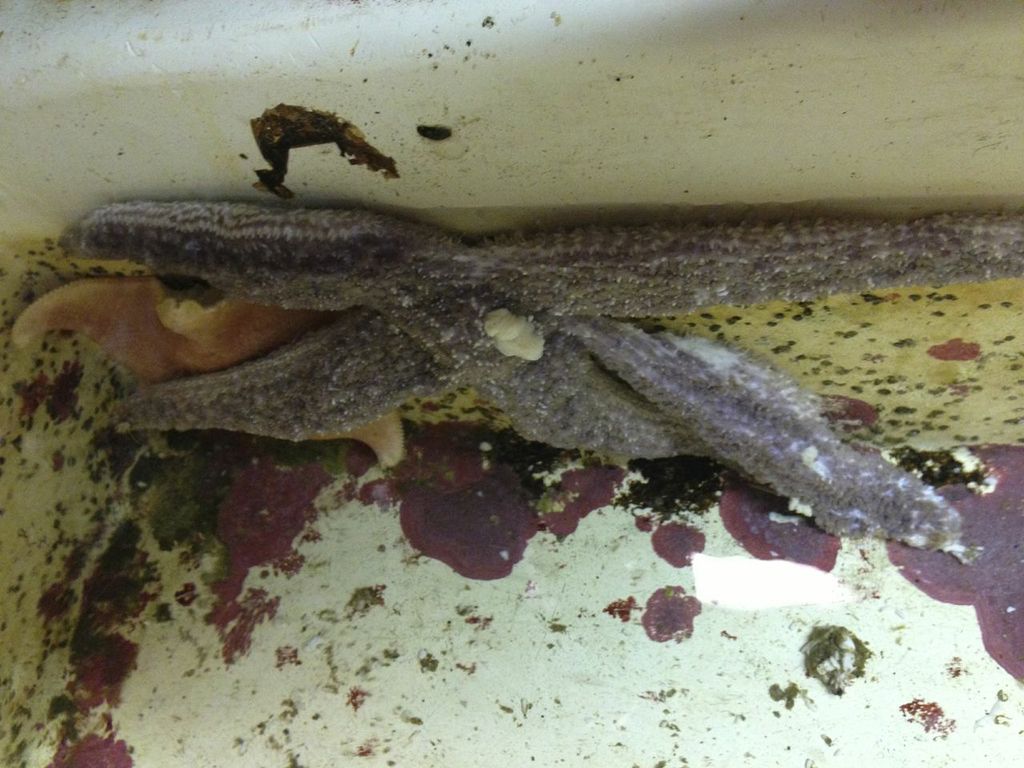
Symptoms of the disease are relatively straightforward:
  1. White colored lesions appear and grow rapidly
  2. There is a loss of body pressure (i.e., turgor)
  3. Body disintegration and autotomy of arms, etc. 
  4. and finally death...
Bates nicely outlines the various stages of the disease in her paper focusing on Pisaster ochraceus, the ochre star.
Fig. 2 from Bates' et al. 2009
Allison Gong recently documented these symptoms in her blog

Lesions...


followed by decay and autotomy (i.e., arms begin to shed..)


The effects DO seem very similar to what happened with the Pycnopodia die-off
P1050330
fr. Jonathan Martin
But what actually causes the disease?? Sadly, we are just beginning to understand it and so we don't actually know WHAT the causative agent is.  Molecular tests for bacteria haven't confirmed anything.
Could it be a virus? A fungus? Some strange combination thereof?

Its also unclear if it is the SAME agent at work in EVERY case. Different species? Different strains? Different diseases?

The symptoms of the disease have been documented widely: on the west coast of North America. From British Columbia down to the Gulf of California. But also in the Mediterranean and the North Atlantic coast of North America.

Nothing yet from the Southern Hemisphere.. Australia, New Zealand, etc.

What Species Does It Affect?
Wasting disease appears to be pretty widespread across MANY starfish groups. 

The symptoms of the disease have been observed as early as 1972 from the east coast of North America in the "common" starfish Asterias vulgaris (now called Asterias rubens, pic on the left)

In 1982, there was a mass die-off of Heliaster kubiniji in the Gulf of California, which was so severe that it led to local extinction in several areas where it had once been abundant. (Image of Asterias by "misenus1", Image of Heliaster by manzanita-pct)
Northern Sea Star, Asterias vulgarisGulf Sunflower Star

Eckert's account in the Channel Islands however, documents the widest spread where it was recorded affecting TEN species of most commonly occurring sea stars! Not to mention three sea urchins, two brittle stars, and one species of sea cucumber!

Disease outbreaks in these species resulted in die-offs and significant population declines.

In our recent example with Pycnopodia, which looks very much like wasting disease, we saw not just Pycnopodia, but also the sun star- Solaster dawsoni..(pics by Jonathan Martin)
P1050397P1050395

Solaster dawsoni feeds on sunflower stars..

Similarly, Allison observed the bat stars, Patiria miniata feeding on decaying Pisaster ochraceus. Can the disease be conveyed as food? Will we start to see greater spread? 

But again, we don't know the actual agent of wasting disease. The symptoms might be something that happens in parallel as a result of several different agents.

Temperature! The Key to Wasting Disease
Eckert's paper speculated that warmer waters in the Southern California region accompanied the onset of wasting disease in the species they studied.

Amanda Bates & her team study studied Pisaster ochraceus in British Columbia and studied several variables and how they affected the disease. 


Indeed, temperature turns out to be a very important factor in the spread of starfish wasting disease! 

The graph below shows that the prevalence of the disease in starfish under experimental conditions is significantly higher under warmer conditions. This was also reflected by observations in the wild as they saw higher incidence of disease in the summer (June) than in August.
Figure 3 from Bates et al. 2009
One final and important observation that Bates and her team recorded was that the disease prevalence was higher in a protected inlet (GM=Grappler Mouth) versus an open wave-swept area (SB=Scott's Bay). 

This highlights another aspect: What aspect of starfish in the protected inlet vs. the open area to the higher infection rate? 
  • Wave action? (and thus more current and temperature circulation)
  • Freshwater input? resulting in higher vulnerability? (starfish don't tolerate freshwater very easily) Sewage? 
Aquaria, it was observed, also tended to show higher incidences of infection. 

So, it appears there seems to be a good correlation with wasting disease prevalence and infection strength with higher temperature. Also being exposed to open ocean conditions vs. more enclosed conditions..

Starfish Wasting Disease in the Big Picture

1. Global Warming. If this disease and the ciliate castration parasite are both temperature dependent and we are seeing an across-the-board increase in ocean temperature, this could have significant or even profound effects on populations.  

Higher rates of diseases and greater vulnerability to diseases affecting not just sea stars, but urchins, and other echinoderms could seriously impact populations of these species. 

2. Impact? Many if not all of these sea star species (to say nothing of the other possible echinoderms that could be affected) are what's called keystone species, that is, in an ecosystem their presence (or absence) represents a profound effect on many other species. 

Ochre stars for example affect mussels and other animals in marine ecosystems that cover rocky intertidal bottoms. Sunflower stars are a major predator of everything from snails to sea urchins, and sometimes other starfishes. 

Diseases like this can decimate or remove these ecologically important species resulting in unforseen results! Just consider this case about abalone and otters as one example..

Tuesday, September 3, 2013

Mysterious Mass Sunflower Starfish (Pycnopodia) Die-off in British Columbia

<i>Pycnopodia</i> detail

Today is a "report from the field" by Jonathan Martin, a research associate at Simon Fraser University, who is among other things, an ROV pilot, diver and photographer. His pictures can be found at this Flickr stream here.

Martin has recently sent me a series of images and video that show a massive die off of the sunflower
star, Pycnopodia helianthoides in the waters of British Columbia in 20-50 feet of water.

A picture of the sunflower star in a healthy state is above. Pycnopodia is a prominent member of the Pacific northwest intertidal/subtidal marine fauna. It boasts about 20-25 rays and can get to be quite large (about 2 to 2.5 feet across).

A couple of years ago I wrote about a huge Pycnopodia population explosion in British Columbia waters.

ALL pictures in today's post were provided by Jonathan (except where noted otherwise).

The Evidence: Images & Video

Here's a video transect made by Jonathan


See all that white stuff on the bottom?? Those are decaying, white tissues and ossicles from sunflower stars. You can see the fleshy remains all around the bottoms.

His direct observations (dated August/September 2013):
I just got back from a dive out in West Vancouver though, and there seems to be a huge mortality event of some kind with the animals, where they seem to waste away, 'deflate' a little, and then just... disintegrate. The arms just detach, and the central disc falls apart. It seems to happen rapidly, and not just dead animals undergoing decomposition, as I observed single arms clinging to the rock faces, tube feet still moving, with the skin split, gills flapping in the current. I've seen single animals in the past looking like this, and the first dive this morning I  thought it might be crabbers chopping them up and tossing them off the rocks. Then we did our second dive in an area closed to fishing, and in absolutely amazing numbers. The bottom from about 20 to 50 feet was absolutely littered with arms, oral discs, tube feet, gonads and gills, the the extent where it was kind of creepy.
More pictures of Pycnopodia in various states of decay..
P1050297
P1050330

P1050364
Partial remains of a disk and white, dead starfish tissues..

P1050366


In some cases, arms were separated with tube feet still moving around
P1050317P1050363

What makes this such a concern?  OTHER starfish species in completely different lineages also seem to be affected. The sea star predator, Solaster dawsoni was also observed in various states of distress..

Solaster feeds on other starfish and does feed on Pycnopodia, so is there a connection??  Especially with the recent population explosion??
P1050360


P1050344


P1050397


P1050395


So What's Going On? 
So, there were a number of different ideas that buzzed through my head. Again, this is all SPECULATION on my part...

1. Is this related to the population explosion, observed almost 3 years ago??  Could the huge populations from 2010 be suddenly dying off? Famine? Disease? (see below) This would be an unusual (or at least poorly known) phenomena. I've seen Pycnopodia in aquaria  live out long lives, so I don't think this is some kind of "natural causes" thing...

2. Could this be a disease?  Jonathan has mentioned the ciliate (Protist) parasite which inhabits sea stars in the Pacific Northwest. The ciliate effectively castrates the host, but has never been observed to actually cause much more damage than that. And accounts of the ciliate suggest that it occurs in a very small % of the overall population.

There are accounts of many sea urchins being decimated by various bacterial infections, such as Bald Sea Urchin disease but my skim of the literature suggests that there isn't anything known about similar diseases in sea stars.  Most mass-mortalities of seastars have been associated with environmental changes- freshwater from rains, storm and wind, toxicity in the water from geological events and so on...

Could this be related to what has been observed on the East coast with Asterias See also this report. Where populations of the well-known intertidal starfish (and btw, SAME family as Pycnopodia) have been undergoing population declines for unknown reasons.
Purple Starfish
Image by lifeboy252
3. Why is it affecting other species? So we have one big Pycnopodia die-off. Why have all the Solaster stars ALSO been dying?  One immediate answer might be that whatever toxic substance is in Pycnopodia has been fed upon by Solaster, resulting in further mortality. Or it could be in the water.. More data and observations are needed.

Have other species in completely different ecological regimes died? 

SO FAR, this has been observed only in the British Columbia region. Hopefully, this is just an isolated incident and nothing that will be slowly moving in any other direction. 

I'm not an ecologist or an invertebrate pathologist.. so maybe someone out there with an appropriately equipped lab will embrace this and seek out the answers?  and hopefully whatever it is, won't be much more widespread.. 

Thursday, September 15, 2011

Some neat deep-sea ROV video from Canada!

A little bit of Echinoblog extra today! thanks to biologist Jackson Chu (His website can be seen here. thanks Jackson!) has posted some exciting new deep-sea video that *needed* to be shared...

Deep-sea Echinoderms from Canada (submersible ROPOS from what the tags say..)
This starts with Gorgonocephalus and proceeds to show deep-sea cucumbers (including some sea pigs!), various starfish, other ophiuroids and sea urchins...

Deep Sea Echinoderms (Northeast Pacific) from Jackson Chu on Vimeo.

Also kind of cool... video of the predatory tunicate Megalodicopia (not an echinoderm-but closely related to you and me). Most tunicates are filter feeders-but these have modified their "in" siphons so that they capture prey in the bowl-shaped hood...
(and on top of it you get some cool music from Kill Bill!)

The predatory tunicate (Megalodicopia) from Jackson Chu on Vimeo.

The Galiano Glass Sponge Reef in the Strait of Georgia! (Vancover Island)

The Galiano Glass Sponge Reef from Jackson Chu on Vimeo.

And More glass sponges!

Glass Sponge Biology from Jackson Chu on Vimeo.

Some majid ("decorator") crab inside a big glass sponge..

Decorator Crab inside a Glass Sponge from Jackson Chu on Vimeo.

Tuesday, January 18, 2011

Tuesday, November 16, 2010

HUGE swarms of Pycnopodia helianthoides (Sunflower Stars) in British Columbia! Starfish Swarms?? Has the Invasion finally come?

(Image courtesy N. McDaniel)
A slightly different kind of post today. One that is a little more in the category "citizen science" than my usual stuff.

So, about a week ago, I received an email report from Neil McDaniel, a marine photographer and cinematographer. (His website with stunning pix is here) regarding an unusual occurrence.

Pycnopodia helianthoides, the large sized and immediately recognizable "sunflower star" present on the west coast of North America, from Alaska to Southern California was being observed in MASSIVE numbers in British Columbia. In Mr. McDaniels' own words:
....Hordes, and I mean hordes of Pycnopodia can be found in the shallow subtidal in Howe Sound, a coastal fjord near Vancouver. During one dive where I covered all of 100 metres horizontally I found densities like this in a band perhaps 3 metres across starting at about 2 m below datum and extending downward to about 5 m below datum. It’s not an exaggeration to say there were several thousand just in this area. Not all of Howe Sound is like this but many areas are. So what’s happening here?
Normally, when one encounters Pycnopodia, its found by itself or rarely in the company of one or two other individuals and they're usually competing for food.. This video gives you a general idea of what Pycnopodia is typically like...


But pictures from Howe Sound in BC shows this:
(Image courtesy N. McDaniel)
and then, I put it together with a Vancouver Aquarium video on YouTube from August 2009. Note the ABUNDANCE of sunflower stars! Based on what I know of, that's unusual....

The Vancouver Aquarium account reads
Research diver Donna Gibbs was able to record on videotape a remarkable event that occurred at the time of an extreme low tide along the shoreline of West Vancouver, just east of Whytecliff Park. As Donna prepared to start a dive with Jeff Marliave at Kettle Point, the crew exchanged comments about the strong shoreline current, as well as the apparent red tide condition. The sea surface was also at a record 23 degrees Celsius. Donna and Jeff went down on a planned drift dive toward the west, counting rockfish at an artificial reef and along natural shoreline reef areas that have been monitored for this entire decade.

The water clarity was excellent at depths below the red tide, and the dive plan proceeded normally until an area was reached where vast numbers of the giant sunflower sea star were covering the rock surfaces. At this point, a down-welling component of the shoreline current was evident and the sea stars were rapidly moving down the slope of the rock. The sea stars were traveling so quickly that they were running over each other, creating slow-motion landslides of sea stars tumbling down the slope.
So, what's going on???
I've asked around my network of scientist and diver colleagues in more southern regions..i.e., California and none of them has seen more than a couple of individuals of Pycnopodia together at one time.

I've even consulted with my colleagues who work in the deep-sea around California.. They see the deep-sea cousin of Pycnopodia, Rathbunaster...and although it can occur in high numbers, its generally different than what's being seen with Pycnopodia... Here's a couple of examples:


Are there possible explanations? Sure. For example....

1. Populations are high because juvenile survivorship is high. This is basically what happened with the crown of thorns (Acanthaster planci) in Australia.

Some environmental factor is different leading to a high survivorship of juveniles leading to a huge abundance of adults. In the case of Pycnopodia, this has not been documented. Could it be Food? Water temperature? Nutrients? Hard to say.

2. Could they be spawning? A lot of invertebrate species gather in large aggregations in order to facilitate spawning. The males produce their sperm and the females are handily nearby to facilitate fertilization between sexes.

That said, most observations of Pycnopodia have never documented more than a few specimens at a time at most... and none of the pictured/recorded individuals seem to be producing reproductive material...
(pic courtesy of Allison Gong, UCSC)
Speaking of which, one of my colleagues Dr. Allison Gong has helped produce an account of the subsequent development of Pycnopodia. You can see that here...

So where does that leave us??
This huge, dense clustering of Pycnopodia is something that I, and many of my colleagues have never seen before. And when the combined experience of close to a dozen scientists haven't seen something on the west coast of North America??? Something weird is going on..

What could be causing it? What could be causing these mysterious swarms of giant, sunflower starfish? Are they just well-fed starfish? Climate change? Food? Social gathering? How does this affect the ecology of the area? How often do these high populations persist?
Could they be preparing an invasion? :-) (disclaimer: the great starfish invasion may not be real...)
(please note that this photo was performed by a professional-please don't try this at home!)

Unlike my other posts-this is NOT a report on a paper...I thought I would throw this out there as a general announcement to divers, scientists and interested folk!

Has anyone out there seen these massive, dense aggregations of sunflower stars? Do you have additional video? Pictures?

Contact me through my profile and let me know!
(THANKS again to Neil McDonald for allowing use of his pictures!)