Showing posts with label Pisaster. Show all posts

Monday, October 14, 2013

Why We Should be Concerned About a Mass Starfish Die-Off and/or Disease! Plus Updates and New Links!

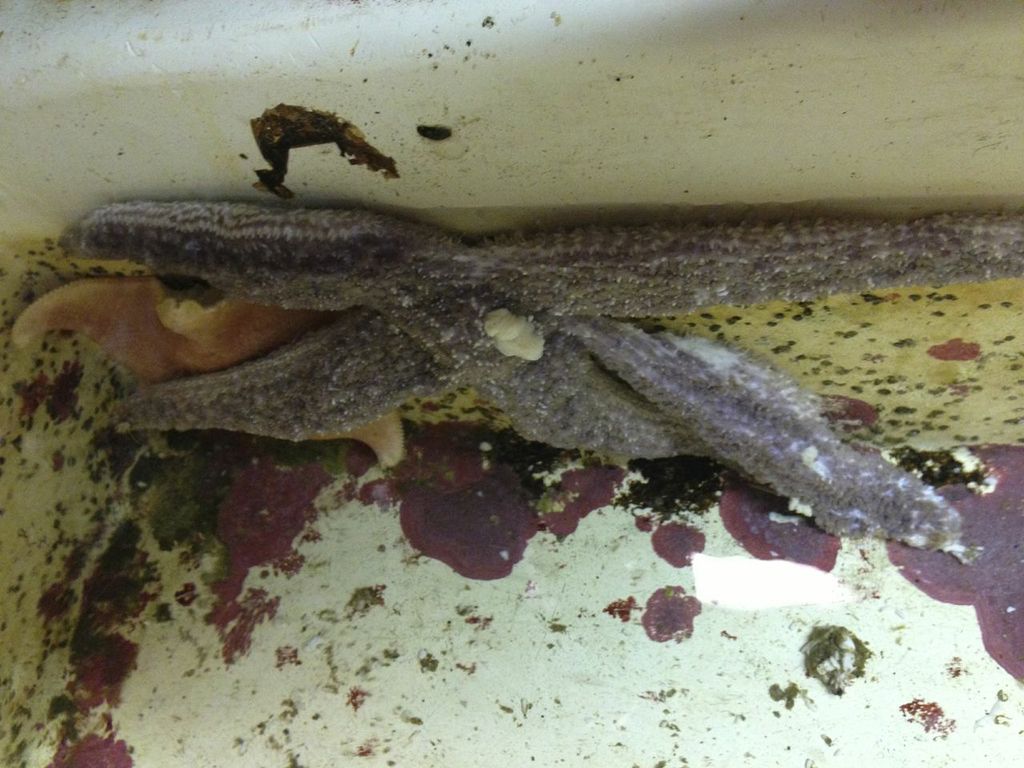
P1050360
Image by Jon Martin
UPDATE: You can upload new pics of starfish wasting disease to this website (iNaturalist). Help track its progression!

Since I originally reported on the big Pycnopodia starfish die off in British Columbia, I've gone on to invoke Starfish Wasting disease which has led to much discussion and reporting of the issue all along the west coast of North America, including concerns invoking the die off of the east coast starfish Asterias, which is closely related.
Meeting of the seastars
Image by Jeff Goddard
New developments since I last wrote:

The disease (?) occurrence in British Columbia seems to be reported now from several places:
Whytecliff Park (video here),
Kelvin Grove (video here),
Howe Sound (account at Aquablog) ,
Croker Island, Sechelt Inlet and ... (I will continue to update).(thanks to Jon Martin, Neil McDaniel and others for their pics and records)

Could Wasting disease also be headed for Washington? (via KUOW.org)

The number of taxa seems to be broadening but is most acutely observed in Pycnopodia. But other accounts in BC waters have been seen in Mediaster, Dermasterias, and Solaster.
P1050449
image by Jon Martin
Other places starfish wasting disease is observed (e.g., California) it seems to be more focused on asteriids, such as Pisaster. An excellent summary of what the disease in California looks like can be found HERE.

Why Should We care? 
With all the media picking up the story and carrying it around to multiple outlets, at some point someone will get beyond the "weird news" twist that has been put on the articles and ask "So What?" Here are 5 reasons I think understanding why this die-off MUST be studied.

1. An Endemic Starfish Fauna.  
     A few years ago I wrote about the phylogenetic (aka the family tree) of forcipulate starfishes. The blog I wrote about it was here (w/paper cited within)

Basically, one of the important facts was that all of the asteriid starfishes in this area, including Pycnopodia (the sunflower starfish), Pisaster (the ochre star), Evasterias, Leptasterias, etc. on the Pacific coast of North America are ENDEMIC TO THE COAST.

That means, you could see a starfish which resembles Pycnopodia in Australia or Mexico and it will have LESS relationship to Pycnopodia than Pycnopodia has to Pisaster!

Bottom line: You won't find these starfish species anywhere else in the world. These animals are an important part of the marine ecology of the Pacific coast of North America.


2. Aesthetic & Cultural History
Ed Ricketts, 1937
Image by sjonnie van der kist
“What do they find to study?” Hazel continued. “They’re just starfish. There’s millions of ’em around. I could get you a million of ’em.”
“They’re complicated and interesting animals,” Doc said a little defensively.
The starfish on the west coast of North America have become iconic. Pisaster ochraceus, aka the Ochre Star is THE model for the Keystone Species in Ecology.  The starfish of the west coast were in John Steinbeck's famous novel Cannery Row as part of the rich career of Ed "Doc" Ricketts:
What if there weren't a million of em any more?  More on this below under #5-ecological impacts. These are animals which have become part of our culture. Conservation of these species is important.

Montastraea Cavernosa With Active Black Band Infection
Image by CIOERT
3. We don't know what causes it. At the moment, there are a bunch of ideas. Bacteria. Virus. Some
kind of microbe?  But as we see in Coral bleaching diseases, microbes are present.
They might be the cause OR they might be the RESULT of some shift in their surroundings? such as temperature or overall water quality. Sea stars DO have a natural microbial fauna (here) What if that fauna/flora goes bad because of changes in some greater part of their environment?

If this isn't a communicable disease per se but is instead more of a series of symptoms related to poor or changing environmental factors, which activates/corrupts/modifies that fauna, THAT could be a concern which leads us to our next point...


4. Canary in a Coal Mine- Global Warming? I think the thing that always concerns me about this whole thing is whether this whole phenomena-the die offs in British Columbia, the wasting disease observations in California and elsewhere - are all tied to a particular environmental change. I have written about echinoderms as the "canary in the coal mine" animals before..but for specific environments such as Antarctica. What if something is happening and this is an early warning that we aren't picking up on?

The original paper by Amanda Bates (here) observed that wasting disease seemed to be most acute when it was warmer.  What happens if Starfish Wasting Disease takes on the scale of the various coral wasting diseases?  Vigilance and data are an ongoing concern....

5. Widespread Ecological Impact. Here's the million dollar issue.. What happens if diseases change abundance or remove these species from their habitats? WHAT HAPPENS? What COULD happen?
Sea Stars
Image by Phil Williamson
Sunflower Star at Rest
Image by Daniel Johnson
The thing is, that BOTH of these species occupy important ecological positions. As mentioned earlier, Pisaster is a keystone species. The presence or absence of a keystone species in an ecosystem can dramatically change the interactions of that ecosystem. 

For example, Ochre stars (Pisaster ochraceus) removed from the intertidal would likely result in a significant overgrowth of mussels and other invertebrates which ochre stars typically feed upon. Mussels might come to dominate an ecosystem and prevent other animals from inhabiting that area. There could be a cascade of other consequences of course...

Similarly, Pycnopodia is a dominant predator of MANY other invertebrates species, sea urchins, abalone, snails, clams, etc.

But MORE than that there could be an unpredictable cascade resulting from fluctuating populations of any of these taxa. An increase in sea urchins, resulting from an absent predatory starfish, for example might result in additional sea urchin "barrens" (as I've described here)

What is perhaps most concerning is how MANY starfish species seem to be affected. Many of their ecological roles are poorly understood but are likely to be important. The effect on the ecosystem is likely to be significant. 

Thanks to many discussions at Science Online Oceans this past weekend for discussions that inspired this post! 


Tuesday, September 10, 2013

Starfish Wasting Disease!


UPDATE: you can now upload YOUR pictures of starfish wasting disease. They are being tracked at this website (iNaturalist)

Last week I reported on an unusually large die-off of the North Pacific sunflower star, Pycnopodia helianthoides (among other starfish species) in the waters of British Columbia. The story even got picked up by National Geographic!
P1050360

This sparked some good academic discussion here which I can only hope will lead to some further insight into what is happening.  One useful thing which came up was the mention of something that would be a good follow up to last weeks' report:  Starfish Wasting Disease!

I have spoken of ciliate protist parasites in sea stars before but this is something different.

Details of the post today about Starfish wasting disease is based on this paper in the journal, Diseases of Aquatic Organisms from an article by Amanda Bates, Brett Hilton and Christopher Harley in 2009

Other information is from an account of starfish wasting disease in the Channel Islands by Ginny Eckert and colleagues. This paper is freely available here.

I should also mention that my friend and colleague Dr. Allison Gong has documented an outbreak of wasting disease in her water table at UC Santa Cruz. I've borrowed many of her pictures below. My thanks to her for allowing me to use them! 

What is Starfish Wasting Disease? 
Symptoms of the disease are relatively straightforward:
  1. White colored lesions appear and grow rapidly
  2. There is a loss of body pressure (i.e., turgor)
  3. Body disintegration and autotomy of arms, etc. 
  4. and finally death...
Bates nicely outlines the various stages of the disease in her paper focusing on Pisaster ochraceus, the ochre star.
Fig. 2 from Bates' et al. 2009
Allison Gong recently documented these symptoms in her blog

Lesions...


followed by decay and autotomy (i.e., arms begin to shed..)


The effects DO seem very similar to what happened with the Pycnopodia die-off
P1050330
fr. Jonathan Martin
But what actually causes the disease?? Sadly, we are just beginning to understand it and so we don't actually know WHAT the causative agent is.  Molecular tests for bacteria haven't confirmed anything.
Could it be a virus? A fungus? Some strange combination thereof?

Its also unclear if it is the SAME agent at work in EVERY case. Different species? Different strains? Different diseases?

The symptoms of the disease have been documented widely: on the west coast of North America. From British Columbia down to the Gulf of California. But also in the Mediterranean and the North Atlantic coast of North America.

Nothing yet from the Southern Hemisphere.. Australia, New Zealand, etc.

What Species Does It Affect?
Wasting disease appears to be pretty widespread across MANY starfish groups. 

The symptoms of the disease have been observed as early as 1972 from the east coast of North America in the "common" starfish Asterias vulgaris (now called Asterias rubens, pic on the left)

In 1982, there was a mass die-off of Heliaster kubiniji in the Gulf of California, which was so severe that it led to local extinction in several areas where it had once been abundant. (Image of Asterias by "misenus1", Image of Heliaster by manzanita-pct)
Northern Sea Star, Asterias vulgarisGulf Sunflower Star

Eckert's account in the Channel Islands however, documents the widest spread where it was recorded affecting TEN species of most commonly occurring sea stars! Not to mention three sea urchins, two brittle stars, and one species of sea cucumber!

Disease outbreaks in these species resulted in die-offs and significant population declines.

In our recent example with Pycnopodia, which looks very much like wasting disease, we saw not just Pycnopodia, but also the sun star- Solaster dawsoni..(pics by Jonathan Martin)
P1050397P1050395

Solaster dawsoni feeds on sunflower stars..

Similarly, Allison observed the bat stars, Patiria miniata feeding on decaying Pisaster ochraceus. Can the disease be conveyed as food? Will we start to see greater spread? 

But again, we don't know the actual agent of wasting disease. The symptoms might be something that happens in parallel as a result of several different agents.

Temperature! The Key to Wasting Disease
Eckert's paper speculated that warmer waters in the Southern California region accompanied the onset of wasting disease in the species they studied.

Amanda Bates & her team study studied Pisaster ochraceus in British Columbia and studied several variables and how they affected the disease. 


Indeed, temperature turns out to be a very important factor in the spread of starfish wasting disease! 

The graph below shows that the prevalence of the disease in starfish under experimental conditions is significantly higher under warmer conditions. This was also reflected by observations in the wild as they saw higher incidence of disease in the summer (June) than in August.
Figure 3 from Bates et al. 2009
One final and important observation that Bates and her team recorded was that the disease prevalence was higher in a protected inlet (GM=Grappler Mouth) versus an open wave-swept area (SB=Scott's Bay). 

This highlights another aspect: What aspect of starfish in the protected inlet vs. the open area to the higher infection rate? 
  • Wave action? (and thus more current and temperature circulation)
  • Freshwater input? resulting in higher vulnerability? (starfish don't tolerate freshwater very easily) Sewage? 
Aquaria, it was observed, also tended to show higher incidences of infection. 

So, it appears there seems to be a good correlation with wasting disease prevalence and infection strength with higher temperature. Also being exposed to open ocean conditions vs. more enclosed conditions..

Starfish Wasting Disease in the Big Picture

1. Global Warming. If this disease and the ciliate castration parasite are both temperature dependent and we are seeing an across-the-board increase in ocean temperature, this could have significant or even profound effects on populations.  

Higher rates of diseases and greater vulnerability to diseases affecting not just sea stars, but urchins, and other echinoderms could seriously impact populations of these species. 

2. Impact? Many if not all of these sea star species (to say nothing of the other possible echinoderms that could be affected) are what's called keystone species, that is, in an ecosystem their presence (or absence) represents a profound effect on many other species. 

Ochre stars for example affect mussels and other animals in marine ecosystems that cover rocky intertidal bottoms. Sunflower stars are a major predator of everything from snails to sea urchins, and sometimes other starfishes. 

Diseases like this can decimate or remove these ecologically important species resulting in unforseen results! Just consider this case about abalone and otters as one example..

Saturday, December 20, 2008

Pt.1: The Echinoderm Xmas Hall of Shame

Holiday Greetings!
I thought I would introduce a new theme every winter/holiday season and find the tackiest, silliest and most awful Xmas or holiday ornaments made OUT of dried echinoderms that I could find....

Hopefully to DISCOURAGE their use or at least to shame the people who make these things..because frankly dressing up dead corpses is kind of macabre AND tacky.

Let us not remember that asteroid tests are actually more like MUMMIES (skin covers the surface). They are NOT shells.

So when you see something like this:

If it were human it would REALLY be something like this:

So, this year, I was able to find these lovely jewels....

1. Protoreaster nodosus (Oreasteridae):

Dead Santa Version:
Living Animal:2. Pentaster tyloderma (Oreasteridae)

Dead Santa Version:

Living Animal:3. Linckia laevigata (Ophidiasteridae)

Dead Santa Version:
Living Animal:4. Asterias forbesi (Asteriidae) made into..Santa and his Reindeer..I guess?

Dead Santa Version:

Living Animal:
5. Pisaster ochraceus (Asteriidae)

Dead Sant....maybe not...uh...I guess an homage to the Mele Kalikimaka song??
Living Animals:On Wed....Pt. 2-The Sea Urchin Hall of Shame!