Showing posts with label what good are echinoderms?. Show all posts

Wednesday, June 15, 2016

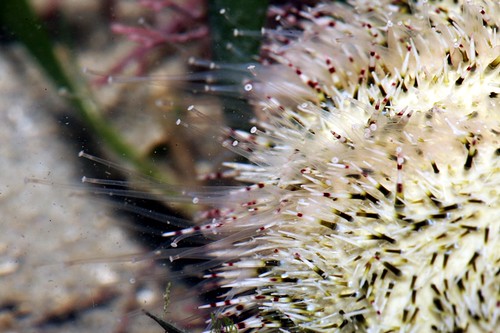
Sea Urchin Biomimicry! Echinoids Inspiring Applications from knives to glue!

Tiny teeth
Its been awhile since i've done a "What have we learned from Echinoderms?" type post.. So, this week a news round up about the utility of sea urchins and their inspired applications!

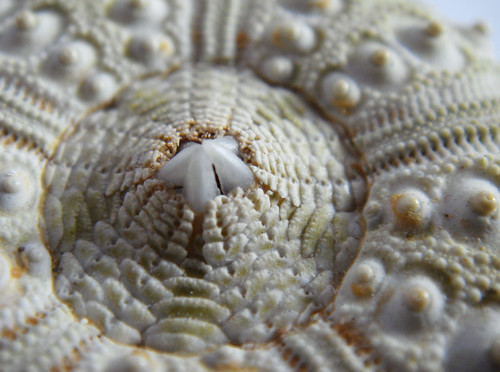
Although I talk about several different inspriations, two of the stories below focus is the elaborate jaw mechanism in sea urchins known as Aristotle's Lantern! A nice basic definition can be found at the Echinoid page on The Natural History Museum in London (here). 

Aristotle's Lantern is this weird yellow piece in the picture below. These sit over the mouth opening and the "teeth" or jaws of the sea urchin emerge through the bottom..

This illustration gives you an idea of the orientation
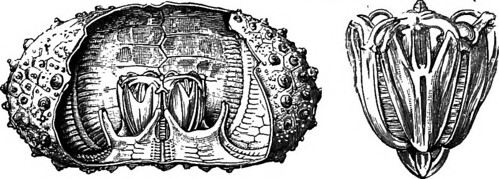
Image from page 201 of "Elementary text-book of zoology" (1902)

And here's a video that allows you to see the teeth emerging through the oral opening and back again. 
Urchins use these teeth to rasp algae and other food off the substrate. They are quite effective when one considers just how much algae a sea urchin eats!

ALL of the stories below are part of a field known as biomimicry!

Basically, taking the idea/engineering from ACTUAL biological structures that have demonstrated effectiveness and reverse-engineering them so that they can be used in industrial or other applications!! Urchins have been quite the inspriation of late! Here's a round up of some of the recent and more interesting ones!

1. Self Sharpening Blades/Knives! 
Based on this account in Advanced Functional Materials and a summary in National Geographic (here) sea urchin teeth were studied with x-rays and determined to occur in separate layers with different structural textures which are interlaced between softer organic layers.                                       
One of the textural layers breaks very easily but is also replaced very easily. These areas get "torn away" whenever the teeth on sea urchin jaws are used.. but are also replaced quite quickly! 

Thus, functionally, the teeth grow continuously and are thus CONSTANTLY being rejuvenated and are essentially always sharp! 


2. Sea Urchin Jaws Inspire Space Exploration??

You can also just watch this video account of the whole thing...

Here's an Italian "bionic model" of how the Aristotle's Lantern jaw might work.. Kind of similar to the way a claw in one of those arcade "grab claw" games works! 


3. Architecture: Urchin Test Shape distributes Stress! 
Its been commented upon at sites such as these that the "oblate" shape of sea urchin skeletons (i.e., the test) is very effective at distributing stress evenly over the surface. Thus, the shape of urchin skeletons might actually be useful for inspiring better shapes in building! 
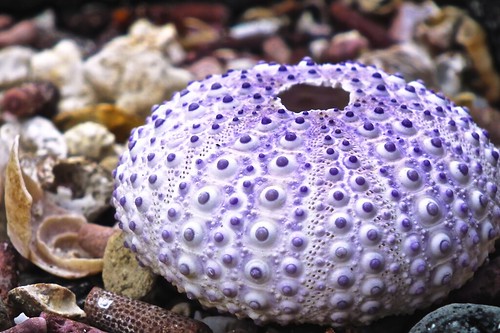
urchin test
...and then of course, there's the TARDIS in Doctor Who! 


4. Sea Urchin Spines Inspire Idea for Concrete! 
A paper by Seto et al in PNAS from 2012 studied the physical structure of sea urchin spines and discovered that they were composed of crystals that were bound together with a second type of calcium carbonate, acting as sort of a mortar, but with no crystal structure. These give the spines a highly resistant texture that suggest a better way to make fracture resistant materials.  A summary of this was in this BBC story.  and yet even more can be found on this blog about Mesocrystals and concrete! 
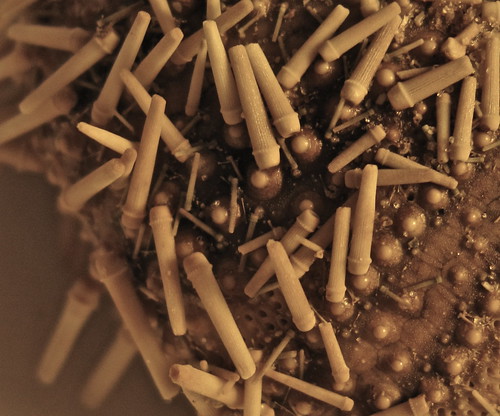
Sea Urchin spines
5. Adhesives!
Amazing sea urchin tube feet

Instead of "suction" as had been believed for decades, it turns out that urchin tube feet work on a chemical adhesive basis! In other words,, they STICK instead of SUCK!  You can go through a brief summary of these details here. 

These provide a lot of potential for marine adhesives if the means of adhesion can be understood and "reverse-engineered"!

Other posts in the "What good are echinoderms" series to be found HERE   
and here

Tuesday, March 27, 2012

What Good Are Echinoderms? Pt. 2! Biotechnology!

Every few years, I get this REALLY annoying question in one form or another...
"Other than evolution, ecology, paleontology, genetics, and marine biology, echinoderms aren't really good for anything are they?"
*sigh* Several years ago, I wrote up something that answered the question "Echinoderms... So, what good are they??"

Its been a few years and the question has once again reared its ugly head. Plus, its always good to re-visit the directions that research may take you..

And so I thought I would present how echinoderms have found their way into several important uses/functions in the rapidly growing field of biotechnology!

And on this post, we don't even TOUCH on all of the ways that echinoderms have been used in Biomimicry! (we'll save that for another post!)

Information below was inspired by two papers! This one by C. Petzelt (Are Echinoderms of Interest to Biotechnology?) which you can find on Google books here. and this paper by Micael et al. (2009) on Exploitation and Conservation of Echinoderms.


1. Sources of Anti-Cancer drugs
There is currently a substantial effort to discover marine biodiversity that may serve as sources for anti-cancer, anti-AIDS and other disease resistant medicines.

There are big research programs, such as the one that was underway at the Coral Reef Research Foundation in Palau (in conjunction with the National Cancer Institute) to discover potentially important materials throughout tropical coral reefs and many other places throughout the world.

One report from Mutee et al. published this year in the African Journal of Pharmacy and Pharmacology claims to have found a valuable anti-cancer agent in what has been a reviled pest and predator of coral... Acanthaster planci the Crown of Thorns Starfish!
(A. planci image from Wikipedia)
Mutee and colleagues have found that an extract from the Crown of Thorns starfish inhibited cell growth and induced "cell death" (called apoptosis) in a breast cancer cell line. Apparently, this cell death effect was more potent and faster than the one created by tamoxifen (another well known anti-cancer agent).

The authors hope that "...A. planci starfish extract may be utilized as a potential chemotherapeutic agents in the treatment of human breast cancer." It would be an interesting turn of events given Acanthaster's long history as a coral reef predator and "villain"...

2. Sources of anti-bacterial drugs.
A 2002 paper in the Journal of Invertebrate Pathology by Haug et al. studied 3 different echinoderms from Norwegian waters for antibacterial properties! the sea cucumber Cucumaria frondosa..
Image from SERPENT Media via the Encyclopedia of Life!

and the green sea urchin, Strongylocentrotus droebachiensis..

Haug and his team found that extracts from all 3 of these species made from the body wall and in the body cavity fluid, as well as eggs and gastrointestinal organs that all showed some antibacterial activity.

These weren't the first echinoderms to show antibacterial activity..with prior accounts showing brittle stars and sea cucumbers all displaying potential.

Haug and other studies found that many echinoderms display very effective lysozyme activity. Lysozymes are special enzymes that attack the cell walls of bacteria. Naturally occurring lysozymes might play a role in the defensive responses of different species.

Compounds within also showed the potential for hemolytic compounds which might be useful as blood thinning agents.
Ultimately, there was a great potential for all of these -but especially the antibacterial compounds that, upon further refinement and purification might lead to potentially "novel antibiotics"!

3. Anti-Fouling Chemicals.

Have you ever noticed how starfish and other echinoderms can just kinda sit there-but NOTHING GROWS ON THEM??

You don't ever see algae, barnacles, sponges, or any other kind of "fouling" organisms that settle out and instantly begin colonizing bottom substrates.

Well, it turns out there's a bunch of people who got interested in that question.. and a few studies by Jana Guenther and colleagues. (It should be noted that there were several other studies before Guenther as well..)

Many of their papers such as this one and this one have shown that chemicals produced by some sea stars may be one reason. Some of their study animals included the common "Blue Linckia" aka Linckia laevigata found throughout the Indo-Pacific.
linckia_laevigata.jpg
Photo by Tim Hochgrebe via Flickr
The very attractive Fromia indica....
Indian Sea Star
And the so-called "fake Astropecten" Archaster typicus which occurs throughout the Indo-Pacific.
Common sea stars (Archaster typicus)

Photo by Wild Singapore

Guenther found from experiments that several chemicals, including hexadecanoic acid, cholesterol, lathosterol, and sitosterol were all extracted from individuals and used to prevent the settlement of diatoms on the sea star surfaces.

These then have the potential to be used as possible treatments to prevent "fouling" on ships and ports. But again, work that requires further purification and experimentations...


4. Bionics! 
The crystal "eyes" of Brittle Stars! This is actually an older discovery from a paper in Nature from 2001! (which you can read by clicking here).
(from the NMNH collection via EOL)
Brittle stars, as it turns out have tiny calcite lenses that are present all over the surface of the disk! They look like this...
(photo by Joanna Aizenberg from Wyss Institute, Harvard)

Aizenberg and her colleagues found that thousands of these lenses form a compound eye that covers the surface of the animal, resulting in "a functon similar to a digital camera that builds up the picture pixel by pixel".

This is apparently the inspiration for engineers in the "photonic industry" who have been trying to imitate these lenses for general use...

5. And there's many more...
I was actually able to stumble upon several more but none were worthy of a separate account so here's a short summary...
Note that ALL of these applications had their roots in more fundamental parts of biology-ecology, evolution and systematics. Some of these bioactive compounds are used in defense. Or are part of the animal's own immune system.

I would advise never to lose sight of the fact that "useful" science originates from more fundamental questions about the animal that started with the far more important interrogative

"Hmm..that's interesting..."