Showing posts with label Aristotle's lantern. Show all posts

Wednesday, June 15, 2016

Sea Urchin Biomimicry! Echinoids Inspiring Applications from knives to glue!

Tiny teeth
Its been awhile since i've done a "What have we learned from Echinoderms?" type post.. So, this week a news round up about the utility of sea urchins and their inspired applications!

Although I talk about several different inspriations, two of the stories below focus is the elaborate jaw mechanism in sea urchins known as Aristotle's Lantern! A nice basic definition can be found at the Echinoid page on The Natural History Museum in London (here). 

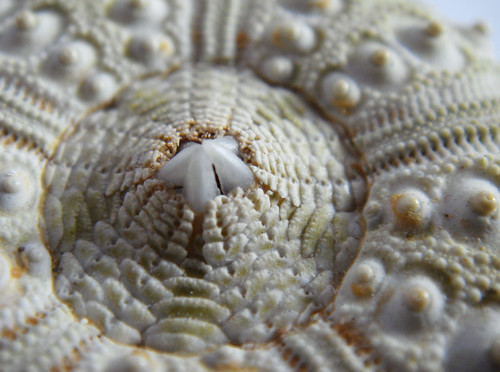
Aristotle's Lantern is this weird yellow piece in the picture below. These sit over the mouth opening and the "teeth" or jaws of the sea urchin emerge through the bottom..

This illustration gives you an idea of the orientation
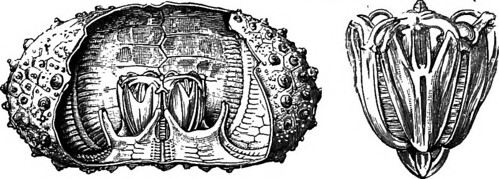
Image from page 201 of "Elementary text-book of zoology" (1902)

And here's a video that allows you to see the teeth emerging through the oral opening and back again. 
Urchins use these teeth to rasp algae and other food off the substrate. They are quite effective when one considers just how much algae a sea urchin eats!

ALL of the stories below are part of a field known as biomimicry!

Basically, taking the idea/engineering from ACTUAL biological structures that have demonstrated effectiveness and reverse-engineering them so that they can be used in industrial or other applications!! Urchins have been quite the inspriation of late! Here's a round up of some of the recent and more interesting ones!

1. Self Sharpening Blades/Knives! 
Based on this account in Advanced Functional Materials and a summary in National Geographic (here) sea urchin teeth were studied with x-rays and determined to occur in separate layers with different structural textures which are interlaced between softer organic layers.                                       
One of the textural layers breaks very easily but is also replaced very easily. These areas get "torn away" whenever the teeth on sea urchin jaws are used.. but are also replaced quite quickly! 

Thus, functionally, the teeth grow continuously and are thus CONSTANTLY being rejuvenated and are essentially always sharp! 


2. Sea Urchin Jaws Inspire Space Exploration??

You can also just watch this video account of the whole thing...

Here's an Italian "bionic model" of how the Aristotle's Lantern jaw might work.. Kind of similar to the way a claw in one of those arcade "grab claw" games works! 


3. Architecture: Urchin Test Shape distributes Stress! 
Its been commented upon at sites such as these that the "oblate" shape of sea urchin skeletons (i.e., the test) is very effective at distributing stress evenly over the surface. Thus, the shape of urchin skeletons might actually be useful for inspiring better shapes in building! 
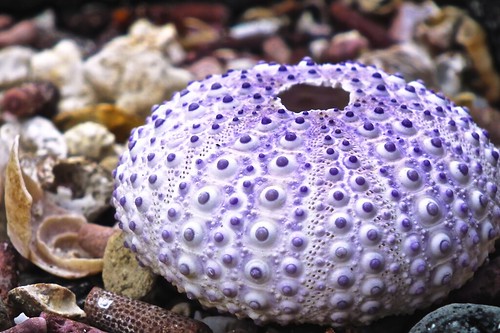
urchin test
...and then of course, there's the TARDIS in Doctor Who! 


4. Sea Urchin Spines Inspire Idea for Concrete! 
A paper by Seto et al in PNAS from 2012 studied the physical structure of sea urchin spines and discovered that they were composed of crystals that were bound together with a second type of calcium carbonate, acting as sort of a mortar, but with no crystal structure. These give the spines a highly resistant texture that suggest a better way to make fracture resistant materials.  A summary of this was in this BBC story.  and yet even more can be found on this blog about Mesocrystals and concrete! 
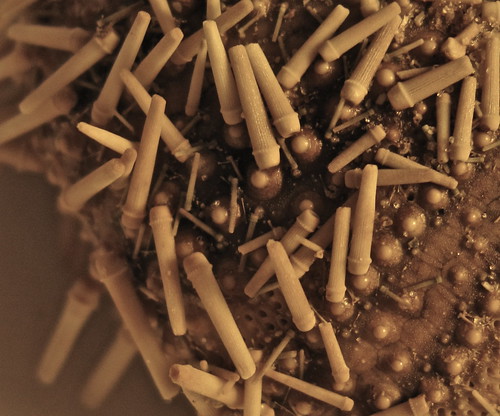
Sea Urchin spines
5. Adhesives!
Amazing sea urchin tube feet

Instead of "suction" as had been believed for decades, it turns out that urchin tube feet work on a chemical adhesive basis! In other words,, they STICK instead of SUCK!  You can go through a brief summary of these details here. 

These provide a lot of potential for marine adhesives if the means of adhesion can be understood and "reverse-engineered"!

Other posts in the "What good are echinoderms" series to be found HERE   
and here

Tuesday, July 9, 2013

What (and How) do Sea Urchins Eat? Sea Urchin Feeding Roundup!

from Wikipedia!
SEA URCHINS! Who doesn't love em? The spiny balls of the sea! We eat em! They're important to marine ecosystems all around the world! They're often visually stunning and they do all sorts of neat and wacky things!

But sometimes I get ahead of myself and forget the basics! Basic questions that everyone has aren't often obvious and so this week a quick summary overview:  What and How do sea urchins eat???

Urchins feed primarily with a unique jaw-like structure known as Aristotle's lantern. It looks like this in most urchins but is modified in so-called "Irregular" urchins such as sand dollars, sea biscuits and etc. A bit about this here.
Here is the jaw in action, with the tips being extended from the mouth as the animal rasps away on the bottom it lives on...

Believe it or not. Sea urchins have among the most diverse feeding modes within the Echinodermata. Here is a roundup... COUNTING DOWN!

5. Herbivores and Grazing
This is the one everybody knows about and the feeding mode with which most people are most familiar. Many sea urchins prefer kelp and various other seaweeds and marine "plants." There are several species found in cold-temperate water habitats.. California, New Zealand, Chile.. to name a few, and all these places have sea urchin species in abundance.

Here is the famous purple sea urchin, Strongylocentrotus purpuratus engaged in some kelp feeding!

Urchins and Kelp
Image by Todd Jackowski
Urchins are ecologically important in kelp forests. Removal of predators (and control of the population) can lead to a circumstance known as "urchin barrens" where sea urchin abundance goes out of control. In those circumstances, even sea urchin poop can become a serious consideration (here)

Here is a nice Shape of Life video that shows feeding by the Purple sea urchin Strongylocentrotus purpuratus.
Echinoderms: Urchin Time-lapse: Eating Kelp from Shape of Life on Vimeo.
Note that while many sea urchins feed primarily on kelp, they are not obligated to do so.  Their diet permits them some nutritional flexibility.....

4. Omnivory and Scavenging

Most people (even several biologists) don't realize that sea urchins can be pretty flexible in their diet. If kelp isn't available, they will obtain whatever nutrition happens to be available.

Some large examples of food here, but feeding also includes microalgae (such as diatoms), encrusting algae, moss animals (i.e. bryozoans) and etc.

Here we have what Strongylocentrotus spp. in the Arctic or sub Arctic feeding on what looks like a wayward or moribund jellyfish..
Sea urchins feeding on Cross jellyfish
Image by Alexander Semenov
And in the tropical Indo-Pacific (Lembeh, Indonesia), Astropyga radiata is feeding on some nice dead fish (and who doesn't like a nice dead fish every so often?)
Radial Sea Urchin feeding on dead fish - Lembeh
Image by Christian Loader
Up until recently though, feeding in sea urchins has been thought to be relatively passive and opportunistic.  Whatever comes along is good to go!

Most people don't think of sea urchins as aggressively chasing down and pursuing ACTIVE prey...
This notion was recently shown to be incorrect...

3. Predation
Probably one of the most dramatic deep-sea/paleontology events in the last few years was the discovery that, not only could stalked crinoids (echinoderms with a ring of feeding tentacles and a stalk) crawl BUT they did so with some urgency!


It turns out that they were running from Cidaroid SEA URCHINS. I've written up these papers here.
Calocidaris -a cidaroid urchin. Image by D. Pawson
This predatory act was observed on video between shallow water species. Here is a shallow water cidaroid urchin attacking a feather star...

WARNING! Those who do not wish to watch crinoids being brutalized and devoured should avert their eyes!


Further evidence on deep-sea crinoid skeletal pieces is here. That notch is a scar left over from where an Aristotle's Lantern has gotten to this animal...
Urchin bite on a crinoid stem by T. Baumiller
There have also been recent accounts that leaving sea urchins in large numbers under artificial circumstances (sea urchin farms) leads to cannibalism! (here)  Sea Urchins eating OTHER Sea Urchins!!

2. Deposit Feeding/Sediment Feeding
Whew! That was quite a violent section for sea urchins, wasn't it???  Let's go to something a bit more majestic!

One of the NEATEST stories in sea urchin evolution is how a major sub group, the "irregularia" aka the sand dollars, sea biscuits, and spatangoid  ('heart urchins') sea urchins all evolved from a more open lifestyle with the feeding modes shown above (herbivory, predation, omnivory) to a specialized series of body forms that involve plowing through sediment/mud/sand in order to obtain food. Deposit or sediment feeding.  A more involved post of this story can be found in this post.

Feeding in these animals is intrinsically connected with their life mode and body shape. Here are some videos that show some of these animals plowing through sand...sometimes just to get around but maybe also to feed?

Japanese sand dollar plowing through sand...but check out the food going to the mouth at 1:05
.


Note all the spines moving through the sediment...


Again.. check out the spines!


1. Filter/Suspension Feeding
So, now that I just got done telling you that sand dollars and their relatives are deposit feeders.. I will immediately point out the exception!  Perhaps the most UNUSUAL feeding mode in sea urchins is filter feeding, i.e., obtaining food from water currents using some kind of sieve or screen.

Urchin morphology tends to be...counterproductive where this sort of feeding is concerned.. Except in TWO unusual examples.....

Dendraster excentricus-is the so-called "Eccentric Sand Dollar"which lives along the west coast of North America.  So named for the very erratic pattern of its feeding grooves on the oral surface.
sand dollar bed
Image by fiveinchpixie
sand dollars (dendraster excentricus)
Image by Peter_r
Note an oddity in its feeding posture.. these animals are tilted at an angle into the water current standing on its "side" in the sand. Other sand dollars such as the ones listed under #3 lie flat on the sandy bottom.

Dendraster uses its tube feet, pedicellariae and spines to pass along food caught from the water currents to the mouth.. More info on this species to be found here..  This is a pretty commonly encountered animal, but really when you look at them in this fashion, they are freaky deaky! 

Dermechinus horridus  So yes. Saved the BEST for last! 

Dermechinus horridus is a strange deep-sea sea urchin which has a body, literally shaped like a cactus, with sharp, needle-like spines to boot!  It is among the oddest of the sea urchins known.
Image by NIWA
But what's even more strange? Its been postulated that this species captures food from the water!! In other words...a suspension feeder! (I wrote this up here)


Here is some of the FIRST available video of this species in its natural habitat occurring next to brisingids, which are suspension feeding asteroids...


And although I don't wish to steal his thunder, let's just say that info from a recent International Echinoderm Conference presents some intriguing possibilities!
Image by NIWA
Spiny balls! Predators! Diggers! Eaters of Kelp and Purveyors of fine watery nutriton! Huzzah!


Wednesday, November 4, 2009

The TRUE (?) meaning of Aristotle's Lantern??

This week: fun ancient etymological mysteries!! Forget the true meaning of Christmas, What is the true meaning of Aristotle's Lantern???

Based on a recent paper (Cahiers de Biologie Marine 49: 299-302) by Eleni Voultsiadou and Chariton Chintiroglou at Aristotle University in Thessaloniki, Greece we have a new perspective on the roots of the special jaw apparatus found in sea urchins (see below).

A nice review of sea urchins and Aristotle's Lantern is found at Daily Kos.
So. All up to speed? Aristotle's Lantern. check. Sea Urchin jaw. check. Great!

What's next?
The "backstory" about this structure, of course, invokes the famous Greek scientist/ philosopher Aristotle who at some point apparently described this structure as a "lantern".
http://biomesblog.typepad.com/photos/uncategorized/aristotleslantern_1.jpg
At face value this seems reasonable enough and enough historians have seemingly verified the story over the years.... (or have they?)
But what if Aristotle did NOT, in fact, mean that the JAW was the "lantern"????

WHAT IF Aristotle's Lantern ACTUALLY referred to the WHOLE BODY (i.e., the test)?? And what we've been taught all along was actually wrong (or mistaken)??

Apparently there had been some historical ambiguities with the original translation.  From Aristotle's original History of Animals as such (boldface is mine):
In respect of its beginning and end the mouth (or body) of the urchin is continuous, though in respect of its superficial appearance it is not continuous, but similar to a lantern not having a surrounding skin.
This little section is apparently problematic for several reasons:
  • it is unclear whether the text refers to stoma, i.e. jaw apparatus or soma, i.e., body (hence drawing attention to the mouth vs. body)
  • the phrase "surrounding skin" and mention of continuity.
Although several scholars have since embarked upon a historical study of the etymological roots of Aristotle's Lantern (most of whom seemed to be happy with the "lantern" as the translation), no actual archeological evidence had actually been brought to bear on the question.
(An ancient "lamp" p.s. to paleontology students? this is where the phrase "lamp shell" for brachiopod comes from!)
The scholarship of Voultsiadou & Chintiroglou have discovered that ancient Greek lamps (circa 5th to 9th c. BC) (i.e., the light source, usually candle or oil lamp) were placed inside lanterns, which were usually translucent skins or perforated ceramic or bronze, to protect the light source from the wind. Thus preventing them from blowing out.

Thus, an ACTUAL lantern from Aristotle's time, looks like this (remember the lamp or light source goes inside):
(A Vergina lantern from the tomb of King Philip II, dated to the 4th Century BC in Northern Greece)

Now, compare and contrast with the MODERN version of a lantern!
(with a "lamp" inside)

(I wish I was kidding about this-but isn't it awesome?)

They proceed to outline how all of the additional incongruities of the original passage can explained based on the assumption that Aristotle was comparing the sea urchin test with a bronze lantern, distinguishing it from those ancient lanterns which were made of skin or other soft material.

Thus, they propose that the "test of the sea urchin and NOT the jaw apparatus should be called 'Aristotle's Lantern'."