Showing posts with label deposit feeding. Show all posts

Tuesday, July 9, 2013

What (and How) do Sea Urchins Eat? Sea Urchin Feeding Roundup!

from Wikipedia!
SEA URCHINS! Who doesn't love em? The spiny balls of the sea! We eat em! They're important to marine ecosystems all around the world! They're often visually stunning and they do all sorts of neat and wacky things!

But sometimes I get ahead of myself and forget the basics! Basic questions that everyone has aren't often obvious and so this week a quick summary overview:  What and How do sea urchins eat???

Urchins feed primarily with a unique jaw-like structure known as Aristotle's lantern. It looks like this in most urchins but is modified in so-called "Irregular" urchins such as sand dollars, sea biscuits and etc. A bit about this here.
Here is the jaw in action, with the tips being extended from the mouth as the animal rasps away on the bottom it lives on...

Believe it or not. Sea urchins have among the most diverse feeding modes within the Echinodermata. Here is a roundup... COUNTING DOWN!

5. Herbivores and Grazing
This is the one everybody knows about and the feeding mode with which most people are most familiar. Many sea urchins prefer kelp and various other seaweeds and marine "plants." There are several species found in cold-temperate water habitats.. California, New Zealand, Chile.. to name a few, and all these places have sea urchin species in abundance.

Here is the famous purple sea urchin, Strongylocentrotus purpuratus engaged in some kelp feeding!

Urchins and Kelp
Image by Todd Jackowski
Urchins are ecologically important in kelp forests. Removal of predators (and control of the population) can lead to a circumstance known as "urchin barrens" where sea urchin abundance goes out of control. In those circumstances, even sea urchin poop can become a serious consideration (here)

Here is a nice Shape of Life video that shows feeding by the Purple sea urchin Strongylocentrotus purpuratus.
Echinoderms: Urchin Time-lapse: Eating Kelp from Shape of Life on Vimeo.
Note that while many sea urchins feed primarily on kelp, they are not obligated to do so.  Their diet permits them some nutritional flexibility.....

4. Omnivory and Scavenging

Most people (even several biologists) don't realize that sea urchins can be pretty flexible in their diet. If kelp isn't available, they will obtain whatever nutrition happens to be available.

Some large examples of food here, but feeding also includes microalgae (such as diatoms), encrusting algae, moss animals (i.e. bryozoans) and etc.

Here we have what Strongylocentrotus spp. in the Arctic or sub Arctic feeding on what looks like a wayward or moribund jellyfish..
Sea urchins feeding on Cross jellyfish
Image by Alexander Semenov
And in the tropical Indo-Pacific (Lembeh, Indonesia), Astropyga radiata is feeding on some nice dead fish (and who doesn't like a nice dead fish every so often?)
Radial Sea Urchin feeding on dead fish - Lembeh
Image by Christian Loader
Up until recently though, feeding in sea urchins has been thought to be relatively passive and opportunistic.  Whatever comes along is good to go!

Most people don't think of sea urchins as aggressively chasing down and pursuing ACTIVE prey...
This notion was recently shown to be incorrect...

3. Predation
Probably one of the most dramatic deep-sea/paleontology events in the last few years was the discovery that, not only could stalked crinoids (echinoderms with a ring of feeding tentacles and a stalk) crawl BUT they did so with some urgency!


It turns out that they were running from Cidaroid SEA URCHINS. I've written up these papers here.
Calocidaris -a cidaroid urchin. Image by D. Pawson
This predatory act was observed on video between shallow water species. Here is a shallow water cidaroid urchin attacking a feather star...

WARNING! Those who do not wish to watch crinoids being brutalized and devoured should avert their eyes!


Further evidence on deep-sea crinoid skeletal pieces is here. That notch is a scar left over from where an Aristotle's Lantern has gotten to this animal...
Urchin bite on a crinoid stem by T. Baumiller
There have also been recent accounts that leaving sea urchins in large numbers under artificial circumstances (sea urchin farms) leads to cannibalism! (here)  Sea Urchins eating OTHER Sea Urchins!!

2. Deposit Feeding/Sediment Feeding
Whew! That was quite a violent section for sea urchins, wasn't it???  Let's go to something a bit more majestic!

One of the NEATEST stories in sea urchin evolution is how a major sub group, the "irregularia" aka the sand dollars, sea biscuits, and spatangoid  ('heart urchins') sea urchins all evolved from a more open lifestyle with the feeding modes shown above (herbivory, predation, omnivory) to a specialized series of body forms that involve plowing through sediment/mud/sand in order to obtain food. Deposit or sediment feeding.  A more involved post of this story can be found in this post.

Feeding in these animals is intrinsically connected with their life mode and body shape. Here are some videos that show some of these animals plowing through sand...sometimes just to get around but maybe also to feed?

Japanese sand dollar plowing through sand...but check out the food going to the mouth at 1:05
.


Note all the spines moving through the sediment...


Again.. check out the spines!


1. Filter/Suspension Feeding
So, now that I just got done telling you that sand dollars and their relatives are deposit feeders.. I will immediately point out the exception!  Perhaps the most UNUSUAL feeding mode in sea urchins is filter feeding, i.e., obtaining food from water currents using some kind of sieve or screen.

Urchin morphology tends to be...counterproductive where this sort of feeding is concerned.. Except in TWO unusual examples.....

Dendraster excentricus-is the so-called "Eccentric Sand Dollar"which lives along the west coast of North America.  So named for the very erratic pattern of its feeding grooves on the oral surface.
sand dollar bed
Image by fiveinchpixie
sand dollars (dendraster excentricus)
Image by Peter_r
Note an oddity in its feeding posture.. these animals are tilted at an angle into the water current standing on its "side" in the sand. Other sand dollars such as the ones listed under #3 lie flat on the sandy bottom.

Dendraster uses its tube feet, pedicellariae and spines to pass along food caught from the water currents to the mouth.. More info on this species to be found here..  This is a pretty commonly encountered animal, but really when you look at them in this fashion, they are freaky deaky! 

Dermechinus horridus  So yes. Saved the BEST for last! 

Dermechinus horridus is a strange deep-sea sea urchin which has a body, literally shaped like a cactus, with sharp, needle-like spines to boot!  It is among the oddest of the sea urchins known.
Image by NIWA
But what's even more strange? Its been postulated that this species captures food from the water!! In other words...a suspension feeder! (I wrote this up here)


Here is some of the FIRST available video of this species in its natural habitat occurring next to brisingids, which are suspension feeding asteroids...


And although I don't wish to steal his thunder, let's just say that info from a recent International Echinoderm Conference presents some intriguing possibilities!
Image by NIWA
Spiny balls! Predators! Diggers! Eaters of Kelp and Purveyors of fine watery nutriton! Huzzah!


Tuesday, October 25, 2011

Plumbing the Depths of Guts in Deep-Sea Sea Cucumbers!

(Deima validum from the ECOMAR site Photo by David Shale, 2010)
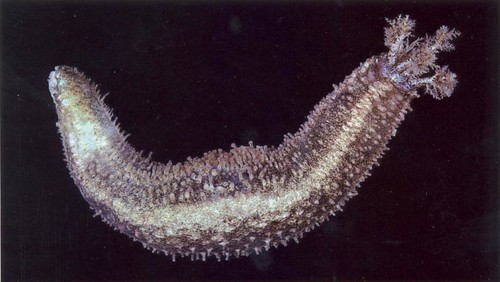
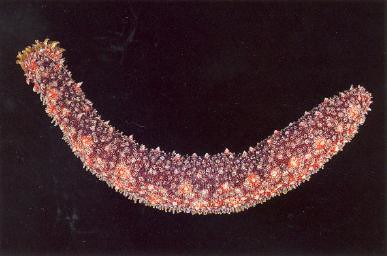
Deep-sea sea cucumbers (including sea pigs!) are weird, funky animals.

And yet for all of their bizarre appearance their fundamental appearance seems remarkably simple..

They troll around on the deep sea floor (and by deep-I mean the TRUE abyss over 1000 meters-and usually 2000 to 5000 meters deep!) rooting for food as these elasiopods are doing...


When biologists started seeing these bizarre animals-they also realized just how MANY of them seem to be present in any one spot.
Sometimes numbering in the 100s in quite a small area! And so naturally a LOT of important questions began popping up.
  • What are they eating exactly?
  • Is digestion part of what makes eating scum so good?
  • What down there is so dang nutritious-that it supports a kajillion deep sea cukes??
  • How can a place that seems wholly depauperate of plants, life and light be supporting SO MANY animals?
In addition to all of this, awhile back, I happened to get a classic question relating to sea pig biology- "Can I have one as a pet???" And the answer was "No." for various reasons. (click here to see that post).

But today I have yet one MORE reason why deep-sea sea cucumbers (including sea pigs) just won't make good pets! (and delve into the biology of these weird deep-sea animals!)

Data for this paper comes from two sources: A paper by Jody Deming and Rita Colwell (University of Maryland, 1982-go here to see it) and another by Teresa Amaro and others in Deep-Sea Research from 2009 (here to see it).

The paper by Deming and Colwell looked at the microbial floras of three genera of abyssal sea cucumbers sampled from the South Atlantic.....

the genus Deima
Psychropotes

and Pseudostichopus
(Pseudostichopus tuberosus from BOLD Systems Taxonomy Browser)

Deming & Colwell sampled the microbial faunas from the intestines of these various holothurian species, sampling different cultures from the gut (# 2) and parallel to stomach in humans) versus the hindgut (#3) (parallel to our long intestines)..Here's a nice image from Amaro et al that shows this...
Fig.2 from Amaro et al.
It turns out that microbes..specifically bacteria WERE present in the intestinal lining of these sea cucumbers! And in significant abundance!!

Here's what they looked like..
(Fig. 5. Transmission electron micograph of the bacteria in the intestinal lining)

These microbial floras were 1.5 to THREE times higher in sediments that had been recently ingested than those where present in the surrounding sediments.

The abundance of these microbes was HIGHEST in the hindgut..where digestion in the intestine occurs (again the equivalent of our long intestine).

But perhaps what was most significant was that these microbial populations were actually MORE ACTIVE under deep-sea pressure (about 400 atmospheres given that "home" pressure was from about 4000 meters!). "Pressure loving" bacteria are what's known as barophilic
(etymological note-that's "baros" for pressure-like in barometer and "philos" for attraction or lovin'...oh yeah...)

Dynamics of the bacterial/microbial community:

  1. Various trivia of sea cucumber digestion. By their estimates, it took about 16 HOURS for the organic materials in the sediment to be affected and cleared through the gut. This resulted in about 105 grams of sediment passing through one animal per day (which may not seem like much-but consider that its deep-sea mud and how many animals are in play)
  2. Commensal Flora? The authors argued that the bacteria assisted or was involved in digestion or in their terms..."transformation" of the organic materials present in the ingested sediments
  3. Food? They did not rule out the possibility that the bacteria were somehow directly involved in providing nutrients via the gut to the sea cucumbers.. perhaps as food? or perhaps contributing to the minerals or the energy of the sediment being digested??
At this juncture I can take a moment to further embellish the answer: Why would deep-sea sea cucumbers make lousy pets? Well, these things have a community of microbes that live in their intestine that they need to survive. And they are MOST successful at deep-sea pressure! (400 atm!)

So-food would likely have a lot of problems metabolizing in these beasts at the surface..assuming they could get the right kind of fine quality, organic scum to begin with!

Adding Further info with studies from MOLPADIA!!

A study that further added some understanding to our knowledge of these gut communities comes from a recent paper by Teresa Amaro and others in Deep-Sea Research from 2009 (here to see it).

Their study focused on the North Atlantic deep-sea sea cucumber Molpadia musculus which is just a lovely animal that is basically a big mud-eating yam-shaped bag..

Yes, I've seen them alive, they are THAT glamorous. Sometimes they are purple.
Amaro and her associates characterized the microbial community within Molpadia with DNA fingerprinting and discovered that in fact, these communities can be quite diverse, with many lineages of bacteria present...
But perhaps what is most interesting was their study that compared two populations of Molpadia-each population present in a different canyon. Each canyon with a different nutritonal setting!

How might these different food rich/poor settings affect the microbe fauna of each sea cucumber population??
The authors compared the bacterial communities present in a canyon with a sediment bottom that was rich in organic matter (i.e., food!) versus one which was poor in organic food.

They found that in the canyon with a rich sediment bottom with lots of yummy organic food, the Molpadia did not need to develop a specialized community of gut bacteria!

In contrast, the population of Molpadia present where the sediment was poorer DID have a more specialized community of bacteria.. Does this augment or provide further nutrients to the host cucumber?

So-getting back to some of the questions asked earlier.. these bacterial communites seem to be an important part of how these weird critters live their lives- as they trundle around on the sea bottom picking up delicious scum from the abyssal mud of the sea bottoms! Perhaps they carry it with them or perhaps they are feeding on them? Many questions remain!

It always seems kind of a funny contrast to me as I observe individuals become so paranoid about bacteria on door knobs and small microbes everywhere in the air.. that at 4000 to 5000 meters below the Earth's surface bacteria (yogurt?) are actually essential to this abundant form of weird life....

Monday, June 8, 2009

When Sea Cucumbers eat plastic-somethin's WRONG!

So, I'm running late on World Oceans Day..but its been a busy day..

I've brought attention to some of the effects of global warming recently on asteroids and others have written about ophiuroids but have not written much about the effects of pollution on echinoderms...
Today, I bring to your attention a new paper by Erin R. Graham (Saint Joseph's University) and Joseph T. Thompson (Franklin & Marshall College) in the 2009 Journal of Experimental Marine Biology and Ecology-"Deposit-and suspension-feeding sea cucumbers (Echinodermata) ingest plastic fragments".

The effects of this:
Plus this:
= trouble???

The authors of the study studied four subject species: Holothuria fieldana, H. grisea, Cucumaria frondosa and Thyonella gemmata in the lab and compared these results with data from three different field sites along the Atlantic coast.
Holothuria (Halodeima) grisea

They used these to study the experimental feeding rates/effects of small plastic bits as they were ingested by sea cucumbers, which are widely ecologically important deposit feeders.

Lab Analysis
The feeding component basically involved artificially seeding an artificial aquarium with plastic shavings and many different kinds of plastic bits-thread, rods, bits, etc.
They discovered that sea cucumbers were preferentially ingesting between 2 and 20 fold MORE plastic fragments per individual (per 4 hour interval) then was expected (I gather they assume "expected"= random).

Remarkably, one species Cucumaria frondosa ingested 73 times more plastic ribbons then expected!

They basically conclude that this was a preference of the individual species. The shapes and sizes were variable factors-but ultimately they strongly influenced the sea cucumbers' predisposition to feeding.

This becomes important in just a moment....
Field Studies & Environmental Impacts
The authors complemented their lab work with field studies and found 105 to 214 pieces of plastic per liter of sediment!
And MORE important? They identified the toxic PCB from one of the more northern localities at a concentration of 0.0106 ug/g suggesting that PCB can be ingested by invertebrates in these soft-sediment communities!

ADD to this? The fact sea cucumbers will PREFERNTIALLY ingest plastic bits over sediment.

What the authors didn't have full data on was the magnitude of how much PCBs would be/could be absorbed into the body tissues of individual species.

Conclusion? To spell it out:
  1. Sea cucumbers preferentially PREFER to ingest plastic bits.
  2. Plastic bits are COMMON in sediment (where sea cucumbers live).
  3. Plastic bits can impart toxic PCBs which are ingested in great quantities by sea cucumbers.
Thus, minute plastic bits can introduce contamination into sediment communities.

So, these would be ecologically important on their own-but imagine how important this would be in places where people EAT sea cucumbers!