Friday, September 25, 2015

Know your Deep-Sea Urchins! (Okeanos echinoid edition!)


Leg 4 of the Hohonu Moana Okeanos Explorer Expedition has begun! (here is the link to live feed!)

We have new investigators Scott France (on invertebrates) and MacKenzie Gerringer (on fishes) studying the huge diversity of deep-sea corals, sponges and other life in the northern Hawaiian Islands region.

The Hawaiian region brings with it a very different fauna from the one we saw in the Atlantic Okeanos cruises. There's actually quite a bit more diversity in the Pacific in sea stars, and many other echinoderms. So I thought I would offer a guide to some of the more prominent groups of echinoderms that we are likely to encounter in these deep-sea habitats: the sea urchins!!

Most everyone is familiar with the spiny balls that one observes in the intertidal or while SCUBA diving. 
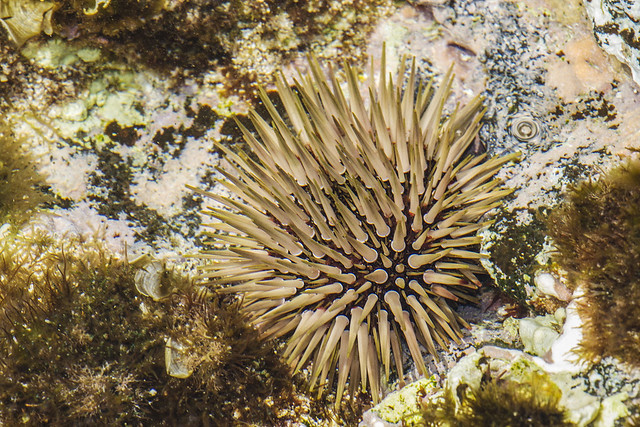
Burrowing Urchin, Echinometra mathaei
And basically, sea urchins in the deep appear the same.. BUT many of them are unusual in some way.  Different adaptations or different evolutionary histories and there's much more to them than the "typical" urchins most people encounter in shallower depths. 

Here are some of the more commonly encountered sea urchins we will likely encounter in the Hawaiian region (below about 1000 m). These are also pretty typical of deep-sea settings throughout the Indo-Pacific.

There ARE a few that aren't noted here. Mostly the "irregular" urchins such as sand dollars, or sea biscuits. 


1. Aspidodiadema This is a genus of unusual deep-sea urchins that is represented in Hawaii and in many tropical deep-sea habitats in the Pacific as well as one species in the Atlantic. These have really long spines that it uses for locomotion in conjunction with its tube feet.

There's apparently more than one species of Aspidodiadema in Hawaii, but so far we've been calling the one seen by Okeanos, Aspidodiadema hawaiiense. Upon looking at both images, there do seem to be some differences but its unclear without a specimen to examine..
Here's a nice moving GIF of this Aspidodiadema species on the move! 
This image shows the same type of animal as the one above but with a mysterious bag like extension emerging from the top. Possibly an anal sac as we see in diadematid urchins?? Unclear.
In comparing them, this second one seems to be lighter in color... 

2. Caenopedina! This genus is a member of the family Pedinidae, of which it is the only living member. This genus is widely occurring mostly in deep-sea habitats. 

According to the Hawaiian Undersea Research Lab's Animal ID guide, there are two recognized species in the region: 

Caenopedina pulchella This species shows these very thick spines which are brightly colored green and purple!
The small individual above seems to have much smaller spines relative to this larger one.. but the colors patterns appear consistent..

This second species is Caenopedina hawaiiensis and it seems to show a very different appearance... 
3. Echinothuriid Urchins! These are one of the most frequently encountered sea urchins in deep-sea settings. Commonly referred to as "pancake urchins" or "tam o shanter" urchins, their body shape is suspended by water pressure, so when removed from the ocean into say, a bucket on the deck of a ship, their very soft skeletons collapse into a flat "pancake" like shape.

I've written on these animals plenty of times here and here and their shallow-water relatives here

One caveat about this section: I'm not sure that any of these can be correctly identified..so I'm keeping it vague. At least for now. 

But salient features of the urchins as a group include: 
1. Needle sharp spines which can be pretty dang painful!
2. Cute little walking legs with special "hooves" on their spines 
We've seen at least 2 species.. this purple species..
Rewatching yesterday's #okeanos dive: sea #urchin w/ mittens on its spines #Hawaii, Lone Cone ~1800m pic.twitter.com/kEL4cTtBIn
There's this slightly different pink echinothuriid
 this grey species                            

Echinothuriids are a frequently encountered group in the deep-sea. We will likely encounter more of them..

4. Cidaroid Urchins! One of the other "typical" urchins one encounters in the deep-sea is that cidaroids.  This is a fairly old group of urchins, which branched off early in the history of urchins and has a fairly good Mesozoic fossil record (see here).   

Cidaroids are unusual for urchins in that they lack skin on their spines, which results in an overabundance of "fouling" animals which can settle and grow on them. I've briefly talked about the ecological importance of this here. 

We've also seen cidaroids with a CRAZY range of spine shapes and morphologies, such as what I summarized here
                           
Cidaroids are not just predators on corals as shown below, but are also likely predators on stalked and other crinoids as I've posted about previously..

A nice diversity of cidaroid urchins in the deep-sea Hawaiian Islands.. More at the HURL gallery here  but sadly we've really only seen a few at the deep depths Okeanos has been exploring..

Histocidaris variabilis.. note the barnacles growing on the spines...


Stereocidaris hawaiiensis

Possibly Stylocidaris calacantha.  This one was observed high up in the branches of this bamboo coral, likely feeding on the polyps..

Wednesday, September 16, 2015

Goniasterid Starfish LOVE to eat Octocorals!

Okeanos Explorer has begun Leg 4 into the Northern Hawaiian Islands and their last stream on Sunday was chock full of amazing vistas full of deep-sea (about 400-500 m) sea pens and corals! 
Probably one of the most exciting parts of these cruises is that I'm able to actually watch my favorite starfish species, some of which I described, in ACTION! Feeding on what turns out is their favorite food: octocorals!!


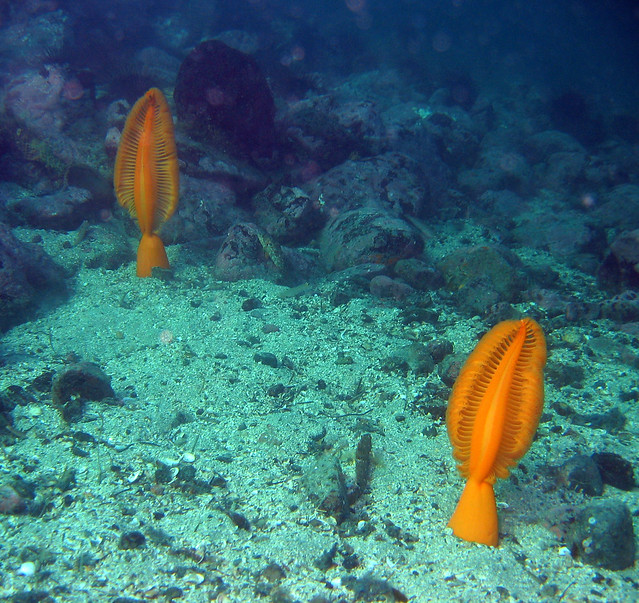
Sea pens are big fleshy octocoral colonies that look sort of like an aquatic "quill" or pen. Here's one called Ptilosarcus, which occurs in shallow water from about SCUBA depth. 
Sea Pens
Octocorals are specific type of cnidarian, which have eight arms on each polyp. They have a whole diversity of body forms and can be more colonial, such as this gorgonian or more like a big fleshy stick like the sea pens seen above..

The majority of the sea stars that we have observed feeding on octocorals are in the family Goniasteridae. As a generality, they look like this.
                                    
A big peripheral ring of plates frames their body. They can be anything from completely pentagonal to more star shaped. Many are covered by spines whereas others are not..

Among the best known of shallow-water goniasterid octocoral predators is the so called "spiny star" aka Hippasteria phrygiana (aka Hippasteria spinosa, etc.), which used to be known by MANY species before being recognized as one wide-spread species which occurs in three oceans! (here). 
Spiny Red Star snacking on a Sea Pen

This species occurs at SCUBA depth (and deeper) and many, involved studies have documented how these animals are important parts of ecosystems due to their predation on sea pens.

Thus, it makes a lot of sense that several of the deeper water species of Hippasteria, such as this Hippasteria imperials seen by the Okeanos Explorer should be a fairly active predator on deep-sea sea pens! 

Disks are swollen with water...
Here is just a gorgeous shot showing a seemingly endless vista of sea pens with these two large, Hippasteria imperialis roaming around like they own the place! 

BUT, Hippasteria imperialis isn't the only goniasterid starfish which feeds on octocorals. Many of its relatives, both close and far are also pretty active predators on deep-sea octocorals..

This big guy is Hippasteria muscipula! A species I just described last year! (here) It would seem to occur over a pretty wide depth range..from several hundreds to several THOUSANDS of meters!

They seem to be primarily predators on bamboo "corals" which are octocorals in the family Isididae.
and there was THIS stunning image showing H. muscipula but with 3 polynoid worms crawling around on its body surface. This is unusual, since polynoid worms usually crawl on the oral surface in the tube foot grooves..

Another closely related Hippasteria-like sea star which we've seen in the Hawaii region is the genus Evoplosoma.  


This shot is just awesome. We can see its stomach and tube feet hard at work clearing off the meat from the bamboo coral's stalk..

BUT that's not all! We've encountered multiple goniasterid species apparently feeding on coral! 

1. Astroceramus eldredgei

2. Calliaster pedicellaris
This species was described by Walter K. Fisher in 1906 and VERY rarely seen since then. 
3. Circeaster pullus
Here's another species I described back in 2006 and named in honor of Dr. Craig Young at the Oregon Institute of Marine Biology. It was observed perched on this coral skeleton where it was presumably feeding..

Have not seen any of these on the Okeanos dives as yet though.

4. Circeaster arandae
This one was a surprise because it very much looks like a species I described in 2006 from Madagascar!!  But it lives in deep, DEEP water (>1000 m) which is consistent with my earlier account. But weird to find it so far off..


How many more octocoral predators will we see??

Wednesday, September 9, 2015

Great Echinoderm art from the Biodiversity Heritage Library!

Image from page 459 of "Brehms Tierleben. Allgemeine kunde des Tierreichs" (1911)

So, while we are waiting for the next leg of the Okeanos Explorer to begin this weekend, I thought it would be a good time to share some newly uploaded illustrations scanned from classic monographs by the Biodiversity Heritage Library and the Internet Archive Book Images Flickr site.

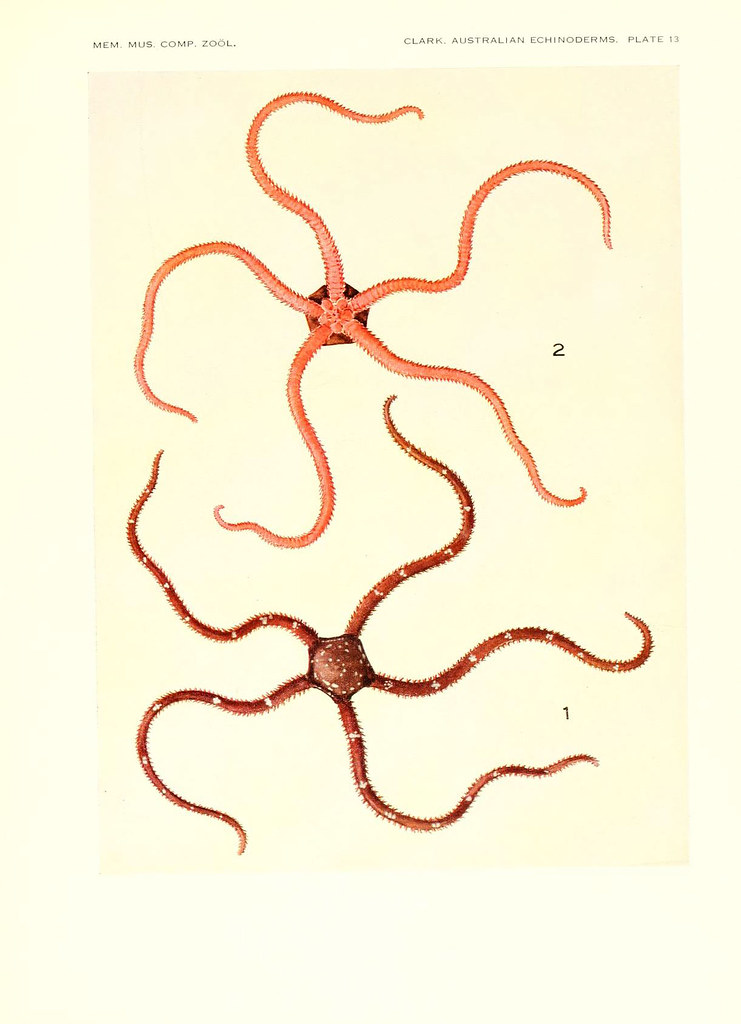
Here are a couple of lovely color plates of echinoderms from the Great Barrier Reef from H.L. Clark's monograph on the Echinoderms of Torres Strait. 
n95_w1150

Some Astropecten..
Plate 1

And some coloriffic ophiuroids! 
n666_w1150
And here's some great Deep-sea Echinoderm Pics! 

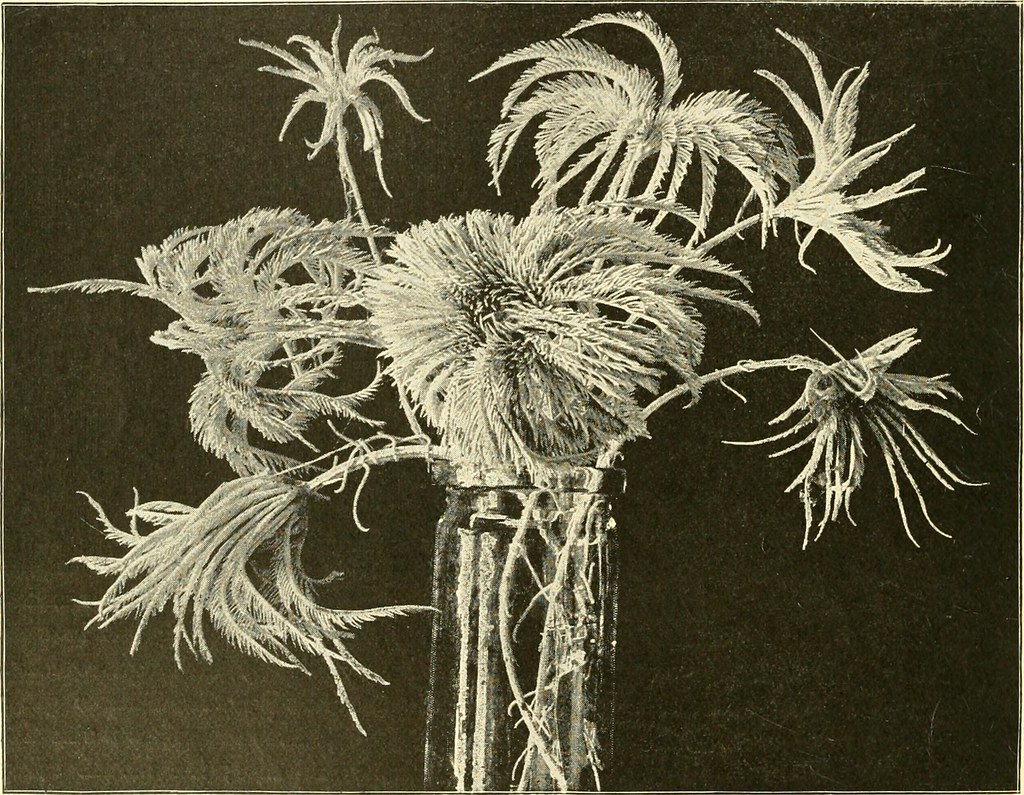
A bouquet of Isocrinid stalked crinoids! 
Image from page 25 of "The royal natural history" (1893)

and the living ones..

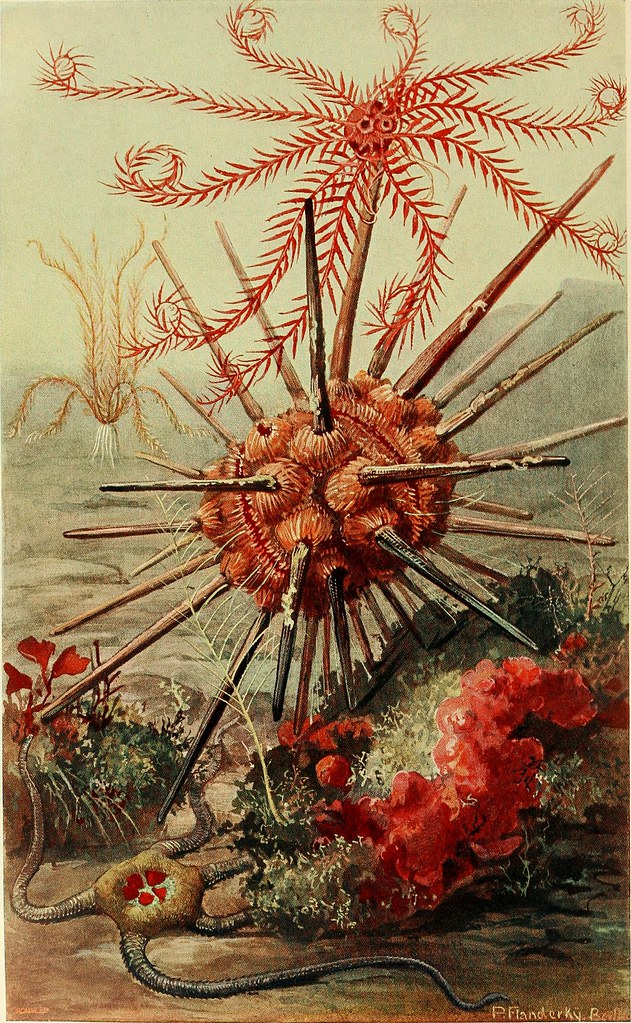
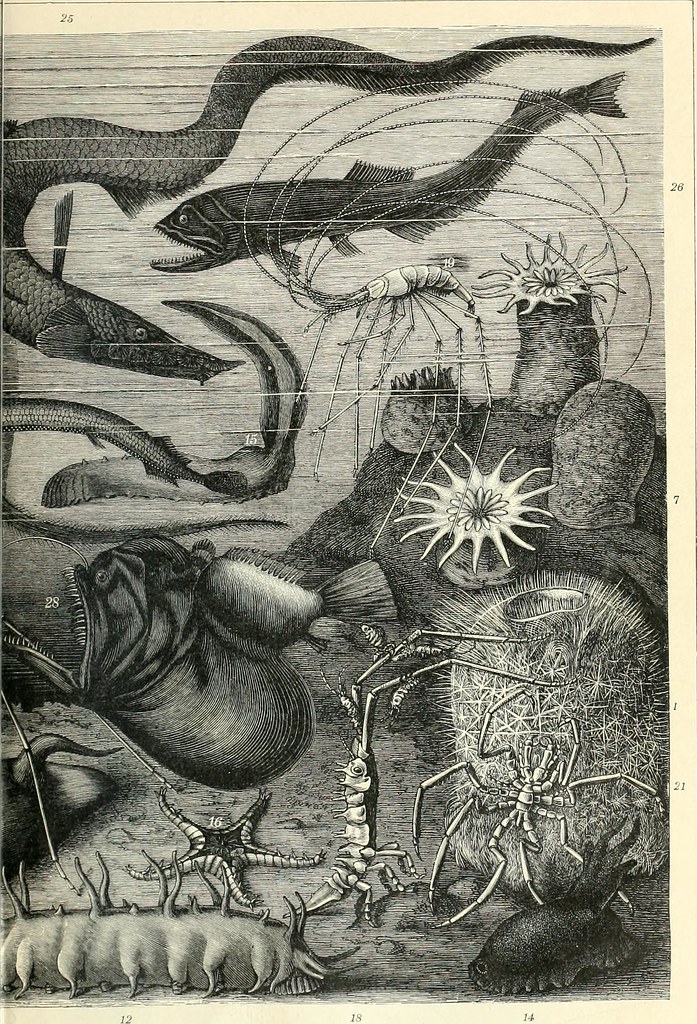
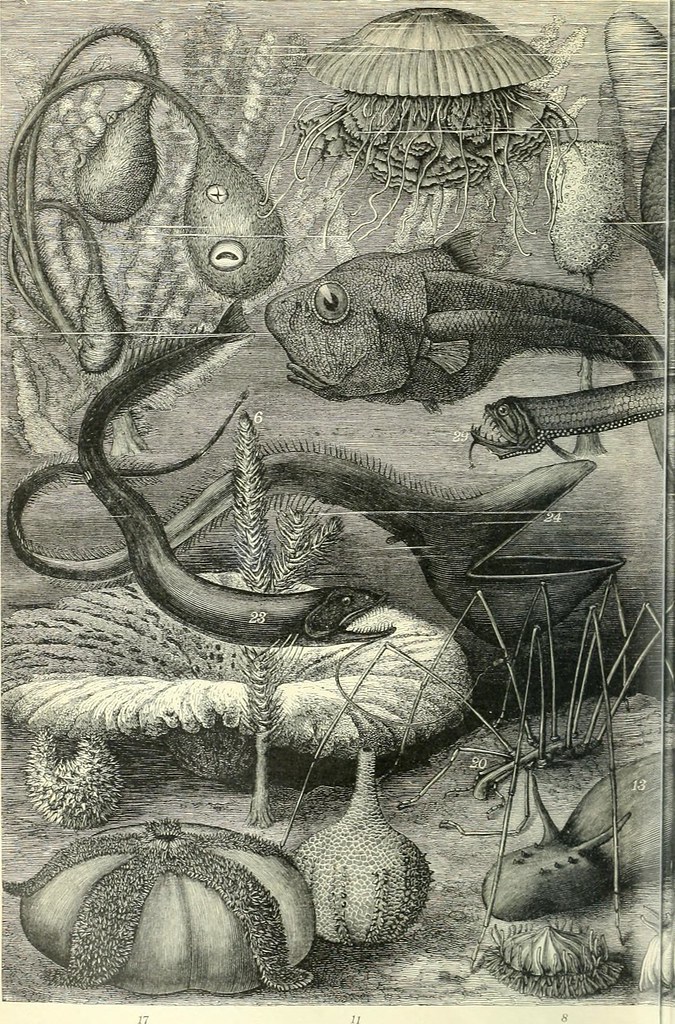
Probably one of the COOLEST things I found was this deep-sea illustration from the Brockhaus Konversations-Lexikon, 1892. Some kind of natural history/science encyclopedia.

It included many, MANY deep-sea animals we see today from Okeanos (and other) video. below I've presented images of these plates along with some images of comparable living species.
Image from page 963 of "Brockhaus' Konversations-Lexikon" (1892)
Note #12 above? That's the deep-sea sea cucumber Oneirophanta mutabilis.. Here's a pic from a recent Okeanos trip for comparison

Image from page 962 of "Brockhaus' Konversations-Lexikon" (1892)

Note #17 above? Thats supposed to be Hymenaster rex, a North Atlantic slime star. Here's an ACTUAL picture of one that is doesn't QUITE meet with the artist's concept...

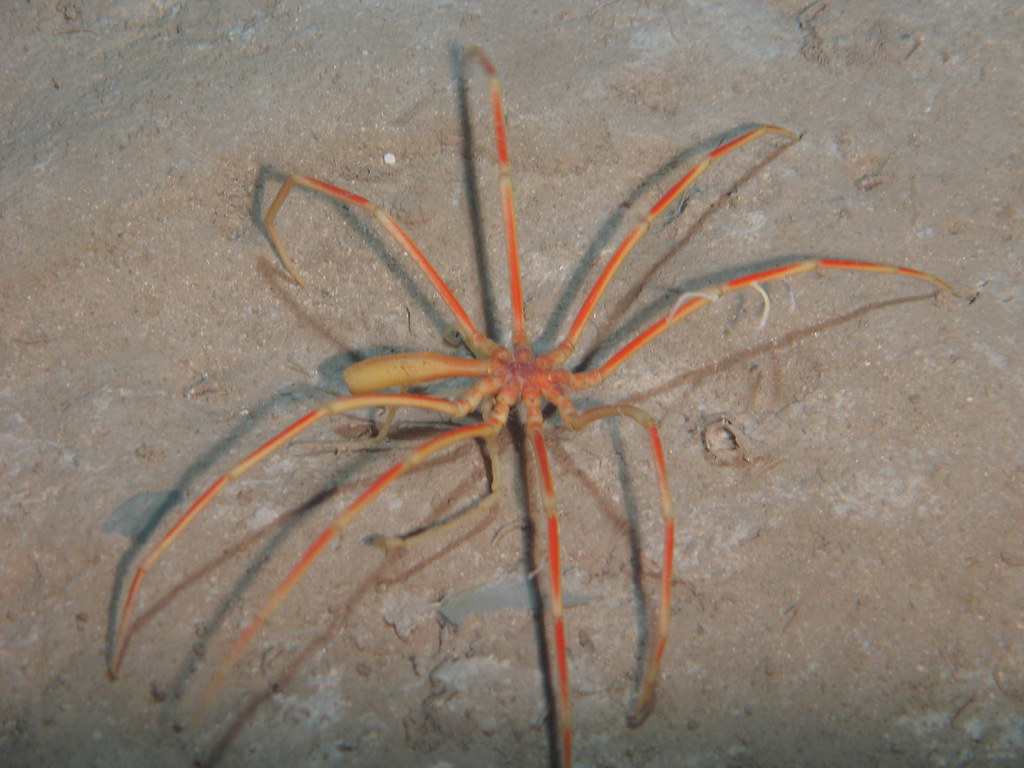
Here's the giant deep-sea sea spider Colossendeis in comparison with #20 above. 
Sea spider

Tuesday, September 1, 2015

Deep Sea Hawaii CONTINUES!! Okeanos Explorer Leg 3 BEGINS!!

So, after a bit of a delay on Friday (the 18th) due to some technical issues, the Okeanos Explorer promptly got underway to begin LEG THREE of its Hawaiian Islands Expedition! Exploring Deep-Sea Coral Communities! (here

Previous posts include: 


Leg 3 has only been active for 4 days (including today) and already they've seen some pretty fantastic invertebrates!
1. This awesome blue comb jelly.
On Sunday (Aug 30th), the ROV was in relatively shallow water and spotted this gorgeous blue/purple comb jelly (ctenophore) at about 450 m off South Point, Hawaii (big island).  George Matsumoto of MBARI has described it as Euplokamis-like..

Lasers below are 10.0 cm apart..so it was a decent sized beast...

2. Was that a NEW STARFISH?
So, this happened only Monday.. The ROV was exploring McCall Seamount at around 2700 meters and came upon this beast..

So, the amazing thing about this is, I didn't recognize it! If you wanted to learn what it was like to "discover" new species along with the scientists??  THIS IS WHAT THAT IS LIKE.
Unfortunately, they couldn't collect it for various reasons..but I'm hopeful an example will turn up so I can eventually confirm its status and learn more about it... and eventually give it a name...

But as you can see its quite soft and its body sort of flutters in the current! 
Video

3. Coral Predators GALORE! 
So, for years we've been watching sea stars and even sea urchins feed on deep-sea corals on the Atlantic Okeanos Explorer video streams. Earlier this year I published a paper on several of these starfish species, including Evoplosoma and Hippasteria.

The Hawaiian islands region has many, MANY corallivorous starfish species. I've discussed a few of them here.  Its interesting to see how much more regularly we are observing predation by sea stars (mostly Hippasteria muscipula but several species are observed) on these octocoral colonies.

What we're also seeing is predation on corals by cidaroid sea urchins!!  We've seen this by the white Atlantic urchin Echinus in the Atlantic, but observations of feeding on corals hasn't been seen by Okeanos in the Pacific before! 

If indeed that is what they are doing in these pictures...

4. Deep Sea crustaceans! 
This deep-sea hermit crab has a commensal sea anemone instead of a shell! 
Deep Sea balanoid barnacles! at 2700 meters! 


5. More orange echinoderms than you can throw a stick at! 
This cool biscuit star: Sphaeriodiscus ammophilus

Based on a tip by ophiuroid expert Sabine Stohr, this ophiacanthid brittle star is likely Ophioplinthaca!
and another nice shot of Hippasteria muscipula which I described only last year (here) What's interesting about it? the disk is HUGELY swollen with water!  A big difference from seeing them preserved in a bucket!!!

What discoveries will next week's expeditions bring???