Showing posts with label Jurassic. Show all posts

Tuesday, April 5, 2016

Crinoid Fossil Forest Revisited!

This week I thought it would be fun to revisit the wonderful world of stalked crinoids!  I've previously looked at photo galleries of deep-sea living stalked crinoids here and a few from the Hawaiian Okeanos expedition.

Here's a hyocrinid "pinwheel" crinoid form the Okeanos dive to Indonesia! (INDEX-SATAL 2010)

For those who might not be familiar with stalked crinoids, they are the ancient ancestors of modern day feather stars (aka comatulid crinoids).
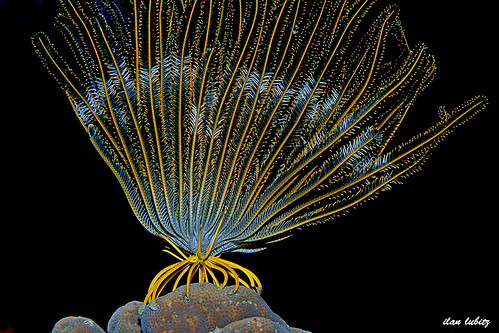
feather star  Oxycomanthus bennetti

Stalked crinoids are fundamentally composed of three main regions: the calyx (or cup), arms and stalk which is very nicely illustrated by this diagram from the Field Museum in Chicago!

Stalked crinoids feed on food particles in the water column using their arms which they move down to the mouth located at the top of the calyx (or cup). The stalked and unstalked forms have an unusual relationship which you can read about in an earlier post here.
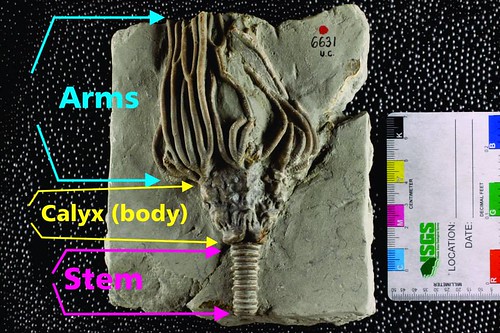
Sea Lily Fossil
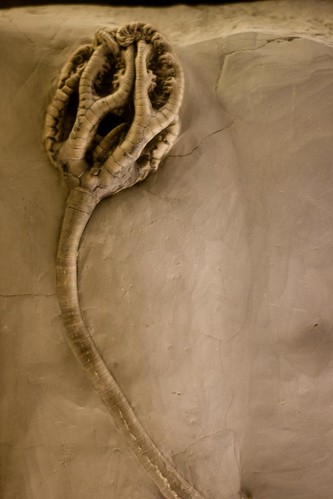
The high point of stalked crinoid diversity was in the Paleozoic, some 250 to 540 million years ago in the time before dinosaurs..there  existed a HUGE diversity of stalked crinoids.. and even DURING the time of the dinosaurs in the Mesozoic there were still quite a few of them (as I'll share below)..

Let's start off with this gorgeous one called Acanthocrinus rex! from the lower Devonian of Germany. This image was reported by crinoid scientist Hans Hess as "certainly one of the most beautiful crinoids ever found.." Sadly, this specimen was lost in World War II.
This image from: https://geo-ebooks.tumblr.com/post/127610816184/acanthocrinus-rex-j%C3%A4kel-from-the-lower-devonian
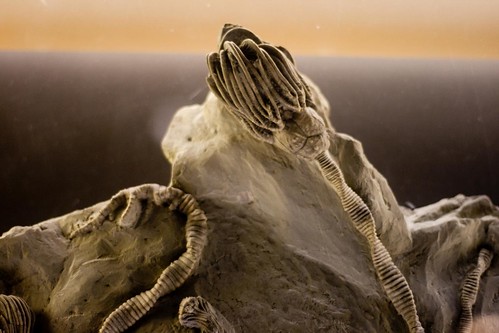
The images below are a nice set of Paleozoic crinoids by James St. John on Flickr..

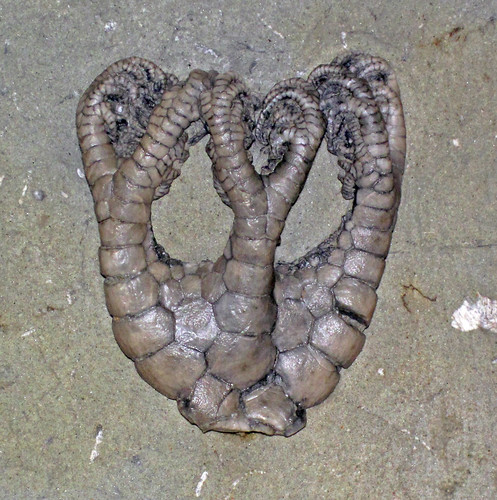
Here is the Paleozoic Taxocrinus colletti from the Edwardsville Formation, Lower Mississippian; Crawfordsville area, Montgomery County, Indiana, USA.
Taxocrinus colletti fossil crinoid (Edwardsville Formation, Lower Mississippian; Crawfordsville area, Montgomery County, Indiana, USA)
A striking one called Platycrinites saffordi from the Edwardsville Formation, Lower Mississippian; Crawfordsville area, Montgomery County, Indiana, USA.
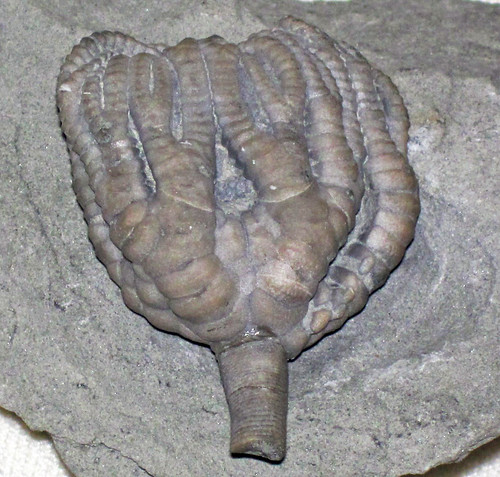
Platycrinites saffordi fossil crinoid (Edwardsville Formation, Lower Mississippian; Crawfordsville area, Montgomery County, Indiana, USA)

One with some strikingly different arm branching patterns: Onychocrinus exculptus from the Edwardsville Formation, Lower Mississippian; Crawfordsville area, Montgomery County, Indiana, USA.
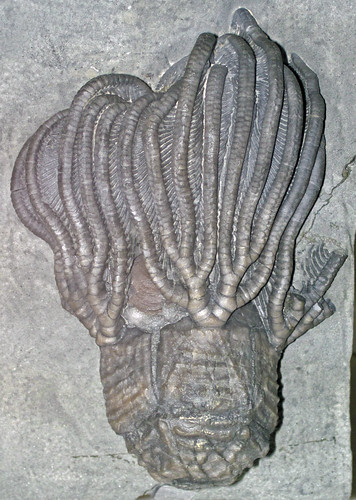
Onychocrinus exculptus fossil crinoid (Edwardsville Formation, Lower Mississippian; Crawfordsville area, Montgomery County, Indiana, USA)

Here is: Onychocrinus ulrichi a fossil crinoid from the Edwardsville Formation, Lower Mississippian; Crawfordsville area, Montgomery County, Indiana, USA.
Onychocrinus ulrichi fossil crinoid (Edwardsville Formation, Lower Mississippian; Crawfordsville area, Montgomery County, Indiana, USA)
David Clark on Twitter brings us this interesting one with large spines emerging from the calyx! The aptly named Acanthocrinus! (from the Devonian of New York)
This next series is from Elrina753 (thanks for the awesome images!) from the Houston Museum of Natural Science. These look like the Mississippian, Platycrinites
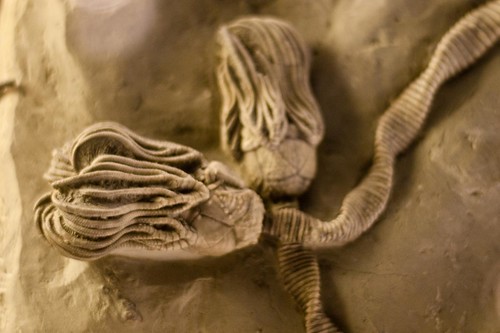
Crinoids
Crinoids
Another gorgeous one from the Houston Museum of Natural Science: Onychocrinus exsculptus
Onychocrinus exsculptus

And this third one from Houston which I don't have a name for...
Crinoids

An interesting Paleozoic one called Eretmocrinus (no other info, so unsure if ID is correct) but the arms have very unusual morphology. Notice how they become paddle like towards the tips! 
Eretmocrinus

And from the displays/collections in Washington DC at the NMNH.. the massive Jurassic Seirocrinus which was actually thought to be pelagic and might have attached to floating logs! More on these two unusual swimming/floating crinoids here.


The bizarre Uintacrinus which some thought might have actually dragged its arms over the bottom as as it floated by...

Monday, October 26, 2009

The Mystery of Sphaeraster! aka JURASSIC fossil starfish are WEIRD!

(Courtesy & copyright of Christian Neuman in APH 37)


Christian studies fossil echinoderms, especially sea urchins and sea stars and put me onto a new short paper he's written in Arbeitskreis Palaontologie Hannover 37: 92-97! Most of the pics featured today are courtesy of his article!

But...WHAT? You didn't realize that there was such a thing as starfish FOSSILS?

Starfish, like other echinoderms are composed of thousands (maybe even hundreds of thousands) of individual calcium carbonate pieces (called ossicles or plates)! So, when they die, those pieces often get scattered into the sediment or the water or etc.

That is why starfish ossicles are SO rare. When they die, these pieces scatter very easily and they fail to preserve over time.
BUT, sometimes we get lucky! Those pieces get preferentially preserved, sometimes while they are still connected together, articulated into large chunks or EVEN the complete animal!

So, in this case, we have pieces that clue us in to one of the most enigmatic of fossil echinoderms! The Sphaerasteridae! An engimatic group of asteroids from the Jurassic!

While dinosaurs were trying to figure out how to roam the Earth, these guys were happily sitting around in the seas of the Mesozoic!

Initially, the pieces recovered were like this:
(Courtesy & copyright of Christian Neuman in APH 37)

You often recover MANY different pieces. Here we have fragments of Sphaeraster punctatus.More precisely..you get either individual pieces (i.e., individual plates) or a "chunk" of the animal that looks like this.
(Courtesy of Christian Neuman in APH 37)

Eventually, you have enough different fragments, pieces, and etc that you can make a guess as to what the original animal looked like.

Starfish paleontology is a LOT like dinosaur paleontology or assembling an airplane model kit without the instructions! You've got a bunch of pieces and you have to reassemble them into what looks like the right shape!

So..what you've get here..VOILA!! A reconstruction of Sphaeraster punctatus (described by Schondorf in 1906!).
(Courtesy of Christian Neuman in APH 37)

It was weird but not really that big..about 75 mm across from left to right. Now bear in mind this is a RECONSTRUCTON. The fossils aren't nearly as nice as this. But it gives you SOME idea of what it looked like.
BOTTOM (=Actinal) VIEW (Courtesy & copyright of Christian Neuman in APH 37)
TOP (=Abactinal) View (Courtesy & copyright of Christian Neuman in APH 37)

So, what did this odd-looking thing do when it was alive?? One of the most useful ideas for interpreting these fossils and putting them back together is a concept in paleonotology-indeed ALL of Geology-called Uniformitarianism!

Basically, this is the idea is that a lot of the physical processes and relationships that happened in Earth's past are generally the SAME as they are today. So, we look for critters that appear SIMILAR today... Because its possible the same physical forces may have influenced their appearance and body shape (and giving us insight into Sphaeraster!).

For example: The Shingle Sea Urchin Colobocentrotus! Colobocentrotus makes its living by using its flattened spines to deflect waves in its habitat: the harsh intertidal zone in the Indo-Pacific. Interesting.

Its got the plates. Its got the flange around the edge similar to the plates on the reconstruction. BUT its NOT a starfish.
Not directly related-but could it have lived this way??? Possibly.
Could it be Xyloplax?? The mysterious asteroid-like beast with a flange of spines around its edge? These beasts live in the deep-sea on sunken wood where they live flush on the surface.

Again..possibly/probably not related-but could it have lived THIS way??
Or perhaps...the strange "top hat" starfish, Tremaster??
..or could it be The LIVING completely, SPHAERICAL starfish-Podosphaeraster??? At first, these nearly round sea stars WERE thought to belong to the fossil Sphaerasteridae. But over the years, these strange creatures have eventually come to be classified in their own unique family-the Podosphaerasteridae and separated from the fossil Sphaerasteridae.

and while, this is plausible, it should be noted that NOTHING is known about these critters. So, maybe its not a podospherasterid either..? We have some AMAZING body shapes and morphology but we have very little biology to match it up with!

Where does that leave us??

Believe it or not, this is it. This is practically our total state of our knowledge of these animals. These beasts fall into the category "about which, little is known..."

It is a pretty curious place where Paleontology and Deep-sea Taxonomy converge!
  • Both involve specimens (often damaged) with unusual shapes or structures which have been subjects of attempted "interpretation".
  • Both often involve bizarre mophologies without any direct observation of ecology or even fundamental life mode.
  • Both subjects usually involve rarely encountered animals which only exceptionally are discovered intact!
So..from here? What do we need? Maybe the talents of Leonard Nimoy on his "In Search of" show, to help discover some of these weird and rare animals?? (cause they sure are a LOT harder to find then the Loch Ness Monster!)Fantastic. BUT real. :-)