Showing posts with label Seirocrinus. Show all posts

Tuesday, April 5, 2016

Crinoid Fossil Forest Revisited!

This week I thought it would be fun to revisit the wonderful world of stalked crinoids!  I've previously looked at photo galleries of deep-sea living stalked crinoids here and a few from the Hawaiian Okeanos expedition.

Here's a hyocrinid "pinwheel" crinoid form the Okeanos dive to Indonesia! (INDEX-SATAL 2010)

For those who might not be familiar with stalked crinoids, they are the ancient ancestors of modern day feather stars (aka comatulid crinoids).
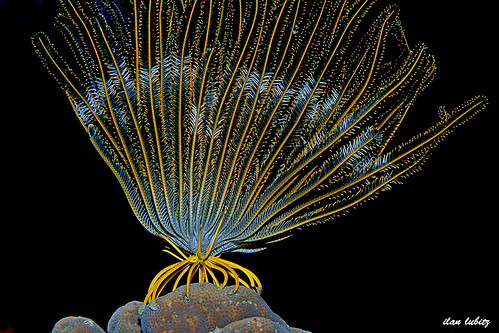
feather star  Oxycomanthus bennetti

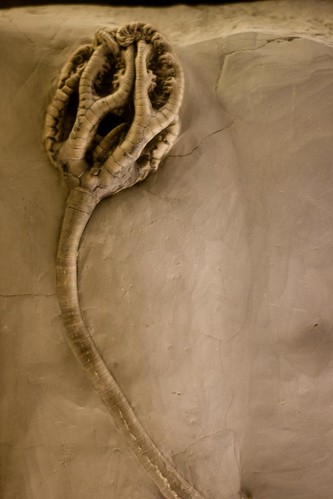
Stalked crinoids are fundamentally composed of three main regions: the calyx (or cup), arms and stalk which is very nicely illustrated by this diagram from the Field Museum in Chicago!

Stalked crinoids feed on food particles in the water column using their arms which they move down to the mouth located at the top of the calyx (or cup). The stalked and unstalked forms have an unusual relationship which you can read about in an earlier post here.
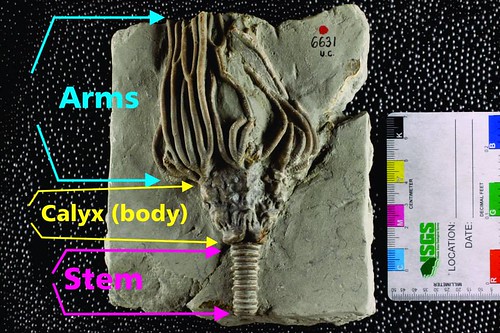
Sea Lily Fossil
The high point of stalked crinoid diversity was in the Paleozoic, some 250 to 540 million years ago in the time before dinosaurs..there  existed a HUGE diversity of stalked crinoids.. and even DURING the time of the dinosaurs in the Mesozoic there were still quite a few of them (as I'll share below)..

Let's start off with this gorgeous one called Acanthocrinus rex! from the lower Devonian of Germany. This image was reported by crinoid scientist Hans Hess as "certainly one of the most beautiful crinoids ever found.." Sadly, this specimen was lost in World War II.
This image from: https://geo-ebooks.tumblr.com/post/127610816184/acanthocrinus-rex-j%C3%A4kel-from-the-lower-devonian
The images below are a nice set of Paleozoic crinoids by James St. John on Flickr..

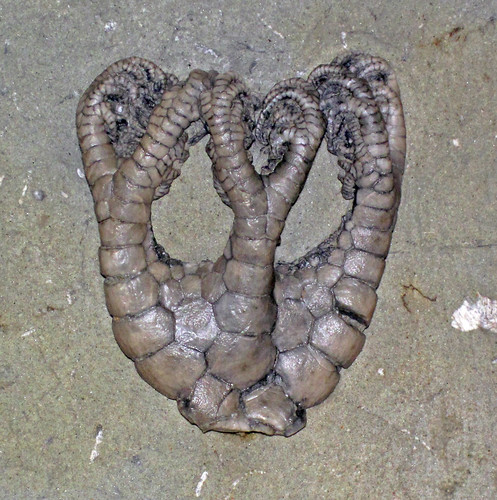
Here is the Paleozoic Taxocrinus colletti from the Edwardsville Formation, Lower Mississippian; Crawfordsville area, Montgomery County, Indiana, USA.
Taxocrinus colletti fossil crinoid (Edwardsville Formation, Lower Mississippian; Crawfordsville area, Montgomery County, Indiana, USA)
A striking one called Platycrinites saffordi from the Edwardsville Formation, Lower Mississippian; Crawfordsville area, Montgomery County, Indiana, USA.
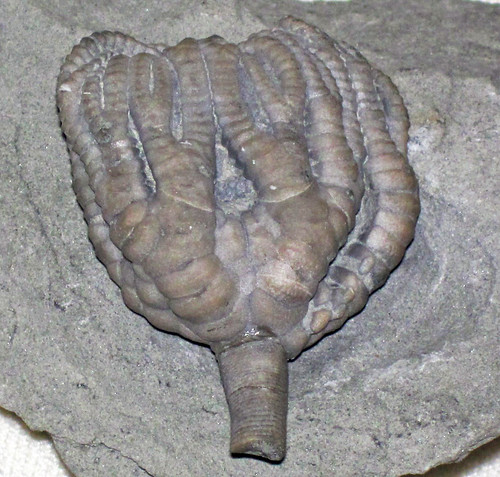
Platycrinites saffordi fossil crinoid (Edwardsville Formation, Lower Mississippian; Crawfordsville area, Montgomery County, Indiana, USA)

One with some strikingly different arm branching patterns: Onychocrinus exculptus from the Edwardsville Formation, Lower Mississippian; Crawfordsville area, Montgomery County, Indiana, USA.
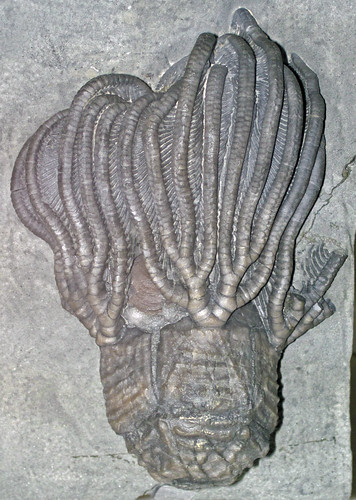
Onychocrinus exculptus fossil crinoid (Edwardsville Formation, Lower Mississippian; Crawfordsville area, Montgomery County, Indiana, USA)

Here is: Onychocrinus ulrichi a fossil crinoid from the Edwardsville Formation, Lower Mississippian; Crawfordsville area, Montgomery County, Indiana, USA.
Onychocrinus ulrichi fossil crinoid (Edwardsville Formation, Lower Mississippian; Crawfordsville area, Montgomery County, Indiana, USA)
David Clark on Twitter brings us this interesting one with large spines emerging from the calyx! The aptly named Acanthocrinus! (from the Devonian of New York)
This next series is from Elrina753 (thanks for the awesome images!) from the Houston Museum of Natural Science. These look like the Mississippian, Platycrinites
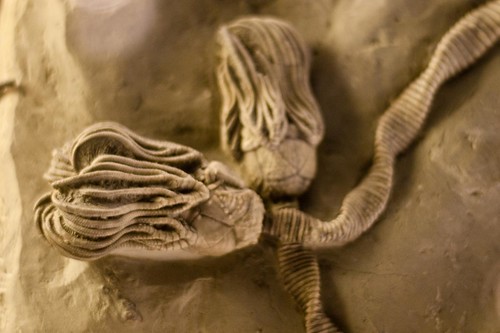
Crinoids
Crinoids
Another gorgeous one from the Houston Museum of Natural Science: Onychocrinus exsculptus
Onychocrinus exsculptus

And this third one from Houston which I don't have a name for...
Crinoids

An interesting Paleozoic one called Eretmocrinus (no other info, so unsure if ID is correct) but the arms have very unusual morphology. Notice how they become paddle like towards the tips! 
Eretmocrinus

And from the displays/collections in Washington DC at the NMNH.. the massive Jurassic Seirocrinus which was actually thought to be pelagic and might have attached to floating logs! More on these two unusual swimming/floating crinoids here.


The bizarre Uintacrinus which some thought might have actually dragged its arms over the bottom as as it floated by...

Tuesday, February 23, 2010

GIANT, floaty, swimmy fossil CRINOIDS! The Dinosaurs of the Fossil Echinoderm World!

Today's post is BIG!

These fossil echinoderms are not ONLY freakishly BIG, BUT to add a little "weird" to it...THEY FLOAT!!! (most echinoderms almost always live on the sea bottom)

So, that you can see how different these critters are relative to the "normal" ones... some introductory crinoid background.

Here is what the most commonly encountered "feather star" aka an "unstalked crinoid" looks like...
(from Chuck Messing's crinoid website)

...and here's some basic anatomy and etc. about the other body form of crinoids with a stalk. These "stalked" crinoids are the ancestral forms and are what you see in the fossil record.

(from the Echinoderm TOL website)

Most of them live on the sea bottom. Sometimes attached and sometimes with a long tail. Go HERE to an older blog I wrote, which has a little bit about their ecology.

What I'm about to say may turn what you know...UPSIDE DOWN!!!

It turns out FOSSIL crinoids from the Jurassic (about 145-200 Mya) and the Devonian (360-416 Mya) did something that NO modern crinoids are known to do!! They were PELAGIC.
in other words...THEY COULD "SWIM". (well..some only float) :-)

Much of the info for this section is from this paper by Seilacher & Hauff 2004.

Basically, there were FOUR kinds of floating crinoids. Here is a handy guide from Seilacher & Hauff (Fig. 1) with the water current flow (added in blue) for emphasis.

Crinoids are all filter feeders.

So, those big cups with all of the arms on them??

They hold them into the water current and food as the water passes through them. The crinoids that float do essentially the same thing but sit in the middle or the top of the water column instead of the bottom.


Here's the different kinds of floating aka pelagic crinoids.


1. "Floaty" crinoids that float on driftwood.

(modified image from Seilacher & Hauff 2004)

These are the best known planktonic crinoid and occur in the Jurassic (145-200 mya) rocks of Germany but have also been collected from China.

They are often preserved attached to driftwood. The stalks were thought to be kind of elastic and used as sort of a filter-feeding "drag net" as they floated through the water..

The fossil deposits of these animals are often excellently preserved.
This includes several genera including Seirocrinus, Traumatocrinus, and Melocrinus and several of them are often found together in huge colonies.

The other really obvious thing about these floating crinoids is that they are HUGE!! They are probably the LARGEST crinoids known!!

IN FACT, they are probably the largest (or at least the longest) ECHINODERMS that the world has ever seen!

See the slab above? There must be at least 50 individual animals (counting the filter feeding cups) on this floating log.
How big are they?? The stalks on these crinoids can approach TWENTY METERS (60 FEET!). The filter feeding cups get to be easily a METER (about 3 feet) in diameter. Here's ME next to a single fossil of Seilocrinus in the museum for scale. Its not as big as some..but STILL....its LARGE.

2. Crinoids with BUOYANT floats!

(modified image from Seilacher & Hauff 2004)

These are interpreted as actually having a FLOAT!!!

That's RIGHT.

They are positively BUOYANT. Similar to the ones above, these were thought to drag their feeding arms, sort of like a tow-net, filtering food from the water.

These were called Scyphocrinites and they were from the Lower Devonian. The big "floats" of these animals are actually fossils called loboliths. They're filled with big porous, presumably air or gas filled calcium carbonate balls. Wow.

3. Stemless floaty crinoids!
(modified image from Seilacher & Hauff 2004)

These are unusual STEMLESS crinoids..but they aren't comatulid crinoids (i.e., not the same as the ones around today)

Genus name is Saccocoma and these fossils are found from the Upper Jurassic Solnhofen limestone in Germany. Its thought by some that these were free-swimming..possibly floating in the water column.

4. Floating Bottom "dredge" crinoids!
(modified image from Seilacher & Hauff 2004)

This is one is just crazy (or at least the interpretation is!).

This one is called Uintacrinus from the Upper Cretaceous and its thought that these had a gas or air-filled cup and that they DRAGGED their arms along the bottom.
Functionally, this makes for one of the strangest terms I've ever heard.."Hemipelagic dredger".

A swimming bottom, deposit feeder. The arms DRAG along the bottom like a frakkin' DREDGE net!!!
Do ya' see that big mess behind my head?? That's because my mind is BLOWN!

(Thanks to Mary Sangrey and the IZ Paleontology department for assistance with photography and specimens!)