Showing posts with label invasive. Show all posts

Sunday, September 23, 2012

UPDATE! Ophiothela brittle stars Invade the Atlantic!

UPDATE: New pictures provided by Gustavo Beolchi show Ophiothela from Angra in Brazil..
on sponges..
esponja e ofiuróide

on a gorgonain
Coral e ofiuróide


BEFORE....
A recent alert went out from ophiuroid biologist at the Los Angeles County Museum- Dr. Gordon Hendler that a six-rayed brittle star from the Indo-Pacific has invaded the Atlantic! 

A pdf account of this from Coral Reefs can be downloaded here.

Invasive species are those which are artificially introduced into regions where they are not native. Their presence can directly or indirectly have significant to dire consequences on the ecology of a particular region.

Ophiothela is a clonal, six-armed brittle star that typically occurs in the Indo-Pacific as seen here (species shown is Ophiothela danae).  Photo by Wild Singapore.
Tiny colourful brittle stars (Ophiothela danae) in sea fan

Wild Singapore has a great page on these (note that not all of these seem to be Ophiothela however)
go here to see it!

But Ophiothela mirabilis seems to have invaded Brazil and St. Vincent as reported above. The species was first observed in Brazil of 2000 and has been observed slowly spreading throughout Brazil and the Caribbean.

This brittle star is asexual, specifically it is fissiparous and so it clones itself, thus facilitating its spread. Unlike other tiny commensal brittle stars, this one seems to have "low host specificity" which means that it can live on just about anything that it is compatible with (as seen below) from gorgonians to sponges..

Courtesy of the Brazillian website Cifonauta here is one of several videos of this invasive species in Brazil! They have several more pictures of this species also...
Can Crowd-Sourcing Help???
A quick look on Flickr indeed shows Ophiothela mirabilis as observed on Polymastia janeirensis (a sponge) from João Fernandes Beach - Buzios - RJ - Brazil (image from August 16, 2009). O. mirabilis is the tiny little orange thing clinging on below...
Polymastia janeirensis and Ophiothela
Photo by "Sea Girl".

Here's another pic from Brazil of what look to be Ophiothela (or maybe not hard to say without a close up) wrapped around what the photographer calls Leptogorgia punicea (a gorgonian)
coral e ofiuróide

The many eyes and cameras of the internet permit greater powers of tracking and observation of this species!  Got one from the Atlantic?  Post links to pics in the comments! Or contact me (or Dr. Hendler) for more info!

Friday, July 31, 2009

Pt 2-Asterias amurensis in Australia! Anatomy of a Starfish Invasion!

So, in Pt. 1 of the Asterias amurensis, story (here), I introduced some general terms and now..some specifics: The Story of an Invasion!

Much of my info is taken from many sources but this awesome 1998 (vol. 15) report (download as a pdf) are available here from the Centre for Research on Introduced Marine Pests (CRIMP) and includes much basic info on the phenomena. as well as other publications..

Taxonomy Is Important: Identifying the Invader!!

The history of the discovery of this species in Australia actually begins all the way back in 1986 when a bunch of these seemingly unknown starfish were brought into the Tasmanian Museum by a woman who had found them in Rosny, Tasmania.

The folks at the Tasmanian Museum are regional specialists and had made the natural assumption that the starfish they were seeing were morphological varieties of their local species, Uniophora granifera, which looks like this:
(image borrowed from Andy & Virg's guide to marine inverts)

Eventually, the began to see more and MORE of these. The coloration was thought to be part of the natural color variation in Uniophora. But eventually, there were more and more specimens and they realized something was....off. They brought specimens of the animal to the South Australian Museum.

It turned out NOT to be Uniophora, but the North Pacific species, Asterias amurensis!
The invaders had arrived!
This was evidently quite a shock! The news was announced directly via the Australian Broadcasting Channel in 1992 and to quote Elizabeth Turner at the Tasmanian Museum:
"Suddenly all hell broke loose. The media and public could not hear enough about it."

This was unprecedented!! To suddenly have discovered a VERY prominent marine predator in their midst with potential menace to a multi-million dollar aquaculture industry. Plus, these animals occurred in large numbers..so unlike, say tunicates, you could SEE these lovely yellow and purple beauties all over the place.

Reaction & Response

So, all of the various Australian marine organizations got to working! And to make a long story short, the various organizations, such as CSIRO and the Department of Primary Industries and Fisheries had formed the National Seastar Task Force! (on a personal note- I have only seen the words "sea star" -"starfish" and "task force" used together EVER, TWICE. Both times in Australia! AWESOME!)

Information was disseminated! but this was just as the Internet was forming..so we saw Pamphlets! Posters! The word was out!

They organized a "clean up" of A. amurensis from an area off Prices Wharf in the Hobart area.
(this picture taken from this account of Asterias control)

This clean up resulted in SIX THOUSAND specimens being collected from a 300 meter stage. Subsequent dives resulted in 24,000 animals killed and piled on the wharf.

I should make sure to note, this did almost NOTHING to the population !!!

What do you do with 30,0000 dead starfish?? These were sent off to composting by the University of Tasmania!

So Where Did They Come From???
Funding started to flow towards various universities and labs to get data on the introduced pest. So, the invaders had arrived via ballast water on ships-but from WHERE??
Early allozyme work using genetic distances (different from today's population genetics using gene data) narrowed down the populations from Tasmania as being most similar to populations in Japan (near Tokyo and Suruga).


Repel the Invasion??
Various methods of minimizing the impact of this species have been developed, considered, and studied over the years. Some are used today and others were not. This includes:

1. Using DNA "fingerprinting" to recognize the larvae from ballast water. Such as in this paper.2. Various poisons, such as the classic anti-starfish measure quicklime, formalin, ammonia, copper sulfate, and even reproductive inhibitors!! The list goes on. Unfortunately all seem to be just as harmful to humans. So, not ideal and let's say...NOT a primary strategy.
3. Natural Control. There are ciliates that parasitize and can castrate sea stars in the North Pacific. This was considered...but using introduced species Vs. introduced species is usually a way to exponentially INCREASE your problems. Its not clear that these could distinguish between A. amurensis and Australian species. So..uh...maybe not.

4. ....and the old standby, physical removal! Simply put-pullin' them off and throwin them up on the pier.
Interestingly, there was also a discussion of using A. amurensis in "commercial harvesting".
Apparently, they cost $1.00 USD in China for FOOD. ugh...(allegedly they are tasty steamed-yuck) They concluded there was NO market for human consumption.

Good call.

What has been the Impact??

So, its now 2009 and its been 23 years since A. amurensis has been in Australia! What has changed???

1. Range Extension. A. amurensis has SPREAD from Tasmania to the southern part of Australia! New Zealand is on alert...
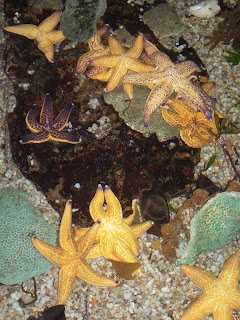
2. The Impact on Soft-bottom communities.
A lot of ecological work has been funded since A. amurensis has taken hold. A lot of this work has been done by Dr. Jeff Ross at the University of Tasmania.

A list of his publications is here.

They eat a variety of bivalves, including the commercial bivalve Fulvia tenuicostata, various snails, and the sea urchin Echinocardium cordatum, changing the abundance of these animals and the long-term ecology of soft bottoms.

The
Carcinus-Asterias ONE-TWO PUNCH! Also, it turns out there's MORE then one big introduced predator in Australian waters!

There is apparently competition between these crabs and Asterias in the feeding of these beasts on bivalves. Asterias amurensis apparently feeds on the BIG bivalve prey VERSUS the crab, Carcinus maenas which feeds on the small ones!! Consider this as there's more and MORE of these and as the two species begin to impact all of the bivalves in the region.

yow.

So, what's the lesson here? Hmmm... Introduced species-BAD.

In contrast an invasion of starfish from space seems kind of welcome...

Tuesday, July 28, 2009

The Starfish Invasion of Australia!! Pt. 1 Asterias amurensis The Echinoderm Invasive!

So, here's a statement you will probably almost NEVER hear....:

- Darn those invasive echinoderm species !!


What's the big deal? Why wouldn't we hear this statement from anyone??? Let's find out!!!

What Is an Invasive Species?
There is a very elaborate exploration of this topic on many web pages, including Wikipedia and blogs, such as Invasive Species Weblog and of course, large national organizations such as NBII.

But the short version is that introduced species are those which are not endemic (i.e., brought from outside its natural range) that have unanticipated ecological effects that have deleterious (=bad) economic, agricultural or other environmental impacts.
http://www.pac.dfo-mpo.gc.ca/publications/docs/images/invasives/federal-eng.jpg

Above are examples of different introduced marine species to the North Pacific of Canada (among other places). Basically different marine invertebrates that have been spread via various ways to areas WAY outside their natural range. Once introduced they have NO natural ties to the ecosystem to their new home.

No Predators. No close ecological relationship with prey. So, they go crazy and cause all kinds of problems!

To illustrate this point quickly..Think of the human equivalent of an alien invasive....
Obviously, one is pretty bad..but more then one and running around on Earth? NOT good.

Marine introduced species are brought along and introduced via a variety of ways. But one of the most prevalent ways?? Boat Ballast Water.
Basically, the larvae (i.e., the babies) of various invertebrate animals are picked up from their natural range, carried around the world where the ship goes and then offloads and dumps them into the water!! Here is the larval stage of our subject today....

But here's the thing, a lot of these invertebrates usually have some kind of physiological predisposition for survival. They can usually tolerate wide ranges of salinity, temperature, and etc. They don't always survive for long where they get dumped off.

Why are echinoderms so unusual as introductions??

Echinoderms are usually pretty sensitive to where they live (since they are essentially filled with seawater). They generally don't tolerate freshwater (I have often seen many dead starfish following a lot of rain in California) and echinoderms are pretty fickle when it comes to temperature, water quality, and etc.

So, generally echinoderms are NOT seen as introduced species in the best-known sense. But then, one found a niche....

MEET
Asterias amurensis....
A. amurensis occurs naturally in the sub-Arctic North Pacific, including the Aleutian Islands/Alaska, Japan, Russia and thereabouts. Mostly in shallow-water but can occur down to about 200 meters depth.
So, this species was essentially transported from the other side of the world!! And miraculously found itself in the cool, temperate waters of Tasmania and South Australia. In an environment VERY similar to its natural range!

A. amurensis is known for two things which makes for a GRAVE concern to Australia.

1. A. amurensis is VERY fecund. A single female of this species can produce 20 MILLION eggs! Since discovery in the early 90s, this has translated to an estimated 30 MILLION individuals in Tasmanian waters (mostly in the Derwent estuary).
2. They EAT shellfish. A LOT of them.
(this is not A. amurensis-but it gets the point across. From the MarLin Gallery)

Australia has a number of very successful shellfish (i.e., bivalves) fisheries. Cockles, mussels, scallops. etc. So, a great deal of work has been dedicated towards the study of the ecological impacts.

Among the more significant findings is this study by Hudson et al. that the introduced A. amurensis does NOT induce the natural escape response that the endemic species does! So, the natural ecological behavior to "RUN AWAY" that endemic Australian starfish species have co-evolved with various scallops is absent from the interaction between the introduced A. amurensis when it feeds on Australian scallops!!


Click here to see part 2 of the A. amurensis Invasion we go more into depth with the Invasion!! The role of Taxonomy!! The National Starfish Taskforce!!!! The Response to the Invasion!