Showing posts with label outreach. Show all posts

Tuesday, November 1, 2011

Starfish are a Mystery! "Ask the Echinoblog" takes questions from a student in Colorado!

Last week, the Echinoblog Mail Dept. received a great letter (a REAL paper letter!) from an aspiring young person with questions about STARFISH!
Her name is Brianne (name changed to protect privacy) and she's an intrepid 6th grader from an elementary school somewhere in Colorado!

Her teacher, JH is applauded for encouraging her to write me the letter and for fostering Brianne's interest in science!
Her letter read as follows (corrected for spelling..)
Our teachers asked us students to write to an expert on a topic, that we chose, and I chose to write mine on starfish. I chose starfish cause starfish are just a mystery; I want to learn more about starfish.

I'm looking forward for your response on starfish, on the questions. Thank you I knew you were the right one to write to.
Thank you Brianne!

First-let me make sure that you understand that when I say "starfish" this is a different word that describes the same animal as "sea star" (Class Asteroidea in the Phylum Echinodermata) and just so that we are clear, a starfish/sea star is NOT a fish in the same way that say, a goldfish is a fish.

Starfish belong to a group of weird spiny-skinned animals called ECHINODERMS. Which includes starfish, sea urchins and all of their relatives!

Brianne's questions follow.... (some questions were related and these have been grouped together)

1. How do starfish eat?
There are many ways that starfish eat. But most of them feed by extending their stomach out THROUGH their mouth and onto whatever they happen to be feeding on.

Food might be anything from organic slime to algae to animals that either don't move very much(such as mussels or clams) or may never move (such as sponges). Some, as we'll see below are fierce predators.

This video shows a small bat star under high speed so that you can see it moving!

Do you notice that kind of brownish colored jelly that seems to grow and than shrink? That is the stomach extending through the mouth and onto the surface of the clear glass aquarium!

But that is not the only way that starfish eat!

Several starfish species can feed on MOVING prey. Here is a blog I wrote about that a few years ago.

2. Do starfish bite?/Do Starfish have teeth? No and Yes.
This will seems strange at first... starfish do not bite! But SOME starfish DO have teeth!

Since most starfish feed using their stomachs, there's no real need for them to bite and chew the same way that say, a dog might.

BUT there are some starfish that have a lot of spines located around their mouth that might be important to helping them eat. See those red circles below? Those are indicating spines present on a few special species that like to eat a particular kind of sea sponge. They aren't for chewing but they might be important for eating in ways that don't know much about yet.
For the sake of being clear, let me say that starfish do NOT BITE. You don't ever have to worry about a starfish ever hurting you in that way. They may have teeth and a stomach-but they don't really have jaws....

3. Can starfish live on shore? Yes (kind of..)
Most starfish species live at depths where they are always underwater, but there are many species that live right at the edge of the ocean but most do not live exactly on the sandy beaches (although some do live near sandy beaches! and become easier to see when the tide goes out)

In this video from British Columbia, you can see many examples of the colorful Ochre Star (species = Pisaster ochraceus) living where the waves crash onto the rocky reefs.

On the other hand, there are other species which live only on muddy or sandy bottoms but in very shallow places near the coast. In the United States, you are likely to find these kinds of species on the tropical Atlantic coasts of Florida and Texas.

But here for example is a video of the intertidal area in Singapore! If you move the video to the time at 3:02 there are sea stars/starfish that live in very shallow mud and sand.

4. Do starfish move? YES. absolutely they do!

However to a human being's eyes-they move VERY slowly, if at all. However, if you put a camera on them and SPEED UP the recorded motion from several hours or minutes you can see all kinds of movement and behavior!

here is an example of such movement as several bat stars move over the seafloor

If you click here..this video of Antarctic starfish shows MANY individuals moving

Some species, such as the Sunflower sea star on the Pacific coast of the US moves so quickly that you can see them without a camera..

5. Can they swim?
ADULT starfish don't swim and live their lives, crawling around entirely on the bottom of the sea floor.

But juvenile starfish (called larvae) have a very different body shape than adults! Starfish undergo a change before they become the large adult-bottom living form in a similar way that slow-moving caterpillars transform into flying butterflies.

When starfish/sea stars are "babies" (=larvae) they look like this and are covered with many small hairs that constantly move and help the larvae to swim and move. So that one day, the larvae will settle on the bottom to become an "adult" starfish.

Larvae are VERY tiny. This one is about the size of the tip of your pencil!
In this case, the tiny larvae above, settles down and grows up into the big adult over the course of several years (almost 2 feet across!).
6. Do starfish have eyes? Yes..kind of..

Although starfish/sea stars DO have something similar to eyes, they are not quite the same. There are organs on each of the armtips that permit starfish to sense light and perhaps heat.

Many special sensors lie on the top of their body that allows them to sense light. Many species are sensitive to light and will move off if it is too hot.

Note the GREEN ARROWS below! Those are where the "eyes" (technically called eye spots) are located.
However, "seeing" is not as important to a starfish as it is to a human being. Starfish bodies are open to the sea water around them. They don't have blood like we do, they just let the ocean fill every part of their body!

Because the ocean is always "inside" them, they can "smell" or detect food immediately. They can detect anything good or bad that might be around them. This includes "smelling" bad things like poisons and uncomfortable things about the water (such as if it is freshwater -starfish only live in sea water). But they can also "smell" predators and prey immediately!

Many predators that feed on starfish can immediately be sensed by a starfish when their "smell" gets into the water. If a starfish doesn't like the smell, it will move away from it very rapidly..

7. Do starfish have gills? Yes!
Starfish breathe by absorbing oxygen from special finger-like structures that are found on their body surface.

If we enlarge the area in the blue circle to the box below...

We see all of those fuzzy patches between all of the white granules/spines. Those fuzzy patches are each a single finger shaped balloon like structure called a papula (plural is papulae). Those are the gills.

Each one of those patches can contain dozens of papulae, which are extended when the animal is comfortable and feels secure. Each of these permits the animal to collect oxygen for the starfish to breathe. They are generally found only on the top and side surfaces, generally not on the underside.

8. Are starfish mammals or do they lay eggs?

Starfish are members of the phylum Echinodermata. A phylum represents the largest natural grouping of different 'types' of animals. For example, phylum Mollusca includes squids, clams and snails and phylum Arthropoda includes insects, crabs, spiders and centipedes. Humans and mammals belong to the phylum Chordata-also called the chordates.

Echinoderms are the "spiny skinned" animals-and include starfish, their close relatives the brittle stars, sea urchins, sea cucumbers, and feather stars. Echinoderms are on the same "side" of the family tree of the animals but are quite distant from chordates (which includes the mammals).
Echinoderms have evolved in a VERY different way and in a much different direction than Chordates (mammals). And so, their biology is also much different.

Their reproductive/egg-laying biology is one example of how different they are..

Here is a video of a starfish from the tropical Pacific (in southern Japan). Not all starfish assume this unusual "standing on arm tips" pose..See those white threads being released by the animal??
This species is releasing reproductive cells-called gametes into the water.

Male and female gametes join together in the water and grow into a series of different small larval stages that eventually settle out and grow into an adult.

Here is video that shows the many different stages as they grow and develop...ultimately becoming an adult.

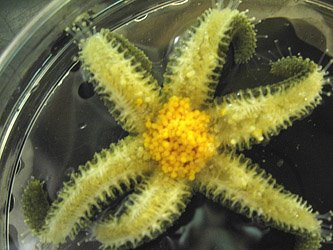
MOST times, eggs and baby starfish form in the ocean. BUT in some UNCOMMON cases there are species of starfish that will actually KEEP their eggs or juveniles until they grow to an adult size...

Again..this is NOT typical.. but it does happen. These eggs and juveniles are usually kept around the mouth...
9. Do starfish have brains? No, but...

So, starfish have what is called radial symmetry (specifically pentaradial or five part symmetry). That is, if you were to cut the animal in half it does not have an exact and opposite side.

The arms all project out from the middle the way that spokes on a bicycle wheel project from the middle.

As a result, there is no head or true central location where the nerves meet.

In its place, is what's called a radial nervous system. The nerves form a ring around the mouth in the disk and radiate out along the arms.
Although the nerves seem simple, this style of nervous system has likely been around in starfish for a very long time.

Although its not as apparently developed as the brain or nervous system in a human (or some other mammal) the behavior in sea stars is surprisingly complicated. Under time lapse cameras, biologists have observed that sea stars are capable of a great deal of behavior that one would not expect from such a seemingly simple nervous system!

10. Can you send a picture of a starfish?
I can do better than that! Click here and this will take you to the Flickr Photostream group for sea stars/starfish! And there are MANY different kinds to enjoy!

Click here
and go to the Encyclopedia of Life's Asteroidea page to see more!

Whew! Okay. that's some good questions!
My thanks to
Brianne and her teacher for these great questions!!

If they or any other students would like to get further clarification of if you have more questions, drop them in the comments below and I'll do my best to answer them by the end of the week! (answers will be in the comments)

Wednesday, May 25, 2011

Answers from the Echinoblog!! YOUR questions from Ocean Portal and Beyond!

Today, I will answer YOUR questions that were asked regarding my recent Ocean Portal Blog via the NMNH Ocean Portal Poll on Facebook as well as questions sent to me via Twitter!

So, some EXTRA Echinoblog goodness This Week!

Via the Ocean Portal Question Poll! The WINNER with 26 votes was....
Can sea stars see?
Yes! But perhaps not in the way that you would imagine. Sea stars and other adult echinoderms have what's called pentameral symmetry (although they are bilateral as larvae-that's another story though). This means that they have bodies that project outward from a central point analogous to the form a jellyfish or sea anemone might have.

They lack a head and a centralized nervous center, such as a brain or a head with optic nerves, and much of their sensory apparatus is more spread out along their body.

Sea stars don't have lens-based "vision" the way, mammals or even octopus or insects do, but they can "see" using two main sensory means:

1. There are cells located throughout the skin (i.e., the epithelium or epidermis) on the surface of most asteroids. The full range of function remains to be determined but from what is known they can detect light, physical contact and chemical/chemosensory stimuli from the environment around them.
A range of sensory cells are also strongly present on the tube feet and on the margins of the tube foot groove. Some 70,000 sensory cells per square millimeter have been reported in these areas!!!

2. There is an "eye spot" at the tip of each arm that is located below the end tube foot (aka terminal tentacle) at the animal's arm tip. There are about 80 to 200 pigment cells there that form an optic cushion which can be used to detect light. As a generality, asteroids are thought to be positively phototactic, or i.e., they move towards light although species show huge variation.

From Facebook...

Tammy P. T. Dr. Mah - Have other echinoderm "outbreaks" been observed other than the one involving the Crown-of-Thorns Sea Star in Japan and Australia? Is this very common? Thank you!
Yes, there are other species which have undergone "outbreak" populations but for different reasons. A recent paper (2009) in Ecological Monographs by Sven Uthicke, Britta Schaffelke, and Maria Byrne at the Australian Institute of Marine Science and the University of Sydney reported some 28 species (6 sea stars, 8 sea urchins, 10 sea cucumbers, and 4 brittle stars) that underwent large population changes.

In most cases, human influences contributed to the changes in abundance/population density changes. These influences include increased nutrition/primary productivity (as in Acanthaster), species introductions, diseases (some population changes go into decline), or overfishing resulting in an absence of predators.

Certain species may have characteristics that make them more predisposed to undergo population "explosions". So, even though the story and environmental conditions may differ it is possibly an intrinsic quality of differing species that may make it more likely to undergo an "outbreak".

Another example of a huge population boom is in the introduced Pacific starfish, Asterias amurensis from Alaska/North Pacific to the temperate South Australian region.

Basically its story is tied to the huge reproductive output combined with the fact that it has no natural predators...

Here are my blogs on Asterias amurensis.. Part 1. and Part 2. (click and go!)

.... And via Twitter

@oceanelements @OceanPortal Q on CoT: If on a particular dive site n 45 min bottom time you see > 10 CoTs, is that considered too many?
First-one should bear in mind that numbers are relative depending on where you are and an outbreak is related to how many are perceived as occuring "normally." Based on numbers summarized by C. Birkeland and J.S. Lucas's fine book "Acanthaster planci: Major Management Problem of Coral Reefs" seeing 10 CoTS would be closer to a "normal" range.

It should be noted that A. planci do have a behavioral tendency to aggregate when enough of them are around. 25 to 30 A. planci per 10 minute swim might simply be "patchy aggregation". If you are seeing 10 in 45 minutes- I'm guessing that's closer to normal.

One account I read suggested that an outbreak density would be 1150 individuals(!) in 20 minutes of swim or 57 animals per minute! In contrast another suggested that an average of 0.22 starfish per 2 minute tow (presumably pulled by a boat) (=.11 starfish per minute) would be an outbreak. This latter would place your value into the outbreak range but is based on a fairly specific set of conditions that you might not be replicating.

So, estimates vary.

From Neptune Canada:
So this video was sent to me via Neptune Canada with regards to the question of these brittle stars (ophiuroids) fighting over this shrimp for food! Go see this blog I wrote awhile back for something similar

Do they have eyes between their tentacles? How do they charge at each other with such accuracy? Can you offer any insight on sensory capabilities of these brittlestars? (answer is below)

Brittle stars are somewhat similar to sea stars in that they have sensory cells in the skin (i.e., the epithelium) which covers their entire body.

Although some brittle stars can detect light, this species occurs in the deep-sea and its unlikely that light or vision plays an important role in how these brittle stars capture prey. So what does that leave??

Basically smell and touch. Bear in mind that ALL echinoderms are basically big open, porous boxes that that have the outside environment (i.e, sea water) slushing around inside them. And skin covers the inside of their bodies as well!

That means they can sense even the slightest change in the surrounding environment and can follow/detect molecules of attractive or offensive substances much more so than you would expect.

This translates to the fact that these brittle stars can detect that big piece of shrimp "meat" very easily, even though they may not physically "see" it the way that you or I might.

And once they've actually gotten their arms around it-evidence suggests that their sense of physical contact is equally sensitive. Several of them know its there because they can "smell" and "feel" it.

Whew! That's it for questions to the Echinoblog this time around!

Do you have more?

Let me know! and we'll have another Q & A session in the future!!

Wednesday, May 13, 2009

Th Echinoblog Answers YOUR Questions! (well..from SFSU Invert Zool. Bio 555!)

[rebeccaJ.jpg]
Today The Echinoblog answers questions from Professor Rebecca Johnson's Biol 555: Marine Invertebrate Zoology at San Francisco State University!! Answers in RED.

Now...ONTO your Questions!!

From "Erik Young":
Sand dollars (Echinoidea) are in the superorder Gnathostomata. I always thought Gnathostomes was the grouping that was associated with the development of jaws in Chordata (as in sharks). I must be missing something. Any thoughts?

Good Question! Yes, they ARE the same. But the nomenclatural codes only mandate the use of a unique name at the family level and below. Here is the ICZN reg (from ICZN.org):
23.3. Application to Synonymy. The Principle of Priority requires that a taxon formed by bringing together into a single taxon at one rank two or more previously established nominal taxa within the family group, genus group or species group takes as its valid name the name determined in accordance with the Principle of Priority [Art. 23.1] and its Purpose [Art. 23.2], with change of suffix if required in the case of a family-group name [Art. 34].

but two superfamilies, orders or higher? Permissible but not advisable for any number of reasons. In this case, the term applies to very disparate taxa (Echinodermata vs. Chordata) and the context is clear in each case-which probably explains why no one has ever sought to change one or the other.


Is there a disadvantage to sand dollars being overweighted, resulting in them being anchored to the bottom?
I don't have any data on this but based on what I've read-Yes. The inability of the sand dollar to better position itself for feeding, protection or any number of other reasons would be a huge adaptive consideration. Presumably, that's how the thinner body and lunule development came about to counter the problems with being blown away or being anchored to the bottom.

From "YouUsed2BeCool"
I was curious as to how quickly the basket stars grow?

The determination of age in basket stars has been looked at in a few species. One paper (Stewart & Mladenov 1997) concluded that growth was not constant. They found the New Zealand Astrobrachion reaching an "adult" size (23.00 mm disk) in approximately 8 years. But there is the caveat that 'aging' plates in these animals is very difficult and is not thought to be really possible for some species.

Also, what material comprises their tentacles?Are these basket stars able to control every since one of their tentacles?

The arms/tentacles are constructed like the arms of any other brittle star except that there is an extensive fleshy overlay covering the skeletal structure you would see in other more "ophiuran" looking brittle stars. Basket stars have additional muscles and other nerve tissue that innervate the armtips along with the hooks that are present. This paper
(Rosenberg et al. 2005) has some good details on Gorgonocephalus biology.

What preys on them? (they're quite large!)

Its not clear to me what will feed on one of these since there's really not much to eat, but generally speaking, big filter feeding echinoderms usually worry about fishes and/or critters that snap at their arms (such as large crabs).
 
How exactly do crinoids go about moving themselves from one perch to another? Do they release their foot or some sort, and just float away? 
I assume you refer to comatulid (i.e., stalkless) crinoids? These move using their arms. Some comatulids are known to "creep" along the bottom using sort of a "Pull-and Push" type motion carried out by the cirri with the aid of the arms. It is thought that where there are arms of differential length, longer arms are anterior during locomotion (ref. to Lawrence 1987). And of course, they can swim...
From "Ariel Tang"

One of those videos shows that sea cucumbers spit their digestive system out when threatened. Can their digestive systems be regenerated later on? How long does it take to regenerate usually? During this period, which part help them digest? Thank you!

Perhaps one of the best known talents of holothurians has been their ability evacuate their guts in defense of their well-being! (inked here)

Sea cucumbers CAN eject their guts, which by the way includes not only the intestine-but also gonads, hemal system and etc. at an oncoming predator or other meacing entity. Some holothurians actually have specialized sticky, toxic structures called Cuvierian tubules which are used instead.
In any case, if we are talking about "evisceration" and guts are used, YES they DO grow back!! 
Regeneration time varies but the papers I found indicated that many of these species could have a completely regenerated intestinal system in 2 to 5 weeks!! (depending on species). The regenerated intestinal system is essentially identical to those of the noneviscerated animals. Presumably, during this time the animal subsists on internal reserves or absorbs nutrition via some other source (e.g., absorbtion through the body wall)-but I'm not sure.
From "Poopie Pants"
Do you know why Culcita novaeguineae have such a prominent "cushion" morphology? It seems like it would hinder locomotion and feeding.

The "cushion" morphology is actually present not only in Culcita but also most members of the family Oreasteridae. Although its not clear what developmental mechanism is responsible-its thought that the swollen body and heavy body calcificiation are defensive adaptations to living in the tropical Indo-Pacific where oreasterids are diverse and abundant.

From "mattmungo"
[hitch1.gif]

One would expect that if the brittle star is to exit the jelly that it would either destroy the bell part to get out or go through the oral opening and risk touching the tentacles of the jelly fish. have any studies been done to see if the brittle starts that hop on for the ride are able to touch the tentacles and not be stung? what are some possible ways for the brittle star to effectively get in and out of the jellyfish, and how does the brittle star know when it is time to jump ship?

There isn't much known about the relationship between jellies and the tiny commensal brittle stars which live inside them but brittle stars would not necessarily destroy the jelly on its way out. Jellies appear delicate and ethereal, but in fact if you've ever held the tissue from one, the texture is like really, tough, thick gelatin. 
The brittle stars in question are practically weightless and both animals are largely suspended by the buoyancy of water. Some of the studies suggest that as the brittle stars get larger they may crawl or simply fall out of the bell (ophiuroids in jellies tend to be smaller) and may possibly just avoid the stings of the tentacles all together.
Departing the bell may be triggered by detection of poor water quality (as was the case in one study) or simply the need for food (as other individuals of the same species are found on soft bottoms).

Why are sand dollars and star fish generally in the shape of perfect pentagons with 72 degree angles between each ray? I understand that in chemistry intermolecular forces cause molecules to take shapes such as this, but since this is much large scale than that of a single compound molecule, what force dictates this perfect symmetry shape? for example why aren't some of the rays 35 degrees apart and so on and so fourth?

hmmm..thats' a good one. I've heard discussions about the physical-chemical constraints of calcium carbonate effect on the overall body form of echinoderm but honestly, I'm not sure that what you're seeing is a reflection of this.

Bear in mind that the bodies of echinoderms are millions of tiny pieces that are held together/embedded in tissue. There may be some overall physical constraints that make it easier for some groups of animals to form pentagons then others-but there is a huge diversity in echinoderm body forms. Especially when you look at the fossil record. See my blog about the Paleozoic Helicoplacoidea (click) as an example of an early echinoderm body form that does NOT show pentagonal body symmetry. But at one level, you're right many echinoderms display this natural symmetry but I'm not sure what the answer is...

From "Joshua Hallas"
I was wondering if there are any other examples of echinoderms living in symbiosis with other cnidarians? and are the brittle stars parasitic or commensal?

Lots of brittle stars live as commensals on corals and their kin...you can go to this post for some idea of the relationship! In many of these relationships, the brittle stars aren't thought to prey on their "hosts" which act primarily as perches for better suspension feeding or homes for the animals to live in. None of these echinoderms are really known to be truly parasitic in the sense that say, nematodes or other invertebrates are.

From "AnthonyM"Is there a chance that instead of thinking they are using the jelly fish as transport or protection that maybe they just happened to be there by accident? And if not how do the jelly fish react to all these different inhabitants?

uh...well, its not an "accident" as you put it. As it sez in the blog, the densities in some specimens some get quite high. Over 800 in that one instance. Its not frequently encountered..but there are many consistent reports.

Its not really known how they affect the jelly much but like many such commensals they are just along for the ride...think of it as much the same way ticks and mites ride in your eyebrows or barnacles ride on whales..


From "Rene"I understand that the ossicles of echinoderms are connected by ligaments composed mainly of collagen; in addition, these ligaments are mutable at short timescales, under neural control. Is it safe to call this structure a form of muscle?

This is an interesting notion and is currently a topic under some discussion in the scientific community. I would go to this paper by Takemae & Motokawa (2005) Ultimately, though Mutable Collagenous Tissue is composed of ligaments and not muscle cells. So, MCT does behave like muscle, but for various other reasons is NOT itself muscle. There's more to this then I can cover here..so I would recommend going to the ref and trying to track down the back-and-forth between the different 'camps' discussing the issue.

On one of my trips to the S.F. Academy of science I came across the water tank of a Fire Urchin. The animal was on its oral side suctioned to the glass via its tube feet. I decided to take a picture of the animal with my phone. When I reviewed my picture I noticed that there were five bright purple dots. When I glance back at the animal I could not see them. The bright purple dots seem to become visible only on the photo. Do urchins in general have some sort of bioluminescence?

So, I suspect you have seen something like what you would see in this picture or this one... This is probably iridescence-the reflection of light from your picture and not bioluminescence, which is the generation of light by the animal and/or its symbionts. There are bioluminescent sea-urchins which live in the deep-sea, but "fire urchins" which is a common name for one of several tropical species often just have these bright reflective blue interradial regions. I'm not sure what they do aside from contrast to the fiery red...but they are a something you would be more inclined to see with light bouncing off them...

Thanks to the Biol 555 and Dr. Rebecca Johnson for participating!!!

Those were some GREAT questions!!!

Do you have an enthusiastic Invertebrate Zoology Class which would like to ASK THE ECHINOBLOG??? Contact me via my profile....