Showing posts with label education. Show all posts

Friday, September 30, 2016

A Guide to Invertebrate Zoology on Twitter!!

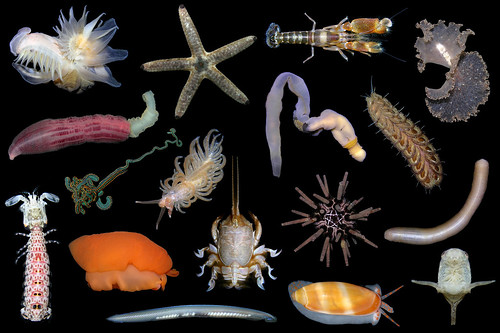
Marine invertebrates potpourri
image by the indubitable Arthur Anker
This week. Something a little different. I was doing a short presentation for some colleagues about using social media next week and I began accumulating Invertebrate Zoology accounts on Twitter... which at one time were quite rare and realized that it would be a good thing to share all of them.

It surprised me that SO MANY have since become established. I remember many years ago when it was less than 6 people and most of it was secondary to blogging!
Now, not ONLY are there many, MANY IZ Twitter themed accounts specializing on specific taxa, there are actually REGULAR twitter events...

Invertebrate Themed Twitter Events

Weekly..
#MolluskMonday or #MolluscMonday.  Yup. Snails. Cephalopods. Scaphopods. Whatever mollusks you like? EVERY Monday. Do it.

#TrilobiteTuesdays. Held every Tuesday.  If you are into Paleozoic arthropods then Tuesdays are YOUR thing!

#WormWednesday: Held every Wednesday. These bring forth all manner of worm-like phyla: Polychaeta, Annelida, Nematoda, Platyhelminthes, Acoela, and so on and so forth..

#SpongeThursday: Held every Thursday. Love the Porifera? the Hexactinellida? Go forth and
enjoy/post about them!

Honorable mention goes to #FossilFriday which is mostly about Dinosaurs and vertebrates..but you get some ammonites and other invertebrates in there pretty regularly...

Yearly..
#CephalopodAwarenessWeek. aka #CephalopodAwarenessDays Every year from October 8 to 12.  You can keep on updates at @cephalopodday. Basically 5 days celebrating EACH class of cephalopods and then some...
  • October 8 – Octopus Day, for all the eight-armed species
  • October 9 – Nautilus Night, a time for all the lesser-known extant cephalopods
  • October 10 – Squid Day/Cuttlefish Day, or Squidturday, covering the tentacular species
  • October 11 – Myths and Legends Day, for all the fantastical cephalopods of movies, literature and legend. 
  • October 12 – Fossil Day
#Polychaete Day. Held yearly on July 1 ever year. (Older hashtag was #InternationalpolychaeteDay).  In conjunction with polychaete related events at the NMNH and other museums.   This day honors international polychaete worm expert Dr. Kristian Fauchald on his birthday July 1st. Celebrates all manner of polychaete (and related) topics!  Here were my posts from 2015 and 2016. 

#SeaSlugDay. Held every year on October 29th in honor of Dr. Terry Gosliner's birthday! Celebrate by posting images, videos and links to all manner of shell-less marine gastropods! Nudibranchs and their kin! My post from last year. 

And of course #Okeanos when the NOAA vessel Okeanos Explorer goes into research/streaming mode!  in which case, there are new deep-sea invertebrate posts for several hours every day for about 2 to 3 weeks!!

Various Twitter accounts/Persons with Invertebrate themed content
from the USNM Invertebrate Zoology FB page @InvertebratesDC
So, here we go. All said and done a list of about 65 IZ twitter accoutns! A list of all the accounts I could locate which focused primarily on Invertebrates, exclusive of insects and arachnids.  Yes, sorry land-based arthropods but you are a whole thing all on your own.

This will be a fairly subjective list-I focused mainly on marine groups and those with academic or otherwise focused content that I thought was appropriate. Activity was also a consideration. Some accounts looked essentially inactive and were not included.

Let me clear that there are a LOT of accounts which have a broader focus that regularly include Invertebrate Zoology themed tweets, including aquariums, natural history museums, etc. and frankly those have so many followers its unnecessary to give them much more publicity anyway..

There were MANY, many individual accounts of photographers, naturalists, educators, scientists, etc. who for one reason or another I just couldn't include for the sake of space, focus, etc.

And there are some topics, for example about coral reefs, there's a TON of coral-related accounts and I simply could not list them all... A search on Twitter's search engine will get you all of those names pretty quickly though.

So, please don't take an omission as an offense. In fact, if you've got an IZ twitter account that you'd like me to know about, please let me know and if I think its appropriate, I'd be happy to include it.

As a side note: my search for these Twitter accounts took me to some interesting places and its curious to see how many of of the phylum or other taxonomic names have made it into popular use: band names, student groups, social clubs, business organizations, video games, so on and so forth...

General Accounts:
Invertebrate Zoology department of the NMNH at the Smithsonian @InvertebratesDC The official account for one of the most active Invertebrate Zoology departments in the world.

Heidi Gartner. @RBCMInverts. Collection Manager at the Royal British Columbia Museum Invertebrate Zoology dept.

Annelida & Segemented Worms

Dr. Christoph Bleidorn @C_Blei. Evolutionary biologist at the MNCN in Madrid

Dr. Conrad Helm. @conrad_helm. Sars International Center at the University of Bergen. Works on the systematics of segmented worms.

Brachiopoda
Brachiopod research at the Natural History Museum in London @NHM_Brachiopoda.

Bryozoa
Bryozoan research at the Natural History Museum in London @BryozoanNHM This is, I daresay, the finest Twitter account about bryozoans I have seen to date!!  Both fossil and living!

Cnidaria
Dr. Allen Collins, NMFS/Invertebrate Zoology NMNH. @tesserazoa. Specialist in jellyfish systematics, sponges and metazoans relationships.

Australian Coral Reef Society. @AustCoralReefs. Official twitter account of the Australian Coral Reef Society.

Dr. Casey Dunn, Brown University. @caseywdunn. Evolutionary biologist at Brown with a special eye towards siphonophores! He also produces Creature Cast videos.

Dr. Cheryl Lewis Ames,  @boxjellytalk. NMNH/University of Maryland, box jelly expert.

Coral Morphologic. @CoralMorph. Strong visuals, images, videos of cnidarians and many other invertebrates.

Gates Lab @GatesCoralLab. Coral Research at the Hawaii Institute of Marine Biology.

Dr. David Plachetzki. University of New Hampshire. @plachetzki.  Cnidarian genomics.

Dr. Mercer R. Brugler @ProfBrugler. Professor at City Tech, SUNY, Taxonomy & Systematics of Black Corals & Anemones.

Medusozoa Columbia. @Medusozoacol.  Jellyfishes of Columbia!

NOAA Coral Program @NOAACoral.  Official Twitter account for the NOAA Coral Reef Conservation Program.

Dr. Rebecca Helm. @RebeccaRHelm. Woods Hole Oceanographic Instition.  Jellyfishes and all manner of swimming cnidarian.

Dr. Paulyn Cartwright @pcart. Professor at the University of Kansas specializing in Cnidarian Evolution.

Dr. Andrea Quattrini. @quattrinia.  Harvey Mudd College. Studies deep-sea corals.

Crustacea
Miranda Lowe, @NatHistGirl. Principal curator of Marine Invertebrates at the Natural History Museum in London.

Dr. Tammy Horton, Amphipod taxonomist at the Discovery Collections in Southampton @tammy_horton. 

Adam Hadsall. @_Nezumiiro_  Tweets #craboftheday and many other items of carcinological interest!

Echinodermata
Chris Mah, Research Associate at the NMNH. @echinoblog. I work on sea stars but know stuff about things.

David Clark. @Clarkeocrinus. A great account for enjoying Paleozoic and fossil stalked crinoids!

Fossil Worms (Miscellaneous)
Luke Perry. At the University of Bristol in the UK/Natural History Museum. @Cambriannelids. Works on Cambrian worms, primarily annelids.

Hemichordates, deuterostomes, etc.

Dr. Chris Cameron. @InvertEvo at the University of Montreal. One of my colleagues who studies the evolution and development of deuterostomes, especially hemichordates.

Invertebrate Paleontology

Dr. Dave Rudkin, @RudkinDave. Royal Ontario Museum. Studies Paleozoic arthropods and other fossil invertebrates.

Invertebrate Vision
Dr. Michael Bok at the University of Hawaii @mikebok. Studies Vision in invertebrates.

Leeches (Hirudinea)
Dr. Anna Phillips, Curator of leeches and parasitic worms at the NMNH, Smithsonian. @Annalida500.

Dr. Mark Siddall Curator at the American Museum of Natural History. @theleechguy. 

Dr. Sebastian Kvist, Curator at the Royal Ontario Museum. @sebastian_kvist. Annelid & leech systematics.

Mollusks-Bivalves
Dr. David Hayes. @Gnarly_Larvae at Eastern Kentucky University. Works primarily on molecular ecology and freshwater mussels.

Freshwater Mussels. @WeNeedMussels. What more can you ask for? A Twitter account entirely devoted to Freshwater mussels!

Mollusks-Cephalopods
ALCES: The AUT Lab for Cephalopod Ecology and Systematics. @ALESonline.  Devoted to studying cephalopod biology, especially deep-sea squids

Research account for fossil cephalopods at the Natural History Museum in London. @NHM_cephalopoda

CIAC-The Cephalopod International Advisory Council. @cephCIAC. The Cephalopod International Advisory Council is a scientific group for cephalopod researchers worldwide

Dr. Louise Allock. @DrShmoo at the National University of Ireland, Galway. Deep-sea octopuses!

The Octopus Newsletter Online (TONMO) @cephs  A hub for cephalopod research and interest.

Dr. Stephanie Bush, Monterey Bay Aquarium. @podlett. Deep-sea Octopus biologist/systematist at MBA.

Mollusks-Gastropoda (shelled snails & slugs)
Dr. Chong Chen, Biologist at JAMSTEC who works on deep-sea snails @squamiferum.  

Jessica Goodheart. @sluglife28. PhD student at the University of Maryland/NMNH. Studies sea slug systematics and behavior.

Dr. Kevin Kokot, @kmkocot. University of Alabama. Mollusk & metazoan phylogeny.

Nematode Worms
The Blaxter Lab (Dr. Mark Blaxter, University of Edinburgh),@blaxterlab.  Nematode, tardigrade and other invertebrate genomics/genetics.

Nemerteans (Ribbon Worms)
Dr. Jon Norenburg, dept. chair of the Invertebrate Zoology dept. at the NMNH. @Jnorenburg and @nemertinator (personal account)  Specializes in ribbon worms and meiofauna.

Iberian Nemerteans. @nemertan. Truth in advertising. A Twitter account about ribbon worms based in Spain.

Parasites (broadly)
Twitter account for the American Society of Parasitologists @AmSocParasit All parasites. All the time.

Tommy Leung, Parasitologist who authors the "Parasite of the Day" blog. @The_Episiarch

Pelagic Invertebrates
Leann Biancani, @LeannMBiancani PhD student at the University of Maryland and the NMNH. Studies the biology and relationships among pelagic invertebrates, including amphipods and polychaetes.

Dr. Steve Haddock, MBARI. @beroe Dr. Haddock is an expert in ALL manner of pelagic deep-sea invertebrates.

Plankton
Dr. Richard Kirby, based in Plymouth, United Kingdom. @planktonpundit. A wonderful account with regular images and videos of planktonic/nektonic and other related organisms.

Platyhelminthes & Flatworms
Dr. Ulf Jondelius @ulfjo, specializes in aceolomorph "flatworms" at the Swedish Museum of Natural History.

Dr. Jean-Lou Justine, specialist on free-living land flatworms at the MNHN in Paris. @Plathelminthe4 If you are REALLY into Bipalium and other terrestrial, free living flatworms this feed is for you!

Polychaete Worms
UPDATE: Christoph Bliedorn has produced a magnificent list of Tweeting Polychaetologists here: https://bembecinus.wordpress.com/2016/10/05/a-list-of-tweeting-polychaetologists/

The Polychaeta Database @WpolyDB Twitter account of the World Polychaete Database (WoRMS)

ケムシ屋 @alciopidae. I don't have a full name unfortunately.  A Japanese polychaete taxonomist (Cirratuliformia/Alvinellidae/ Myzostomida/Opheliidae/Polynoidae etc...)

Dr. Helena Wiklund. @helena_wiklund, University of Gothenberg, Germany. Polychaetes and annelid diversity.

Maddie Brasier. @Madsbrasier.  Studying Antarctic polychaetes.

Dr. Shinri Tomioka. @Capitellico PhD student at Hokkaido University in Japan studying polychaetes.

Dr. Torkild Bakken. @TorkildBakken. Marine biologist at NTNU University Museum, polychaetes and other deep-sea diversity.

Porifera (the sponges)
Twitter account for deep-seasponges.org @Deepsea_sponges You don't get much more specific than this, where deep-sea Porifera are concerned!

Dr. Jackson Chu @jwfchu. Glass sponges and benthic ecology.

The Pawlik Lab @PawlikLab at the University of North Carolina, Wilmington. Sponge chemical ecology and biology.

Dr. Ana Riesgo at the Natural History Museum in London. @anariesgogil  Sponge researcher at the British Museum.

Dr. Bob Thacker at Stony Brook University. @thackerbob 
Ecology and systematics of sponges,  Involved with the Porifera Tree of Life Project.

Protists!
The International Society of Protistologists! @protistologists . Pretty much all in the title.

Psi Wavefunction.@PsiWavefunction. Protist blogger and scientist.

Tardigrades
Dr. Daiki Horikawa. University of Tokyo. @daikidhori  Tardigrade biology & genomics!

Tuesday, December 11, 2012

Hawaiian Brisingid Starfish Munitions Mysteries!

Image courtesy of Chris Kelley, Hawaiian Undersea Research Labs
November has been a busy month! While I was hard at work in Paris other projects were underway! I often wish that I could be in two places at once because it happens that different and exciting things happen at once!

Case in point-I have discussed how I have worked with the University of Hawaii and the Hawaiian Undersea Research Laboratory before. (go here to see)
From the HUMMA Project website
Specifically, I have been working with Dr. Margo Edwards in conjunction with the Hawai'i Undersea Military Munitions Assessment Project (or HUMMA) which is a coalition of institutions including the University of Hawai'i, NOAA, the US Army and others. 

To put it briefly, there's a lot of unexploded bombs and munitions about 5 miles off the coast of the island of Oahu (and other locations throughout the Hawaiian Islands).

Screen shot 2012-12-02 at 12.41.01 PM

The HUMMA project is part of an ongoing effort to map, survey and reconcile these weapons. A Frequently Asked Questions (FAQ) about this can be found here.

A nice video about this project is here:


And in fact the HUMMA Project has a Youtube Channel with a bunch of interesting things documenting their work here

So how does a humble starfish scientist like me get involved with all of this seemingly unrelated (but interesting) work?

Brisingid starfishes!
What are brisingids? Short answer: Sea Stars/Starfish that put their arms up into the water to capture food using a special kind of "starfish velcro".  Go here to see a full write up about these weird deep-sea starfish!

In November the Hawaiian Undersea Research Lab (HURL) and the HUMMA Project took to the water with the submersible Pisces V (one of the only manned research submersibles still operating in the US!)
From the Friends of HURL Facebook page
From the Friends of HURL Facebook page!
One of their objectives during this November dive was to look at the various animal biota in and around the ordnance (go here for a HUMMA Project update) such as these sea anemones living on a vertically oriented mine...
From the HUMMA Project website
Probably one of the most abundant and interesting of the animals living in and around the ordnance and other structures were brisingid asteroids. So, there was an interest in finding out more about them.

Especially since they seemed to have large round "lesions" or swellings on the arms (note the large one on the upper center arm)..
Image courtesy of Chris Kelley, Hawaiian Undersea Research Labs
Unfortunately, there's only so much you can do with brisingids from video and pictures taken at a distance.  So many questions!

What species were these brisingids?  
How many different kinds of brisingids were present? 
What were the swellings?  Why were there so many of them? 

And so, collections were made using the Pisces V submersible's collector arm..

Being able to look over the specimens at long last gave us two valuable discoveries!

1. Possibly a new species?  The brisingids we were studying belonged to a genus that had never been seen in Hawaii before! And a species that could not be reconciled with any of the known ones!  Further work remains to be done-but it seems like there is good reason to believe at least some of the brisingids studied belong to an undiscovered species!

2. What were the swellings? An examination of the swellings revealed an even more interesting discovery!!   They were parasitic barnacles!!

There are some VERY unusual types of barnacles called Ascothoracidans that can enter into the body cavity of sea stars (and other echinoderms), affix themselves to the internal body structures.

Some relatives of ascothoracidans, called rhizocephalans have highly unusual relationships and can take over a host's reproductive system! (go here to see on case)  It is unclear what the parasites in these brisingids do however.

The Time Lapse Project!
Brisingids were the subject of a neat project undertaken by 3 intrepid students from Honolulu's famous Iolani High School: Kyle, Erin and Logan (shown here with model of their study organism)

Their efforts were largely directed at some ecology and behavior of these starfish, about which VERY little is known.  Often times, we can barely identify brisingids much less describe how they live in their natural habitat!
They participated and won awards at the 2012 International Science and Engineering Fair! Woo! Here was a pin of their crest!

One part of the student's work involved engineering and developing their very own time-lapse camera for use in observing brisingid sea stars!!

Here is a video from their early efforts in shallow water   
and extended to night time....

And finally, here is the final product observing deep-sea brisingid starfish and some deep-sea sea anemones!  Note how the brisingids move.. 
The full scientific impact and write up of all these discoveries is currently underway.

But I find it a hearty endorsement of these kids' abilities that they were able to develop such a clever and useful device given their constraints!  This was something they did in high school! I look forward to their efforts in college!

Tuesday, November 1, 2011

Starfish are a Mystery! "Ask the Echinoblog" takes questions from a student in Colorado!

Last week, the Echinoblog Mail Dept. received a great letter (a REAL paper letter!) from an aspiring young person with questions about STARFISH!
Her name is Brianne (name changed to protect privacy) and she's an intrepid 6th grader from an elementary school somewhere in Colorado!

Her teacher, JH is applauded for encouraging her to write me the letter and for fostering Brianne's interest in science!
Her letter read as follows (corrected for spelling..)
Our teachers asked us students to write to an expert on a topic, that we chose, and I chose to write mine on starfish. I chose starfish cause starfish are just a mystery; I want to learn more about starfish.

I'm looking forward for your response on starfish, on the questions. Thank you I knew you were the right one to write to.
Thank you Brianne!

First-let me make sure that you understand that when I say "starfish" this is a different word that describes the same animal as "sea star" (Class Asteroidea in the Phylum Echinodermata) and just so that we are clear, a starfish/sea star is NOT a fish in the same way that say, a goldfish is a fish.

Starfish belong to a group of weird spiny-skinned animals called ECHINODERMS. Which includes starfish, sea urchins and all of their relatives!

Brianne's questions follow.... (some questions were related and these have been grouped together)

1. How do starfish eat?
There are many ways that starfish eat. But most of them feed by extending their stomach out THROUGH their mouth and onto whatever they happen to be feeding on.

Food might be anything from organic slime to algae to animals that either don't move very much(such as mussels or clams) or may never move (such as sponges). Some, as we'll see below are fierce predators.

This video shows a small bat star under high speed so that you can see it moving!

Do you notice that kind of brownish colored jelly that seems to grow and than shrink? That is the stomach extending through the mouth and onto the surface of the clear glass aquarium!

But that is not the only way that starfish eat!

Several starfish species can feed on MOVING prey. Here is a blog I wrote about that a few years ago.

2. Do starfish bite?/Do Starfish have teeth? No and Yes.
This will seems strange at first... starfish do not bite! But SOME starfish DO have teeth!

Since most starfish feed using their stomachs, there's no real need for them to bite and chew the same way that say, a dog might.

BUT there are some starfish that have a lot of spines located around their mouth that might be important to helping them eat. See those red circles below? Those are indicating spines present on a few special species that like to eat a particular kind of sea sponge. They aren't for chewing but they might be important for eating in ways that don't know much about yet.
For the sake of being clear, let me say that starfish do NOT BITE. You don't ever have to worry about a starfish ever hurting you in that way. They may have teeth and a stomach-but they don't really have jaws....

3. Can starfish live on shore? Yes (kind of..)
Most starfish species live at depths where they are always underwater, but there are many species that live right at the edge of the ocean but most do not live exactly on the sandy beaches (although some do live near sandy beaches! and become easier to see when the tide goes out)

In this video from British Columbia, you can see many examples of the colorful Ochre Star (species = Pisaster ochraceus) living where the waves crash onto the rocky reefs.

On the other hand, there are other species which live only on muddy or sandy bottoms but in very shallow places near the coast. In the United States, you are likely to find these kinds of species on the tropical Atlantic coasts of Florida and Texas.

But here for example is a video of the intertidal area in Singapore! If you move the video to the time at 3:02 there are sea stars/starfish that live in very shallow mud and sand.

4. Do starfish move? YES. absolutely they do!

However to a human being's eyes-they move VERY slowly, if at all. However, if you put a camera on them and SPEED UP the recorded motion from several hours or minutes you can see all kinds of movement and behavior!

here is an example of such movement as several bat stars move over the seafloor

If you click here..this video of Antarctic starfish shows MANY individuals moving

Some species, such as the Sunflower sea star on the Pacific coast of the US moves so quickly that you can see them without a camera..

5. Can they swim?
ADULT starfish don't swim and live their lives, crawling around entirely on the bottom of the sea floor.

But juvenile starfish (called larvae) have a very different body shape than adults! Starfish undergo a change before they become the large adult-bottom living form in a similar way that slow-moving caterpillars transform into flying butterflies.

When starfish/sea stars are "babies" (=larvae) they look like this and are covered with many small hairs that constantly move and help the larvae to swim and move. So that one day, the larvae will settle on the bottom to become an "adult" starfish.

Larvae are VERY tiny. This one is about the size of the tip of your pencil!
In this case, the tiny larvae above, settles down and grows up into the big adult over the course of several years (almost 2 feet across!).
6. Do starfish have eyes? Yes..kind of..

Although starfish/sea stars DO have something similar to eyes, they are not quite the same. There are organs on each of the armtips that permit starfish to sense light and perhaps heat.

Many special sensors lie on the top of their body that allows them to sense light. Many species are sensitive to light and will move off if it is too hot.

Note the GREEN ARROWS below! Those are where the "eyes" (technically called eye spots) are located.
However, "seeing" is not as important to a starfish as it is to a human being. Starfish bodies are open to the sea water around them. They don't have blood like we do, they just let the ocean fill every part of their body!

Because the ocean is always "inside" them, they can "smell" or detect food immediately. They can detect anything good or bad that might be around them. This includes "smelling" bad things like poisons and uncomfortable things about the water (such as if it is freshwater -starfish only live in sea water). But they can also "smell" predators and prey immediately!

Many predators that feed on starfish can immediately be sensed by a starfish when their "smell" gets into the water. If a starfish doesn't like the smell, it will move away from it very rapidly..

7. Do starfish have gills? Yes!
Starfish breathe by absorbing oxygen from special finger-like structures that are found on their body surface.

If we enlarge the area in the blue circle to the box below...

We see all of those fuzzy patches between all of the white granules/spines. Those fuzzy patches are each a single finger shaped balloon like structure called a papula (plural is papulae). Those are the gills.

Each one of those patches can contain dozens of papulae, which are extended when the animal is comfortable and feels secure. Each of these permits the animal to collect oxygen for the starfish to breathe. They are generally found only on the top and side surfaces, generally not on the underside.

8. Are starfish mammals or do they lay eggs?

Starfish are members of the phylum Echinodermata. A phylum represents the largest natural grouping of different 'types' of animals. For example, phylum Mollusca includes squids, clams and snails and phylum Arthropoda includes insects, crabs, spiders and centipedes. Humans and mammals belong to the phylum Chordata-also called the chordates.

Echinoderms are the "spiny skinned" animals-and include starfish, their close relatives the brittle stars, sea urchins, sea cucumbers, and feather stars. Echinoderms are on the same "side" of the family tree of the animals but are quite distant from chordates (which includes the mammals).
Echinoderms have evolved in a VERY different way and in a much different direction than Chordates (mammals). And so, their biology is also much different.

Their reproductive/egg-laying biology is one example of how different they are..

Here is a video of a starfish from the tropical Pacific (in southern Japan). Not all starfish assume this unusual "standing on arm tips" pose..See those white threads being released by the animal??
This species is releasing reproductive cells-called gametes into the water.

Male and female gametes join together in the water and grow into a series of different small larval stages that eventually settle out and grow into an adult.

Here is video that shows the many different stages as they grow and develop...ultimately becoming an adult.

MOST times, eggs and baby starfish form in the ocean. BUT in some UNCOMMON cases there are species of starfish that will actually KEEP their eggs or juveniles until they grow to an adult size...

Again..this is NOT typical.. but it does happen. These eggs and juveniles are usually kept around the mouth...
9. Do starfish have brains? No, but...

So, starfish have what is called radial symmetry (specifically pentaradial or five part symmetry). That is, if you were to cut the animal in half it does not have an exact and opposite side.

The arms all project out from the middle the way that spokes on a bicycle wheel project from the middle.

As a result, there is no head or true central location where the nerves meet.

In its place, is what's called a radial nervous system. The nerves form a ring around the mouth in the disk and radiate out along the arms.
Although the nerves seem simple, this style of nervous system has likely been around in starfish for a very long time.

Although its not as apparently developed as the brain or nervous system in a human (or some other mammal) the behavior in sea stars is surprisingly complicated. Under time lapse cameras, biologists have observed that sea stars are capable of a great deal of behavior that one would not expect from such a seemingly simple nervous system!

10. Can you send a picture of a starfish?
I can do better than that! Click here and this will take you to the Flickr Photostream group for sea stars/starfish! And there are MANY different kinds to enjoy!

Click here
and go to the Encyclopedia of Life's Asteroidea page to see more!

Whew! Okay. that's some good questions!
My thanks to
Brianne and her teacher for these great questions!!

If they or any other students would like to get further clarification of if you have more questions, drop them in the comments below and I'll do my best to answer them by the end of the week! (answers will be in the comments)

Tuesday, August 23, 2011

Kids and Folk Singin' About Echinoderms!

Across the world there's all sorts of people tasked with learning some of the basic important lessons in zoology.. among them, What are echinoderms?

Students and educators alike have invoked their MOST creative potential to bring you these incredible SONGS ABOUT ECHINODERMS!!

and frankly, they ROCK! Go check em' out!

Echinoderms to Justin Bieber's "Baby"

Dr. Dre and ECHINODERMS?? Check it out!

Three young talents from USC...


The Echinoderm Song! (with lyrics!)


And finally, this pretty cool animation/puppet show...


Wednesday, May 13, 2009

Th Echinoblog Answers YOUR Questions! (well..from SFSU Invert Zool. Bio 555!)

[rebeccaJ.jpg]
Today The Echinoblog answers questions from Professor Rebecca Johnson's Biol 555: Marine Invertebrate Zoology at San Francisco State University!! Answers in RED.

Now...ONTO your Questions!!

From "Erik Young":
Sand dollars (Echinoidea) are in the superorder Gnathostomata. I always thought Gnathostomes was the grouping that was associated with the development of jaws in Chordata (as in sharks). I must be missing something. Any thoughts?

Good Question! Yes, they ARE the same. But the nomenclatural codes only mandate the use of a unique name at the family level and below. Here is the ICZN reg (from ICZN.org):
23.3. Application to Synonymy. The Principle of Priority requires that a taxon formed by bringing together into a single taxon at one rank two or more previously established nominal taxa within the family group, genus group or species group takes as its valid name the name determined in accordance with the Principle of Priority [Art. 23.1] and its Purpose [Art. 23.2], with change of suffix if required in the case of a family-group name [Art. 34].

but two superfamilies, orders or higher? Permissible but not advisable for any number of reasons. In this case, the term applies to very disparate taxa (Echinodermata vs. Chordata) and the context is clear in each case-which probably explains why no one has ever sought to change one or the other.


Is there a disadvantage to sand dollars being overweighted, resulting in them being anchored to the bottom?
I don't have any data on this but based on what I've read-Yes. The inability of the sand dollar to better position itself for feeding, protection or any number of other reasons would be a huge adaptive consideration. Presumably, that's how the thinner body and lunule development came about to counter the problems with being blown away or being anchored to the bottom.

From "YouUsed2BeCool"
I was curious as to how quickly the basket stars grow?

The determination of age in basket stars has been looked at in a few species. One paper (Stewart & Mladenov 1997) concluded that growth was not constant. They found the New Zealand Astrobrachion reaching an "adult" size (23.00 mm disk) in approximately 8 years. But there is the caveat that 'aging' plates in these animals is very difficult and is not thought to be really possible for some species.

Also, what material comprises their tentacles?Are these basket stars able to control every since one of their tentacles?

The arms/tentacles are constructed like the arms of any other brittle star except that there is an extensive fleshy overlay covering the skeletal structure you would see in other more "ophiuran" looking brittle stars. Basket stars have additional muscles and other nerve tissue that innervate the armtips along with the hooks that are present. This paper
(Rosenberg et al. 2005) has some good details on Gorgonocephalus biology.

What preys on them? (they're quite large!)

Its not clear to me what will feed on one of these since there's really not much to eat, but generally speaking, big filter feeding echinoderms usually worry about fishes and/or critters that snap at their arms (such as large crabs).
 
How exactly do crinoids go about moving themselves from one perch to another? Do they release their foot or some sort, and just float away? 
I assume you refer to comatulid (i.e., stalkless) crinoids? These move using their arms. Some comatulids are known to "creep" along the bottom using sort of a "Pull-and Push" type motion carried out by the cirri with the aid of the arms. It is thought that where there are arms of differential length, longer arms are anterior during locomotion (ref. to Lawrence 1987). And of course, they can swim...
From "Ariel Tang"

One of those videos shows that sea cucumbers spit their digestive system out when threatened. Can their digestive systems be regenerated later on? How long does it take to regenerate usually? During this period, which part help them digest? Thank you!

Perhaps one of the best known talents of holothurians has been their ability evacuate their guts in defense of their well-being! (inked here)

Sea cucumbers CAN eject their guts, which by the way includes not only the intestine-but also gonads, hemal system and etc. at an oncoming predator or other meacing entity. Some holothurians actually have specialized sticky, toxic structures called Cuvierian tubules which are used instead.
In any case, if we are talking about "evisceration" and guts are used, YES they DO grow back!! 
Regeneration time varies but the papers I found indicated that many of these species could have a completely regenerated intestinal system in 2 to 5 weeks!! (depending on species). The regenerated intestinal system is essentially identical to those of the noneviscerated animals. Presumably, during this time the animal subsists on internal reserves or absorbs nutrition via some other source (e.g., absorbtion through the body wall)-but I'm not sure.
From "Poopie Pants"
Do you know why Culcita novaeguineae have such a prominent "cushion" morphology? It seems like it would hinder locomotion and feeding.

The "cushion" morphology is actually present not only in Culcita but also most members of the family Oreasteridae. Although its not clear what developmental mechanism is responsible-its thought that the swollen body and heavy body calcificiation are defensive adaptations to living in the tropical Indo-Pacific where oreasterids are diverse and abundant.

From "mattmungo"
[hitch1.gif]

One would expect that if the brittle star is to exit the jelly that it would either destroy the bell part to get out or go through the oral opening and risk touching the tentacles of the jelly fish. have any studies been done to see if the brittle starts that hop on for the ride are able to touch the tentacles and not be stung? what are some possible ways for the brittle star to effectively get in and out of the jellyfish, and how does the brittle star know when it is time to jump ship?

There isn't much known about the relationship between jellies and the tiny commensal brittle stars which live inside them but brittle stars would not necessarily destroy the jelly on its way out. Jellies appear delicate and ethereal, but in fact if you've ever held the tissue from one, the texture is like really, tough, thick gelatin. 
The brittle stars in question are practically weightless and both animals are largely suspended by the buoyancy of water. Some of the studies suggest that as the brittle stars get larger they may crawl or simply fall out of the bell (ophiuroids in jellies tend to be smaller) and may possibly just avoid the stings of the tentacles all together.
Departing the bell may be triggered by detection of poor water quality (as was the case in one study) or simply the need for food (as other individuals of the same species are found on soft bottoms).

Why are sand dollars and star fish generally in the shape of perfect pentagons with 72 degree angles between each ray? I understand that in chemistry intermolecular forces cause molecules to take shapes such as this, but since this is much large scale than that of a single compound molecule, what force dictates this perfect symmetry shape? for example why aren't some of the rays 35 degrees apart and so on and so fourth?

hmmm..thats' a good one. I've heard discussions about the physical-chemical constraints of calcium carbonate effect on the overall body form of echinoderm but honestly, I'm not sure that what you're seeing is a reflection of this.

Bear in mind that the bodies of echinoderms are millions of tiny pieces that are held together/embedded in tissue. There may be some overall physical constraints that make it easier for some groups of animals to form pentagons then others-but there is a huge diversity in echinoderm body forms. Especially when you look at the fossil record. See my blog about the Paleozoic Helicoplacoidea (click) as an example of an early echinoderm body form that does NOT show pentagonal body symmetry. But at one level, you're right many echinoderms display this natural symmetry but I'm not sure what the answer is...

From "Joshua Hallas"
I was wondering if there are any other examples of echinoderms living in symbiosis with other cnidarians? and are the brittle stars parasitic or commensal?

Lots of brittle stars live as commensals on corals and their kin...you can go to this post for some idea of the relationship! In many of these relationships, the brittle stars aren't thought to prey on their "hosts" which act primarily as perches for better suspension feeding or homes for the animals to live in. None of these echinoderms are really known to be truly parasitic in the sense that say, nematodes or other invertebrates are.

From "AnthonyM"Is there a chance that instead of thinking they are using the jelly fish as transport or protection that maybe they just happened to be there by accident? And if not how do the jelly fish react to all these different inhabitants?

uh...well, its not an "accident" as you put it. As it sez in the blog, the densities in some specimens some get quite high. Over 800 in that one instance. Its not frequently encountered..but there are many consistent reports.

Its not really known how they affect the jelly much but like many such commensals they are just along for the ride...think of it as much the same way ticks and mites ride in your eyebrows or barnacles ride on whales..


From "Rene"I understand that the ossicles of echinoderms are connected by ligaments composed mainly of collagen; in addition, these ligaments are mutable at short timescales, under neural control. Is it safe to call this structure a form of muscle?

This is an interesting notion and is currently a topic under some discussion in the scientific community. I would go to this paper by Takemae & Motokawa (2005) Ultimately, though Mutable Collagenous Tissue is composed of ligaments and not muscle cells. So, MCT does behave like muscle, but for various other reasons is NOT itself muscle. There's more to this then I can cover here..so I would recommend going to the ref and trying to track down the back-and-forth between the different 'camps' discussing the issue.

On one of my trips to the S.F. Academy of science I came across the water tank of a Fire Urchin. The animal was on its oral side suctioned to the glass via its tube feet. I decided to take a picture of the animal with my phone. When I reviewed my picture I noticed that there were five bright purple dots. When I glance back at the animal I could not see them. The bright purple dots seem to become visible only on the photo. Do urchins in general have some sort of bioluminescence?

So, I suspect you have seen something like what you would see in this picture or this one... This is probably iridescence-the reflection of light from your picture and not bioluminescence, which is the generation of light by the animal and/or its symbionts. There are bioluminescent sea-urchins which live in the deep-sea, but "fire urchins" which is a common name for one of several tropical species often just have these bright reflective blue interradial regions. I'm not sure what they do aside from contrast to the fiery red...but they are a something you would be more inclined to see with light bouncing off them...

Thanks to the Biol 555 and Dr. Rebecca Johnson for participating!!!

Those were some GREAT questions!!!

Do you have an enthusiastic Invertebrate Zoology Class which would like to ASK THE ECHINOBLOG??? Contact me via my profile....

Wednesday, January 28, 2009

Brief Interlude: Scientist Is IN! at Sant Ocean Hall...

Pix from my first "Scientist Is In" session at the NMNH Sant Ocean Hall today...(thanks to Mary Sangrey for the classy pix!)


More Sand Dollar Stuff tomorrowish!!

Sunday, June 8, 2008

Choosing & Understanding Graduate School

So, on Friday, I was a member of a Q&A panel for the Smithsonian's Research Training Program (RTP) in the National Museum of Natural History where, I helped to answer a the questions from some very bright and enthusiastic young people who have interests in pursuing careers as scientists in the "Natural History" field-systematic biology, mineralogy, paleontology, entomology, botany, etc. Basically, if you want to study echinoderms, this is the stop for you!

A lot of regular questions and misconceptions come up ever year I do this, so I thought I would share some of my advice and comments with everyone since I have spent some 8 years or so in grad school!! I went to San Francisco State University for my Masters in Marine Biology and got my PhD in Geology at the University of Illinois at Urbana Champaign in Illinois.

Please bear in mind that this is advice for people interested in the types of sciences indicated above-academic research in the natural sciences. What I know, wouldn't be as helpful for someone seeking to pursue a more distant type of grad program, like say, Humanities, Med school, Business or somesuch thing.

What is Grad School like?


Graduate school is very dissimilar to being in an undergraduate program for a variety of reasons.
  • Your time is largely unstructured. You have some classes but they don't own your time the way that undergraduate classes do. You might take 2 or 3 classes a semester but you'll have sometimes whole days left to your judgement. The program will also have high expectations of your performance. Getting an A or a B is what any instructor will expect of a grad student in their class. All of that unstructured time does NOT mean you won't have anything to do! You'll be teaching, taking care of research, working for your advisor or any number of other independent tasks.
  • Your overall priorities are different. As an undergraduate you are treated like a "customer" in the school program (the school serves you)-but as grad student you become part of the institutional fabric. You are committed to the program. You become, in a sense, indentured to the school. You are a resource. A talent. There are obligations to the department that you must meet as part of your service commitment.
How do Masters and a PhD programs differ? Which one should I get?
  • Time Investment. Most major universities with a well-developed research program will prefer their students to enter into a PhD program (usually about 5-6 years). They often have options for a shorter Masters (about 2 years) program. But for most professors, training a grad student for a 2 year program, which results in one or maybe two publications, is less fruitful then training a student for a 5-6 year program, which results in someone with more publications and overall experience. Many schools will grant a masters to people who don't complete the PhD program.
  • Getting a Masters first can be good preparation. Unsure about how much of a commitment you can make to grad school? It might be a good idea to go to a either a smaller school or a smaller program and take 2-3 years for a Masters to figure out if you like it. For many students, it can be an easier transition to ease into a 2 year program rather then to jump head first into a 6 year commitment with a PhD program. Many undergraduates I've met are often traumatized by the abrupt shift from being an undergrad to a PhD grad. Some are fortunate to have the focus and drive to do the PhD program immediately. Getting a Masters first, can also give you a lot more experience before you actually apply to a PhD. I was much more comfortable with my PhD surroundings than many of the students around me.
How will I pay for graduate school?
  • It is the school's responsibility to fund its grad students.For most science programs, it is typical for that school to provide SOME way to fund its students. Most science departments I have seen in sciences will waive the tuition fee for their grad students. Because of this, most programs limit the number of students based on how much money they can obtain to support the number of students in their program. Some will end up being Teaching Assistants for their lower-division classes. Others will be fortunate enough to have a Research Assistantship, performing research tasks for their advisor. You might even be lucky enough to have a Fellowship or some other grant that will only require your thesis or dissertation research with no outside responsibilities!!
  • Other funding. Aside from teaching, a diversity of methods are available for domestic students. Financial Aid loans. Work study. But these should be secondary sources of funding relative to the above.
How should I select my graduate program??
  • Think about the advisor that you want to work with. A lot of people sort of figure that choosing a grad program is like picking a undergraduate degree program...i.e., "I want to go there because there is a generally good reputation for teaching, etc" But there's usually a SPECIFIC focus for working on something and a SPECIFIC person or persons involved. Unless you have very broad interests it will make your life difficult to just go to a department and hope that there's someone there doing something you will find interesting. When you look into grad school-it's about YOU and YOUR specific interests. You want to work on crinoid ecology? sea urchin paleoecology? deep-sea sea cucumbers? Try and find out who the professional experts are in those fields and go to them. Researchers are almost always receptive to having students so don't be shy about contacting them directly.
  • How is the program? What do you want to accomplish while you're there? Education? Research? Is the department well-funded for research? Mellow but good with teaching? Will you be professionally alone, aside from your advisor? Or will you be in good company. In other words, if you want to study sea urchin paleoecology and your advisor is in a Geology department-does that department have a big Paleontology program? Or is your advisor the only paleobiologist amidst an ocean of geophysicists?? Are there other people you can work with?
  • Having an advisor as contact will work for you when you apply. Most grad programs still require the requisite battery of GRE scores, good grades, and application materials. If you have contacted a person who wants you to work in their lab, they can vouch or maneuver your application through the application process. Your advisor can also give you the heads-up on funding and/or other importants facts of grad school before you apply.
Should I go to the same graduate school as my undergraduate?
  • Probably not. Generally speaking most schools and programs don't look upon it favorably that you got your undergraduate+graduate degrees at the same place. Its interpreted as a sort of academic inbreeding. You don't get to see integrate and learn how other schools and programs differ from the one you began in. This is not to say that it can't be or isn't done-but as a general rule, its considered a good move that you have more academic outcrossing then less.
How do international programs compare with domestic?
  • US programs are longer and often more involved. Schools around the world vary but from what I've seen-PhD programs in Europe, Australia and New Zealand fund you for about 3-4 years to do nothing but your research and then they cut you loose. No teaching commitments or very many of the other travails that you get with a US program. US PhD programs are filled with more distractions, including regular teaching commitments and more involved course work.
There's certainly more which I've missed...and I may follow up with another similar post. But was there another question about grad school? echinoderms? Ask the Starfish man!

Weird Echinoderm stuff to return soon!!