Our paper addresses how Antarctic echinoderms but specifically sea stars (=starfish) and brittle stars are likely to be vulnerable as the climate changes, creating a more acidic ocean environment.
Here is a quick video that nicely summarizes the broader phenomena of Ocean Acidification (abbreviated OA)
But here is where we add further details-the acidification? affects different kinds of calcium carbonate (the material which composes shells, coral skeletons, etc.) differently...
Most of the shells and skeletons that you read about in the news are usually made either out of different forms of calcium carbonate-either aragonite (wikipedia has a nice summary here) or calcite. Aragonite is usually what's seen as associated with shells, skeletons, etc..
But, of course, echinoderms being echinoderms have something a little different going on... Echinoderms have skeletons with a high concentration of magnesium (Mg).
Their skeletons are composed of Mg-calcite (magnesium calcite)
One can see many recent stories about how aragonite in shells is easily dissolved by ocean acidification.
Mg-calcite is even MORE soluble (and more vulnerable) than aragonite!
Looking at Mg-calcite in Antarctic Echinoderms

McClintock and his team sampled some 26 species of echinoderms, representing all 5 living classes (sea stars, brittle stars, crinoids, sea urchins, sea cucumbers) and analyzed them for % composition of Mg calcite.
The sampled specimens showed that skeletal components in Anatarctic echinoderms met the defined standards for "high-Mg-calcite species" (MORE than 4% Mg-calcite by mol%)

Of all the echinoderms? Which had the HIGHEST amount of Mg-calcite by % weight??
Several species of Starfish!
I would note that ophiuroids were not heavily sampled-below but in all liklihood they are just as if not more important here..

Specfically, this very widespread species, Porania antarctica dsplayed among the HIGHEST % weight of Mg-Calcite
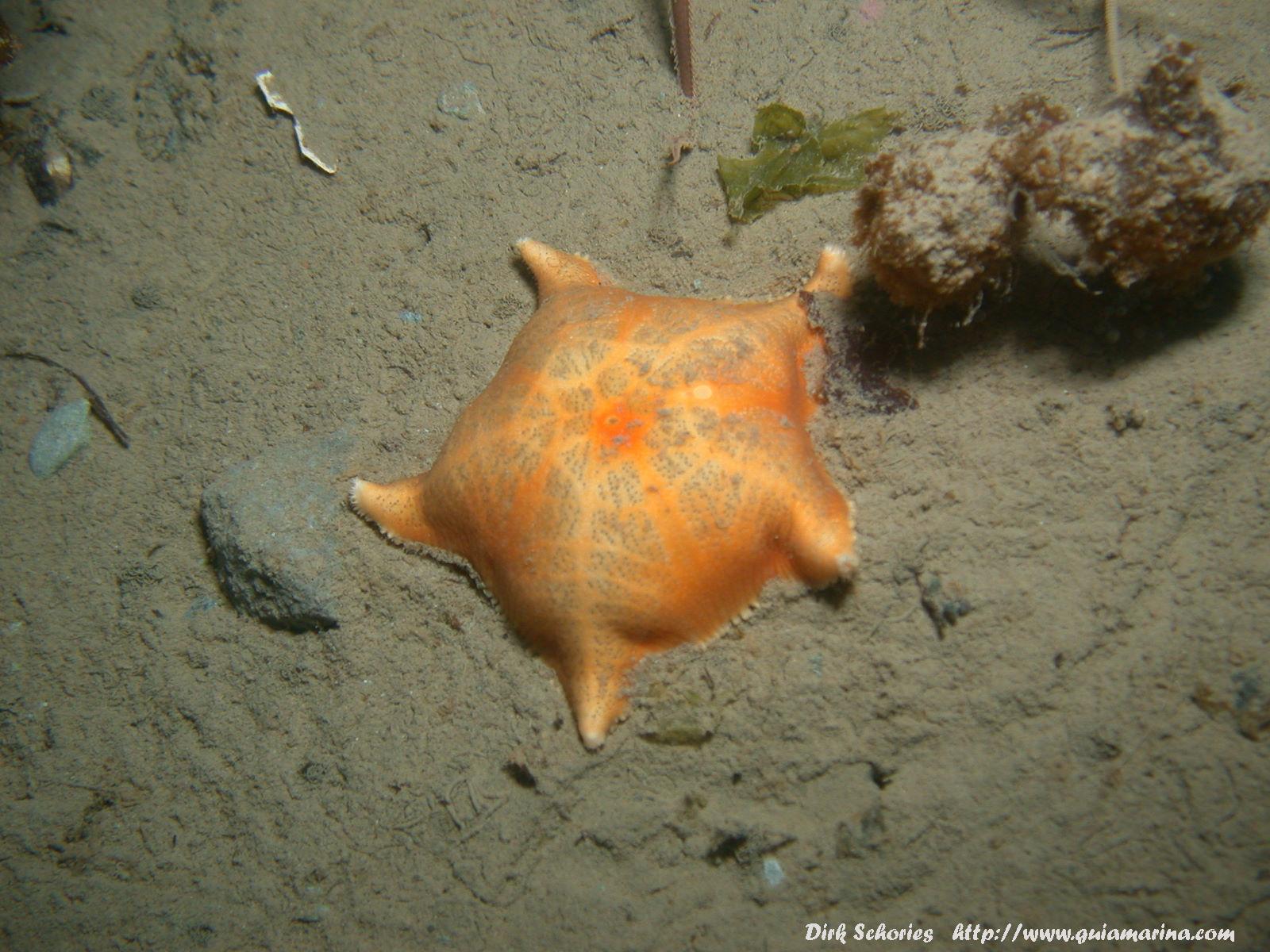 |
| Photo by Dirk Shories at this site. |
In the above image-the animal looks quite fleshy but in a dried one below..you can see there's actually quite a bit going on...
And here are some rather large Macroptychaster in a pic seen around the world..but you can see how big they get. The % of Mg-calcite is quite high in this and many other Antarctic asteroid species...

One major conclusion: Antarctic echinoderms-especially sea stars (starfish) have high amounts (in terms of % of total weight) of Mg-calcite in their skeletons.
This total amount of Mg-calcite was compared relative to OTHER %of Wt. values across different latitudes (0=equator, higher = closer to Antarctica)

Note the datapoints indicated by the RED ARROW. Those are the data from Antarctic taxa.
There's a global pattern that shows that those echinoderms close to the tropics have, by weight, the greatest % of Mg-calcite. This makes sense when you think about how heavily calcified tropical starfish are (such as this Protoreaster nodosus)

An excellent question. Here are some answers.
1. Temperature is an important part of the "calcium carbonate in sea water" ocean chemistry dynamic. Cold water settings, such as the Arctic and the Antarctic have shown the most dramatic decreases in the amount of calcium carbonate available for shell/skeleton building as ocean acidification increases. This has been shown most recently in pteropod mollusks (click here for ref)
2. Mg-calcite is most vulnerable to dissolution. A study on coralline algae (that's algae which builds a skeleton for itself using the mineral Mg-calcite) showed that when 8-12% by wt. of a calcite skeleton is composed of Mg-calcite it becomes HIGHLY soluble.. Look above at the Table 2 from the paper most sea stars have 9 to 10% by wt. Mg-calcite skeletons!
3. Echinoderms are a dominant force in the Antarctic. They have HUGE biomass. In other words there's a LOT of them and they're important to the global carbon cycle. Notice the large numbers of sea stars in the video below...That is a lot of Mg-calcite...
Thus, Antarctic species may not have the highest % of Mg-calcite across the full "band" of possibilities but they are among the MOST vulnerable.
So-all this leads to an important realization:
Echinoderms, probably sea stars, will probably be an important, I daresay, critical indicator of which faunas will be affected as climate change continues and ocean acidification creates a more acidic ocean environment.
This could affect the larval development, the physiology or the ecology of these species. Its also important to realize that echinoderms have an endoskeleton as opposed to a shell which is what you see in other studied taxa... MUCH more remains to be studied.
Its also interesting to note the prior extinctions of echinoderms and other echinoderms from Antarctica as I've mentioned here , possibly during the Eocene glaciation event.