Showing posts with label porania. Show all posts

Wednesday, March 20, 2013

Antarctic Echinoderms:Canary in a Coal Mine for Ocean Acidification?

This week a 2011 vol. 119(5): 457-466 paper  from the Journal of Geology by Antarctic biologist James McClintock, my colleagues at the University of Alabama (M. Amsler, R. Angus, R.C. Challener, J.B. Schram, C.D. Amsler), myself and colleagues at the University of South Florida (J. Cuce and B. Baker).

Our paper addresses how Antarctic echinoderms but specifically sea stars (=starfish) and brittle stars are likely to be vulnerable as the climate changes, creating a more acidic ocean environment.

Here is a quick video that nicely summarizes the broader phenomena of Ocean Acidification (abbreviated OA)

But here is where we add further details-the acidification? affects different kinds of calcium carbonate (the material which composes shells, coral skeletons, etc.) differently...

Most of the shells and skeletons that you read about in the news are usually made either out of different forms of calcium carbonate-either aragonite (wikipedia has a nice summary here) or calcite. Aragonite is usually what's seen as associated with shells, skeletons, etc..

But, of course, echinoderms being echinoderms have something a little different going on... Echinoderms have skeletons with a high concentration of magnesium (Mg).

Their skeletons are composed of Mg-calcite (magnesium calcite)

One can see many recent stories about how aragonite in shells is easily dissolved by ocean acidification.

Mg-calcite is even MORE soluble (and more vulnerable) than aragonite!

Looking at Mg-calcite in Antarctic Echinoderms
McClintock and his team sampled some 26 species of echinoderms, representing all 5 living classes (sea stars, brittle stars, crinoids, sea urchins, sea cucumbers) and analyzed them for % composition of Mg calcite. 

The sampled specimens showed that skeletal components in Anatarctic echinoderms met the defined standards for "high-Mg-calcite species" (MORE than 4% Mg-calcite by mol%)
Sea stars

Of all the echinoderms? Which had the HIGHEST amount of Mg-calcite by % weight??
Several species of Starfish!

I would note that ophiuroids were not heavily sampled-below but in all liklihood they are just as if not more important here..

Specfically, this very widespread species, Porania antarctica  dsplayed among the HIGHEST % weight of Mg-Calcite
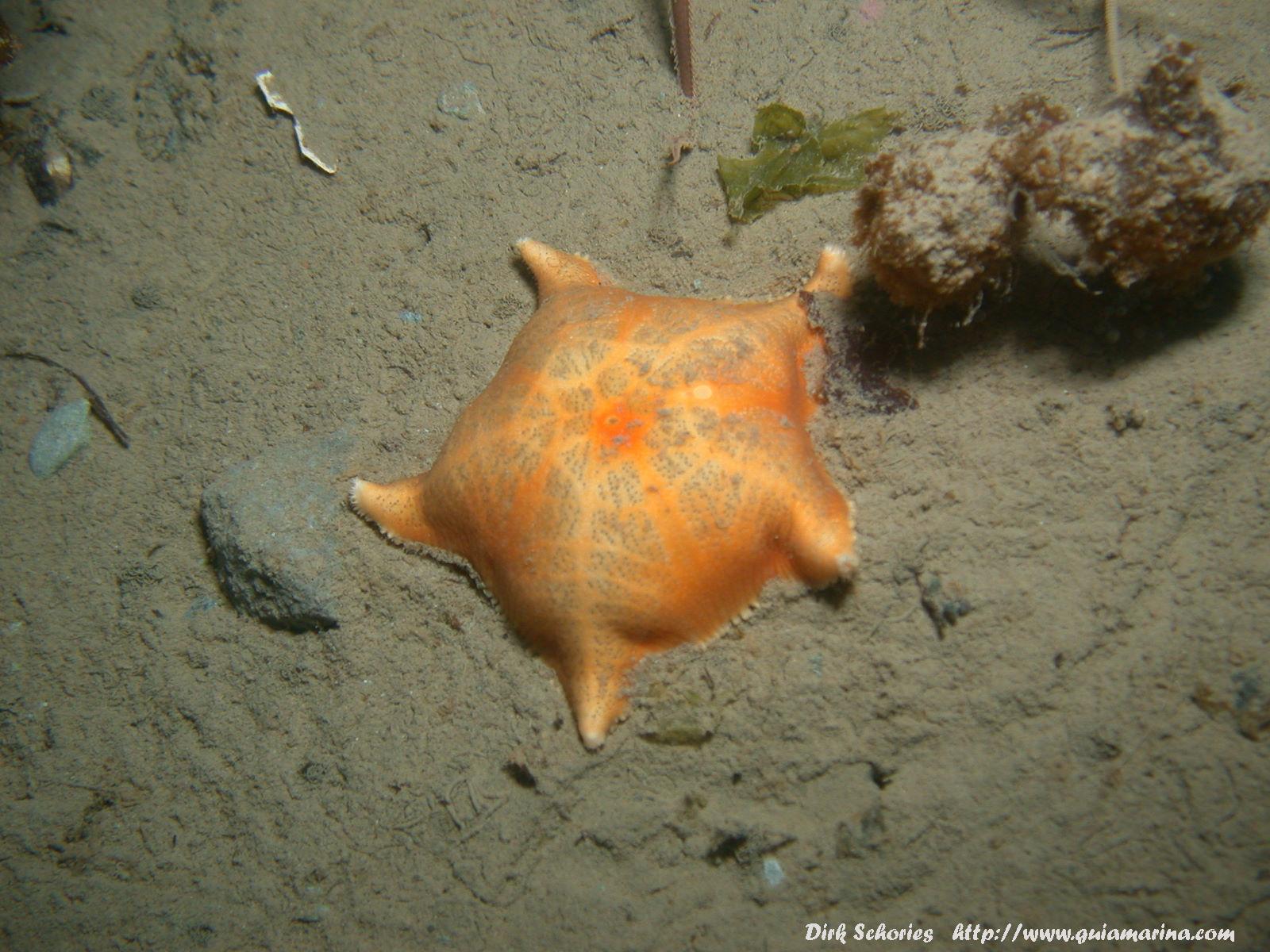
Photo by Dirk Shories at this site.
In the above image-the animal looks quite fleshy but in a dried one below..you can see there's actually quite a bit going on...
And here are some rather large Macroptychaster in a pic seen around the world..but you can see how big they get. The % of Mg-calcite is quite high in this and many other Antarctic asteroid species...
                                      
One major conclusion: Antarctic echinoderms-especially sea stars (starfish) have high amounts (in terms of % of total weight) of Mg-calcite in their skeletons.  

Mg-calcite is more inclined to dissolve as a result from OA and therefore makes them highly vulnerable to dissolution!
This total amount of Mg-calcite was compared relative to OTHER %of Wt. values across different latitudes (0=equator, higher = closer to Antarctica)


Note the datapoints indicated by the RED ARROW. Those are the data from Antarctic taxa.

There's a global pattern that shows that those echinoderms close to the tropics have, by weight, the greatest % of Mg-calcite.  This makes sense when you think about how heavily calcified tropical starfish are (such as this Protoreaster nodosus)
Protoreaster nodosus

So, if tropical echinoderms have the greatest % of Mg-calcite by weight, why are we worried the MOST about POLAR species???

An excellent question.  Here are some answers.

1.  Temperature is an important part of the "calcium carbonate in sea water" ocean chemistry dynamic. Cold water settings, such as the Arctic and the Antarctic have shown the most dramatic decreases in the amount of calcium carbonate available for shell/skeleton building as ocean acidification increases.  This has been shown most recently in pteropod mollusks (click here for ref)

2. Mg-calcite is most vulnerable to dissolution. A study on coralline algae (that's algae which builds a skeleton for itself using the mineral Mg-calcite) showed that when 8-12% by wt. of a calcite skeleton is composed of Mg-calcite it becomes HIGHLY soluble.. Look above at the Table 2 from the paper most sea stars have 9 to 10% by wt. Mg-calcite skeletons!

3. Echinoderms are a dominant force in the Antarctic. They have HUGE biomass. In other words there's a LOT of them and they're important to the global carbon cycle.  Notice the large numbers of sea stars in the video below...That is a lot of Mg-calcite...
Thus, Antarctic species may not have the highest % of Mg-calcite across the full "band" of possibilities but they are among the MOST vulnerable.

So-all this leads to an important realization:  

Echinoderms, probably sea stars, will probably be an important, I daresay, critical indicator of  which faunas will be affected as climate change continues and  ocean acidification creates a more acidic ocean environment.  

This could affect the larval development, the physiology or the ecology of these species. Its also important to realize that echinoderms have an endoskeleton as opposed to a shell which is what you see in other studied taxa...  MUCH more remains to be studied. 

Its also interesting to note the prior extinctions of echinoderms and other echinoderms from Antarctica as I've mentioned here , possibly during the Eocene glaciation event.

Monday, January 31, 2011

The Lost World: The biology of echinoderm "living fossils" (stalked crinoids) on an Antarctic Seamount!!

Dinosaurs Living in Underground Caves! Pre-historic Monsters Living in the Deep Sea!

This is what we envision whenever the term "living fossil" gets brought up!
At this exact moment, a whole bunch of paleontologists' heads are exploding BECAUSE I've used the term "living fossil". (BABOOM!) Why?

The term basically refers to any organism that physically RESEMBLES an organism that we know primarily as a fossil. So, examples would be..the coelocanth, lungfish, nautilus, ginko trees, and tuataras.
These types of organisms (and not just animals) are often abundant or at least, prominent in the fossil record but are really not too common today..

Why does this cause such ire in people who study fossils? Well, I would say that its inaccurate and hard to define. Technically EVERYTHING alive is a "living fossil". Its an ambiguous term at best. And the "good examples" are largely biased by public perception of the most frequently encountered fossil types. So, really the term doesn't mean anything! And yet the term persists...

THAT said.. people (including scientists) continue to have a fascination with "archaic" forms, which continue to live in the "recent" and the ecology that said forms exhibit.

It is through observation of how these modern analogs of extinct fossil animals interact that we hope to gain insight into ecosystems into the past. A romantic might almost say that these provide us with kind of a "window to the past"....

This is the subject of this week's blog.. A NEW paper by David Bowden and associated researchers at New Zealand's foremost oceanographic agency-NIWA (New Zealand Institute of Water and Atmosphere) focusing on "Archaic crinoid-dominated assemblages on an Antarctic Seamount) in the new issue of Deep-Sea Research II.

Stalked crinoids of course, are one of the most prominent of echinoderm "living fossils" and are the ancestors of the smaller feather stars seen today in tropical habitats. The relationship between the two can be seen in this past blog...
The paper features video captured by NIWA's towed video array operated by the R/V Tangaroa
From this area... (in the box). This includes Admiralty Seamount and several other seamounts and islands just north of the Ross Sea.
And it is on Admiralty Seamount that they see a substantial population of a NEW species of a large (~50 cm tall!) stalked crinoid !! (Family Hyocrinidae)

Note that hyocrinids, unlike other stalked crinoids are permanently attached to the bottom.
Out of a total seabed area of approximately 11,300 square meters..they observed 1,348 crinoids!
(images courtesy of David Bowden, NIWA)

Admiralty Seamount is apparently QUITE the hangout for the filter-feeding set. Also seen on the seamount in large densities is the large suspension feeding ophiuuroid Ophiocamax gigas...
(image courtesy of David Bowden, NIWA)

Among some of the more interesting interactions... one of this crinoid being devoured by Porania antarctica
(image courtesy of David Bowden, NIWA)

This is kind of interesting to me..because poraniids have one of the oldest fossil records of modern asteroids. A Triassic fossil poraniid (click here) was described here.

and here we see the sea urchin Sterechinus antarcticus also apparently munching on a crinoid.
(image courtesy of David Bowden, NIWA)

Sea urchins attacking stalked crinoids?? We've discussed that relationship here and here with regards to cidaroid sea urchins versus stalked crinoids in the deep-sea..

So, among the first observations is that with the crinoids and their echinoderm predators, we see a conspicuous LACK of big crab and fish predators. This suggests that it is a "Paleozoic Style" Ecosystem as proposed by Rich Aronson, Dan Blake and others which is present in the Antarctic.

This is an ecosystem dominated by suspension/filter feeders, particularly invertebrates. Certain types of predators, such as crabs and fishes, which are able to crush bony parts were absent-and so many MORE types of invertebrates flourished without being devoured.

This type of ecosystem occurs throughout geologic history wherever and whenever certain types of predators are absent.

One such ecosystem that included suspension feeding ophiuroids and crinoids similar to the ones on Admiralty Seamount was thought to have been present about 65 to 56 million years ago (the Palaeocene) but which again, ended due to a radiation of fishes and crustaceans around that time. Dang fishes and crabs!
How did this particular assemblage of crinoids and associated suspension feeders (without predators) originate?

Physical oceanography may be the key, as several factors (including current and food) influence how the different taxa are transported onto the seamount. As it turns out, Admiralty Seamount is close to the center of a nearby ocean gyre,

(Figure 7B from Bowden et al., 2011)

The seamount's location may be influenced by a confluence of the gyre, plus cold currents from the Ross Sea region, which likely reduces the chances of larvae (small baby forms of marine animals) arriving at the seamount from the "source populations" near shore.

And both of the species above have floating larvae that disperse via ocean currents..
(photo by Allison Gong. Not from Porania nor from an Antarctic species..its just here to help demonstrate a point.)

It may be the location of the seamount under the center of this gyre and the interaction of currents from the Ross Sea shelf that prevent the larvae of predators, such as crabs, from settling and growing out as well as ensuring the preferential settlement of suspension feeding critters like crinoids and ophiuroids.

Thus, it may be the seamount's location (which effectively isolates the crinoids and ophiuroids from predators like crabs and fish) acts as a sort of "refuge" where this "Paleozoic style" ecosystem can continue to persist!

So, how long have these crinoids been around Admiralty Seamount? Some intriguing clues present themselves.

Remember how I said that hyocrinids were anchored? Their holdfasts and attachment points are found all over the sea bottom and are the remants of past animals which have died. (these are the tiny white circles on the rock).
The authors speculate that based on the accumulation of sediments formed from crinoid body parts (ossicles) in conjunction with a conservative age per generation of about 20 years, this alone suggests that the crinoids here may have "persisted for centuries...if not millennia."

Sadly, all good things must come to an end...

The authors also note that the area of seabed at Admiralty Seamount covered by sediments formed by crinoids and these basal disks is much greater than that covered by living animals.

This, in conjunction with the observed predation-the authors speculate that the crinoid population here may already be on its way out... Talk about a gentrified neighborhood!