Showing posts with label Antarctic. Show all posts

Tuesday, September 29, 2015

Let's Learn About Multi-armed OPHIUROIDS!


I've often talked of my love of multi-armed sea stars. BUT brittle stars can have more than five rays (arms) also!!

So wait, there are ophiuroids (brittle stars, basket stars, etc.) that have MORE than 5 rays?? 
Yes.
Most sea stars (close relatives to ophiuroids) have 5 rays, but a significant number of them have more than five rays and there are some entire groups of sea stars (e.g., the Brisingida) which are characterized by having multiple arms (six to 20ish). When sea stars have more than 5 rays there tend to be about 7 to 15 of them. But some, such as the Antarctic Labidiaster can have up to 50.

What one sees in most  starfish species is that multi-armed sea stars tend to be large, highly mobile and predatory. This tropical, shallow water Luidia maculata for example demonstrates all of those qualities.
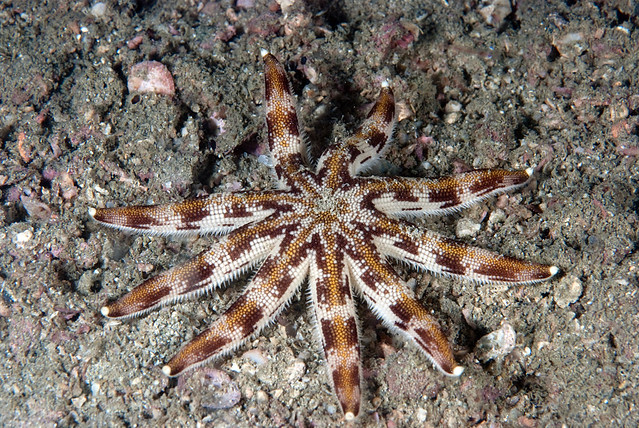
Ninearmed starfish (Luidia maculata)
In contrast, Multi-armed ophiuroids have different patterns than what sea stars demonstrate. Ophiuroids tend to be either six to seven rayed or 10 or more. Generally none with intermediate arm numbers (i.e., 8 to 9) and no species are known with more than 12 rays.

Certainly no 20-50 rayed beasts like the sea star Labidiaster. And as we'll see, there's no apparent ecological association with having more than 5 arms in ophiuroids.

The multi-armed condiiton occurs  in many, many different groups of asteroids throughout evolutionary time (here) and has evolved multiple times throughout the group. This is also the case for brittle stars...
(My thanks to Dr. Sabine Stohr for assistance with names!)

Diversity in Multi-armed Ophiuroids
Most brittle stars have 5 rays. Having more, implies that the extra arms are somehow adaptive or suggest that the added investment to develop one further body part is somehow consistent with the life mode of the animal. Most ophiuroids appear to have a much more invested skeleton compared to asteroids, so it would seem that adding more arms is much more of an investment in development,


Low numbered multi-rayed brittle star species, those with about six to eight arms are not uncommon and seem to show a fairly diverse range of habitats. But the ones with more than 10 rays are more seldom seen.

This one for example is Ophiothela danae. 6 rays. These occur in tropical-shallow water habitats and live with their arms wrapped around the stalks of sea fans and sea whips.  Does the sixth arm help facilitate this lifestyle??

This species appears to be successful. It occurs widely in the tropics and has "invaded" the tropical Atlantic from the Pacific. 
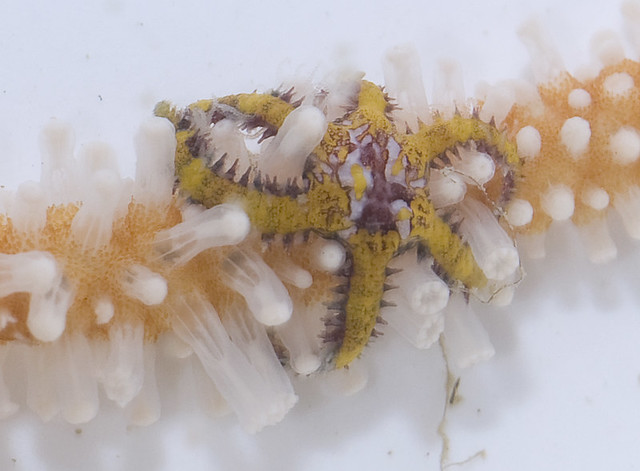
Tiny colourful brittle stars (Ophiothela danae)
Here is Ophiactis savignyi, a brittle star that reproduces both sexually and asexually (i.e. it divides in half) brittle star which occurs globally all around the world (read more here). Perhaps its sixth arm is part of the asexual condition? Or maybe its cryptic life style?

Here is Ophionotus hexactis. Six arms. Adaptive? Predatory? Highly Mobile? An animal I'm not sure much is known about it.


But on the OTHER hand, here are some Antarctic brittle stars, such as Ophiacantha vivipara which have SEVEN arms. Its a brooding species (i.e., the adults raise babies on their bodies). Not sure how this benefits the animal. Maybe in feeding?  Aids in parental care somehow? Or maybe its just an incidental feature?
From Antarctic ophiuroid blog https://brittlestars.wordpress.com/2010/01/27/some-peculiarities-of-the-antarctic-ophiuroids/

There are a few more species of ophiuroids that show six to seven arms than I've shown here. But for various reasons (i.e,  I either didn't have pictures of them, space, etc) I haven't included them. Several species of serpent stars in the genus Asteromorpha for example can demonstrate six or seven arms.

Species with more than 10 arms

Ophiacantha enneactis & O. decaactis. The genus Ophiacantha, is kind of unusual because it includes several species which possess more than 5 arms (see O. vivipara above).

Two of them, O. enneactis (illustration-top) and O. decaactis (below) have been collected from the Aleutian Islands in deep-water. O. enneactis is from 549-881 m. And O. decaactis is from comparable depths.

These are similar species and both are pretty small. What they do down there in the deeps with all their arms is "poorly understood." (i.e. we don't know). Perhaps suspension feeding? Predation?
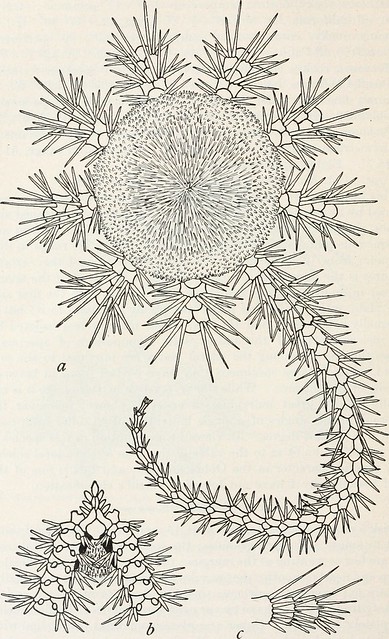
Image from page 233 of "Bulletin - United States National Museum" (1877)
Ophiacantha decaactis Belyaev & Litvinova 1976
Image from Belyaev & Litvinova 1976
Astrochlamys sol Probably the winner of ALL the multi-armed ophiuroids though is this species: Astrochlamys sol, a bizarre Antarctic form, which is a member of the Gorgonocephalidae, so its actually a modified basket star.


I thought Basket Stars already had more than five arms?? 
Basket stars are a subdivision of ophiuroids called the Euryalida. They tend to have big, thick arms with fleshy tissue covering over their skeleton. These ophiuroids extend their arms into the water column and usually have hooks or long arms to feed on food or prey as it swims by..

I've written about one particular basket star, Gorgonocephalus here  But there are a fair number of basket stars in cold water and tropical habitats.

Note that although there seem to be many arms, there are in fact ONLY five. But they branch...
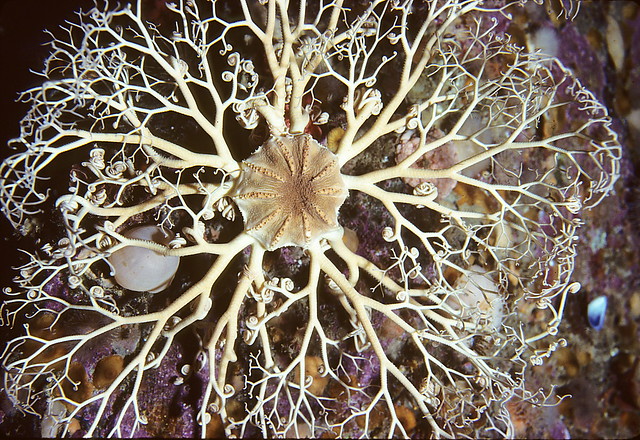
Northern basket star, Gorgonocephalus arcticus, off Cape St Francis, Newfoundland, Canada

Below is the underside of Gorgonocephalus, the cold-water basket star from the Arctic/subArctic. Note that only five rays radiate away from its mouth. The  arms bifurcate or split for several iterations away from the five primary rays on the disk..


That's what makes A. sol, so unusual. It actually has 10 to 11 arms!! Making it the ophiuroid (not technically a "brittle star") with the MOST number of arms!
Its species name "sol" refers to sun, which likely alludes to its arms radiating away from the mouth.

This species occurs in the Antarctic in fairly deep depths 300-1200 meters. It was described by the famous echinoderm taxonomist/biologist Theodor Mortensen in 1936 in his HMS Discovery monograph. We apparently don't know much about its biology aside from the fact that its a brooding species and tightly hugs its substrate...
Image by Igor Smirnov via WoRMS
On a personal note I'm always fascinated by these forms. Unusual in appearance but also kind of mysterious.  What does it do with all those arms? What is so unusual about deep-sea/cold-water/Antarctic species that they have so many arms? Is brooding related? 

Friday, August 12, 2011

Some Cool Chilean (Antarctic) Echinoderm Time Lapse Videos!

This week I am doing some museum/starfish related travel.

So that means Videos!

Antarctic Time Lapse= GO!

Some sea urchins...

the basket star Gorgonocephalus chilensis (the good bits star about halfway through..)

more urchins..

Chilean bottom critters (invertebrates mostly)

And this one is always a classic!

Saturday, June 19, 2010

Saturday extra! FANTASTIC Antarctic Underwater dive Video!!

This is a FANTASTIC video of diving in Antarctica that I don't think has been appreciated enough... The cool Antarctic inverts don't start until about 2 minutes in..

Antarctica - Below Zero from Alex.Be. on Vimeo.

The Time codes for interesting stuff:

-sponges and anemones (along with some sponge-eating Odontaster) at 2:30-2:40
-Anthomastus like soft coral at 2:40
-the big krill eating starfish Labidiaster at 2:49 (its being pretty quiet though)
-A Cool looking salp at 4:24
-Awesome Antarctic isopod at 4:40
-Dorid Nudibranch at 5:17
-Amphipod at 5:40
-Limpet at 5:50

Alex.be has MANY awesome videos. His underwater lake videos are hauntingly beautiful.

Echinoblog sez GO CHECK IT OUT!

Tuesday, December 29, 2009

Antarctic Echinoderms! Courtesy of the British Antarctic Survey

The British Antarctic Survey has recently put out a spread of cool Antarctic invertebrate images. These include this "sea pig" (a sea cucumber, Family Elpidiidae- probably related to the deep-sea Scotoplanes)
(photos by BAS photographer Peter Bucktrout)

What they are calling Gorgonocephalus, (an ophiuroid) apparently perched on an octocoral...
(photos by BAS photographer Peter Bucktrout)

The ubiquitous Antarctic crinoid Promachocrinus, which may be composed of a cryptic species complex
(photos by BAS photographer Peter Bucktrout)

....and this isnt an echinoderm (its an Antarctic amphipod)..but damn. Its cool, isn't it?
(photos by BAS photographer Peter Bucktrout)

Monday, December 7, 2009

The Echinoderm Christmas Tree?? Antarctic Cidaroid Sea Urchins!!!

Today, another SPECIAL Holiday-Themed Echinoblog!!! Allow me to explain!

I was just thinking about this:
Are there any kinds of echinoderms that are kinda like Christmas trees? They originate in cold places and you hang all sorts of weird crap on their branches???

hmmm.....YES!

Antarctic Cidaroid SEA URCHINS!!

Most people by now are probably saying "Okay, I'm not sure I understand a LOT of those words you just said"

So here's the Breakdown: There's sea urchins that live in Antarctica (and elsewhere-mostly in the deep-sea) that belong to a group known as the Cidaridae.

Cidaroid sea urchins are one of the more prominent groups found in the cold waters of the Antarctic and do some odd things. But what makes them of interest here is the LACK of skin on their spines!

"What? I didn't know sea urchins had skin on their spines????"

YES. Here is close up pic of a sea urchins spine. Notice the blue line around it?? ALL echinoderms, including sea urchins are actually COVERED by a thin, ciliated epidermis.

This epidermis is the primary reason most echinoderms you see don't get covered in encrusting organisms like algae or small grit and how stuff seems to flow over their body surface.
ALL groups of sea urchins have this epidermis EXCEPT for one group! The Cidaroids. Strangely enough, cidaroid sea urchins LACK a layer of epidermal covering on their spines!!!

As a result, some cidaroid sea urchin spines have become the substrate for encrusting animals that settle as larvae and cover over the spines!!

Thus, the sea urchin becomes a kind of host for a huge diversity of organisms! (shown here-and below is Austrocidaris)
What kinds of animals hang off these sea urchin spines the same way that lights and holly balls hang off a Christmas tree branch??
Here we got serpulid worm tubes of various sizes
....AND we got SPONGES that form around the spines, in and around the worm tubes!!

In addition to those-other encrusting animals recorded living on these spines include bryozoans, hydroids, small crustaceans, sea cucumbers (!), bivalves and foraminifera!

Multiple kinds of cidaroid sea urchins are known to host these many animal "decorations"! The one shown here is Austrocidaris, but others include (but are not limited to) Rhynchocidaris and Ctenocidaris.

But these "decorations" do MORE then just give the urchin that fine finished look!!! They can actually AFFECT the diversity of the area around it!!!

One study by Heterier et al. which focused on cidaroid sea urchins in the Weddel Sea found that the presence of these sea urchins actually PROMOTED higher species richness of these encrusting animals and increased their overall abundance!!

How does THAT work??
It turns out that the sea urchin spine surface is a ATTRACTIVE surface for encrusting animals to live!!

Why?
Most of these encrusting animals are filter feeders (i.e., they pick food out of the water) and living on sea urchin spines lifts them into the water water column and off the gritty, dirty bottom! Its all about prime real estate baby!

So, it is hypothesized that these different species of encrusting critters are actually MORE EFFECTIVE at selectively locating sea urchin spines to settle upon then on general rocky bottoms! These species become more "specialized" in finding a place to live.
BUT, the more "generalized" encrusting animals are left to settle on rocks in the surrounding area. So, the presence of urchins AND rocks apparently separates different SPECIES of these animals!

However, it does not alter the actual composition of overall diversity (i.e., many different kinds of foraminiferan species may settle but not different phyla of organisms).

So, the "decorations" on some of these cidaroid sea urchins can change (however subtly) the composition and richness of its surroundings !!!

Ha!

Can a "normal" Christmas tree do that?
You decide.

Happy Holidays from the Echinoblog!

Monday, April 13, 2009

The NMNH US Antarctic Research Program Page is OPEN!


Today, I wanted to announce that the United States Antarctic Research Program (USARP) office in the Smithsonian NMNH Invertebrate Zoology Department opened their website today!!(click to go see!)

This has been an ambitious project to catalog ALL of the Antarctic and subAntarctic marine invertebrates (including but not limited to corals, jellies, worms, crustaceans, mollusks, and of course...echinoderms!) which have been collected under the auspices of the USARP since 1963 and housed in Washington DC in the collections at National Museum of Natural History! This project is of course, supported by the NMNH and the National Science Foundation!!


I have written up how I have worked with the USARP in order to get the specimens and this website up and running (link here).

and mentioned some neat pictures and a site that features the people involved wth USARP!

Their website has a bunch of cool features!  For example...let's take a look at the deep-sea molpadid sea cucumber Molpadia musculus!!

1. Specimen Photos!

You get an expert photo for some of the available specimens!
(NMNH specimen USNM E33281.341505)

2. DATA!!

You also get a summary of all the NMNH holdings of that particular Antarctic or subAntarctic species!!

What's even MORE cool???? You can get this information MAPPED onto a display of the Antarctic area and classified by depth range!!!!
And of course, what good would it be if it didn't come cross-referenced with a taxonomic scheme and basic classification information???
The website is a work in progress...but from what I've seen the database is VERY well populated...so definitely a good start!!

The citation:

Lemaitre, R., M. G. Harasewych, and J. Hammock (Editors). 2009. ANTIZ v 1.0: A Database of Antarctic and Subantarctic Marine Invertebrates. National Museum of Natural History, Smithsonian Institution. World Wide Web electronic publication. URL http://invertebrates.si.edu/ANTIZ

Thursday, March 12, 2009

The Starfish Elvis


(Pteraster sp. image courtesy of the USARP-thanks to JennH for the gestalt!)

Ha! (so sue me. its the end of the week!)

Thursday, December 4, 2008

Antarctic Echinoderm Video Friday!

Today..some Video from some recent expeditions to Antarctica by The Census of Antarctic Marine Life!

to see the full Youtube channel for the Census of Antarctic Marine Life click here.

A News report from NDTV (New tang Dynasty TV)


Dance of the Feather Stars


Accompanying text on this video:
Video from the Deep Underwater Camera by Rob Beaman, research scientist in marine geology at James Cook University, Cairns, Australia.
Feather stars live fixed to a substrate (sediment, other organisms) by small appendices called cirri. To move about, they free themselves by opening the cirri and moving their arms in an organized fashion that releases them. They rise in the water column and move a few meters then drop like a parachute. The video shows several Antarctic feather stars swimming, here: Promachocrinus kerguelensis. It can move as a flight reflex when confronted with a potential predator or an environmental disturbance, due here to the approaching camera. Swimming time is brief (a few seconds) because the energy required to mobilize the arm muscles is quite substantial.


Polarstern-Census Antarctic Marine Life ROV footage


Accompanying text for this video (by Gauthier Chapelle):
13th of January 2007
Third ROV footage of the seafloor in the Larsen B area, Antarctica. It was taken at 250 m water depth, right in front of the new ice shelf edge after it collapsed in 2002. The bottom is composed of very fine sediment and occasional drop stones, which is surprising, so close to the ice shelf edge.
The first fifteen seconds show a recent ice scour left by an iceberg on the sea floor. Then, the first translucent species of holothurians (also known as sea-cucumbers) appears, which is feeding by extracting organic matter from the ingested muddy sediment. The second species, on the left side, is bigger, with a plumper shape, and is very rarely seen outside the deep sea in Antarctica. These two holothurians were the dominant species. The next animals are a solitary hydrozoan (related to corals), three yellow sea lilies, or stalked crinoids, also commonly found in the deep sea and finally a sea anemone. They are followed by two types of structure; firstly a crater-like, probably also created by a foraging animal, and secondly little mounds, possibly produced by burying worms. The sequence ends with two bushes of colonial hydrozoans and a glass sponge.

And...More ROV footage..keep your eyes open for the Antarctic cucumber!

Tuesday, May 6, 2008

Giant Monster Starfish ALERT (aka Labidiaster annulatus) from THE SOUTH POLE!!!

ye olde tale of Antarctick Monstrosity....

One of, if not THE most rewarding experience I had when visiting Antarctica was finally getting to see this animal ALIVE.

When I began studying starfish many years ago, I was captivated by this paper by John H. Dearborn, K.C. Edwards & D.B. Fratt 1991 who very wonderfully described the feeding biology and behavior of Labidiaster annulatus...a large BENTHOPELAGIC predator in the Southern Ocean ecosystem!
yes, you heard that right. A starfish that EATS mobile SWIMMING prey. Not just the odd, errant sick fish..but small, fast moving krill on a regular basis!!

How?
Labidiaster annulatus uses these crazy long arms (note the rings which contribute to the skeletal flexibility) to wrap around, nab or otherwise grab prey in conjunction with these helpful things....
(pedicellariae from Dearborn et al. 1991)
These nightmares from a dental convention are awesome structures are known as PEDICELLARIAE.
Essentially, they are jaw/claw-shaped structures that literally cover the surface of the animal like a big dangerous, shaggy rug covered with bear traps.

When small krill or other prey settle, get too close or otherwise get within striking distance..the starfish GRABS the food with the pedicellariae or its arms and DRAGS the prey via the arms and tube feet down to the mouth, where it is digested immediately by the stomach.

Labidiaster does eat other food..moribund material, etc. as opportunity presents. But gut contents suggest that pelagic prey...amphipods, krill, etc. are its preferred prey. The picture below was taken after having fed a Labidiaster specimen at the Palmer station Marine Lab aquaria.

But even this is only PART of the picture. Other physical aspects contribute to the striking image of this beast:

1. Labidiaster is BIG. With arms outstretched...these animals can reach and possibly surpass a diameter of TWO FEET!

2. They PERCH. That is, they find places to crawl up onto in order to take advantage of water flow...so they sit like kings on sponges, rocks, or what have you and sit above the substratum with their immense arms outstretched like large deadly flowers.

3. Labidiaster is very abundant within its range. Basically, Labidiaster is one of the most numerous starfish to be found in the South Shetland Island/Antarctic Peninsula region (see Manjon-Cabeza et al. 2001)

These Antarctic benthos look like a scene out of some terrifying Lovecraftian-horror story...Large tentacled starfish sitting on their monstrous poriferan thrones ruling over the obsequious but ravenous brittle stars, swimming carnivorous ribbon worms, and who knows what other crazy stuff running amok!! But curiously...NO Fish!! Something I will go into further detail later on...