Showing posts with label citizen science. Show all posts

Wednesday, January 24, 2018

Unusual Surface Texture in Luidia ciliaris! Unknown natural history or ???

GREETINGS! and Happy New Year! Yes.  Sorry. Its been awhile since I've blogged.. Lots of travelling and research are a good thing...but time for essential outreach can sometimes be fleeting!

For my inaugural 2018 post: a MYSTERY!

I've written about the genus Luidia before.. these are predatory sand stars which are found all around the world.

They can vary in appearance and in some places they are very abundant.. Most species are shallow and occur in temperate tropical habitats. Although many species are five rayed.. some such as L. ciliaris can have seven or more arms. Some species in the tropical Indo-Pacific have very striking patterns and can reach almost 2 feet in diameter!

Luidia ciliaris is found pretty much only in the North Atlantic although it has likely close-relatives in nearby areas. This species is regularly seen by divers in the United Kingdom, France, Spain and etc..
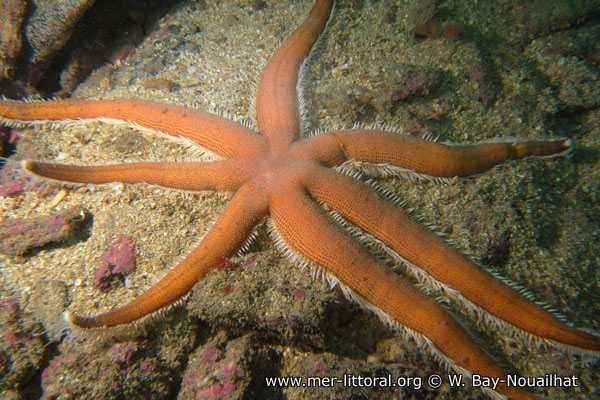
Image from http://www.european-marine-life.org/30/photo-luidia-ciliaris-wb01.php
Today.. Andy Jackson, an underwater photographer grabbed this wonderful time lapse video of the North Atlantic 7 armed sea star Luidia ciliaris IN ACTION!  Doing a move through this field of brittle stars! 

seven armed starfish with banding - Luidia ciliaris from Andy Jackson on Vimeo.

Interestingly, he noticed that THIS one had a VERY unusual banding or strange segmentation on the arms!
He came to me with the question.. WHAT IS the BANDING??? That strange surface texture that is visible on the surface of the animal???

You see it in headlines a lot...but I will actually say it "Scientist (in this case-ME) was baffled!!"

BUT, it turns out other people on social media have seen it before.. even if they didn't realize what it was... 
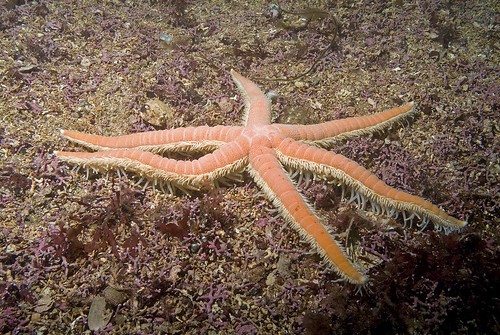
 A seven armed starfish on a maerl bed with red seaweeds
Here is a normal one again for comparison.. the top surface is even.. NOT with the strange surface segments present along the arms..
Image from http://www.european-marine-life.org/30/photo-luidia-ciliaris-wb01.php

So, when I see deformations like this.. I always have to wonder about two possible hypothesis:

1. Is this a "normal" part of this species' behavior?? Something which we have simply never seen before?  
2. Or could it be NOT normal... What could this mean?? I don't know. But years ago? Sunflower stars in British Columbia began experiencing weird "arm twists"  and it wasn't much longer after that, that the entire population of sunflower stars suffered from SSWD

One might see from Andy's video that the animal was in the process of moving through a field of brittle stars..could the odd surface texture have been caused as a defense? from irritation? stress? 

This is why "Natural History" becomes important! and how citizen scientsts, including everyone from divers to intertidal naturalists have something to contribute! 

For example, this Twitter thread from July 2017 shows a specimen of Luidia ciliaris washed up on a beach with the"banding" on its arms.. (note arm in front above the person's left hand)
Photo by Chris Orr via Twitter
One person in the thread speculates that the star was not in good health...was it? Possibly just stressed from being washed up??  Certainly, this was idle speculation and it is difficult to know what was going on... 
So, I am putting this OUT THERE to let people be aware of it.. and who knows? 
WHAT DOES THIS MEAN??? 
Perhaps a pathologist, natural historian, ecologist and more? Might take up an interest... More data and MORE OBSERVATIONS could well help us figure out if this is something to be concerned about..
(thanks to Andy Jackson and Bernard Picton!)

Wednesday, July 29, 2015

Deep-Sea Citizen Science??? Okeanos Begins August 1 in the Hawaiian Islands!

NOAA Ocean Explorer: NOAA Ship Okeanos Explorer: Galapagos Rift Exploration 2011 - EX1103 Leg2

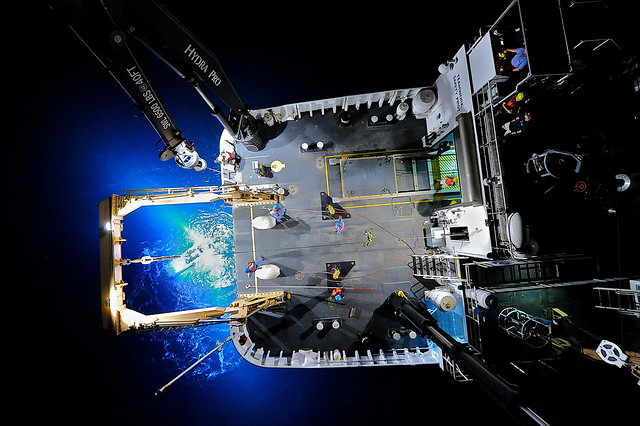
At the moment, the Explorer has been mapping the region and you can see all of this live, but come Saturday you'll be able to watch the actual EXPLORATION of the Hawaiian deep-sea here:
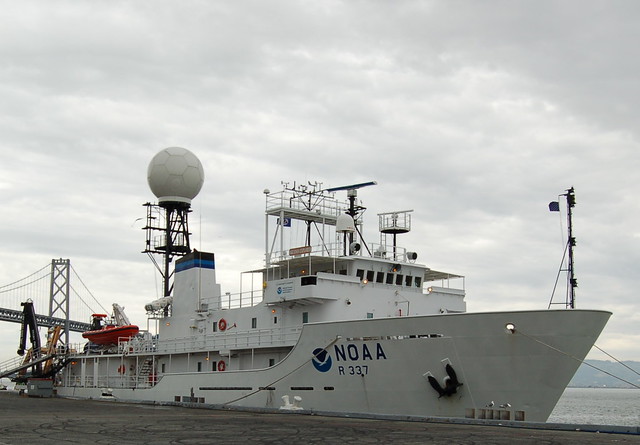
NOAA Ship Okeanos Explorer (R 337)
                             
Why am I so Farkin' excited about this??
I've been studying deep-sea Hawaiian starfish since the mid 1990s and in fact, my very first EVER publication was a checklist of Hawaiian starfish based on material at the Bishop Museum in Honolulu. In 2001 I got to actually go to the BOTTOM of the Hawaiian deeps! (about 1000 m I think?) in the submersible Pisces V. 

So, to actually be able to SEE all of these species with High-Definition video?? EXCITING!!

What Sorts of Starfish and other Echinoderms Will We See??
As with past Okeanos Explorer dives, the dives will involve a Remotely Operated Vehicle deployed to the deep-sea with narration but also with ONSHORE support via phone, computer and social media. That includes me and a veritable ARMY of other marine biologists, including ecologists, taxonomists (i.e. people who identify different species) and geologists.

I've helped summarize the various starfish species seen on Okeanos Explorer dives in the North Atlantic (here).  But the diversity in the Hawaiian region and especially in the Pacific is fair bit MORE diverse!
and even though there's been a deep-sea research operation in Hawaii for the last 30 years or so, the truth is, we don't know a lot about many of the animals which live out here. So, the chances of our seeing something new out here? I would think those chances are VERY good!

The folks at the Hawaiian Undersea Research Laboratory have an "ID Gallery" not just of Sea stars but of ALL the many different animals found at depth here... from crustaceans to corals and sea urchins to fish! 

There's the potential to encounter one of approximately 55 species of deep-sea asteroids described in the Hawaiian region (that's not including any shallow water species).
I've had the pleasure of describing at least four NEW species in the Hawaiian region, including  Apollonaster kelleyi, named for Dr. Chris Kelley who will be one of the science leads on the Okeanos team!
We may even get to see my other new species, Astroceramus eldredgei (named for Lu Eldredge at the Bishop Museum) in glorious feeding action!
Image courtesy of HURL
Here are some posts I've written about the deep-sea Hawaiian fauna, including
BUT WAIT! That's not all! What about the Citizen Science part I mentioned!!! 
The Okeanos live stream has played a big role in part of a new and fascinating dynamic to deep-sea research!  Citizen Science!

Now ANYONE around the world can watch a live streamed research cruise! (Note: Google is GREAT at helping calculate the time differences in different parts of the world).

But how does the citizen science thing work?

Screengrab software is pretty much a free feature on computers. My macintosh has it and I'm pretty sure most PCs have it. And if it doesn't already come with it, you can probably download some free software for it.  There are even software apps that allow you to take short movies off the video feed.

So, basically, ANYONE can basically take a screengrab off the feed and contribute to a larger community of scientists and other interested people who are interested in deep-sea biology!!

IF YOU SEE SOMETHING NEW you will see it along WITH the scientists and the entire world!
Who knows? Maybe a screengrab that YOU take could lead to a new discovery!!

Where do you find these and how do you contribute?

There's TWITTER of course! Hashtag it with #Okeanos and Boom! there it goes!  If I can, I actually make it a point to LIVE TWEET any identifications and observations I make off the live stream..
In addition to my Twitter handle: @echinoblog, others scientists and biologists who are usually watching include
@ademopoulos An ecologist at the US Geological Survey
@DrChrisKellogg A microbiologist/coral biologist
@CarinaDSLR A marine biology PhD student 

But there are often many, many more...

The other interesting option is the FACEBOOK Underwater webcams Screenshot Group!  So, basically if you join, this group is made up of nearly 1000 people (some scientists but many are not) that are just taking and posting screengrabs from underwater live stream video including R/V Nautilus and Okeanos Explorer.

There's usually someone on taking a grab of something almost 24 hours a day. If you missed that cute dumbo octopus?? Not to worry, in all liklihood, someone took a screen grab of it on this group!

If you see something during the Okeanos feed, you can usually ask someone on Twitter or in the Facebook group and one can usually get a response the same day.. There are innumerable taxonomists and scientists monitoring. Some will call in on the phone, which you'll be able to hear on the live stream, others may add information via the Facebook group while others such as myself may Tweet an answer.

New discoveries happen pretty regularly. New behavior. New species. Sometimes even rarely seen species!  On the last Okeanos Cruise, you may remember that they observed a deep-sea starfish which had not been seen since 1878 (130 years!)

Who knows what we shall discover in Hawaii???

Tuesday, April 16, 2013

Natural History Meets Data Mining! A case study in Porania pulvillus

porania pulvillus-01
Image by Geir Friestad via Flickr. Norway I think.
I've always been a big fan of how the vast body of available images and crowd-sourced information can be beneficial to scientists but also interesting and engaging to the citizen scientist!  From tracking down videos and images of rarely seen benthic ctenophores (here) to helping to locate invasive brittle stars! (here)

As I've said in the past-images and videos collected by everyone..from amateur divers on Flickr to pics aggregated on websites such as the Encyclopedia of Life contain MASSIVE amounts of potential observations (and thus data)!! 

But of course, the images have to be recognized first.  How often do discoveries like this happen?  Sometimes new species are found on Flickr (such as this new lacewing species). 

I've blogged about how crowd sourcing and citizen science has discovered new and unpublished (or at least very poorly known) commensal behavior in sea stars, fishes and their commensals (here!) and today another discovery!  

But not in the exotic Indo-Pacific but in the cold to temperate water familiar North Atlantic!! 

Our subject is a starfish called Porania pulvillus (aka the "red cushion star"-one of many), one of many summary accounts of this species can be found here.  It is an uncommon but recognized species in the North Atlantic from both the North American and European sides...  Porania is a member of the Poraniidae which is an unusual group occuring mostly in deep-sea and cold-water habitats, occurring from roughly 10 to 300 (often deeper in some places) meter depths . Surprisingly little is known about them...

The story starts with a picture...
Yesterday, I received an inquiry from my colleague at EOL- Dr. Jen Hammock who forwarded me a link to the picture below from the SERPENT Media Archive!  SERPENT is a coalition of industry and academic organizations that work to share images of the deep-sea with the public..(here) to see more.

 She asked me "What's going on here?" "Is this feeding on sea pens a thing?"
from this EOL page via SERPENT Media Archive
Indeed it was a "thing!"

But let's take a quick step back and get started with all the players! 

What we know...
First: the species..... Porania pulvillus! A nicer pic is here: 

Note that the white "dots" above and the finger-like yellow bits below are the papulae- aka the gills! This is how the animal "breathes".. Image by Mark Craig
Close-up of a Cushion Starfish
In 1915, zoologist James F. Gemmill described what he observed to be filter feeding using the numerous tiny cillia covering the body of this species.

Dr. Gemmill was quite an authority..being an  M.A., M.D. D.Sc, F. Z.S."!!! And is pretty well known historically for a number of significant contributions.  He dropped little red carmine particles (basically a  red dye made up of a fine powder) on P. pulvillus and watched them move over the surface..

A quick reminder about basic biology of this (and all starfish). The epidermis COVERS the body! The epidermis is in turn covered by tiny hair-like structures called cilia, which are usually in constant motion.

These little particles were moved over the body and apparently headed towards the mouth. Here's his diagram showing the little arrows apparently indicating how water was flowing to the mouth.
Fig. 2 from Gemmill 1915
And this description as a "filter feeder" has stuck. Even a relatively recent paper (here) from 2005 describes them as "suspension feeders." But are they truly???  Is that all there is to the story?  Could they be predators? Opportunists? 

A paper in 1973 (here), one of the first SCUBA accounts documented that they fed on "soft corals" such as this Alcyonium digitatum-the so-called "Dead Man's Fingers"
Porania on Alcyonium digitatum
Image by Christine Howson via Flickr
The paper reports that this species feeds on brachiopods and even tunicates!  Here's a nice one showing feeding on tunicates...
Oban-201205-InishIs-Starfish-CushionStar2-FeedingOnAlcyoniumDigitatum-PoraniaPulvillus
Image by Tony J. Gilbert

Perhaps P. pulvillus is sort of an opportunistic predator in addition to the "suspension feeding" with mucous threads?

Is this Porania pulvillus getting ready for a big banquet? Or is this the echinoderm version of those "1 dog, 1 pig, and a cat" pet adventure stories?
5.Kuddstjostjarna
Image by www.ilreporter.com
But getting back to the picture...
It turns out that what we are seeing here is probably something unreported! NEW!!  A previously undocumented feeding interaction!!
From this EOL page via SERPENT
So, that Porania pulvillus was FEEDING (that's what it appears to be doing) on this sea pen (called Pennatula phosphorea). Image was from 124 meter depth in the North Sea, west of Shetland.


Here's a nicer pic of the sea pen...
pennatula phosphorea
Image by Jarle Strømodden via Flickr

Again-this was a NEW discovery! What does it mean for this animal's ecology? Does it mainly feed on yummy cnidarians?  Is the species more opportunistic than thought?  More predatory than previously thought??

And of course.. there's the impact on the bottom fauna.... I've written about goniasterids that feed on deep-sea coral (here) and here's a video about them from MBARI a few years back...

These types of interactions are important owing to our interest in deep-sea corals and their role in biodiversity and conservation of deep-sea ecosystems..

But after looking at the pic above from the SERPENT pool on EOL, I discovered several more...

Some further interesting feeding observations of Porania pulvillus, such as this one of it hunched over this rock and possibly feeding on the polychaete worm Pomatocerus sp. (which makes up the tubes). And of course, there could be hydroids or other encrusting goodies on there as well...
EOL page link here SERPENT Media
Here were a couple that showed P. pulvillus CLEARLY hunched on and probably feeding on something-but it was unclear exactly what it was.  Dead sea pen maybe??
From this EOL page working w/ SERPENT Media
From the EOL page here SERPENT Media
And here we have P. pulvillus feeding on another mysterious gooey blob...
From EOL page by SERPENT media
The one below was labelled as "Porania pulvillus" but at least most of these look like the goniasterid Ceramaster granularis, another species with a large disk and triangular arms...These look like they're hunched over the sponges.  Looks very much like feeding...

But either way with whichever species, here's ANOTHER great example of a behavior that hasn't been published on as yet.. 
From the EOL page SERPENT Media archive

Bear in mind-if these things had been thought of as primarily suspension feeders for years and years-and it turns out they're big time predators???  That would represent a big shift in understanding the ecosystem/food web in this area. Sometimes it can all be in the details..

So.. really ALL kinds of neat legitimately important observations from this pretty vast pool of data fr. SERPENT/EOL!

And there's MORE??

With my appetite teased I spread out a little more and went looking on Flickr!

Feeding on some green stuff! Algae? Hydroids? Image by Gordon.Milligan
Red cushion star
Or maybe gettin' ready to go after those tunicates in the upper right hand corner?
Red cushion star

Feeding?  Or getting ready to spawn? 
Red cushion starfish and shrimp
Image by Mark Craig via Flickr
So, I've spoken about how poorly known the "spawning on tippy toes" posture is... Here was the link to that post

What does this say? 
What I see when I look at these pictures is inspiration.  ANY of these observations- the feeding or the spawning posture might be the beginning of someone's research project...or be relevant to one. 

It seems strange to think -but this blog has more on the "natural history" of this species than has been published since that last account in 1973!  Many of these pictures have been floating around the internet for YEARS. Funny to think of "natural history" and "data mining" as terms that go together here, but here they are indeed a strange marriage....

Thanks to Jen Hammock, EOL, the SERPENT Media Project and all the photographers cited!

Tuesday, June 5, 2012

The Firebrick Star (Asterodiscides truncatus): Some biology from Flickr!

Asterodiscides truncatus (Firebrick Seastar)3, Batemans Marine Park
(photo by NSW National Parks)
I've spoken before about how photostreams like Flickr are intriguing portals that connect scientists and the public with high quality images of animals from "the field."

Another example of a starfish species that falls under the category "about which, little is known..."  but thanks to photographers from Australia and New Zealand we can now see some stunning images of not just its appearance but some biology as well! 

The subject?  A starfish called Asterodiscides truncatus (described in 1911) called "the fire brick starfish" because of the very fiery colored, brick-like tubercles that cover the surface of this species. 
Firebrick Star
Photo above by Simon Franicevic

Photo by kbean45
PKnights_032008_ (14 of 20)

Also.. note the large swollen tubercles at each arm tip which kind of resemble buttocks?? or a pair of toenails?   These features are present in all 18 species of Asterodiscides, which are found throughout the Indo-Pacific from Madagascar to Hawaii/Japan and to the South Pacific. 

Photo by WillOwyong
Firebrick Sea Star and Half Banded Sea Perch

Photo by quikflik
Firebrick Starfish

They tend to occur in deeper water and so there isn't that much known about them. 

They get quite big.. (photo by newtestleopard)
Firebrick Starfish

Some biology from Flickr!

For example, this image by Richard Ling looks to show A. truncatus in feeding position on some bryozoans. 
Sea Star Party

Asterodiscides is shown here in "tippy toe" formation producing gametes! I wrote about this awhile back. The significance isn't well understood-and this is probably the FIRST time this behavior has been documented in this species.
Spawning firebrick
Photo above by cameronandali@yahoo.com.au

These images show various crustacean commensals with A. truncatus.  A shrimp (photo by Rowland Cain)
Fire Brick Seastar & Shrimp - Ulladulla

and an amphipod (also by Rowland Cain)
Amphipod - Auginish Rocks

Some great close up shots of the beautifully colored tubercles on the animal's surface
from Richard Ling
Firebrick Sea Star

from Billunder
a closer look at the texture of a Firebrick Sea Star (Asterodiscides truncatus).

from lndr
Asterodiscides texture

from tarasutherland
Firebrick Starfish on Landing Bay Pinnacle, Poor Knights Islands Marine Reserve

from kbean45
PKnights_032008_ (15 of 20)

And here's some video so you can see what they look like alive! Something most scientists have probably not experienced. (I know that I have never seen one of these alive).

My gratitude to all of the photographers who took the time to take such incredible shots and make them available for all. Not only have you made an aesthetic contribution-but perhaps these will inspire a scientific endeavor as well!