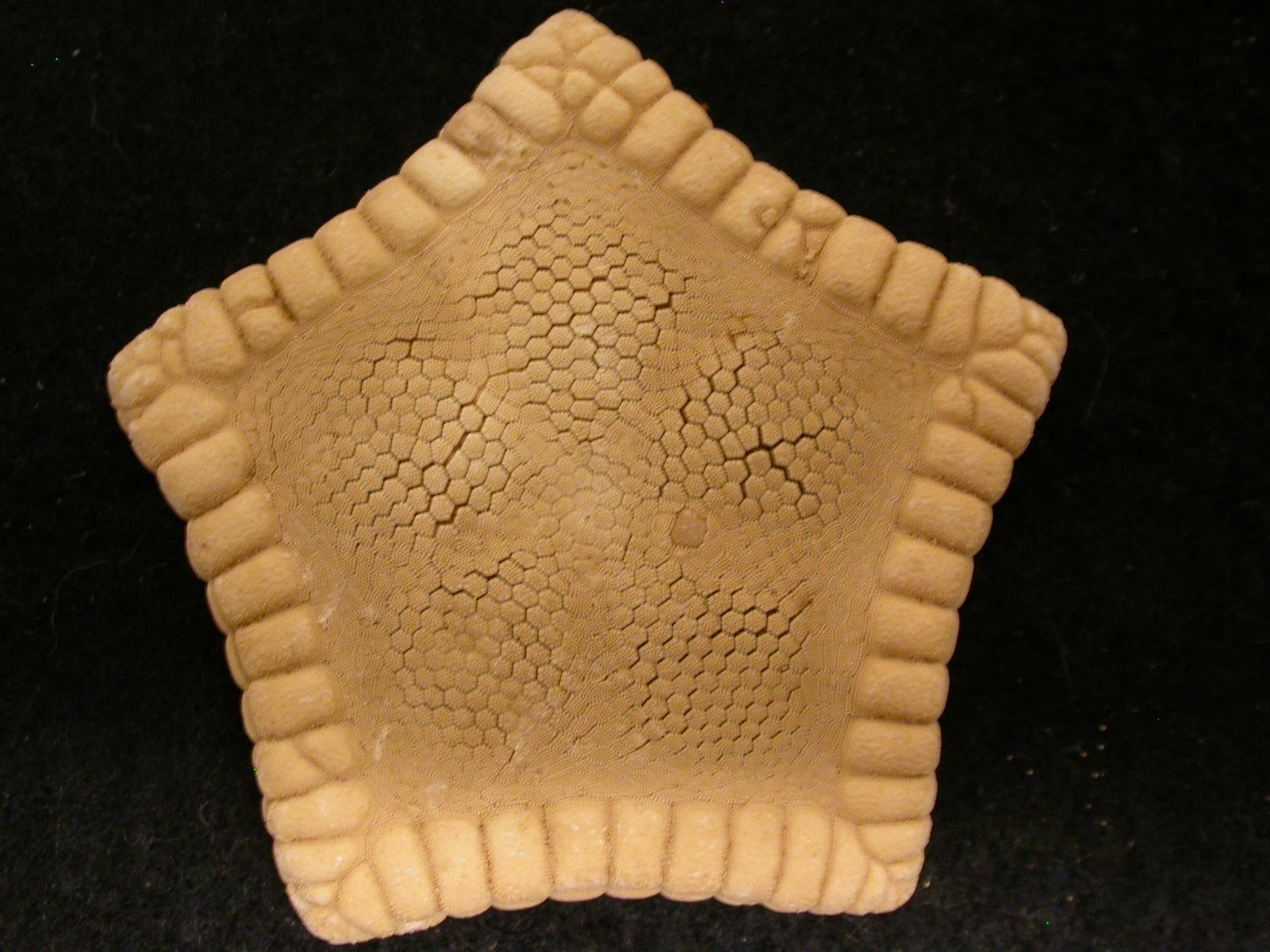
Echinodermata! Starfish! Sea Urchins! Sea Cucumbers! Stone Lillies! Feather Stars! Blastozoans! Sea Daisies!
Marine invertebrates found throughout the world's oceans with a rich and ancient fossil legacy. Their biology and evolution includes a wide range of crazy and wonderful things. Let me share those things with YOU!
Just some quick bits... first, the above statue of some oceanic nymph or goddess doing battle with a giant fish!
One thing that comes up every so often while going through the Paris museum is how incredibly OLD it is! Nothing I've seen in any American museum comes close. Many of the specimens were actually on display in the museum gallery up until its facelift in the late 1980s/early 1990s.
These older specimens are relicts from an era when each museum specimen was treated with a reverence (and resources) that is/are really not seen any more.
This includes some pretty intricate display bottle/jars such as this one...which is sealed with a melted metal, which I think is tin and has the specimen tied to a thread and actually suspended from a floaty glass sphere!! Several of the specimens in the collection have been here since the 1800s..since the days of Lamarck!
Lamarck, whose full name was Jean Baptiste Lamarck (yes I know its longer) was a famous French naturalist who published widely on botany, geology, and invertebrates. But is perhaps best known for Lamarckian style evolution (aka Lamarckism).
This was an early version of the idea of evolution that "proposed that individual efforts during the lifetime of the organisms were the main mechanism driving species to adaptation, as they supposedly would acquire adaptive changes and pass them on to offspring."
A nicer summary of Lamarckism is found here. thanks to Echinoblog reader Trevor P.!
As promised! This week, the Echinoblog comes to you LIVE from Paris, France!
My apologies for running late this week! Travel can be fun and productive, but you invariably encounter adversity! In this case, a combination of jet lag, getting administrative stuff done, and catching a stomach bug yesterday! The museum has a LONG history of studying evolution, practically before it was KNOWN as evolution! ("transformational: biology?)
You can tell what a bad ass he was from the fact that the statue shows him sitting on a frakkking LION!!
The museum itself is VERY old and was founded in 1793! Shown here is the Grande Gallerie d'Evolution! Paris has hosted many distinguished scientific minds, including Lamarck, and Georges Cuvier
Why am I here?
As many of you know, I am a scientist who studies sea stars (i.e., the Asteroidea) and the Museum national d'Histoire naturelle contains one of the largest collections of deep-sea asteroids from exotic locales that I know about!
What most people don't know is that BELOW the Grande gallerie is 3 floor vault -like bunker complex... And its down here that innumerable specimens are housed and cared for! This includes specimens from the many exotic locales sampled by French scientists, including this spiny Calliaster elegans.. these neato little "cookie" stars... (Sphaerodiscus I think) This big cookie, Ceramaster patagonicus australis... and finally, Calliaster regenerator-a weird starfish with screwdriver like spines! More is on the way!
I had hoped to put together something more ambitious this week, but alas, forces have worked against me. But NEXT week and for the few weeks? Something SPECIAL ..as the Echinoblog blogs from EUROPE!! As I work from the world famous Museum national d'Histoire naturelle in PARIS, FRANCE!!
But for now, enjoy these very keen videos of the sand star Astropecten which is found in various tropical shallow water environments on sandy bottoms around the world...
From Japan, an outstanding video of what looks like Astropecten polyacanthus gliding gracefully over a sand bottom to a French sound track!
From Tarifa, Spain, a neat vid of what is identified as Astropecten aranciacus...
A slightly different kind of post today. One that is a little more in the category "citizen science" than my usual stuff.
So, about a week ago, I received an email report from Neil McDaniel, a marine photographer and cinematographer. (His website with stunning pix is here) regarding an unusual occurrence.
Pycnopodia helianthoides, the large sized and immediately recognizable "sunflower star" present on the west coast of North America, from Alaska to Southern California was being observed in MASSIVE numbers in British Columbia. In Mr. McDaniels' own words:
....Hordes, and I mean hordes of Pycnopodia can be found in the shallow subtidal in Howe Sound, a coastal fjord near Vancouver. During one dive where I covered all of 100 metres horizontally I found densities like this in a band perhaps 3 metres across starting at about 2 m below datum and extending downward to about 5 m below datum. It’s not an exaggeration to say there were several thousand just in this area. Not all of Howe Sound is like this but many areas are. So what’s happening here?
Normally, when one encounters Pycnopodia, its found by itself or rarely in the company of one or two other individuals and they're usually competing for food.. This video gives you a general idea of what Pycnopodia is typically like...
But pictures from Howe Sound in BC shows this:
(Image courtesy N. McDaniel)
(Image courtesy N. McDaniel)
(Image courtesy N. McDaniel)
(Image courtesy N. McDaniel)
and then, I put it together with a Vancouver Aquarium video on YouTube from August 2009. Note the ABUNDANCE of sunflower stars! Based on what I know of, that's unusual....
The Vancouver Aquarium account reads
Research diver Donna Gibbs was able to record on videotape a remarkable event that occurred at the time of an extreme low tide along the shoreline of West Vancouver, just east of Whytecliff Park. As Donna prepared to start a dive with Jeff Marliave at Kettle Point, the crew exchanged comments about the strong shoreline current, as well as the apparent red tide condition. The sea surface was also at a record 23 degrees Celsius. Donna and Jeff went down on a planned drift dive toward the west, counting rockfish at an artificial reef and along natural shoreline reef areas that have been monitored for this entire decade. The water clarity was excellent at depths below the red tide, and the dive plan proceeded normally until an area was reached where vast numbers of the giant sunflower sea star were covering the rock surfaces. At this point, a down-welling component of the shoreline current was evident and the sea stars were rapidly moving down the slope of the rock. The sea stars were traveling so quickly that they were running over each other, creating slow-motion landslides of sea stars tumbling down the slope.
So, what's going on???
I've asked around my network of scientist and diver colleagues in more southern regions..i.e., California and none of them has seen more than a couple of individuals of Pycnopodia together at one time.
I've even consulted with my colleagues who work in the deep-sea around California.. They see the deep-sea cousin of Pycnopodia, Rathbunaster...and although it can occur in high numbers, its generally different than what's being seen with Pycnopodia... Here's a couple of examples:
Are there possible explanations? Sure. For example....
1. Populations are high because juvenile survivorship is high. This is basically what happened with the crown of thorns (Acanthaster planci) in Australia.
Some environmental factor is different leading to a high survivorship of juveniles leading to a huge abundance of adults. In the case of Pycnopodia, this has not been documented. Could it be Food? Water temperature? Nutrients? Hard to say.
2. Could they be spawning? A lot of invertebrate species gather in large aggregations in order to facilitate spawning. The males produce their sperm and the females are handily nearby to facilitate fertilization between sexes.
That said, most observations of Pycnopodia have never documented more than a few specimens at a time at most... and none of the pictured/recorded individuals seem to be producing reproductive material...
(pic courtesy of Allison Gong, UCSC)
Speaking of which, one of my colleagues Dr. Allison Gong has helped produce an account of the subsequent development of Pycnopodia. You can see that here... So where does that leave us??
This huge, dense clustering of Pycnopodia is something that I, and many of my colleagues have never seen before. And when the combined experience of close to a dozen scientists haven't seen something on the west coast of North America??? Something weird is going on..
What could be causing it? What could be causing these mysterious swarms of giant, sunflower starfish? Are they just well-fed starfish? Climate change? Food? Social gathering? How does this affect the ecology of the area? How often do these high populations persist?
Could they be preparing an invasion? :-) (disclaimer: the great starfish invasion may not be real...)
(please note that this photo was performed by a professional-please don't try this at home!)
Unlike my other posts-this is NOT a report on a paper...I thought I would throw this out there as a general announcement to divers, scientists and interested folk!
Has anyone out there seen these massive, dense aggregations of sunflower stars? Do you have additional video? Pictures?
Contact me through my profile and let me know! (THANKS again to Neil McDonald for allowing use of his pictures!)
I stayed at a local hotel which included waffles made with a waffle-making-machine which was part of their complimentary "continental breakfast" offerings! MMMmmmm...waffles! This and a cup of coffee later..I'm off to the museum!
After a search through the collection and working on their newly collected specimens from deep-sea Seamount expeditions and other exotic locales, I proceeded to review the older parts of their collection, and many interesting historical items presented themselves!
This dried and brilliantly painted asteroid, Dermasterias imbricata Also came upon a very amazingly dissected Aristotle's "Lantern" in the collection.. Really hard to find one that is quite so well prepared... I was also able to delve more deeply into the historical artifacts and lore of the Yale Peabody Invertebrate collections!
An incredible painting of Verrill can be found in the Invertebrate Zoology offices... Here is a photo of Verrill for comparison.. What did A. E. Verrill do for us?
Well, in his day, (roughly the 1860s to the early 1900s) Verrill was one of the most prolific and pre-eminent invertebrate zoologists in the United States. He described over 1200 taxonomic names of various marine species, including corals and worms!! (although to be fair-not all of them remain valid, but still...) Approximately 290 of these names were starfish....
If you work on the Pacific Northwest coast, here are a couple of Verrill's starfish names that have remained "good species" in spite of taxonomic changes over the last 100 years or so...
Shifting Gears-A Visit to Invertebrate Paleontology! So, during this visit, I also took some time to visit the equally world famous Invertebrate Paleontology department at the Peabody Museum to examine starfish fossils.. (which for various reasons I won't be showing you here...)
As a result, there are some awesome models representing the living interpretations of various Paleozoic invertebrates that were in the Paleo department collections! Many of these were made by the masterful artist George S. Rennie III who produced models for many different departments in the Peabody Museum.
Here is a good-sized model of the Cambrian predator Anomolocaris nathorsti..Wiki on Anomalocaris is here.(Note that All images below are courtesy of the Division of Invertebrate Paleontology, Peabody Museum of Natural History, Yale University, New Haven, CT, specimen YPM 203911) View from the perspective of potential food! And a dorsal view... Here is model of the Cambrian Priapulid worm, Ottoia prolifica (wiki article is here), which could get to up to 80 CENTIMETERS in length!! (All images below are courtesy of the Division of Invertebrate Paleontology, Peabody Museum of Natural History, Yale University, New Haven, CT.specimen YPM 203912) So, with me there for scale, we see that this model was actually close to life sized!
Now THAT is a big worm.
Another cool giant Paleozoic invertebrate-A huge stylonurid!! Based on an actual head-shield, making this model a reconstruction of a LIFE SIZED individual!!(All images below are courtesy of the Division of Invertebrate Paleontology, Peabody Museum of Natural History, Yale University, New Haven, CT.specimen YPM 220638, ) Stylonurids were related to eurypterids-Giant predatory "sea scorpions" that swam through the shallow seas on the Paleozoic. Here is a schematic from one of the hallway displays showing how big some sea scorpions (not stylonurids but related to) got relative to humans.. Yet, another reminder of how, if you find yourself in the Paleozoic, you should NEVER go into the water!
And here is a model of the Paleozoic worm Plumulites which is thought to have been ancestral to modern polychaetes. (gratefully, this was not life sized! ) And here we have some hallway displays of more giant Paleozoic arthropods, such as this eurypterid! A close up of this mean beast! and finally a Trilobite display! I had a very productive trip to Yale and was enthusiastically recieved/hosted by Yale's friendly and gracious staff! In Invertebrate Zoology: Collection Manager Eric Lazo Wasem and museum assistants, Lourdes Rojas and Daniel Drew and in Invertebrate Paleontology: Collection Manager Susan Butts and museum assistant Jessicz Bazeley!
 Just some quick bits... first, the above statue of some oceanic nymph or goddess doing battle with a giant fish!
  Several of the specimens in the collection have been here since the 1800s..since the days of Lamarck!

 I'm not sure, but I think that this might even be his writing!