Tuesday, August 5, 2014

Before Computers! Deep-Sea Starfish Plates from circa 1919!


Something a little different today! There have been some plates from old 20th Century starfish & other echinoderm monographs in storage in and around our lab space and they are just gorgeous!  I've shared some of these before (several years ago here) But there are MANY of them....


Image from this MBL page
Fisher wasn't perfect, but he is considered one of the giants of starfish taxonomy and described about 312 species of starfishes that continue to remain in use. He also described sea cucumbers, peanut worms, stylasterine corals and probably more.

Much of his work was done as huge monographic tomes which included hundreds of pages of scientific descriptions including some of the finest photographic figures available. 
And he did this way before computers. No word processing. No internet. 
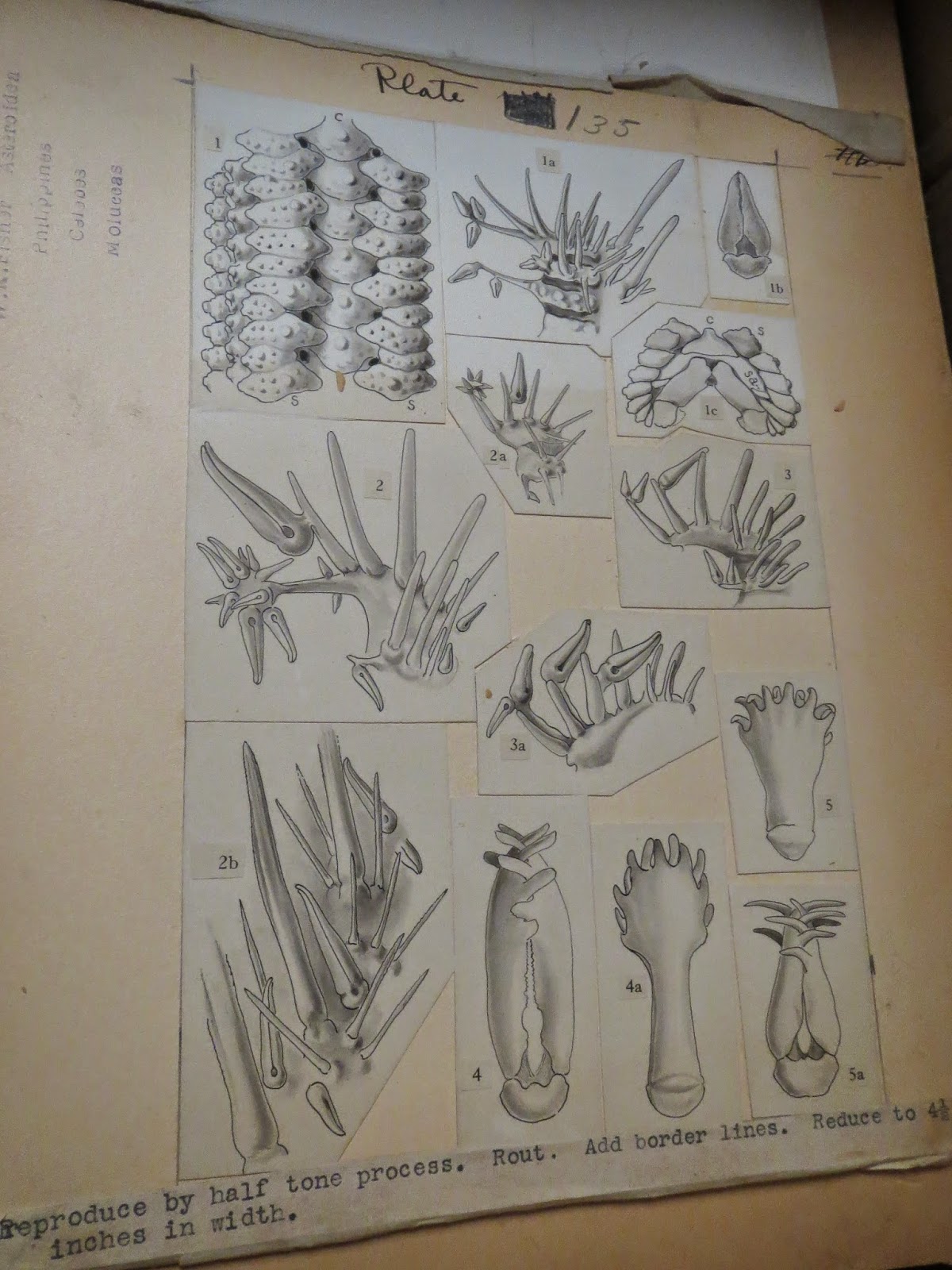
Before we had photoshop and imaging software, publishing was a very physical process. Photographs were mounted to cardboard as seen below. So, the "plates" were quite literally so. These got quite big and cumbersome.
No photoshop, so images were pasted together by hand as so..
Here is a plate from an ophiuroid or brittle star plate from a monograph by French researcher Rene Koehler. Also assembled from a photograph.
                                 
If you wanted to modify or target images for plates, there was no image modification software to do it for you, you literally had to take an exacto knife or razor blade to photographs, cut them out and affix them to the hardboard plates...
                  
But the images were done in amazingly high quality and remain attractive to this day.. Here are scans of the ORIGINAL plates from Fisher's Philippine Starfish monograph. No Instagram. No other photo modification.  These are directly off the original plates..


some from before...

Wednesday, July 30, 2014

The Rotulidae: Strangest of the Sand Dollars

Leave it to echinoderms to take even the best known of animals, like a sand dollar, and make it even STRANGER than you could have thought!!


But first things first. Sand dollars are highly modified SEA URCHINS that live on sandy bottoms, mostly in shallow tropical to temperate water places. Please make a note of it. (or go read this post here!)

Most sand dollars are either kind of disc-shaped such as this Pacific Dendraster excentricus.


But then you get THESE weirdos!
See all of those flanges or finger-like projections coming off the edges?? Those are NORMAL for these sand dollars!  Let me introduce you to the sand dollars of the family Rotulidae! 
There are actually THREE genera of rotulid sand dollars, Rotuloidea (the oval one), Rotula (the one with holes) and Heliophora (the one without holes). And all of them seem to have some degree of these weird finger-like projections. Living rotulids seem to occur almost exclusively in the West Africa region (and some are fossils-see below).
This image is from Wikipedia! 
Let's go through and meet these three kinds of rotulid sand dollars!! By the way, if you want a scientific guide to ALL THE SAND DOLLARS including the rotulids, it is available as an OPEN ACCESS file here. A fine piece of work by California Academy of Sciences Curator and sea urchin/echinoderm expert Rich Mooi. 

I should note that all members of the Rotulidae are also found as fossils...
                          

1. The genus Rotuloidea. The first is this relatively simple looking guy.. Rotuloidea fimbriata. This species is only found as a fossil, occurring from the Miocene to the Pliocene (that's between 3-23 million years ago).  Found in Morocco.
Image from this Echinoids Gallery page

2. The second member of this fantastic sea urchin trio is the genus Heliophora! 
 That is ONE FANCY ass name! The genus is actually Latin for "Bearer of the sun" and you can sort of see why if you see one positioned as such (upside down). This genus includes two species.. Heliophora orbiculus and Heliophora orbicularis. 

This website recites a legend that Heliophora are actually coins left by mermaids! I wasn't able to verify it, but it does sound reasonable (as a legend of course. Mermaids aren't real.. :-) )


What is going on with all of these crazy flanges??? Its not really been shown exactly what they do. Studies suggest that they might be related to feeding or play a role in keeping the animal from being swept away. (more on that below)..

His work seems to suggest that these feed like other sand dollars, i.e. in the sand on the bottom. Ghiold suggests that the spines may further function to facilitate feeding. 

Also of interest is that the plates which form the perimeter of these animals seems to grow a LOT faster than the more proximal areas. 

Some members of the genus Heliophora get kinda CRAZY... 
This image borrowed from this Excellent French site: Sciences de la Terre et de la Vie. Photo by Coco CHATAIGNER
3. The genus Rotula. Last but not Least! The scientific name "Rotula"is Latin for "Little Wheel" There is one spectacular species here: Rotula deciesdigitatus. I believe the species name refers to "deci" or 10 in conjunction with "digitatus" or digit referring to the number of flanges or projections. 

So the name literally means "Little Wheel with 10 digits"
Note that in this species there are TWO BIG holes!! These are what's called LUNULES. While these have not been specifically tested, an earlier post I wrote summarized how these holes (the lunules) were thought to prevent sand dollars from being gaining "lift" and being "blown" away by water current!!

And that still does not explain the MANY weird "fingers" along the edge! and on only one side! 

I managed to snap a cool shot of a specimen in Paris awhile back showing the oral side of one of these with ALL the spines or "hair" present...

Living sand dollars are covered by "hair" which are in fact tiny spines that move food to the mouth. 
                             
Here's a video of a sand dollar (but not Rotula) with said spines in full motion!  This is the oral side where the mouth is located.  

Even for sand dollars, these critters are very odd! Many evolutionary and functional biology questions! What are the flanges for? How do they develop? Why ONLY in this group???  Is there something unusual about the environment that is associated with these flanges and shapes???

These sand dollars have been known since the 19th Century and yet we know next to NOTHING about them (relative to their more northern counterparts). These sand dollars are seen throughout hobby websites and are collected by enthusiasts! And yet we know very little about them.

 They present many tantalizing and interesting questions to the future marine and evolutionary biologists! 

Tuesday, July 22, 2014

Deep-Sea Poop, Amoebas, Basket Stars, Pinwheel Crinoids and MORE! Pics from the NOAA Deep-sea Photo Archive!

Gulf of Alaska 2004 Expedition. NOAA Office of Ocean Exploration 
This week I have been researching images from deep-sea video on the home page for the NOAA Photo Library, which has housed ALL of the deep-sea and other imagery from NOAA's deep-sea expeditions since 2003, including those of the Okeanos Explorer!

Many of you know that I have participated in the last two R/V Okeanos ROV dives as an onshore advisor. I often identify asteroids (i.e. starfish) and provide other information as I am able. I've only helped them out since 2013 but found lots of their images useful for my research.

You can find NOAA-Okeanos dive screengrab recaps on my blog here for 2013 and here for the recent 2014 dive. 

Those of you on my Twitter account (@echinoblog) have been watching me post links to various pictures as I have been reviewing these pics.. There are literally THOUSANDS of pictures of deep-sea biology, geology and history !!!  Who would be crazy enough to go through all of it one by one???  Yes. Me!

So, for your education and infotainment I have cherry picked many noteworthy images and have showcased them below. (note that ALL images have original links below them)! Enjoy!

Giant Amoeba Houses??
Here's a cool structure made by a giant amoeba called a xenophyophorean! (deep-sea Galapagos) Take a moment to consider that a UNICELLULAR organism could have made this! (and yes, they will eat proper animals!)
From the 2011 NOAA Okeanos Explorer Program, Galapagos Rift Expedition 2011 
But in contrast, what about this from Indonesia??? A Mystery?? Another xenophyophorean?? 
From July 2010 NOAA Okeanos Explorer Program, INDEX-SATAL 2010


Basket Stars Behaving uh... badly? 
What is going on here? I've honestly never seen TWO basket stars so close to one another. What are they doing? Fighting? Doin teh sex? The gorgonocephalid equivalent of a backrub?   Only they know for sure.  (North Atlantic)
From Lophelia II 2008: Deepwater Coral Expedition: Reefs, Rigs, and Wrecks 
Brittle Stars Doing Crazy Things! 
From the Atlantic... Probably just filter feeding, but I don't know that I've ever seen so many of them with their arms all curled up like that just FLAT on the sediment. Weird.
From the Lophelia II 2008: Deepwater Coral Expedition: Reefs, Rigs, and Wrecks 
and more of the same...
from Lophelia II 2008: Deepwater Coral Expedition: Reefs, Rigs, and Wrecks 

Here is what we call in science "a fancy pants brittle star" (note the gorgeous red and white pattern though) on a really extended whip coral (aka antipatharian). Video from the Bahamas in 2009. 
From Bioluminescence 2009 Expedition, NOAA/OER 
And still MORE!
From 2009 Bioluminescence 2009 Expedition, NOAA/OER 
PIN WHEEL CRINOID?? 
A cool looking "pin wheel" stalked crinoid (Hyocrinidae) from Indonesia, a new species currently being worked on by colleagues in Paris. This is what it looks like "open"
From NOAA Okeanos Explorer Program, INDEX-SATAL 2010 
and curiously, this species retracts its arm in repose like this! As the kids say these days "That is pretty whack! "
From NOAA Okeanos Explorer Program, INDEX-SATAL 2010
BIG PACKS OF FILTER FEEDING ECHINODERMS! 
Stalked isocrinid crinoids! From the Marianas Arc, Pacific Ocean! All turned into the current!! 
 Image courtesy of Submarine Ring of Fire 2006 Exploration, NOAA Vents Program 
Also from the Marianas Arc, Pacific Ocean: A crazy huge field of basket stars (Gorgonocephalidae)..
Image from the Submarine Ring of Fire 2006 Exploration, NOAA Vents Program 
Some translucent Swimming Sea Cucumber intestine showing POOP?? 
 from NOAA Okeanos Explorer Program, Mid-Cayman Rise Expedition 2011 
Is this Sea Cucumber Poop??
Exotic Indonesian Sea cucumber poop?  Or possibly from an Acorn Worm? (below)
 From NOAA Okeanos Explorer Program, INDEX-SATAL 2010 
From NOAA Okeanos Explorer Program, INDEX-SATAL 2010
Deep-Sea Urchin POOP! 
Here is a great shot of an Echinothuriid urchin (aka the pancake or tam o shanter urchin) taking a poop!! A Gulf of Mexico species. Contrary to what the labels on the website say, this is defecation and NOT gametes being released.
NOAA Okeanos Explorer Program, Gulf of Mexico 2012 Expedition 
 Deep-sea Urchin Poop! 
NOAA Okeanos Explorer Program, Gulf of Mexico 2012 Expedition 
and a special non-echinoderm poop bonus! Acorn Worm POOP! 
Images from Indonesia.. Worms leaving unique castings in the sediment...
From NOAA Okeanos Explorer Program, INDEX-SATAL 2010 
What I hope is that this will provide a spotlight on NOAA's very EXTENSIVE library of images!

MANY valuable and interesting things in there! Enough for many more posts. But what's most amazing? A lot of it is UNPUBLISHED stuff!!

But its hard to make a guess as to what kinds of things you will find (sometimes because you don't know what you are looking for)  This provides a taste of the diversity and abundance of tantalizing images. Sponges! Corals! Worms! Even protists!
                              

Tuesday, July 15, 2014

Sea Cucumber Skin Up Close! Bizarre & Beautiful!

Thelenota ananas Via Wikipedia commons. Photo by Nick Hobgood
Cool Crowdsourced Photo time! This week..some gorgeous closeups of the neat skin textures on tropical sea cucumbers!

Some of these give you an idea of how colorful and unusual the skin in sea cucumbers can be. This one is called  Thelenota rubolineata (the species name literally means "red lines"). This is an example of what the whole animal of one of the pics below looks like...

What do they feel like? Sort of soft and rubbery. Firm. And yes, people eat these species...

Here's a nice roundup of similar closeup photo essays of other echinoderms 
  1. Here's the one for Up close Starfish! 
  2. Another one showing close ups on Crinoids (aka Feather stars)
  3. COLORS! in brittle stars! 
  4. Crabs that live in sea cucumber anuses! here.
  5. Worms & Snails that live on sea cucumbers! here. 
Below.. you will find many different close ups of the skin of sea cucumbers.


this one is Thelenota I think...


Some striking full body pics...