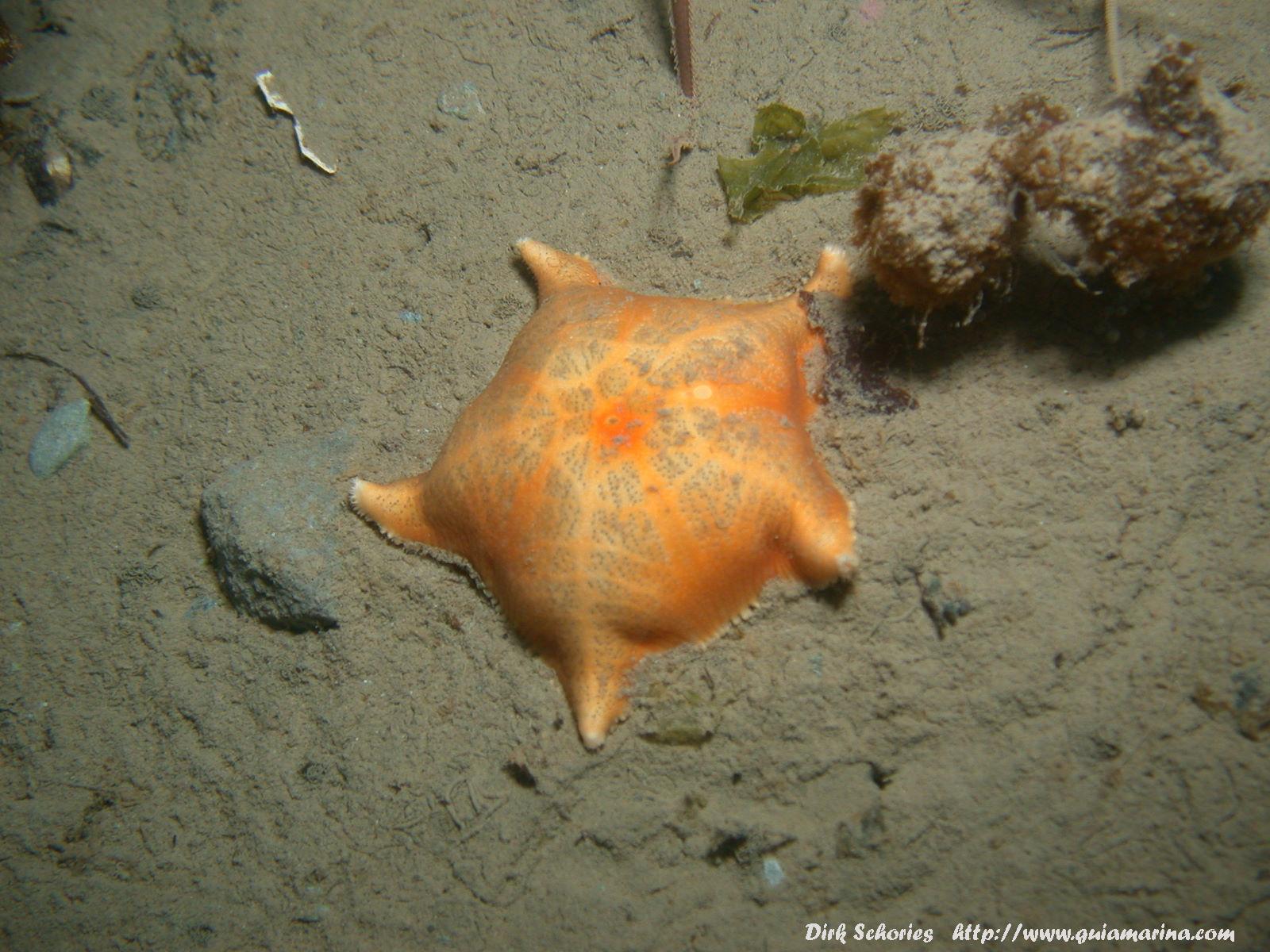
|
| thanks to Paul G. for the photo! |
A topic that has found bitter and vicious debate at museums, aquariums, marine biology and even paleontology programs around the world!
Undoubtedly upon this post reaching public circulation, many of my colleagues will probably stop returning my email and spit upon me as I walk by them (although some of them do that anyway!)
I speak of course, of the dreaded "Starfish or Sea star (seastar)??" controversy!
Which common name should we use for these frequently encountered and familiar marine animals???
But where to start? Let's define some terms, so this discussion doesn't get completely out of hand.
Let us make no mistake-when we talk of this debate that we speak of members of the ASTEROIDEA.
- Starfish/Sea Star is a term that VERY SPECIFICALLY refers to the ASTEROIDEA-one of five living classes within the phylum Echinodermata (the others include sea urchins, sea cucumbers, crinoids, and ophiuroids).
- It is incorrect to refer to OPHIUROIDS as "sea stars" or "starfish", per se. Ophiuroids are an altogether DIFFERENT class of animals from asteroids. Go HERE to see some characters that tell them apart. Common names of ophiuroids include: brittle stars, serpent stars, basket stars. I find it acceptable that certain echinoderms are referred to as "XXXX stars" under certain circumstances. A separate class of echinoderm-the Crinoidea (lacking a stalk), for example are often called "Feather stars." I'm cool with that. The specific terms "sea stars" and "starfish" should only be applied to ASTEROIDS.
- Note that this is one of the few groups in which the common name DOES correspond to a 'real' classification. Terms such as "crab", "coral", or "jellyfish" actually do NOT refer to a single natural classification of animal-but rather several similar looking kinds of often distantly related animals. This video about "jellyfish" explains the issue nicely:
There are THREE, Latin-based, English terms- as outlined below: "asteroid" (from the scientific name Asteroidea), "starfish", and "sea star." This discussion comes up over and over..and seldom seems to find resolution... Here then are a list and discussion of these terms and the back-and-forth over the terms..
Note that the terms "starfish" and "sea star" do not reflect different morphologies within the Asteroidea the way that say, common names for ophiuroids do (e.g., Basket stars = the name for Gorgonocephalidae). So there really has been quite a commotion over these two terms as they find standardized use...
These reflect various arguments I have heard/collected over the years. While I have my conclusions at the bottom...please feel free to take these different perspectives to your classrooms, aquarium education courses, and grad school discussion groups to discuss at your pleasure! Yell at me in the comments if you wish!
1. The term "asteroid" (from class Asteroidea)
We Should Use the Term Asteroid Because:
The latin name from the group, ASTEROIDEA was officially put to paper by the noted French zoologist Henri Marie Ducrotay de Blainville in 1830 from the Greek aster and eidos referring to "star (as in the sky)" and "form or likeness." Nouns are derived from the scientific name.. so "asteroids" is technically the proper term for animals that we would refer to as "sea stars" or "starfish".
The Main Argument against: No, we can't use the term "asteroid" because it might be confused with a giant space rock hurtling through space! OH NOES!
2. The term "Starfyshe"(starfish)?
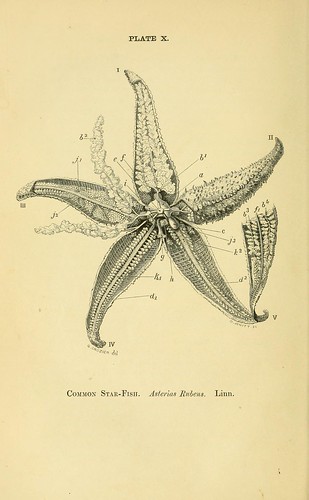
1. The word starfish is widely used and "I" like it. So why change what ain't broke?
Google recovers 13, 200,000 hits relating to "starfish"including use in religion, politics, obscene rock lyrics, hitting the bed and splaying out on the surface, charity organizations, nuclear bombs, and yes, sometimes it even refers to animals!
2. So what if the word is a misnomer? Plenty of words in the English language are inaccurate. Greenland is icy and Iceland is green! Sea horses aren't horses! Why can't we just put up with one more? That's life! C'est la vie!
3. Starfish is the oldest known western term. (thanks to John Lawrence, at USF for the info) According to the Oxford English Dictionary (OED) this dates back to 1538 referring to "Stella, a sterre, also a sterrefyshe."(from Elvot, dic.) This usage corresponds to the first definitiion given for "fish" in the OED: "In popular language, any animal living exclusively in the water"
These days of course, our terminology has been much revised based on tons of evidence showing classifications among animals and we acknowledge that "fishe" had a much different meaning 475 years ago, but the term has stuck with us and its not likely to be going away anytime soon.
I'll bet that scientists and students are probably not as big a majority user of the term "starfish" as they believe themselves to be. The term is widely used throughout the many aforementioned outside disciplines and probably won't find much change even if scientists begin to radically suppress the term...
These reflect various arguments I have heard/collected over the years. While I have my conclusions at the bottom...please feel free to take these different perspectives to your classrooms, aquarium education courses, and grad school discussion groups to discuss at your pleasure! Yell at me in the comments if you wish!
1. The term "asteroid" (from class Asteroidea)
We Should Use the Term Asteroid Because:
The latin name from the group, ASTEROIDEA was officially put to paper by the noted French zoologist Henri Marie Ducrotay de Blainville in 1830 from the Greek aster and eidos referring to "star (as in the sky)" and "form or likeness." Nouns are derived from the scientific name.. so "asteroids" is technically the proper term for animals that we would refer to as "sea stars" or "starfish".
The Main Argument against: No, we can't use the term "asteroid" because it might be confused with a giant space rock hurtling through space! OH NOES!
 |
| From Nat Geo article about asteroid collision |
1. The word starfish is widely used and "I" like it. So why change what ain't broke?
Google recovers 13, 200,000 hits relating to "starfish"including use in religion, politics, obscene rock lyrics, hitting the bed and splaying out on the surface, charity organizations, nuclear bombs, and yes, sometimes it even refers to animals!
2. So what if the word is a misnomer? Plenty of words in the English language are inaccurate. Greenland is icy and Iceland is green! Sea horses aren't horses! Why can't we just put up with one more? That's life! C'est la vie!
3. Starfish is the oldest known western term. (thanks to John Lawrence, at USF for the info) According to the Oxford English Dictionary (OED) this dates back to 1538 referring to "Stella, a sterre, also a sterrefyshe."(from Elvot, dic.) This usage corresponds to the first definitiion given for "fish" in the OED: "In popular language, any animal living exclusively in the water"
These days of course, our terminology has been much revised based on tons of evidence showing classifications among animals and we acknowledge that "fishe" had a much different meaning 475 years ago, but the term has stuck with us and its not likely to be going away anytime soon.
I'll bet that scientists and students are probably not as big a majority user of the term "starfish" as they believe themselves to be. The term is widely used throughout the many aforementioned outside disciplines and probably won't find much change even if scientists begin to radically suppress the term...
Arguments against the term starfish!
 Starfish are NOT fish! The term is inaccurate since any MODERN definition of "fish" refers to proper vertebrates and NOT invertebrates! Inaccurate terms are SO confusing! People and students who have not had basic biology will not know that asteroids are NOT fish! Oh Noes!
3. The term "Sea Star (or Seastar)"? (yes there's even a controversy over whether "sea star" is one or two words!)
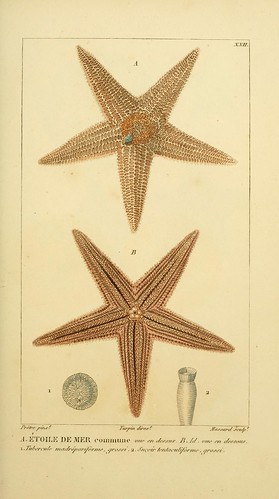
Arguments for using the term sea star (or seastar)!
1. The term is more accurate. Asteroids aren't true fish so why call them that ?? (other than historical tradition, which is dumb!).
3. The term "Sea Star (or Seastar)"? (yes there's even a controversy over whether "sea star" is one or two words!)
Arguments for using the term sea star (or seastar)!
1. The term is more accurate. Asteroids aren't true fish so why call them that ?? (other than historical tradition, which is dumb!).
2. ALL the other western countries use "sea star" why don't we? We should do that too! Its consistent! Get with the program! Don't you want to be doing what all the cool countries are doing? (e.g., German=seesterne, Spanish=estrella de mar, French=étoile de mer and I believe even the Chinese word means "ocean star")
Arguments against the term Sea Star
1. The term Sea Star gets less use than Starfish. "Seastar" (one word gets 2,660,000 hits) but note that "sea star" (two words gets 475,000,000 hits-but many of these may be random combinations of "sea" and "star"). Its dumb that we use such a wishy washy word that other countries use!
2. Sea Stars are not stars. Asteroids may not be "fish" but nor are they big burning balls of space gas! I once used the "sea stars are not stars" thing jokingly-but it turns out, the reference to stellar bodies has a real basis!
The FIRST definition for "sea star" in the OE dictionary (and indeed Websters as well) (date uncertain) is of a "star which guides mariners at sea", the Star of the Sea, with only the SECOND definition referring to proper asteroids.
Earliest usage in reference to the animal I have record of:
 Other times flat and almost paper-like..
 And still others can be almost ball-shaped

Dispelling a Myth about "sea star" as political correctness
In the 90s (or thereabouts) there was a huge revolution in educational programs across museums and aquariums throughout the US, and inevitably beyond. Many of the various common names ended up getting names that people felt were more accurate. So jellyfish were called sea jellies. Hagfish were called sea hags and so on.
At about the same time was the big "political correctness" revolution from the late 80s, early 90s which was intended at diffusing offense and infusing more respectful terminology among public and political dialog-with extensive changes to almost all terminology. Here is a full workup of that scene at Wikipedia.
Naturally, it was widely assumed that common names in science had befallen the same fate. But as indicated above.. the term "sea star" has been around since the 1700s. And across different languages. And since, ultimately, asteroids DON'T really care WHAT you call them, it does seem unecessary to apply political correctness to echinoderms.
Are European terms the only one we should consider?
At a certain point in this discussion it becomes readily apparent that the "common name" argument for asteroids emphasizes the western/English terms. Do terms for starfish in other languages offer more attractive options? Let's look at a few!
*hitode (ヒトデ). This word means "palm" in Japanese. Here is a post I wrote about Japanese starfish names! Records of the term hitode date back to 1712!
*tapak sulaiman.In Malay, this word literally translates to "Solomon's Footprint"! Snazzy, eh?
*불가사리 In Korean, the word for starfish refers to "Immortality"!!!
(my thanks to Yoichi Kogure, Marcus, Tai-Lin and Taekjun for their helpful insights!)
These are all awesome. and hmm.. Solomon's Footprint is a pretty cool name for an asteroid!
Ultimately, though these terms seem to work out best in their homelands where the cultural context makes the terms more useful (and perhaps less confusing in English). Although I dunno... I'm still kinda fond of Solomon's footprint..
What was the oldest name again?
1538: sterrefyshe
1569: sea starre
1712: hitode
Yup. Its "starfish" and not technically "sea star"..so if you're a big taxonomic synonymy fan but not a big fan of "starfish"..uh.. sorry...
Within the international rules that dictate proper scientific names for animal species, it is generally accepted that the OLDEST term has seniority over the others. But these rules generally only apply to the proper Latin species names and not the "common" or popular names. So, they don't necessarily apply. But as far as established 'legal' criteria goes this is one of the few which exists, so it should be considered. "Starfish" is the senior name..
Finish it up! I ain't got all day!
These are things that are not negotiable
1. Asteroids are starfish/sea stars. NOT ophiuroids (aka brittle stars). I often see a wide variety of individuals in the popular arena apply the terms mistakenly. That is improper use and thus, is disapproved of. Hrrumph!! Double Hrrmumph! PLEASE STOP IT!
2. The term "asteroid" is technically correct. As indicated above, this is a NOUN based on the actual scientific name of the animal? HERE YOU GO. But of course, we could still confuse a big space rock with a giant interstellar starfish.

I prefer to use "asteroid" as a scientist of course, but barring that?
WHY NOT USE ALL THE TERMS?
Many languages have different words for the same thing. I accept that there are different words with the same meaning. I trust context to decide usage. I tend to use "sea star" around students and/or an audience that might not be familiar with asteroids. I use "starfish" around people who know better.. and I use "asteroid" among my colleagues..but obviously there is interchange.
But yes, please know that a "starfish" is NOT a fish before you begin using it. :-)
Over the years, the whole argument has started to sound kind of silly...
person 1: We can't use "asteroid" because we could confuse it with a space rock! Oh NOES!
person 2: Okay. Let's use starfish instead.
person 1: We CAN'T use starfish because people would confuse it with a FISH!
We MUST use sea star.
person 2: Sea star! Pfah! weak. Why be conformist? Plus they are not burning balls of hydrogen! Bark! Bark! We shall use starfish!!! Its traditional! And sounds better!
person 1: NO! SEA STAR! IT LESS CONFUSING!
person 2: STARFISH!
person 1: SEA STAR!
person 2: STARFISH!
person 3: SEASTAR! BUT WITH NO SPACE BETWEEN THE WORDS!
BARK! BARK!
Me: Asteroid?
everyone: Oh NOES! TOO CONFUSING WITH Space Rock!
*sigh*
HAPPY 5th ANNIVERSARY from the Echinoblog!
1. The term Sea Star gets less use than Starfish. "Seastar" (one word gets 2,660,000 hits) but note that "sea star" (two words gets 475,000,000 hits-but many of these may be random combinations of "sea" and "star"). Its dumb that we use such a wishy washy word that other countries use!
2. Sea Stars are not stars. Asteroids may not be "fish" but nor are they big burning balls of space gas! I once used the "sea stars are not stars" thing jokingly-but it turns out, the reference to stellar bodies has a real basis!
The FIRST definition for "sea star" in the OE dictionary (and indeed Websters as well) (date uncertain) is of a "star which guides mariners at sea", the Star of the Sea, with only the SECOND definition referring to proper asteroids.
 |
| Blue Star. by negombo83 on Flickr |
1569... A kind of fishe called Stella or Sea starre, bycause it hath the figure of a painted starre (fr. Fenton-Secret Wond. Nature)Curiously a subsequent definition reads
1594..The fishes called Sea-starres, that burne one another by excessive heat. (fr.Nashe, Unfort. Trav.)3. Asteroids are not always star-shaped! Sometimes they are pentagonal...almost to the point of being round..


In the 90s (or thereabouts) there was a huge revolution in educational programs across museums and aquariums throughout the US, and inevitably beyond. Many of the various common names ended up getting names that people felt were more accurate. So jellyfish were called sea jellies. Hagfish were called sea hags and so on.
At about the same time was the big "political correctness" revolution from the late 80s, early 90s which was intended at diffusing offense and infusing more respectful terminology among public and political dialog-with extensive changes to almost all terminology. Here is a full workup of that scene at Wikipedia.
Naturally, it was widely assumed that common names in science had befallen the same fate. But as indicated above.. the term "sea star" has been around since the 1700s. And across different languages. And since, ultimately, asteroids DON'T really care WHAT you call them, it does seem unecessary to apply political correctness to echinoderms.
Are European terms the only one we should consider?
At a certain point in this discussion it becomes readily apparent that the "common name" argument for asteroids emphasizes the western/English terms. Do terms for starfish in other languages offer more attractive options? Let's look at a few!
*hitode (ヒトデ). This word means "palm" in Japanese. Here is a post I wrote about Japanese starfish names! Records of the term hitode date back to 1712!
*tapak sulaiman.In Malay, this word literally translates to "Solomon's Footprint"! Snazzy, eh?
*불가사리 In Korean, the word for starfish refers to "Immortality"!!!
(my thanks to Yoichi Kogure, Marcus, Tai-Lin and Taekjun for their helpful insights!)
These are all awesome. and hmm.. Solomon's Footprint is a pretty cool name for an asteroid!
Ultimately, though these terms seem to work out best in their homelands where the cultural context makes the terms more useful (and perhaps less confusing in English). Although I dunno... I'm still kinda fond of Solomon's footprint..
What was the oldest name again?
1538: sterrefyshe
1569: sea starre
1712: hitode
Yup. Its "starfish" and not technically "sea star"..so if you're a big taxonomic synonymy fan but not a big fan of "starfish"..uh.. sorry...
Within the international rules that dictate proper scientific names for animal species, it is generally accepted that the OLDEST term has seniority over the others. But these rules generally only apply to the proper Latin species names and not the "common" or popular names. So, they don't necessarily apply. But as far as established 'legal' criteria goes this is one of the few which exists, so it should be considered. "Starfish" is the senior name..
Finish it up! I ain't got all day!
These are things that are not negotiable
1. Asteroids are starfish/sea stars. NOT ophiuroids (aka brittle stars). I often see a wide variety of individuals in the popular arena apply the terms mistakenly. That is improper use and thus, is disapproved of. Hrrumph!! Double Hrrmumph! PLEASE STOP IT!
2. The term "asteroid" is technically correct. As indicated above, this is a NOUN based on the actual scientific name of the animal? HERE YOU GO. But of course, we could still confuse a big space rock with a giant interstellar starfish.

I prefer to use "asteroid" as a scientist of course, but barring that?
WHY NOT USE ALL THE TERMS?
Many languages have different words for the same thing. I accept that there are different words with the same meaning. I trust context to decide usage. I tend to use "sea star" around students and/or an audience that might not be familiar with asteroids. I use "starfish" around people who know better.. and I use "asteroid" among my colleagues..but obviously there is interchange.
But yes, please know that a "starfish" is NOT a fish before you begin using it. :-)
Over the years, the whole argument has started to sound kind of silly...
person 1: We can't use "asteroid" because we could confuse it with a space rock! Oh NOES!
person 2: Okay. Let's use starfish instead.
person 1: We CAN'T use starfish because people would confuse it with a FISH!
We MUST use sea star.
person 2: Sea star! Pfah! weak. Why be conformist? Plus they are not burning balls of hydrogen! Bark! Bark! We shall use starfish!!! Its traditional! And sounds better!
person 1: NO! SEA STAR! IT LESS CONFUSING!
person 2: STARFISH!
person 1: SEA STAR!
person 2: STARFISH!
person 3: SEASTAR! BUT WITH NO SPACE BETWEEN THE WORDS!
BARK! BARK!
Me: Asteroid?
everyone: Oh NOES! TOO CONFUSING WITH Space Rock!
*sigh*
HAPPY 5th ANNIVERSARY from the Echinoblog!