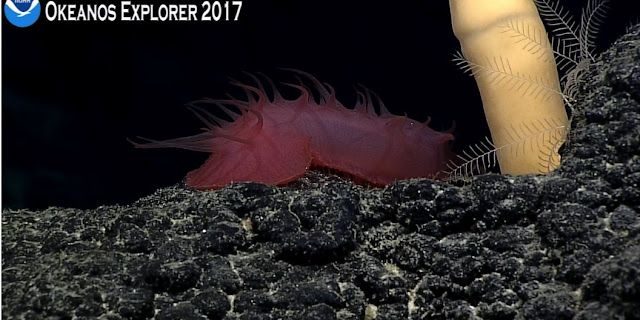
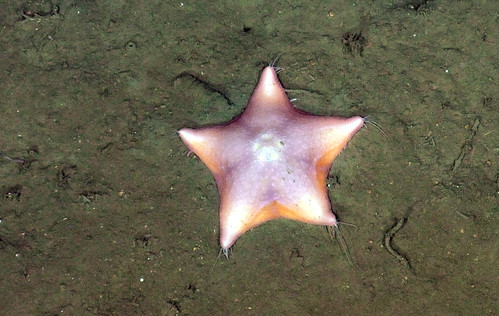
Showing posts sorted by relevance for query slime star. Sort by date Show all posts

Monday, September 13, 2010

Pteraster & Kin- Starfish that FIGHT BACK with MUCUS!

Everybody LOVES mucus! Yes! Don't deny it!

What would our lives be without it? Dry, boring and unlubricated.

I thought I would kick off the Fall with one of my favoritest and weirdest of echinoderms.. Pteraster and its kin aka the Slime (or Mucus) Stars!!

Who??

Pteraster is one genus in the family Pterasteridae.

This is group of starfishes that includes 8 genera that mostly live in cold-water habitats, but are most diverse in the deep-sea. The genus Pteraster alone includes about 45 species that occur worldwide, from the Arctic to the Antarctic and all the deep, dark places in between... Many of them eat sponges. So, on the surface, fairly harmless..

We'll be focusing on one particularly well-studied species, Pteraster tesselatus that occurs on the west coast of North America between California and Alaska.

This is a sort of thick, pudgy looking beast that can have a diversity of color patterns...
What makes Pteraster and all of the Pterasteridae so unusual?

The surface of the animal is actually concealed below a tent-like covering [called a SUPRADORSAL MEMBRANE (SD in the figure below)] that extends OVER the animal's proper surface!!

That proper surface below the supradorsal membrane is where you would find the typical features on a sea star's surface, such as the gills and etc.. Here is a cross-section through the arm. Tube feet on the bottom.
Why is this important? Well, its through the supradorsal membrane that the SLIME comes out!!

2. The SLIME Star!!
So, let's cut to the chase-Pteraster tesselatus earns its common name "the Slime Star" owing to its ability to defensively SPEW MUCUS when annoyed by unwanted contact (and who wouldn't want to do that??) !! GOBS and GOBS of it.

Note to you grammar types... MUCUS= noun. MUCOUS=adjective!

(this photo from the Stony Brook mar bio page)

This picture illustrates a typical encounter with Pteraster. Pick it up, and the next thing you know...you've got a bucket full of mucus!

Much of the info presented herein was based on studies by James Nance (Texas A& M University) and Lee Braithwaite (Brigham Young University) from some neat papers in 1979 and 1981 in the Journal of Experimental Marine Biology & Ecology.

How It works!
Within the supradorsal membrane are a VAST number of mucus producing cells both on the surface and throughout pores present all throughout.

When Pteraster feels threatened, water enters the animal via the bottom tube foot grooves and flows throw the body cavity and up into the cavity between the animals' surface and the supradorsal membrane.

Mucus is produced by cells in the supradorsal membrane.
An opening in the supradorsal membrane, called the osculum, which is normally open

suddenly CLOSES


....and all of the little pores in the supradorsal membrane OPENS!!

So, water pressure EXPELS the Mucous-Water mixture out of the supradorsal membrane!!
So..imagine suddenly stopping up the pipes in your bathroom....and watching it all go somewhere else...
ShABLURRRUUUUUBBBBPTTTHHHHHHHH!!!!!! (noise is simulated-Pteraster does not actually make this noise unless you REALLY want it to. Then, go ahead-knock yourself out!)and you get THIS!
But WHY does it do that? Would could POSSIBLY offend such an innocuous creature? That just wants to sit around eating sponges all day?

On the west coast of North America, starfish ecology usually involves one of these two predatory "bad boys"...

Solaster..usually Solaster dawsoni, which feeds mostly on other starfish.
(One species of Solaster shown here eating a sea cucumber.. pic from the SIMON/NOAA/MBARI)

Solaster (diameter=24 cm) can apparently take up to FOUR DAYS to devour an undefended Pteraster (about 14 cm across)! And that's basically Pteraster being devoured alive!

OR the fearsome Sunflower Star..Pycnopodia helianthoides which usually just SWALLOWS their prey whole! This takes about 2 days to digest...
(photo by Allison Gong, UCSC)

Tests using mucus applied directly to food being eaten by either of these two species almost instantly resulted in the predator moving away VERY quickly.

Lab tests applying mucus to fish and other invertebrates, such as snails and etc. also results in avoidance or outright fatality following extended exposure.

The mucus probably contains saponins or something similar. I've talked about how 0ther starfish species use saponins as a means of discouraging predators here..

What about other Pterasterids?
So, I've mentioned other deep-sea starfish related to Pteraster..such as this Hymenaster from
the deep sea North Pacific, which is practically MADE from clear gelatinous goo!
...and here...(about a foot across)
And if you pick them up? You get the mucous love!
or to say it another way.. "It slimed me!"


But this simple behavior begs a lot of interesting questions.
If the slime is defensive then WHAT PREYS on the other species around the world in the deep sea?
What about the tropical Pacific Euretaster?
Is the slime more or less toxic where specific predators are around?
How has this affected the long term evolution of the Pterasterids?

All questions for another day. Pteraster is interesting for MANY reasons that I haven't even begun to address...

Friday, March 17, 2017

Okeanos Tropical Pacific Highlights: RARE and BRILLIANT Echinoderms!!

Over the last 10 days or so since Okeanos Explorer has resumed its ROV-telepresence based exploration of the Phoenix Islands and adjacent areas in the tropical Pacific they've seen some REMARKABLE animals of all kinds, from corals to siphonophores, crabs to ribbon worms, etc... but particularly ECHINODERMS!

Before I get into the cool pix.. remember NOAA OPERATES Okeanos Explorer!! NOAA has been threatened with severe budget cuts. CONTACT YOUR CONGRESSIONAL REP AND TELL THEM THAT NOAA IS AN ESSENTIAL Agency!

1. PELAGOTHURIA!  The "TRUE" swimming Echinoderm!!
I have written about this amazing animal before when I found an image of it misidentified as a jellyfish in the Galapagos Rift 2011 Okeanos photo gallery and have written at some length about swimming sea cucumbers here.

Basically, almost all sea cucumbers and indeed most echinoderms are benthic..that is they live entirely on the sea floor and never get into the water column the way fish or jellyfish do.. Yes. Some sea cucumbers can swim but ultimately they return to the bottom.

Pelagothuria is unique because it LIVES SWIMMING in the water column! Similar to the way a jellyfish does. As a result of its strange lifestyle, it has MANY bizarre adaptations and looks unlike most other sea cucumbers much less other echinoderms!

Its not a commonly encountered animal..and we live in a wonderous time that we can see several minutes of HD video of this seldom seen animal swimming by...

The video for this can be found HERE:  http://oceanexplorer.noaa.gov/okeanos/explorations/ex1703/dailyupdates/media/video/dive08_seacuke/seacuke.html
Here are the feeding arms extended into the water...


Pelagothuria is contrasted with this other swimming sea cucumber which, after landing on the bottom, poops and then takes off! (from that unnamed seamount off Winslow Reef)


2. The strange irregular urchin Phrissocystis! From Polo Seamount, about 2100 m we saw one of the most seldom seen spatangoid urchins known! These are highly evolutionarily derived sea urchins which live by digging through and swallowing sediment looking for food.

Although they are bristling with spines, they are actually quite delicate. One collected many years ago apparently collapsed as soon as it was brought out of the water in the submersible collection box!

3. A stunning new phyrocrinid stalked crinoid! From an unamed seamount in the Phoenix Island chain, this bold and striking stalked crinoid was observed..and ultimately collected after it was identified as a new species by crinoid scientist Chuck Messing (based on a paper by Tunniclife et al.)

It was quite large with an unusual texture to the stalk and the cup...

4. The "jumping" brittle star Ophioplinthaca
Brittle stars, distant cousins of sea stars, are EVERYWHERE in the ocean. And especially in the deep-sea you can see them inhabiting numerous cracks, crevices and living on corals!

Some are VERY spiny.. such as this species, what I think is called Ophioplinthaca. We've been seeing these ever since the first leg of the Samoa Expedition.  They seem to occur on corals with the tissue removed.. possibly by the ophiuroid itself..

Another curiosity is that these seem to "jump" off their perches as soon as the ROV approaches. Whether this is due to light, vibration, the bow wave of the D2 or disturbance in the "ophiuroid force" (NOTE: Ophiuroid force does not exist) is unclear...


5. The enigmatic sea star Tremaster mirabilis Here's another strange one! A sea star that basically looks like a bowl on the top of a table!

We've seen these before on Atlantic Okeanos dives (see that here) and I wrote about this animal many years ago before people started seeing them alive..

There is nominally ONE species present in almost every ocean in the world.. they've been found in the Atlantic, around New Caledonia, near Hawaii and in the Antarctic. Not sure if they've been found in the Indian Ocean.

Interestingly, these were found in astonishing abundance on one of the seamount dives


5a. The Deep-Sea Slime Star HYMENASTER 
From Titov Seamount was this glorious, glorious deep-sea SLIME STAR, in the genus Hymenaster.

I've written about the shallow water representatives of this genus here. and explored the diversity of Hymenaster in the deep-sea here


*EXTRA! and of course a bunch of weird sea cucumbers!!
A deimatid sea cucumber with many tentacular extensions, this one from Swains Atoll
and this one from Titov Seamount  but they look to be similar if not identical


This one has been seen repeatedly rearing back and presenting what I think is its mouth into the water. so maybe feeding?

A red one from Polo Seamount
This interesting purple/translucent one from Polo Seamount

Some kind of translucent "sea pig" (family Elpidiidae?) also from Polo Seamount

Wednesday, August 10, 2016

HYMENASTER Deep-Sea Slime Stars from the Atlantic and Pacific!

From 2001. Hymenaster pentagonalis from the Hawaiian Islands region. Image by H. Reiswig
Probably one of my FAVORITE deep-sea starfish, other than brisingids has to be these enigmatic and bizarre deep-sea "slime stars"! aka the genus HYMENASTER in the family Pterasteridae!  I've talked about these briefly in a prior account of shallow water slime stars in the genus Pteraster here. 

My first exposure to LIVING Hymenaster was back in 2001 when I was working with Craig Young on an expedition to study glass sponges in the Hawaiian Islands (see pic above)

I got an opportunity to collect a bunch of deep-sea asteroids at that time and saw my FIRST deep-sea slime star!!

and a few minutes after, I discovered for the first time that, just like their shallow-water cousins, Hymenaster could emit mucus just as effectively!!  In other words SLIME!
Image by H. Reiswig.
Hymenaster is a WEIRD animal. The entire surface has evolved into a strange soft covering, This varies in different species. In some the body is membranous and kind of leathery, others, sometimes soft and in others, almost completely gelatinous. In those latter gelatinous species, almost the entire body, save for the tube foot grooves, mouth frame and various other structures are nearly all soft and squishy. Very little in the way of "hard parts"

The name Hymenaster translates from the Greek into "Hymen" and "aster" or "Membrane Star" which as we shall see is pretty fitting.

The body is almost transparent. You can see the five radiating tube foot grooves plus the mouth and some spines and etc. in the surface areas which you can sort of see through.
 Hymenaster sp. from Maro Crater (Hawaiian Islands)
Hymenaster's translucent body draws an analogous comparison with many deep-sea sea cucumbers such as this one observed at 4800 m in the Hawaiian Islands... So perhaps there is an adaptive advantage to having this gelatinous body wall?

Hymenaster occurs all throughout the world: Atlantic, Pacific, Arctic, Indian and Antarctic (i.e. the Southern) Ocean. The genus includes approximately 60 species.

Hymenaster lives primarily in very DEEP water (1000-8400) with some species occurring in the DEEPEST of ocean depths, setting records for starfish deep-sea occurrence (here). The deepest known Hymenaster was recorded from 8,400 meter depths aka the ULTRA abyssal!!  But some, such as the shallow Hymenaster pellucidus take advantage of the cold water in the Arctic and can occur in as shallow as 128 meters.

The problem with many of these deep-sea pictures is that the diagnostic characters used to ID them are from characters that are either on the underside, along the tube foot grooves or actually INSIDE the body. Color, shape and surface texture all seem to vary..so it can be difficult to "nail down" which species is which..

Unfortunately, these animals don't hold up well after collection. Here's one after the delicate touch of a robot submersible. Think about what what a delicate animal like this looks like AFTER a trawl net has dragged it for about an hour on the sea bottom!
It depends on the species of course, some of the tougher species are pretty tough. This one looks like its in pretty good shape. Still weird but the features are all there...

One of the most complicated aspects of studying these animals is "matching up" the examined, often damaged specimens from above with the living animals. And lately there have been a LOT of images of living animals!

There is nearly NOTHING known about the biology of these animals. What do they eat? What is the slime used for? What is the gelatin-like body an adaptation for?  Where do the species live? Are they separated by depth? How have they evolved?

ALL of the observations below have screengrabs via the Okeanos Explorer program!!

PACIFIC OBSERVATIONS
The deep Pacific is a VAST area. Images below are mostly from North Pacific observations..undoubtedly there remain many MORE species further south.  

A Pink One from the southern region of "Bank 9" in the Hawaiian Islands region

here was an ENORMOUS one from the Hawaiian Okeanos that was HUGE about 20 cm across!

This one nicely illustrates the osculum, which is that big center hole on the surface which is how water enters the cavity surrounding the body surface thus bringing water/gases to the papulae (i.e. the gills) within..
 It gave us a nice show with its opening and closing osculum!


This is what I previously identified for HURL as H. pentagonalis..but it doesn't seem to match the orange one at the top of the post above in terms of color or texture. So, possibly something else.

From East Necker Seamount in the Hawaiian Islands region. A different color from H. pentagonalis.


and yet ANOTHER Hymenaster species (I think??)  from Salmon Bank in the Hawaiian region. White with flyffy surface texture!

A recent image of Hymenaster sp. from McDonnell Guyot in the Wake Island region. Same genus but the surface texture is VERY different..

Here is yet ANOTHER species from Barkley Canyon off British Columbia.. Again, very different body shape, surface texture and color..
Deep-sea Slime Star

ATLANTIC OBSERVATIONS
Its also entirely POSSIBLE that SOME of these Atlantic species might actually be the SAME ones as the Pacific ones.. There are some similarities below with the ones above..

From Puerto Rico

From Atlantis II Seamount (North Atlantic)


From the Atlantic, Mytilus Seamount (via Okeanos). On top of everything else, the surface membrane is "ballooned" up... which is more mysterious behavior.

From Physalia Seamount (North Atlantic). Honestly, this one might be something else entirely. The surface texture is unusual. 

Big goopy starfish! The mysteries remain!