WHY DO WORMS GIVE US THE CREEPS??
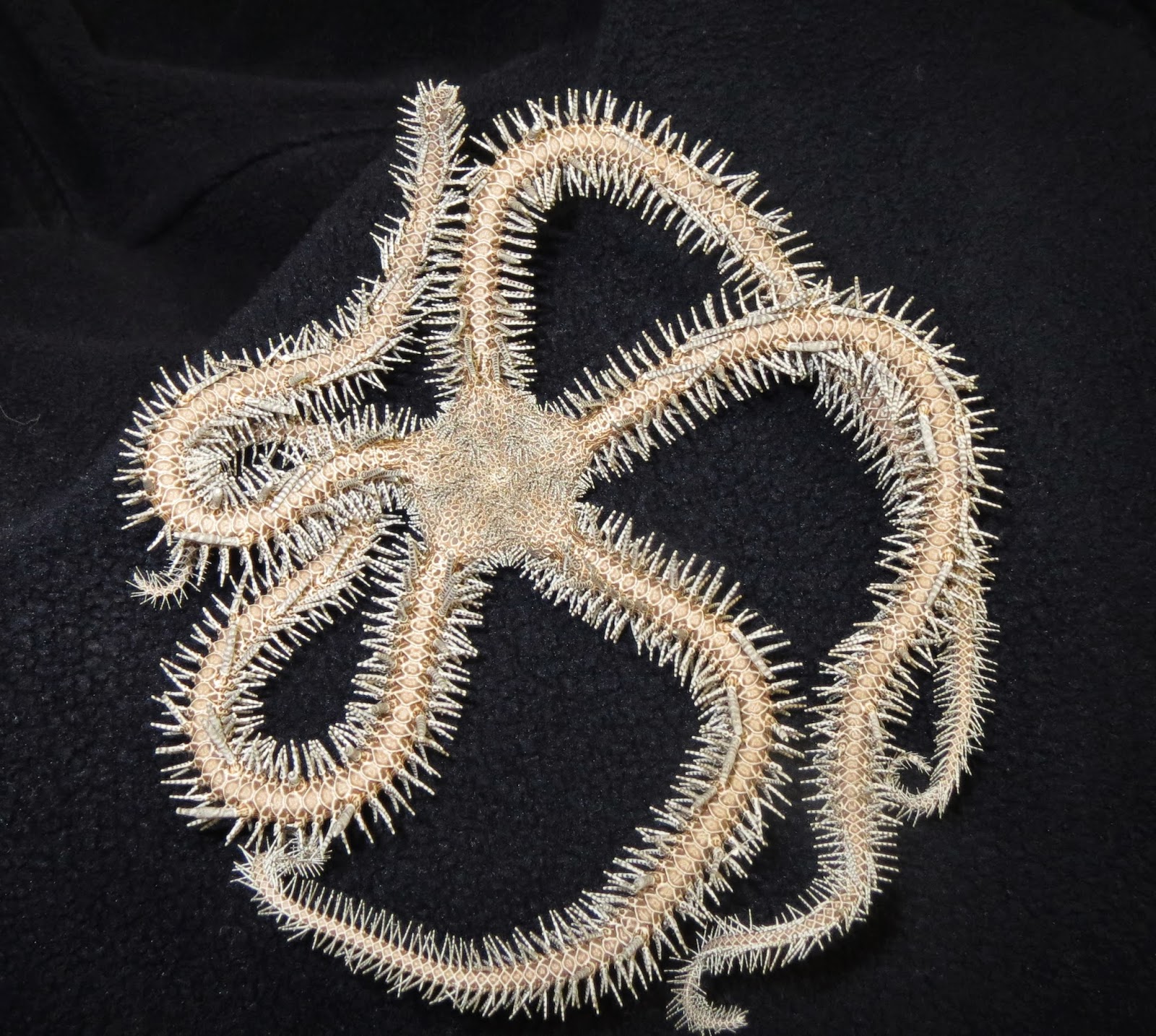
The "worm" body plan is a successful one. A head. Bilateral symmetry. Long body. That makes a lot of sense. The head takes the lead and you've got a long, slender body which facilitates success for moving through crevices and such. This has been thought by some to be
the body plan for the very first metazoan predators (although not all with the body plan are predators).
 |
| Image by Divaholic |
There's versatility in feeding and life modes... and the body plan is observed in multiple PHYLA (major grouping) of animals (e.g., annelids, flatworms, etc) and even in other groups which don't primarily have a "worm" like body plan (e.g., aplacophorans in molluscs, sea cucumbers in echinoderms, snakes in vertebrates).
Curiously, there's something ABOUT animals with this body shape that seems to freak people out.
Is it the body shape? Something left over from our "metazoan" brain from a LONG time ago?
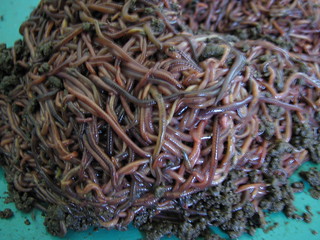
People hate snakes. They always use 'mealworms" (actually beetle larvae) on monster and horror films and TV (totally harmless btw). Heck, earthworms are HARMLESS (at least to people) and you can still totally squick most people out by dangling one in front of them!
 |
| Image by Mely-o |
So what if we looked at worms that are actually PREDATORS? That feed on prey in really graphic ways??
Its Halloween week!
Here's FIVE disturbing predatory worms!
Imagining ANY of these as human sized or above would be cause for alarm!
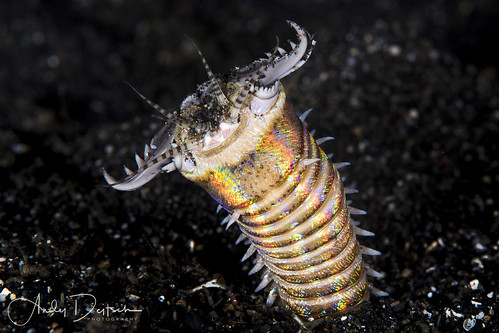
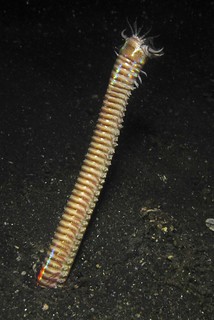
1. Bobbit Worm-Raptorial Predator!
Lets start with an easy one. By this point, a LOT of people know about Bobbit Worms.
I've written about them before.
Short version: Tropical, shallow-water predators. Up to 6 or more FEET long. They lie in wait and pounce on prey with their spring-loaded jaws. They feed on fish and other vertebrates!
 |
| Image by MerMate |
There's plenty of video... but here's a nice one...
So, I know 46 year old men who STILL get freaked out by Bobbit Worms. Even after all the reassurances and graphic photo evidence PLUS the knowledge that they will never go SCUBA diving in the tropical Pacific!!
Wanna see WORSE than the Bobbit worm?? Let's GO!
2. Ribbon Worms-Long distance Death!
Ribbon worms, also known as Nemerteans, are an obscure phylum of worms that are similar in appearance to flatworms (below) BUT one of the big differences is that Ribbon Worms possess a CRAZY long proboscis!
Basically the proboscis is an extended feeding structure
used for a FAST grab which in some cases, extends easily 100% of the worms body LENGTH!
Ribbon worms really need to be seen to be appreciated. So here's some video!
A terrestrial species....
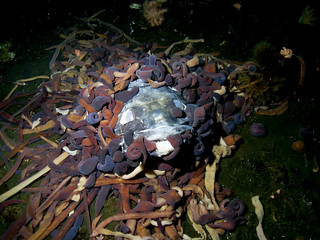
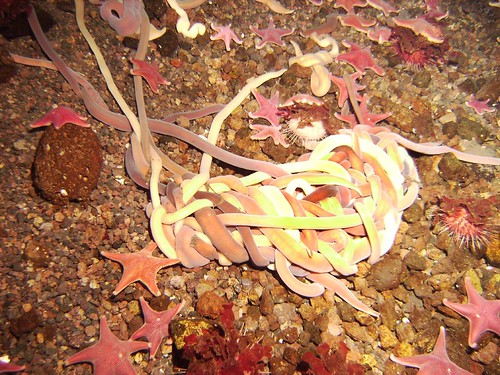
But not all nemerteans are small, cryptic beasts. Some species, such as the Antarctic
Parborlasia are HUGE.
I wrote about them in this post about Weird Antarctic Invertebrates. They are upwards of THREE FEET LONG. And are about as wide around as a garden hose!
 |
| Image by Icy_Sea_Slugs |
and they EAT everything. In both the picture above and the one near the top, there's a dead fish under all those worms!
Ribbon worms are CRAZY abundant and are almost certainly important to the ecosystems they inhabit but they're often difficult to find...
3. Marine Flatworms! Eating from the inside out
Feeding in this worm, is to put it mildly, HORRIFIC. The marine Euplana gracilis is a flatworm that consumes its prey by LITERALLY sucking out its guts, while the prey is still ALIVE!
I'll let the video's author comment:
In this video, Euplana attacks a shrimp-like amphipod by wrapping around its back and completely immobilizing it. Sticking its tube-like pharynx through a segment of the amphipod, the flatworm then consumes and digests its internals--a process that takes about half an hour. Once finished, it abandons the empty carcass and goes into a resting period until its next meal. On the outside, an amphipod that's been eaten doesn't look that different from a normal amphipod...except for the fact that it's, well, dead.
Videographer: Dean Janiak (Smithsonian Environmental Research Center Benthic Ecologist)
4. LAND Flatworms! Eat em' while they're alive!
Flatworms that live on the land are seen uncommonly but they're there. And they are mean, vicious predators. I wouldn't have known or even thought to think that, but here we go...
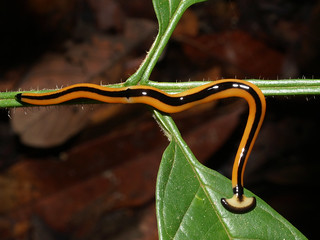
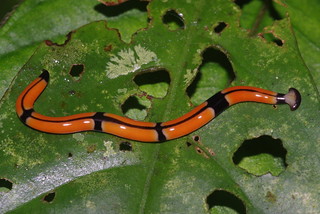
Here is Bipalium, a widely known genus of terrestrial flatworm. Originally from Asia, they've since been introduced all over the world. In their natural habitat, they have these really gorgeous, bright colors....
 |
| image by pbertner |
Bipalium feeds on earthworms, so much so that they will inspire an immediate escape response whenever they are put in contact with one (see the video below).
Ever see an earthworm literally JUMP in sheer terror? Watch this...
Here's the feeding dance blow by blow... The worm's head approaches the worm and applies digestive enzymes. It physically begins digesting its prey WHILE THE PREY IS ALIVE...
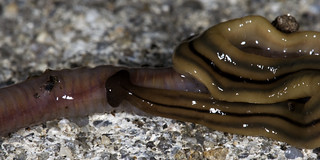 |
| Image by Amuderick |
It digests its meal as a dissolved earthworm milkshake...
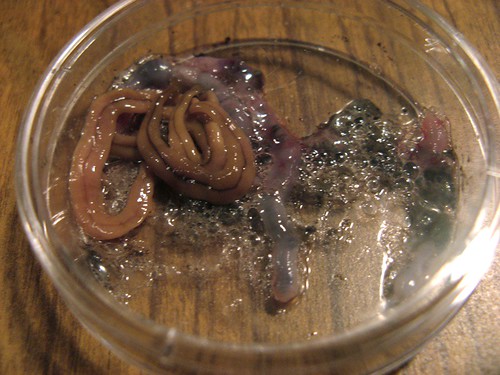 |
| Image by Cornell Fungi |
BUT its not just the one to one predation which is a concern. TOO many of these predatory land flatworms can actually affect the large-scale ECOLOGY of a region if they devour all the earthworms!
As summarized nicely in the video. No earthworms? No aeration of the soil. No crops.
Flatworms: An Invasive Flatworm Hunts Earthworms from
Shape of Life on
Vimeo.
5. LEECHES!
 |
| Image by uezane |
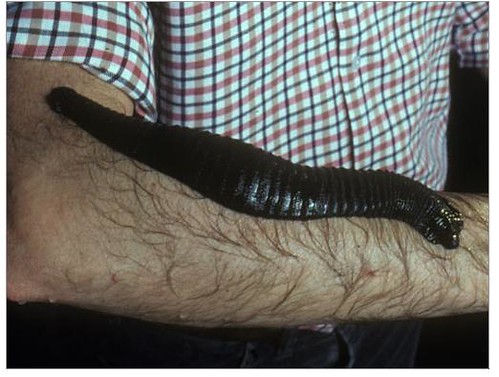
There's marine leeches, terrestrial leeches and of course, freshwater leeches such as the Giant Amazon Leech pictured above! It reaches a length of frakking 18 inches long!! and feed on mammals that happen to stop by to drink...
While many leeches do the blood sucking thing- others are purely predatory, feeding on earthworms and other comparably sized animals.
Here is a pretty amazing pic of a leech eating a tiny toad!
Here's some marine leeches! One from Lembeh, Indonesia.
 |
| Image by Christian Loader |
and another from Singapore
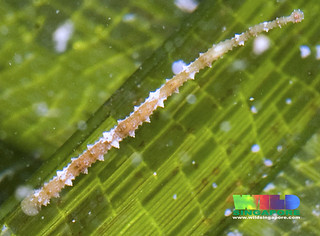 |
| Image by Ria Tan and Wild Singapore! |
Honorable Mention to Whale Worms!
When I say "whale worms" No, I don't mean,
yet another post about Osedax, I mean worms that live IN the INTESTINES OF WHALES! (and other cetaceans)
 |
| thanks to Miriam for letting me borrow her pic to the Tokyo Tapeworm Museum & fr providing scale |
As a tantalizing and horrifying tip, the tapeworm that parasitizes a whale's intestine has SIX sets of reproductive organs and is over 30 METERS (90 FEET) LONG!
But that's for another day....