Monday, December 1, 2014

The Strange Deep-Sea Ophiuroids of Paris! Featuring Dr. Tim O'Hara!


Bonjour once again!! So, my trip to Paris has all but ended and I'll be returning to the United States in a few days. The trip has been a challenging one. The laptop crashed and was out of the loop for two weeks and left me without a computer for data collection and etc..

So, much of my trip has been "old school".. working with paper and notes labelling jars with species names as best as I can...
Although data collection has not been as efficient as I like, I have done the Paris Museum (my host) some good by identifying a massive number of specimens in the collection...
I not only got through many of these older specimens but several of the newer ones as well...
All said and done, I've identified around 900 specimen lots for the museum. Given that Paris probably contains the largest collections of asteroids in the world, that is no small feat!!

But one of the GREAT things about this trip is that my visit, inadvertently overlapped with a trip being undertaken by one of my colleagues. Dr. Tim O'Hara at the Museum Victoria in Melbourne, Australia!! One of the world experts on ophiuroid systematics and ecology! 

I have written about Tim's work before:
  1. This new species of the Australian starfish Tosia, which was described by one of his students.
  2. This fantastic biogeographic pattern in brittle stars which he published several years ago! 
  3. Tim was also the one who identified and, in part, documented "Brittle Star city"
Tim and I are friends from waaaay back. We worked together in the museum in 1999 before either of had our PhDs and its strange to think of that being almost 15 years ago...  

I had a great chance to learn about weird brittle stars from Tim and so I did!!

Learning about weird, deep-sea brittle stars with Dr. Tim O'Hara from Museum Victoria! 
Tim was working with deep-sea biologists at the Paris Museum who are interested in New Caledonia.  (I am one of them).  Some may remember that this time last year, a huge new marine reserve was created in the New Caledonia region. 

Thus, Dr. O'Hara's ecological and taxonomic expertise was brought to bear... not only to identify brittle stars...
but ALSO to share his new cutting edge research with the greater scientific community! A recent paper by Dr. O'Hara has used cutting edge "Next Gen" technology, using over 425 genes to reconstruct the "family history" of the Brittle Stars.  

Its noteworthy not only for the fact that he used an exhaustive amount of genetic data, but he was able to sample and identify ALL the brittle stars necessary for the study! Not an easy feat when you can count the total number of brittle star  taxonomy experts in the world on one hand! 

Here is Tim giving the presentation to a full room of French scientists and colleagues (myself included) in the Paris Museum...

The important part of ALL of Tim's work is being able to identify all of these strange, deep-sea brittle stars from distant parts of the world...  and he was happy to share several of these with me...

1. Amphiophiura insolita!! Don't know much about it, but its got a spectacular rose-like disk pattern...
This specimen of Amphiophiura bakeri was huge! Almost 2 cm across! It looked like an egg had grown five arms! 
2. These two different species of the deep-sea Ophiomusium make it easy to see why brittle stars are so difficult to work with and identify.


3. The tiny male living on the large female Ophiosphaera insignis!!  Notice all the white arrows.. Those point out the arms of the tiny, smaller male.  He lives on the female.

Its unusual for there to be two distinct sexes in echinoderms. In this case, it is thought that this might be a pattern similar to that observed in anglerfish. The male is essentially a parasite on the female. 


4. One of the strangest of deep-sea ophiuroids is almost never seen by most people. This is the ophiuroid Ophiomyces, which has this bizarre sac-like disk membrane..  


Its certainly freaky enough that its hard to believe that the picture really captures what the animal looks like, so here's an actual specimen. Its only a few cm across..
Here's one museum specimen, which as treated with metal for scanning electron microscopy...Its still kind of a surreal looking animal....
  

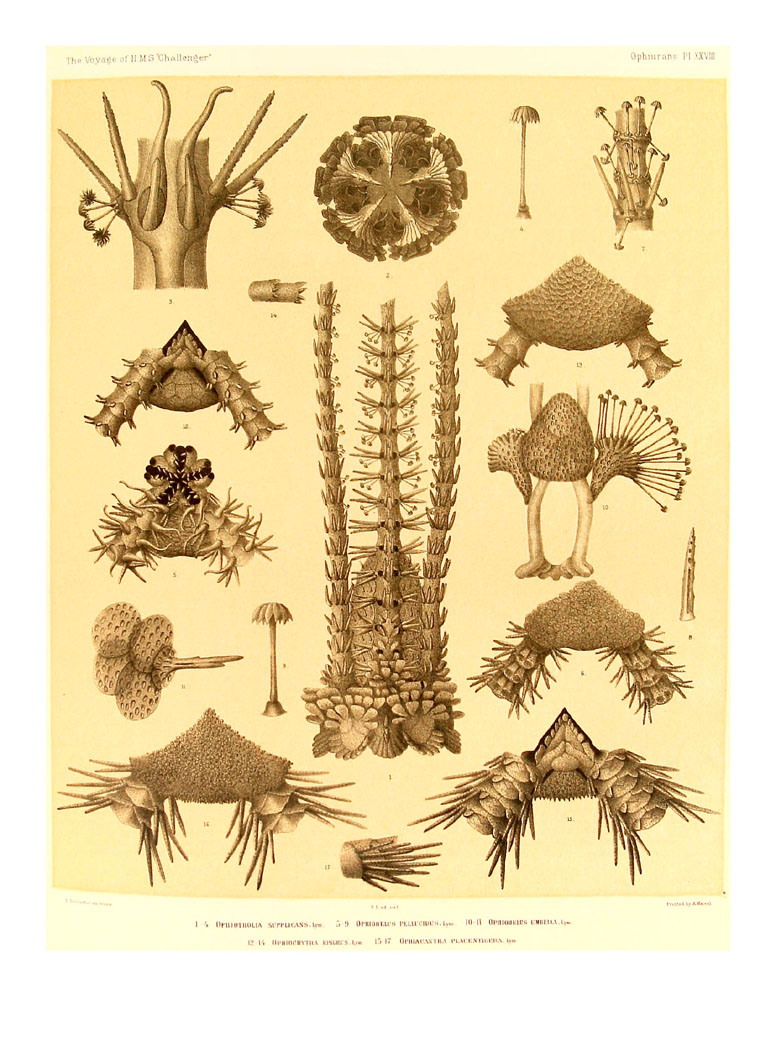
5. A related brittle star is this genus, Ophiotholia, which differs in having funny little hooks on its spines... but has a more distinctly conical disk and specimens are always found with arms locked upwards.

Again, a fairly small animal, only about 1-2 cm across. The drawn image on the left is from a plate of this species from the HMS Challenger vs. the right one which is an actual specimen...

       
And amazingly, thanks to all of his molecular work, Tim now also has a very good idea where these strange critters go in the big "tree" of ophiuroid evolution!! 

Ophiuroids are just a whole bunch of crazy sh*t that just makes my mind POP!!  

Monday, November 24, 2014

The Funky Octopuses of Paris Pt. 2!!

Bonjour! Greetings to everyone from Paris! My apologies for the brief silence. Trips do not always go as planned and my laptop decided it had other plans a couple of weeks ago. "Technical difficulties"..  Ah well.. C'est la vie!

As I am trying to get stuff done before my return to the United States, I thought I would offer a follow up to my artsy octopus post from last year (here)

As a bit of contrast, here was a hyper awesome (and realistic) brass octopus at the gates to the Institute d'Oceanographie....
But I think most of the rest of these are more reminiscent of "dumbo octopuses" which we saw recently on the Okeanos Explorer... 
These are placed all throughout Paris and its often a treat to go hunting for them in various corners of this wonderous city! 

They  are all the work of a street artist, GZUP Stretart (his facebook page is here) But many are goofy or otherwise "interpret" popular media icons.. 

Here for example.. ZOIDBERG!! 
Johnny Depp as Jack Sparrow! 
Oprah? I believe?  (Reader Claire clarifies that this is in fact Rhianna! thanks!)

The Mouse! 
And just more....
An interesting one....

Meh...


!!!!!!!
TROLL! 
More sciency stuff next week...! after I've gotten more caught up! 

Tuesday, November 4, 2014

Gorgeous Goniasterid Starfish! & some Cousteau Connection??

 Bonjour from Paris! This week: a new post looking at some cool specimens I'm looking at while researching at the world famous Museum national d'Historie Naturelle!   Home of Lamark and many other natural history legends!

Today...two neat specimens with some interesting commentary and history, respectively...

First, a rarely encountered species & some taxonomic commentary... 

Paraferdina plakos! A new species I've described only recently! It LOOKS like Fromia monilis, but isn't....  (as I said here awhile back..)
They Key is in the arrangement of spines (or the lack thereof) on the underside of the tube foot groove...

which is unfortunate, as you often don't see people with pictures of these in the wild...
This looks like Paraferdina 

Here's a "proper" Fromia monilis.. similar but with smaller marginal plates and more slender arms. 

I will be going back to Flickr, where I will be beating my head into a hole in the wall, trying to figure all these different things out now... 

A starfish from Cousteau?? 
Here's some cool shots of the Atlantic "cookie" star Peltaster placenta, which I 'm showing you, to give you an intro to ANOTHER specimen of this species below... These generally live at SCUBA depth and much deeper...
A pic of this species alive...Note how the disk is much more swollen
I showed you the pic above, so I could share a cool specimen of this species I found... 
 WOW! Look at the name of the collector! Could this be THE Calypso of Jacques Cousteau fame??? 

The MNHN is of course, the "national repository" (i.e., where they put all their stuff) of France, in the same way that the Smithsonian is the national repository of the United States. So, yeah, in theory anything they collect would be here. 
The tag indicates "1964 (May), Greece".  Cousteau was in the nearby Red Sea in 1964 shooting his epic "Le Monde Sans Soleil" aka The World without Sun in 1964!! Could this have been collected before or perhaps as an excursion by the Calypso away from Red Sea??
What other interesting specimens will present themselves?? 

BONUS: And if you like the food porn? Here's some fresh, hand made donuts from a Farmer's Market.. Mmmmm....

Tuesday, October 28, 2014

Five Invertebrates that would be Terrifying if they were Bigger!

The secret of the big terrifying jaws is #1 below! 
HALLOWEEN! Every year, I like to use the season's festive theme to try and highlight some cool invertebrate diversity! Last year I did an overview of creepy worms and the year before that, I did an overview of spooky things that echinoderms (my research focus & subject of this blog's love) are known to do. 

So, note that I actually am using REAL aspects of these animal's biology that make them, creepy, terrifying, spooky, whatever. Unlike SOME places.. I won't just find some weird looking, random animal and just SAY its spooky or creepy. It actually HAS to do something worthy of the name!

This year: a theme that often comes up with invertebrates: Predators that would be terrifying if they were larger!! 

So, this is a pretty popular trope and frankly, there are ALREADY a bunch of huge, oversized marine invertebrates that freak people out. You will doubtlessly see some tweets about those beasts this week.

Here are some of my picks for invertebrate PREDATORS that to me, have earned the RIGHT to be optioned for movie rights! or other fantastic treatment!  So, nothing that is weird looking but harmless (I mean, c'mon, BASKING SHARKS? SHREWS?)

There were MANY to choose from of course and so perhaps next year I'll present more of them. But for now, here's some good ones.....

5. Arrow Worms (phylum Chaetognatha)
Imagine the oceans filled with fast-swimming, transparent worms with sharp spines for teeth on their head, and which can effectively "see" in a 360 degree field of view AND attack and devour prey several times their own size.

Bodies are transparent and with unusual "eyes" that are arrayed in 5 directions, essentially giving them a full field view (360 degrees). Fortunately, these "eyes" lack lenses and are thought primarily to be used for orienting to light and dark.
They feed with these big nasty hooks that emerge off the front of the head!!  Some are even known to do so with venoms like tetrodotoxin, the potent toxin from puffer fish.

Arrow worms have been documented as having capture prey several times their size...like fish!
Here's an interesting video that shows the spines extending from the head on a Japanese species... 
Sadly, or perhaps fortunately for us.. these are pretty small. Ranging from less than half an inch with monsters up to 4 inches! 

But what if they were HUGE????  Honestly, I think one movie from 1998Deep Rising had these things, which swam through the water at a good clip. and the spines were KINDA chaetognath like! 

So, yes! We want MORE ARROW WORM MONSTERS PLEASE!!! 
Via Wikipedia
4. Cone Snails.  Does everyone know what cone snails are? Marine snails that use a modified tooth like a harpoon + very potent toxins to capture their highly mobile prey. Often times, vertebrates like fish..

Some of them, however, rather than using the proboscis to directly paralyze prey, will use this  highly modified "net" which is presumably, a modified feeding proboscis.. 
Yikes.. imagine what that would be like if cone snails were bigger..like bear or even elephant sized! 

3. Rhizocephalans! Barnacle Parasites that take command of your Body! 
Imagine  a fleshy parasitic network that works its way into your body, commandeering your all your bodily functions, INCLUDING your gonads, such that all you do is produce eggs to make NEW parasites.

These don't really NEED to be bigger..but merely adjusted to parasitizing MORE than crabs.

These have been written about in some detail by Rebecca Helm over at Deep Sea News. Her account is quite chilling. I recommend reading it in the dark, while you are alone with some seafood....
Or, watch this video from Casey Dunn's "Creature Cast" series which also very ably explains the life of this creepy parasitic barnacle... 


2. LEECHES! This is kind of a cheat, since I put leeches into my "Creepiest Worms" post last year.  I just thought this was kind of awesome... 

1. Labidiaster annulatus, the giant 50 armed star of the Antarctic!
This is one of my FAVORITE beasts.. which I wrote up here, early on in the blog (and on numerous other occasions).
But the short story:  Giant 1.5 foot wide starfish with 50 arms, catches krill and other prey with arms!!                  

The surface of the starfish, especially on the arms is covered by THESE.. 

Jaw like structures called pedicellariae which act as "bear traps" to capture krill and other prey if they get too close to the arms. 
Thanks to Bob Ford & Taylor Steed of Frederick University for the SEM pics
These are ALREADY pretty big. About 1-2 mm. But look at those fangs!!  and the shanks on the teeth!

Can you IMAGINE if this critter was DOG or even BEAR sized on the land????  Catching everything from tiny mammals to birds!!! 


For the Next few weeks: Echinoblog Returns to PARIS!

Wednesday, October 22, 2014

Coelopleurus! The most gorgeous urchin you never heard of!

This week, I thought I'd share some gorgeous sea urchin love! Behold Coelopleurus

What's that? You've never HEARD of Coelopleurus??  Well, that's about right, I suppose. Its a distinctive looking enough species but it lives in slightly deeper water than is typical for most casual SCUBA divers or vacationing snorkelers..
Described by Louis Agassiz in 1840, Coelopleurus is a genus in the family Arbaciidae. There are about 14 known species. Eleven living species and four fossils.  

Coelopleurus is a deep-sea urchin, but on the shallow side, about 75 to 500 meters. They occur primarily in the tropics, but across the Atlantic, Pacific and Indian Oceans. 

Biology of these animals is poorly known. 


It is also kind of unusual because it is one of the few sea urchins that displays secondary sex characteristics.. i.e., you can tell the females from the males when the males are spawning. 

You see that structure that the red arrows are pointing to?? 

That is the male "papillae". And in "C" you can see sperm being ejected into the water column. Yow!! This image is from a paper by Dave Pawson and John E. Miller in the Bulletin of Marine Science, 1979. 29(4): 581-586.  
Coelopleurus is unusual because it has these big, long curved spines BUT they are brilliantly colored in red and white!
But even MORE than that?? The tests (i.e., the skeletons) are brightly colored with these very striking patterns that seem to be rather variable..

Here is the test of Coelopleurus floridanus... 
But here's one that is considered the SAME species but a LARGER specimen.... Honestly.. it wasn't clear to me how important the patterns were to identifying each species.

The colors and patterns are embedded in the skeleton. So, if you drop them in a preservative like alcohol, the reds and purples, and etc. don't go away. They remain after death.
Here's another species. This one is from Japan... Coelopleurus undulatus from M. Shigei. 1986. The sea urchins of Sagami Bay. Biological Laboratory, Imperial Household, Maruzen Co. Ltd, Japan.

Gorgeous and amazing. 
Image from the NHM Echinoid database
Here is the most recently described species, Coelopleurus exquisitus which had the distinction of being described, in part from specimens purchased from the online auction house Ebay in 2006. 


Here again, is the very distinctive and unusual color pattern observed in this species... 

But wait! Coelopleurus also occurs in the fossil record!!  Here's Coelopleurus coronaformis from the Cenozoic of Mexico (< 66 million years ago) so pretty recent..

Here's Coelopleurus coronalis from the Eocene of Barcelona, Spain... 

Wednesday, October 15, 2014

Five Points About The Fossil History of Echinoderms! Happy National Fossil Day!

Happy National Fossil Day!
Every few years I'm in a position to share some more love about echinoderms and fossils. I've done this on previous National Fossil Days and tried to shed some light on the often arcane world of fossil echinoderms...

Here's one on paleocology & fossil parasites..

A nice gallery of fossil crinoids..   and this classic piece on giant floating/pelagic crinoids! 

Paleozoic Echinoderms: The Ophiocystioids!  and the Helicoplacoids! 

A LOT of the REALLY weird stuff in echinoderms takes place in the days of the Paleozoic, some 245 to 541 MILLION YEARS Ago... There was a lot of crazy stuff (evolutionarily speaking) happening then. Echinoderms, as a lineage PREDATE Dinosaurs and they've been around since before vertebrates walked on land.

But here's a bunch of interesting facts I've cobbled together to better understand and appreciate fossil echinoderms and their history!!

5. Animal Body Type can bias preservation. This is really a dynamic of fossil preservation which is true for almost ANYTHING. In order for animals or any organism to undergo the fossilization process, it has to "survive" long enough to be buried and then kept together so that it undergoes the process.  MANY factors can affect which animals/organisms/whatever are preserved in the fossil record. The study of how different factors affect fossil preservation is called taphonomy and it affects our perception of the history of life on the planet.

One of those factors is the physical strength of the body itself. Is it delicate? Is it REALLY strong and tough?? Delicate, soft bodies tend NOT to preserve very well (although they can exceptionally) but some bodies with very heavy and strongly calcified bodies are MORE likely to preserve.

So for example, these starfish, in life would have a fairly chalky body. They hold together pretty well when all the tissue is removed.
Here's a whole bunch of crinoid stems preserved in limestone. These are pieces of the "stalk" in stalked crinoids. Hard parts that are pretty structurally solid. You're most likely to find this of all the pieces of a crinoid (aka a "stone lily").

4. Preservation Environment is important. So, here's the thing. The fossilization process requires pretty RAPID burial of the subject organism/animal, whatever for fossilization to eventually take place.  Which brings us to another "bias" of preservation: The environment!!

If the animal lives in an environment in which it is predisposed to be buried ANYWAY, that makes it THAT much MORE likely that it will be preserved. One good example are sand dollars (or really anything which lives buried).

Sand dollars have a pretty solid skeleton but ALSO live buried in sand. Sometimes, they can be killed by burial and pretty much just get preserved there in the sediment as it turns into rock.
                           

and voila! (yes, its not the same species but play along, its not easy finding matching videos and pictures of fossil sand dollars! )

3. There were MORE KINDS of Echinoderms in the Paleozoic!
One of the oldest questions from biologists unfamiliar with the fossil record is, "Why haven't you completely figured out the evolutionary history (i.e. phylogeny) of Echinoderms yet?? There's only FIVE of them!"

Yes. Only five LIVING groups (crinoids, sea stars, brittle stars, sea urchins & sea cucumbers) are around today. BUT when you get into the VERY earliest days of echinoderms in the Paleozoic (245-541 MILLION years ago), you have easily TRIPLE the number of groups! (i.e. classes) and a crazy diversity of body plans NOT seen today!

You got things that look like crinoids. Disc-shaped echinoderms. Accordian-shaped, asymmetrical echinoderms. Weird, crazy tentacle-balls. and all sorts of natural "experiments" in Echinoderm morphology.

A crazy panoply of things! Oh, to go back in a time machine to see when rock was young!
                           
2. The Roots of Recent Echinoderms were there...
Picking up on the crazy, diversity of echinoderms mentioned above its worth mentioning that the ancestors of MODERN echinoderms were seen among them.

Ophiocistioids for example are intermediate between sea urchins and sea cucumbers.

Also in the Paleozoic, we had the early ancestors to brittle stars and sea stars.  Today, the brittle stars and sea stars distinctive looking in appearance that we can easily tell them apart, but looking at those early forms was NOT so easy...

Can you imagine walking around in the Paleozoic seas and seeing something that was NOT quite a starfish but also NOT quite a brittle star!! Something in between....

That's kind of why some paleontologists get so twitchy about what you call a "sea star" versus a "brittle star". They have LITERALLY spent years arguing WHY that is the case..

1. The Permian/Triassic Extinction Changed everything
So, then at the END of the Paleozoic, in the Permian, you have one of the most devastating MASS EXTINCTIONS known to life on Earth at the Permian-Triassic Boundary. That is the end of the Paleozoic and the beginning of the Mesozoic (i..e time of the dinosaurs).

This extinction was huge. 96% of marine species were wiped out. Part of this? All those aforementioned echinoderm classes.. (about 15 of them)? GONE.

Only survivors from FIVE groups survived to live on today.   Here's a cartoon of this from Echinoblog Art Department!
Echinoblog Art Department Lives on!
Any one of these could be a whole blog post but this gives you a short summary of some dynamics involved with the rich fossil history of the Echinoderms! Happy National Fossil Day! 

Sunday, October 12, 2014

What is that WEIRD THING on FACEBOOK???


So by now, everyone and their 3 best friends have seen the critter above and the video on Facebook (below) which seems to have freaked everyone the frack out. Its been circulated and seen by over 5.6 million people!!

And everyone keeps on asking WHAT IS IT?? I've received this video now, what feels like a million, jillion times from people who want.. nay, DEMAND to know:  What IS IT???

Answer: A basket star. A distant relative of sea stars.

First thing: HARMLESS.  and out of its element. But we don't know much about them.

This was even given time by IFLS but not being echinoderm specialists, their answer was a bit over generalized... So, here's MORE. Its actually a pretty neat beast.

1. This is a BASKET STAR. These are specialized ophiuroids. Ophiuroids are members of the phylum Echinodermata. In other words, its related to Sea Stars, sea urchins, etc. Basket stars in particular have a highly branched system of arms which they use to feed. I've discussed the feeding biology of basket stars here They have hooks on those branches with which they feed on tiny bits of food.

There are actually several different groups (i.e., families) of ophiuroids which have these fleshy arms and highly branched arms.They occur widely and vary from habitat to habitat.

2. Euryale aspera?  I've consulted with one of the world's experts on basket stars and euryalinid brittle stars, my colleague Dr. Masanori Okanishi, currently at Kyoto University. Discussions with him and checking my own resources suggests that the animal above is a shallow-water tropical species, called Euryale aspera. Identification of the species is uncertain since there was only a picture and no specimen but based on my cross-check, this seems like a likely name.


3. Where and HOW does it live? Euryale aspera is a shallow water species which occurs widely across the Indo-Pacifc. This species is found throughout the Indo-Pacific, from Asia but as far west as Madagascar in the Indian Ocean.

As with other basket stars, feeding is accomplished via tiny hooks present on the MANY branching arms spread out into the water column when they feed.

Here are some videos of various Japanese basket stars which MIGHT be Euryale aspera. Its difficult to ID these from images, but these give you an idea of how they live. Arms up in the water during ideal water flow, but withdrawn when not feeding.


4. What does the name mean? So, as you may have noticed from one of my earlier posts, one of the better known genera of basket stars is called Gorgonocephalus. "Cephalus" means head while "Gorgon" refers to the head of Medusa and her sisters: The Gorgons of ancient Greek Myth. One of Medusa's sisters is named EURYALE. She was identical to Medusa in appearance with snakes for hair and transformed men into stone with her gaze. Thus, the genus of this other "basket star" follows the theme of a "medusa's head" type appearance. The species name "aspera" is Latin and a references a descriptor for "rough" which likely alludes to the spines and other tiny accessories on the body surface.
Euryale aspera was described in 1816 by the famous zoologist Jean Baptiste Lamarck himself!

5. What about OTHER BASKET STARS???
The term "basket stars" informally refers to several groups of ophiuroids within the order Euryalida, which all have thick, fleshy arms. Some are more serpentine (i.e. serpent stars) whereas others are branching and appear to form a "basket" (i.e., basket stars). But they are often similar in appearance leading once again to some "blurred lines" where common names are applied. There are about 177 species in five families.

Members of the Euryalida occur widely throughout the ocean depths. Many are shallow water, occurring in both cold and tropical habitats whereas others occur in the deep, deep sea (> 1000 m). Many of them occur at depths in between. But you can encounter basket stars at SCUBA depths on reefs or other shallow habitats, which is where the "creature" above was apparently collected from.

A "serpent star" (Asteroporpa annulata from the tropical Atlantic)
A "basket star"


And by the way, these have been caught on deck and seen before... 


The original video indicates that the one collected was returned to the ocean. These don't take exposure very well.. but perhaps more adverse to the animal was its ability to re-establish a perch to resume feeding. But, frankly our knowledge of their biology is very poor. We don't know much about them.